An MIT professor taught the same math course for 62 years, and the day he retired, students from every country on earth showed up online to watch him give his final lecture.
I opened the playlist at 2am and ended up watching three of them back to back.
His name is Gilbert Strang. The course is MIT 18.06 Linear Algebra.
Every machine learning engineer, every data scientist, every quant, every self-taught programmer who actually understands how AI works learned the math from this one man. Most of them never set foot on MIT's campus. They just opened a free playlist on YouTube and let him teach.
Here's the story almost nobody tells you.
Strang joined the MIT math faculty in 1962. He retired in 2023. That is 61 years of standing at the same chalkboard teaching the same subject to 18-year-olds.
The interesting part is what he did when MIT launched OpenCourseWare in 2002. Most professors were skeptical. They worried that putting their lectures online would make their classrooms irrelevant. Strang did not hesitate. He said his life's mission was to open mathematics to students everywhere. He filmed every lecture and gave it away.
The decision quietly changed how the world learns math.
For decades linear algebra was taught the wrong way. Professors started with abstract vector spaces and proofs about field axioms. Students drowned in the abstraction. Most never recovered. They walked out believing they were bad at math when they had simply been taught in an order that nobody's brain is built to absorb.
Strang inverted the entire curriculum.
He started with matrix multiplication. Something you can write down on paper. Something you can compute by hand. Something you can see. Then he showed his students that everything else in linear algebra eigenvectors, singular value decomposition, orthogonality, the four fundamental subspaces was just a different lens for understanding what the matrix was actually doing under the hood.
His rule was strict. If a student could not explain a concept using a concrete 3 by 3 example, that student did not actually understand the concept yet. The abstraction was supposed to come last, not first. The intuition was the foundation. The proofs were just confirmation that the intuition was correct.
The second thing Strang changed was the classroom itself. He said please and thank you to his students. Every single lecture. He paused mid-derivation to ask "am I OK?" to check if anyone was lost. He never used the word "obviously" or "trivially" because he knew exactly what those words do to a student who is one step behind. He treated 19-year-olds learning math for the first time the way he treated his own colleagues. With patience. With respect. With the assumption that they belonged in the room.
For 62 years.
The result is something that has never happened in the history of education. A single math professor became the default teacher of his subject for the entire planet.
Universities in India, China, Brazil, Nigeria, every country with a computer science department, started telling their own students to just watch Strang's lectures. The University of Illinois revised its linear algebra course to do almost no in-person lecturing. The reason was honest. The professor said they could not compete with the videos.
His final lecture was in May 2023.
The auditorium was packed with students who had never met him before. He walked to the chalkboard, taught for an hour, and at the end the entire room stood and applauded. He looked confused for a moment, like he genuinely did not understand why they were cheering. Then he smiled and waved them off and walked out.
His written comment under the YouTube video of that final lecture was four sentences long. He said teaching had been a wonderful life. He said he was grateful to everyone who saw the importance of linear algebra. He said the movement of teaching it well would continue because it was right.
That was it. No book promotion. No farewell speech. No legacy management.
The man whose teaching is the foundation of modern AI just thanked the audience and went home.
20 million views. Zero ego. The entire engine of the AI revolution sits on top of math that millions of people learned for free from one quiet professor in Cambridge.
The course is still on MIT OpenCourseWare. Every lecture, every problem set, every exam, every solution. Free.
The most important math course of the 21st century is sitting one click away from you. Most people will never open it.
If you died tomorrow your family could not access a single thing you own digitally.
Bank accounts. Crypto. Passwords. Cloud storage. All of it locked permanently.
Here is how to fix that in 30 minutes:
In 2006 a high school English teacher asked students to write to a famous author & ask for advice.
KURT VONNEGUT (who left us 19yrs ago today) was the only one to respond.
His reply was a doozy.
Instead of watching Netflix, watch this 1-hour Yale lecture by Professor Ben Polak.
It will change how you think about decisions in negotiations, business, and everyday life.
Let me walk you through what happened one hour before Trump announced the five day moratorium on Iran strikes.
$1.5 billion in notional S&P E-mini futures contracts. Four to six times normal activity.
One hour before the announcement.
Simultaneously, $192 million in crude oil futures purchased at the same time.
They made between $300 and $400 million dollars off those trades.
Trump claimed he spoke to an Iranian official to negotiate the moratorium.
The Iranians said that person doesn't exist and the conversation never happened.
This is not the first time.
It has happened multiple times. He says something. The trade goes on. He says another thing. The market moves.
But whatever you call it — they are laughing at you and they are laughing at me while they do it.
Hunter Biden sold a painting and Washington lost its mind.
These people are making hundreds upon hundreds of millions of dollars trading on information that only exists inside the most powerful office in the world.
I think we are dramatically underreporting how much money is actually being made here.
This isn't politics anymore.
This is a financial operation running out of the White House.
Lots of clinical trials for Long COVID coming out. Here's a quick guide on how to assess it.
A study is getting quite a bit of coverage, suggesting that the antidepressant fluvaxamine is effective for Long COVID. We'll use it as an example.
https://t.co/p5WBSCkmqp
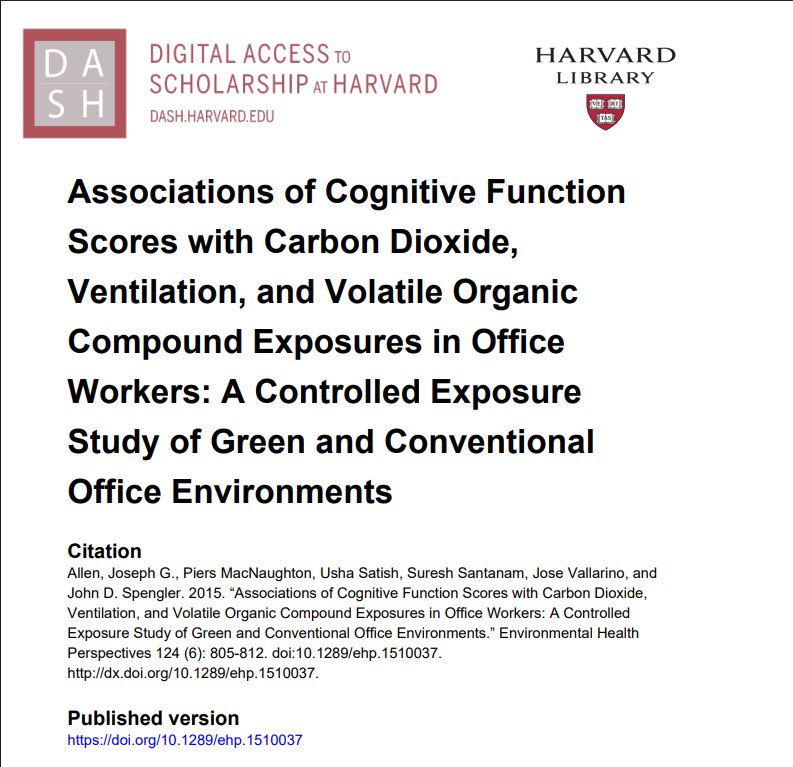
Damn, that’s wild—Harvard stuck 24 office workers in the same room for 6 days, secretly tweaking the air quality (ventilation, CO2, and VOCs from typical office stuff), and their cognitive scores doubled in the cleaner “green+” conditions vs. standard stale setups. Better decision-making, strategy, crisis response—all crushed by poor indoor air we breathe 90% of the time.
Open windows, crank ventilation, cut the junk emitters. Your brain’s paying the price right now. Fix the air, sharpen the mind.
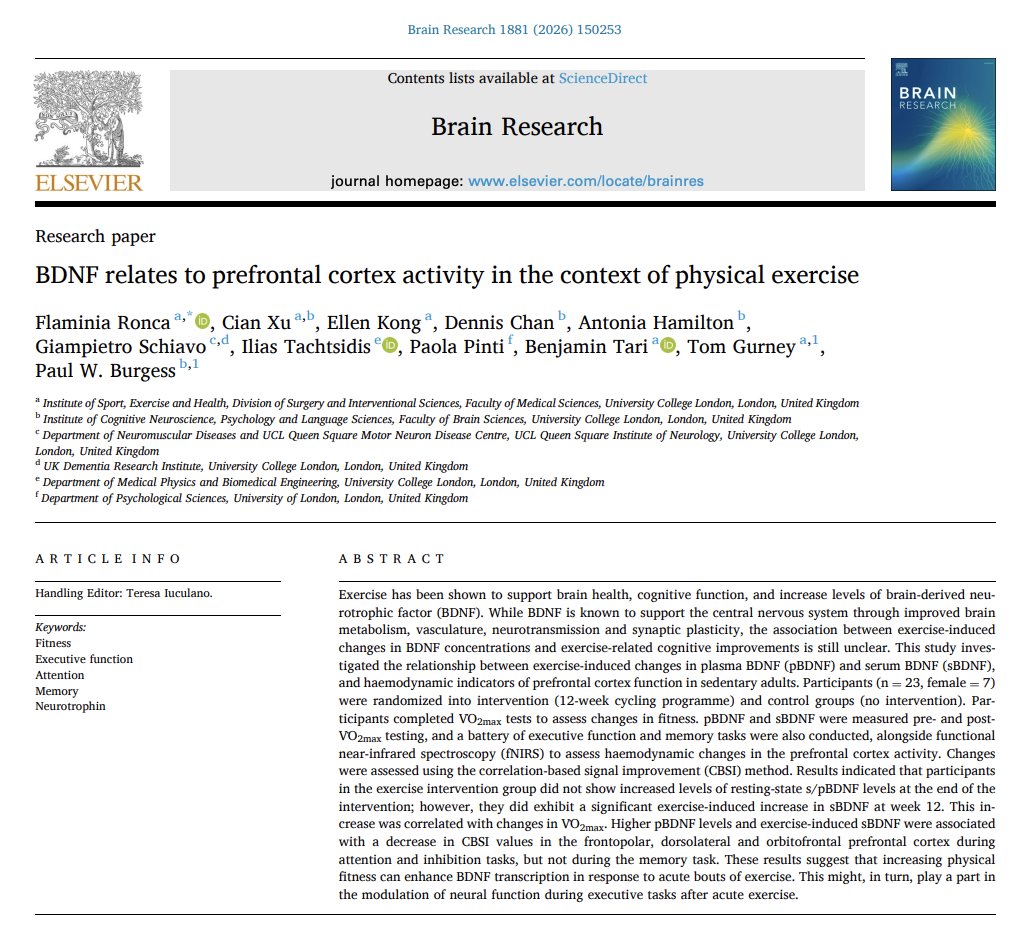
🚨 2026 Research: The Fitter You Are, The Smarter Your Brain Responds
A brand new 2026 study just uncovered how fitness rewires your brain in real time.
What the latest science shows:
- Fitness amplifies your brain boost
After 12 weeks of training, participants released more BDNF after exercise, not at rest
- VO₂ max is the key driver
The greater the improvement in aerobic fitness, the bigger the BDNF spike
- Your brain upgrades with training
Even a single workout becomes more powerful once you're fitter
- BDNF directly affects brain function
Higher post-exercise BDNF linked to changes in prefrontal cortex activity
- Executive performance gets the biggest gain
Improvements seen in attention and inhibition, not memory
- Results can start fast
Brain response improvements can begin in as little as 6 weeks
You are not just training your body. You are training your brain to respond better every single time you move.
A MIT professor taught the same lecture every January for 40 years, and every single time it was standing room only.
I watched it at 2am and it completely rewired how I think about communication.
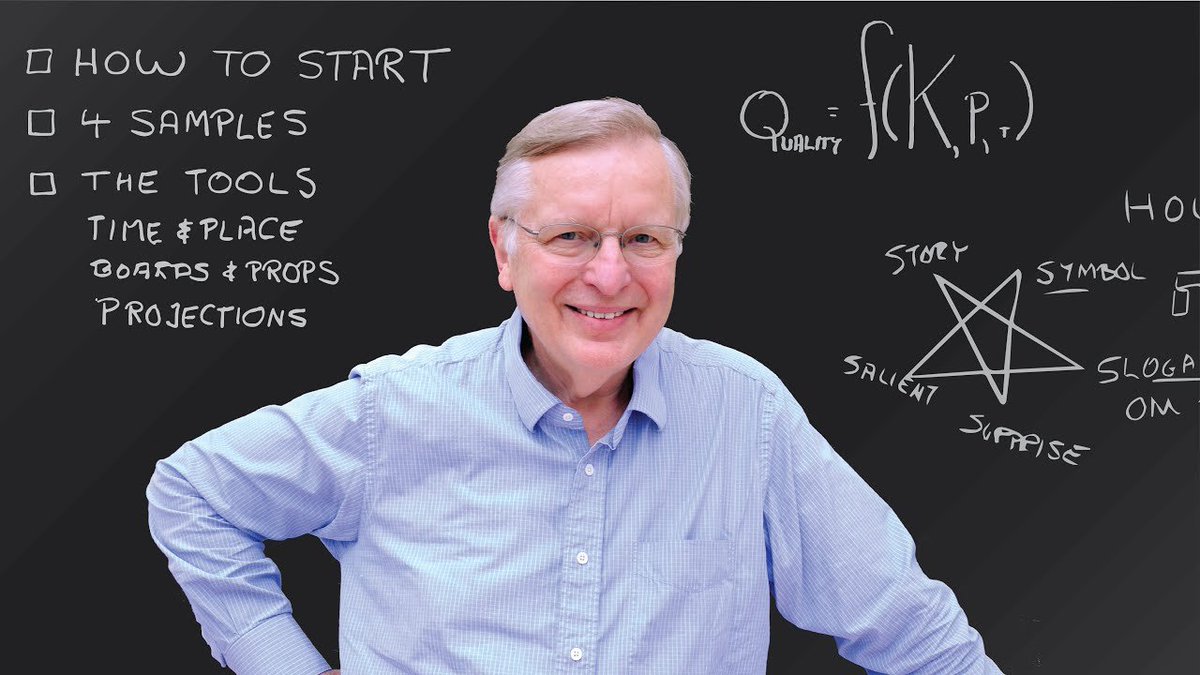
His name was Patrick Winston. The lecture is called "How to Speak."
His opening line hit like a truck: your success in life will be determined largely by your ability to speak, your ability to write, and the quality of your ideas in that order.
Not your GPA. Not your pedigree. Not your IQ. How you speak is what separates people who get heard from people who get ignored.
Here's the framework he drilled into MIT students for four decades.
He said never start with a joke. Start by telling people exactly what they're going to learn. Prime the pump before you pour anything in. He called it the "empowerment promise" give people a reason to stay in their seats within the first 60 seconds.
Then he broke down the 5S rule for making ideas stick: Symbol, Slogan, Surprise, Salient, and Story. Every idea worth remembering hits at least three of these.
The part that floored me was his "near miss" technique. Don't just show what's right show what almost looks right but isn't. That contrast is when the brain actually locks something in permanently.
His final rule before any big talk: end with a contribution, not a summary. Don't recap what you said. Tell people what you gave them that they didn't have before they walked in.
I've used this framework in pitches, interviews, and presentations ever since watching it, and the results are not subtle.
Patrick Winston passed away in 2019, but this lecture is still free on MIT OpenCourseWare. One hour, watched by millions, and it costs absolutely nothing.
The most important class MIT ever put on the internet isn't about code or math. It's about how to make people actually listen to you.
In 2009, Stanford professor Robert Sapolsky explained why depression is not a mental problem but a biological breakdown.
He revealed:
- Why “just be strong” is nonsense
- Why stress rewires your future
- How biology + psychology collide
15 lessons on the science of depression: