Expand your imagination 🍥
What appears to be a single galaxy is actually two that are far apart! The closer galaxy is in the image's center, while the more distant galaxy appears to be wrapped around it in a rare phenomenon we call an “Einstein ring.”
https://t.co/pXb6kHWZC8
Webb explored the Orion Molecular Cloud Complex, looking for the faintest and the smallest of brown dwarfs - that category of objects that are not planets, but are also so small their cores can't sustain fusing hydrogen like full-fledged stars. https://t.co/B2LiaKBtT4
With our powers combined...
The two galaxies in this #HubbleClassic view are in the process of merging together. Known collectively as UGC 2369, this duo's mutual gravitational attraction pulls them closer and closer together, distorting their shapes: https://t.co/oJ2RD88eNw
NGC 2090 looks good in any light!
Hubble's visible and ultraviolet view shows off the galaxy's bright core and dusty disk, while @NASAWebb's infrared vision details the galaxy's two winding arms and swirling gas.
Try out a slider tool to compare them: https://t.co/6YXZL5c1Hv
A new photo of the Sombrero galaxy from @NASAWebb reveals finer details of the hat-like formation. It has a smooth inner disk, while its “brim” – the outer ring – is made of intricate lumps. https://t.co/9Hj5pd2TmL
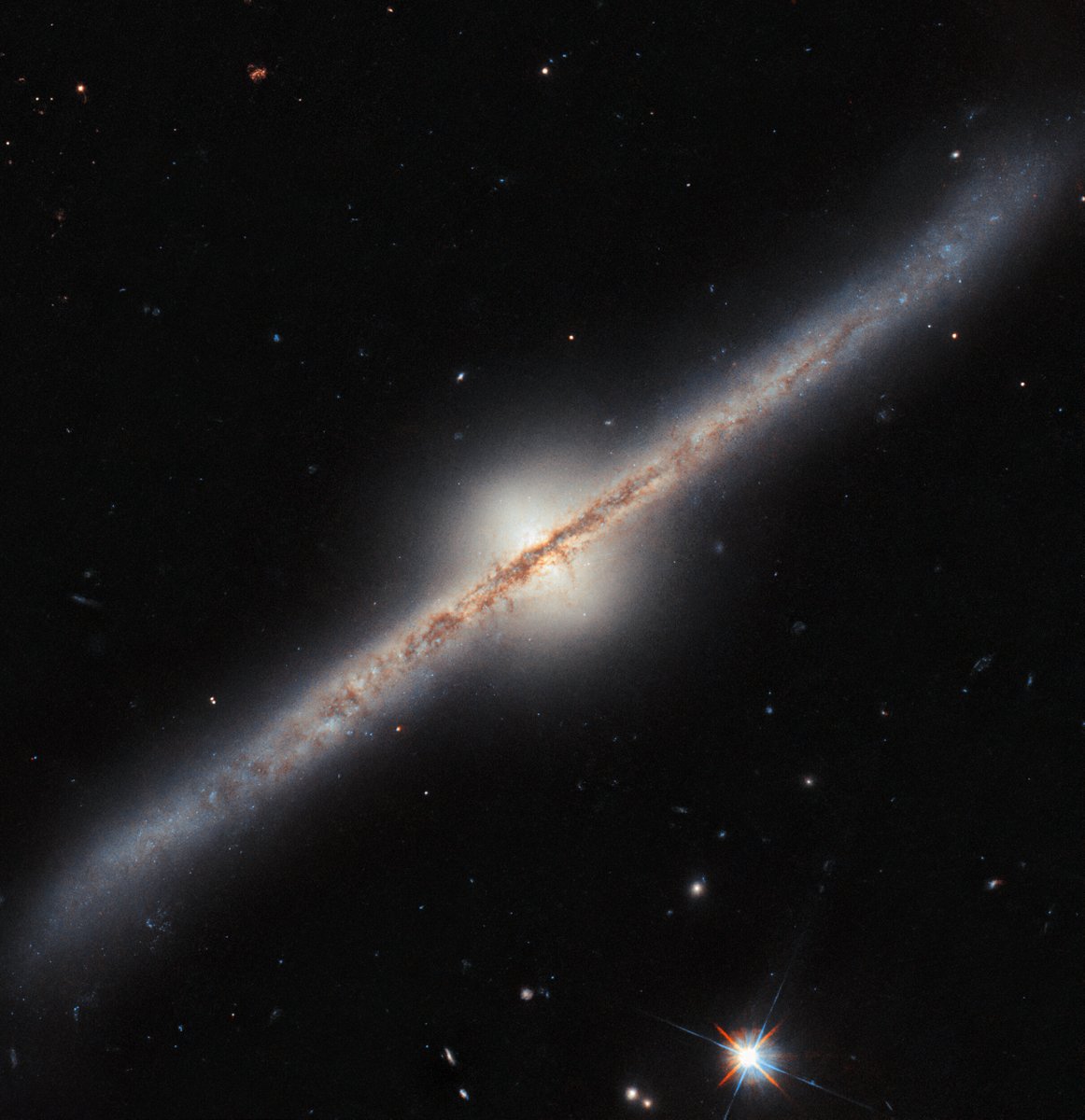
Feeling edgy?
This new #HubbleFriday image features an edge-on glimpse of the spiral galaxy UGC 10043.
Located roughly 150 million light-years from Earth, UGC 10043 is one of the rare spiral galaxies that Hubble sees edge-on from its perspective: https://t.co/J91Nq6IR0n
Stars can create huge and intricate dust sculptures from the dense and dark molecular clouds from which they are born. The tools the stars use to carve their detailed works are high energy light and fast stellar winds. The heat they generate evaporates the dark molecular dust as well as causing ambient hydrogen gas to disperse and glow. Pictured here, a new open cluster of stars designated IC 1590 is nearing completion around the intricate interstellar dust structures in the emission nebula NGC 281, dubbed the Pac-man Nebula because of its overall shape. The dust cloud just above center is classified as a Bok Globule as it may gravitationally collapse and form a star -- or stars. The Pacman Nebula lies about 10,000 light years away toward the constellation of Cassiopeia.
Image Credit & Copyright: Malcolm Loro
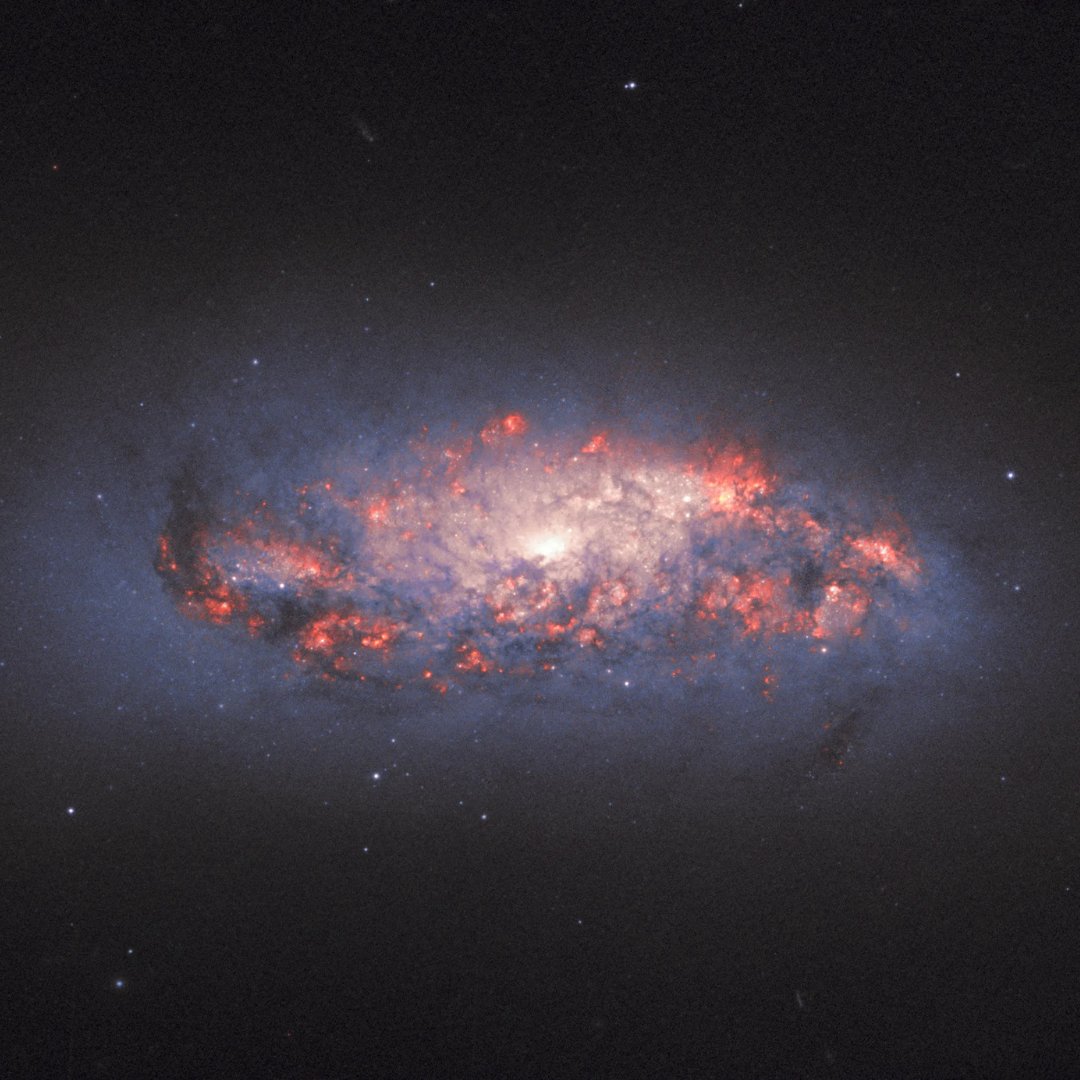
Stars in bloom 🌹
Bright, colorful patches of star formation unfurl like red roses in this #HubbleClassic image.
Known as NGC 972, this spiral galaxy is just under 70 million light-years away from us.
Discover more: https://t.co/qAt91snvVu
I always feel like somebody’s watching me 👀
Happy Halloween from @NASAWebb & @NASAHubble! This creepy new image combines mid-infrared light from Webb with ultraviolet and visible light from Hubble, revealing a pair of “eyes” from space. https://t.co/4RU3Hn2s8C
This spooky, mysterious starburst galaxy churns out stars at a high rate.
Seen in this #HubbleClassic view, IC 10 has a faint appearance that makes it hard to observe, especially since it's located along a line-of-sight brimming with dust and stars: https://t.co/Iy5V1izEQ7
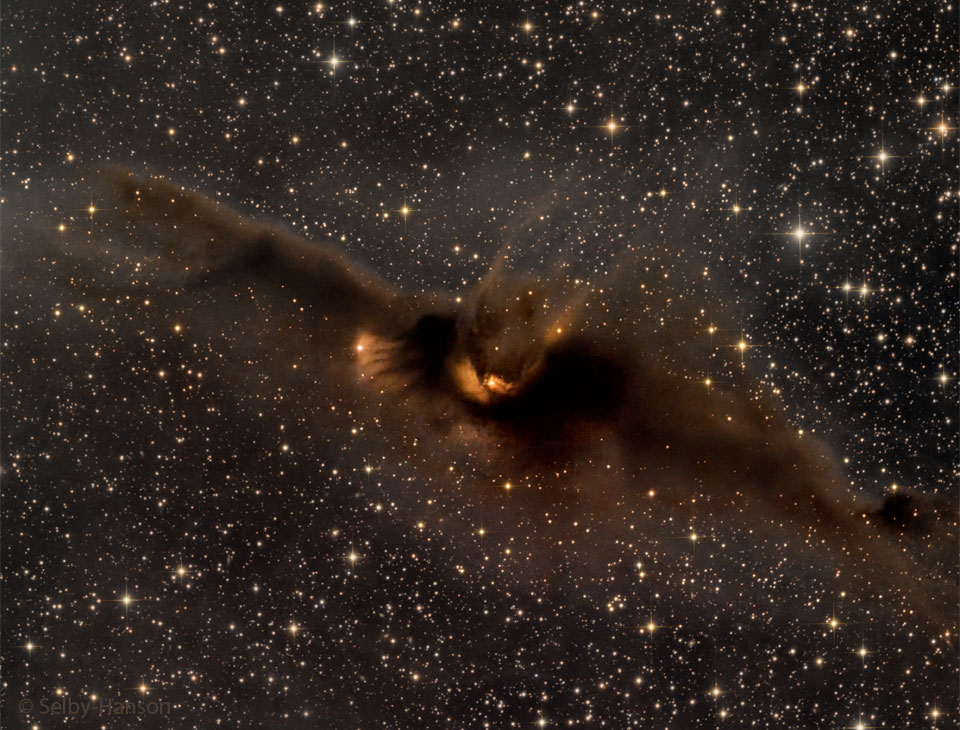
What is the most spook-tacular nebula in the galaxy? One contender is LDN 43, which bears an astonishing resemblance to a vast cosmic bat flying amongst the stars on a dark Halloween night. Located about 1400 light years away in the constellation Ophiuchus, this molecular cloud is dense enough to block light not only from background stars, but from wisps of gas lit up by the nearby reflection nebula LBN 7. Far from being a harbinger of death, this 12-light year-long filament of gas and dust is actually a stellar nursery. Glowing with eerie light, the bat is lit up from inside by dense gaseous knots that have just formed young stars.
Credit & Copyright: Mark Hanson and Mike Selby; Text: Michelle Thaller (NASA's GSFC)
It’s giving rainbows and unicorns, like a middle school binder 🦄🌈
Meet NGC 602, a young star cluster in the Small Magellanic Cloud, where astronomers using @NASAWebb have found candidates for the first brown dwarfs outside of our galaxy. https://t.co/jdupXcWiAH
Imagine a sky full of hundreds of stars as bright as the full moon… If our solar system were a part of this “super star” cluster, that is what we might experience. Here is Webb’s look at Westerlund 1, one of the closest clusters of its kind. https://t.co/LyphCSpnwh