I've been building on Flare for a while — FTSO infra, validator bonds, DeFi education. The last couple of weeks I built something different, and I'm giving it away.
Flare proposed capturing network-positive MEV at the protocol level back in April. The piece that grabbed me was the cross-chain half of the problem: how does a solver get paid for work done on another chain — without anyone trusting anyone?
So I built the settlement core and put it on Coston2:
→ A solver posts an FLR bond and claims a job
→ Executes it on XRPL (testnet)
→ Flare's FDC attests the payment
→ The contract verifies the Merkle proof itself. Valid proof pays the solver. No proof by the deadline slashes the bond.
The fee split is immutable at zero. I take nothing from this, forever — that's on chain, go read it. If the Flare team wants it, it's theirs.
Don't take my word for any of it. The demo site lets you forge a proof in your browser and watch the deployed contract reject it. No wallet, no gas, no signup:
https://t.co/Eu4lr1nSND
Why give it away? Because I have a lot invested in this network — my FTSO, our bond lots, our courses all live here. Making Flare better IS the return. You don't have to be a taker.
If you like what we're building at FlareForward, come see the rest: https://t.co/edO3uW0HxB
https://t.co/07t83AdnS3
This is surreal
Six weeks ago @agentvault_flr was a rough sketch on a blank piece of paper on my desk. Today it’s a first place finish in a hackathon with over 300 projects
Huge thank you to @FlareDevHub@FlareNetworks for running this and for FCC existing at all, none of this works without it
Congrats to Remnara, Astryum, UMBRA as well
This was only step one, onward 🛠️
As market makers stand up liquidity, the first $XRP options are starting to be traded, following the listing of FlareXRP as collateral.
Yesterday, $2.6m in XRP options traded, a small number that can rack up pretty quickly.
Some large bull spreads hit the RFQ, and we expect this to pick up further.
Question for the @FlareNetworks team. @HugoPhilion
FIP.16 talks about cross chain MEV capture. How far is Flare willing to go with that? What is Flare willing to develop/maintain when it comes to cross-chain MEV capture?
I’m thinking something like this:
Reminder:
FIP.16 already names atomic and cross-chain CEX/DEX arbitrage, lending liquidations, JIT liquidity, and post-trade DEX arbitrage as permitted network-positive MEV.
Also as a reminder, cross-chain MEV usually happens when an asset has different prices in different places. Someone can buy where it’s cheap and sell where it’s expensive. That’s ordinary arbitrage. Now multiply this across XRP, BTC, DOGE, stablecoins, FAssets, CEXs, DEXs, bridges, lending, etc, and you get an enormous distributed market where information arrives at different places at different times.
Because the information arrives at different places and different times, and because Flare can process external events using FDC (the FDC is the key part), Flare can potentially build a “cross chain state map”. And because they can build this sort of “state map” across a whole ecosystem, it presents them with some unique opportunities.
Proposal 1: Flare Cross-Chain MEV Engine
A protocol level product that CONTINUALLY monitors and calculates discrepancies between assets, identifying those MEV capture opportunities, and then making them available to solvers.
The Flare CC-MEV Engine wouldn’t ust look at price, it calculates “net executable profit” after gas, slippage, bridge cost, failure probability, etc. So, instead of “fXRP is 0.7% expensive”, it says, “There’s $22,500 of executable profit with a 97% probability of successful completion.” That’s a much more sophisticated system.
Flare doesn’t have to execute the trades. (Probably doesn’t want to anyway). They’re essentially creating a cross-chain solver market.
Example:
Imagine the Flare CC-MEV Engine identifies a $100,000 XRP arbitrage opportunity across various CEX’s/DEX’s/fXRP. (A network-positive opportunity of course).
Solver A: I can capture $25,000
Solver B: I can capture $27,000
Solver C: I can capture $29,000
Solver C wins. The engine provides them with the details, they execute the transactions, and the $29,000 profit is split between the solver, Flare (FIRE), and liquidity providers.
Now, put $FLR into the mix. Require solvers to bond $FLR. If a solver wants to participate in Flares cross-chain market, they must lock $1M FLR to receive permission to execute opportunities worth up to some amount. Why? Because now the solver has something to lose. If they manipulate execution, submit fraudulent results, or violate the rules, their $FLR bond can be penalized/slashed. Now, $FLR becomes economic security for cross-chain commerce. That’s much more interesting than another staking requirement.
(Add in FCC and it becomes even better. One problem with profitable arbitrage is: If everyone can see the opportunity, everyone races to capture it. FCC allows Flare to move the most sensitive parts of the process into confidential execution).
Flare could become a cross-chain “dark pool” for MEV. (Not a dark pool in the regulatory sense). A confidential place where cross-chain intents are matched before execution.
Now, part 2 of the proposal. Most cross-chain arbitrage isn’t waiting for a bridge (too slow), it uses pre-positioned inventory. (Google it).
Proposal 2: Flare Cross-Chain Inventory Network
This part is usually managed by cross-chain bridges, liquidity routers, and solver networks built on TOP of a chain. (Usually built on top because most chains don’t care about what’s happening on other networks because they don’t have the FDC. But Flare does).
Imagine a chain where liquidity providers deposit capital, and in return receive part of the arbitrage fees, execution fees, inventory fees, & liquidity fees.
One provider may provide 5M XRP, another may provide $1M USDT, another 100M FLR, 20 BTC, and so on.
Institutions provide the assets, Flare then positions the inventory across ecosystems and uses its data advantage to announce opportunities to solvers.
Once arbitrage is identified and executed, the Inventory Network protocol rebalances the inventory, pays the solver, and distributes fees (to both the provider and FIRE). You don’t need to move the asset across the bridge during the opportunity, that’s the key, the Inventory Network just rebalances afterwards.
This creates a new financial avenue for liquidity providers. Instead of, “I’m going to provide liquidity to a DEX”, it becomes, “I’m going to provide liquidity to the Flare network.” The Flare network itself becomes a liquidity marketplace.
Closing: Flare has some unique opportunities when it comes to MEV capture because of their FDC.
We didn’t even get to JIT liquidity, liquidation MEV, (both of which are huge), and more.
Imagine a single Flare engine that identifies opportunities, creates a solver market, liquidations, JIT liquidity, CEX/DEX arbitrage, post-trade arbitrage, liquidity network, MEV APIs, and more.
Seems like there’s TONS of ways to monetize the information and data they have, for the good of the network.
I would love to hear more about their plans.
Thanks for reading.
“I don’t participate in a liquidity pool because I’m worried about impermanent loss.”
Well, @SparkDexAI is adding smart protection for liquidity providers, reducing the risk of impermanent loss.
The core idea is simple but powerful: Before every swap, it checks the pool price against Flare’s FTSO price. If the pool is lagging behind the real market (the classic situation where arb bots extract value from LPs), the hook steps in:
* Exploitative swaps get hit with higher fees or get reverted
* Swaps that help rebalance the pool toward the true price can get a fee discount
The extra fees go straight to LPs instead of leaking to arbitrage bots.
This specifically reduces LVR (Loss-Versus-Rebalancing), the biggest continuous source of impermanent loss in AMMs.
Spread the word. Provide liquidity with confidence. Start earning.
Great video.
A proposed change to rFLR. Prioritize long term liquidity.
Idea: reward long term liquidity providers with boosted rewards, converting short term capital into multi-role participants who keep providing liquidity.
Details:
Extend the full-vesting period to 18 months.
Introduce a short cliff (ie. first 1–2 months non-claimable) so pure farmers cannot exit immediately.
Make the early withdrawal penalty progressive (ie. 70% in the first 3 months, tapering to 30% later) to further raise the cost of quick exits.
Add MULTIPLIERS for longer-term commitment and multi-role participation.
Duration Multiplier
* Base LP position: 1.0×
* Continuously provided liquidity for 3+ months: 1.25×
* 6+ months continuous: 1.5×
* 9+ months continuous: 2.0×
* 12+ months continuous: 2.5x
Staking Multiplier
Layering an additional rFLR multiplier on top creates strong alignment.
* LP only: 1.0×
* LP + P-chain stake: 1.5×
* LP + meaningful P-chain stake (ie. above a threshold such as 1M FLR, or proportional to LP size): 2.5x.
Implementation detail:
Prevent gaming. Require continuous liquidity (no frequent in/out), minimum position sizes, or use time-weighted averages. Random snapshots help prevent last-minute gaming.
Sticky liquidity produces sustained volume, deeper markets, more arbitrage/liquidations, and higher protocol fees/MEV, exactly the revenue streams FIRE is designed to capture and recycle into FLR buybacks and burns.
This combination of vesting and targeted multipliers for duration and P-chain staking turns a pure liquidity incentive into a broader network alignment program. It rewards people who are not just providing temporary depth but who are also helping secure and govern Flare.
@FlareNetworks@HugoPhilion
Firelight combines on-chain risk protection with sustainable staking rewards, creating a safer DeFi experience for users and institutions alike.
Built for institutional-grade resilience, designed to secure the future of on-chain finance.
FXRP/RLUSD on @Morpho: over $4M $RLUSD size, ~$3.6M borrowed against over $7M in FXRP collateral.
@SentoraHQ’s vault is keeps filling fast.
Caps scale with demand.
https://t.co/JHvtoFDjeR
There are two types of people in crypto:
1. Optimizers: they're in when crypto is the best opportunity. When something else is a better opportunity, they're out. If crypto becomes the best again, they may return. Local top to local top, no industry/asset class constraint. Optimal. Smart.
2. Missionaries: they're in crypto because they're passionate about crypto. There here to be part of the journey and drive it forward, come rain or shine — top and bottom.
After a while in bear markets, you wind up with fewer people toiling away. They are mostly missionaries, and in bear markets, underdogs.
I love these moments in the journey.
BREAKING: XRP holders can now borrow Ripple’s RLUSD on Ethereum without selling their XRP.
Flare’s FXRP was approved as collateral in a $280M lending vault on Morpho.
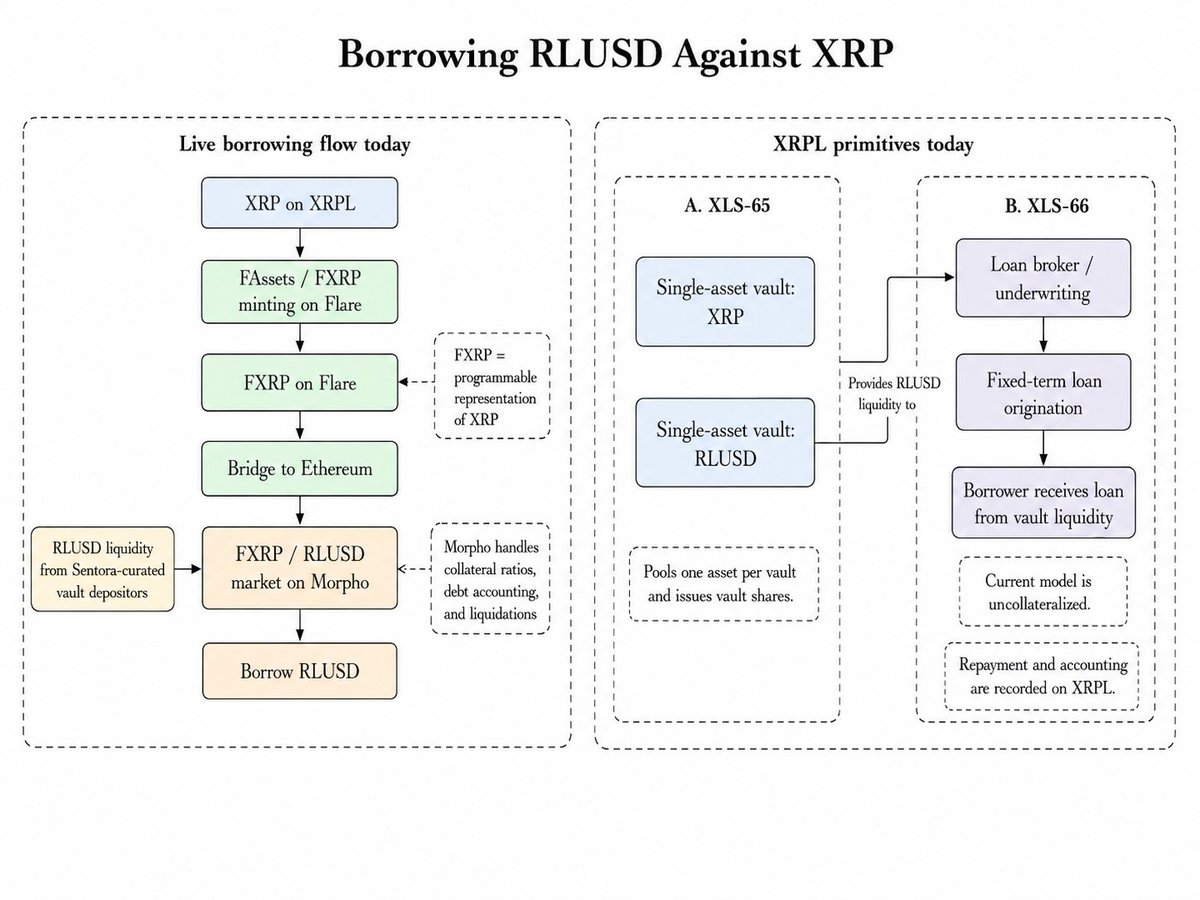
On the topic of borrowing RLUSD against XRP, the system needs four things: XRP locked as collateral, an RLUSD debt linked to it, a reliable XRP/RLUSD price, and a liquidation process when the position becomes unsafe.
FXRP makes this possible by turning XRP into a programmable asset. XRP is minted into FXRP through FAssets on Flare, bridged to Ethereum, and deposited as collateral in the FXRP/RLUSD market on Morpho. RLUSD comes from Sentora’s curated vault, while Morpho tracks the debt and makes undercollateralized positions available for liquidation.
XLS-65 and XLS-66 introduce a different lending model on XRPL.
XLS-65 creates single-asset vaults that pool assets such as XRP or RLUSD. XLS-66 allows those vaults to fund fixed-term, uncollateralized loans approved by a loan broker.
XRPL currently does not bind a borrower’s XRP to an RLUSD debt with automatic collateral valuation and liquidation. FXRP gives XRP access to those capabilities through programmable lending markets that already support them.
@Sentora just took a major step to make XRP useful onchain.
XRP is one of crypto’s largest and most liquid assets. Yet it remains surprisingly underused in onchain credit.
That changes today.
@FlareNetworks 's FXRP is now live as collateral in @SentoraHQ’s RLUSD Main vault on Morpho, marking the first time XRP can be used as collateral in an institutionally curated lending vault on Ethereum mainnet : https://t.co/JedKbYGyGk
XRP holders can now mint FXRP, bridge it to Ethereum, post it as collateral and borrow RLUSD—without selling their underlying XRP exposure: https://t.co/6KI4KacC4y
The new FXRP/RLUSD market is built on Morpho Blue using an isolated-market architecture. Its collateral asset, debt asset, oracle and liquidation LTV are configured independently. This isolates risk: an issue in the FXRP market remains contained rather than cascading across other markets in the vault.
The borrower flow is straightforward:
XRP → mint FXRP on Flare → bridge to Ethereum → supply collateral → borrow RLUSD
Access is non-custodial and permissionless, with a conservative initial supply cap that can scale alongside liquidity, market depth and borrowing demand.
The market sits inside @SentoraHQ’s $280 million RLUSD Main vault, the largest institutionally curated RLUSD vault on Ethereum. FXRP passed Sentora’s collateral-review process, which evaluates asset behavior, oracle reliability, liquidity, liquidation capacity, withdrawal conditions and other onchain risk factors.
This is more than another collateral listing. It connects XRP’s massive asset base with Ethereum’s programmable credit infrastructure—unlocking new possibilities for stablecoin carry, treasury financing and onchain liquidity while making XRP meaningfully productive across DeFi.