🚨 What if #shock is not simply a deficit of #pressure or #flow, but a loss of structural coherence?
Here, we propose a new perspective on hemodynamic failure integrating Guytonian physiology, cardiopulmonary interactions, and computational modeling
🔗 https://t.co/wB7yo0uEZ5
Septic shock+ARDS is a complex 🫀🫁 interaction—not just lung failure with hypotension
A new review explores physiology-guided hemodynamic optimization in this uniquely unstable population
#MedTwitter#FOAMed#CriticalCare#intensivecare#anaesethesia#ICU
https://t.co/31QGastgTC
I may be biased here, as I extubate MANY patients directly to NIV when I "feel" they will benefit, without relying on CO2, age, or cardiorespiratory status. This was a post-hoc analysis of two RCTs, and showed that in high-risk patients without hypercapnia at extubation,
The production of Christopher Nolan received permission for 15 days of filming in Greece with a budget of 16 million euros. The Greek state gave them 6 million as a subsidy from the money of Greek taxpayers, who were never informed about the cast of the film or the distortion of the most important work in our history.
The issue here is not that they received money. We Greeks would gladly have given all 16 million for Nolan to shoot a faithful Odyssey. But it should have been a film that properly represents us Greeks, Hellenism and stays true to the values and writings of Homer. Not so we Greeks could pay for a Black Helen and Clytemnestra, a Batman-like Agamemnon, a trans Achilles or Elpenor (a woman playing a male role), a Black Athena, and a script based on the worst possible "translation" that exists.
In short, Nolan disrespected all Greeks, while the Greek people are now officially in the crosshairs of racism and the falsification of their history and culture. Woke Hollywood must die.
Μακριά τα μικρά παιδιά από τις οθόνες. Μακριά τα μικρά παιδιά από τις οθόνες. Μακριά.
Ναι, κάποιες στιγμές είναι «ευκολία» να δίνεις μια οθόνη σε ένα παιδί για να απασχολείται. Αλλά μην το κάνετε!
The smartest doctors are rarely the ones who make the greatest impact in medicine.
Impact is less about intelligence in 2026 and beyond.
It’s about agency.
Intelligence is the ability to understand, analyze, and process information.
It’s pattern recognition. Memory. Reasoning. Cognitive horsepower.
Medicine selects heavily for this.
But intelligence alone is no longer scarce - particularly as AI has begun to meet and exceed human intelligence for many tasks.
Agency is different.
Agency is the ability to:
-Observe the world as it is
-Recognize that it is not immutable
-Act to change it
-Execute despite uncertainty, friction, or incomplete knowledge
Agency = curiosity + creativity + execution.
In the pre-AI era, expertise was largely about how:
-How to run statistics
-How to code analyses
-How to format manuscripts
-How to search literature
That made intelligence and technical mastery the bottleneck.
That world is gone.
Today, AI can:
-Run statistical models
-Write clean, reproducible code
-Perform literature searches
-Draft and revise text
-Execute technical steps accurately and repeatedly
I say this as someone who did a Master’s in epidemiology and learned to write Python for stats.
The syntax mattered then.
Today, I can write the scripts in minutes using Claude Code.
If the "how" is becoming automated, what's left to automate? The "what" and the "why". @johnrushx talks about this.
- What to study.
- Why it matters.
- When to act.
- And whether you actually do anything at all.
That’s agency.
Medicine doesn’t suffer from a lack of smart people.
It suffers from a lack of people who:
-Start projects
-Ship imperfect versions
-Build things outside formal pathways
-Take responsibility for changing broken systems
95% of people never take the first step.
Not because they aren’t smart —
but because agency is uncomfortable.
For the next generation of physicians:
- Stop trying to maximize how much you know.
- Start maximizing how much you can do.
Learn to:
- Turn ideas into action (even bad first drafts)
- Execute without permission
- Build, test, iterate
Use intelligence as a tool, not an identity.
In 2025 and beyond, agency will define who shapes medicine
🔥New paper out! “Heart–Lung Interactions in Combined Distributive Shock & ARDS: Applied Cardiopulmonary Physiology at the Bedside" A focused physiology-based framework integrating mechanics&hemodynamics for bedside care🫀🫁
https://t.co/XXOLe8f1dq
#FOAMed#MedX@CritCareReviews
Lung protective ventilation (LPV) should be the default strategy for all surgical patients—it's simple, low-risk, and proven to reduce postoperative pulmonary complications across risk groups. #MedTwitter#Anaesthesia#PerioperativeCare#LPV@JamesJae5
🔗https://t.co/2EQ93PKd0W
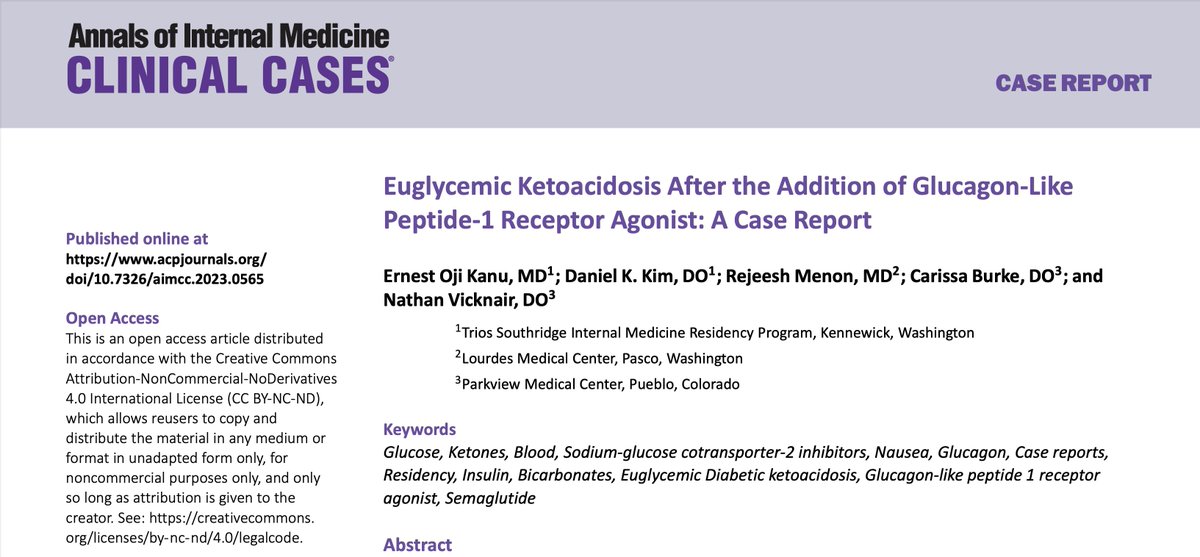
It took us a while to recognize euglycemic diabetic ketoacidosis (euDKA) in patients treated with Na-glucose cotransporter-2 inhibitors. It seems that we may have to be on the lookout for euDKA in patients treated with glucagon-like peptide-1 receptor agonists (#Wegovy#Zepbound)
🩸 Veins aren’t just “pipes” — they store blood and regulate venous return.
⚡ The new drug Centhaquine boosts filling pressure via venoconstriction and α2A receptor action, improving microcirculation.
👉 Read more: https://t.co/daIKKuRHDx
🩸 Veins aren’t just “pipes” — they store blood and regulate venous return.
⚡ The new drug Centhaquine boosts filling pressure via venoconstriction and α2A receptor action, improving microcirculation.
👉 Read more: https://t.co/daIKKuRHDx
ICU Facts:
In my experience, in any decent size ICU (~15 beds), at any point in time there is at least 1 patient with unequal pupils (anisocoria). People are often freaking out & rush to get a CT brain to rule out intracranial bleeding. Just think hard before reflexively do this
ICU Line Secrets:
Is there anything about "lines" that has not been done or studied already? Not much, I guess, so these actually are not secrets, just things I had to do the last couple of weeks & hopefully you also find useful in your practice
Here it begins:
1. "Twin lines"