Learned more working the grill at Wendy’s than the classrooms at Yale. Proud Memphian, Grizz fan. Today’s stranger, tomorrow’s friend. Build up and not out.
Bill Gurley: Anthropic Thinks It’s Building God
@Jason: It is the ultimate level of narcissism and delusion of grandeur to think you can create God.
@bgurley:
“Anthropic is a mystery to me. I've never, ever seen a company that is both leading their field and the most negatively outspoken commenter on what they do.
And my initial theory was the regulatory capture theory. Quite frankly, I think they're very close to achieving that.
But then they just got so loud that I've literally, in the past 30 days, read everything I can about Anthropic, and I've come up with a new theory.
I call it the Dr. Frankenstein theory.
The more I dig, I've met people who, I dare say, think it's their responsibility, and they're excited about, building a species that's superior to humans.
Dario wrote this blog post called ‘Machines of Loving Grace.’ It was based on a poem.
The last stanza of the poem says, ‘I like to think of a cybernetic ecology where we are free of our labors, and joined back to nature, returned to our mammal brothers and sisters, and all watched over by machines of loving grace.’
Sounds like an overlord to me.
And then in Dario's post, he says, ‘It could be a capitalist economy of AI systems which then give out resources to humans based on some secondary economy of what the AI systems think makes sense to reward in humans…’
So I don't think they think they're writing software. I think they're midwifing a deity here.”
Jason:
“These are delusions of grandeur. Let's call it what it is.
They believe that they're so powerful, these individuals, that they can create God, and that by creating God, they are like this Prometheus kind of species.
It literally is the ultimate level of narcissism and delusion of grandeur to think you can create God.”
Carey Bringle has owned Peg Leg Porker in Nashville for the last 14 years.
“Our property tax started at around $9,900 when I bought this property in 2012. It’s now around $77,000 a year,” he said.
Nashville Mayor Freddie O’Connell will not include reducing the property tax rate in his budget proposal this year.
He told FOX 17 News he did not include a property tax reduction in his budget because historically it has not been done before.
“This business means everything to me. This is the place where they make memories. And it’s local. I’m born and raised here in Nashville. And you’re not going to get any more local than this,” Bringle said.
903 Gleaves St, Nashville, Tennessee
-WZTV Nashville
#commercialrealestate
With today’s Supreme Court decision in Louisiana vs Callais, how many terms remain for (D) control of District 9?
Hard to imagine Tennessee won’t be 9 safe red seats.
Ruling changes local political calcs. mightily.
Might the best (D) seat now be non-partisan & local?
How does that impact something as big as “consolidation” or “de-annexation”?
https://t.co/1s3eLbzj1e
Paul Tudor Jones says the US is more dependent on equity prices than ever, and explains what a 35% correction would trigger in the economy:
"We're 252% of stock market cap to GDP. In 1929 we were 65%. In 1987 we got to ~85-90%. In 2000, 170%.
If you think about the periodicity of significant bear markets. Since 1970, we get a mean reversion about every 10 years.
Let's say mean revert to the past 25 or 30-year PE. That would be a 30, 35% decline. Well, 35% on 250% of GDP is 80, 90% of GDP.
10% of our tax revenues are capital gains, they go to zero. So you can see the budget deficit blowing up. You can see the bond market getting smoked. You can see this kind of negative self-reinforcing effect.
In the stock market, we're over-equitized as a country. We have the highest individual equity weightings in the history of the country.
And then the real problem is if you look at private equity in 2007-2008, that was about 7% of institutional portfolios. Now it's about 16% of the institutional portfolios. We're so much more illiquid than we were in 2008.
The problem is that if you buy the S&P at this current valuation, the 10-year forward return is negative when you buy the S&P with a PE of 22. That's what history shows.
So yes, the S&P is spectacular long-term, if you have a hundred-year view. But that's because that's an average of a hundred years, including times when the S&P 500 PE was 6, 7 and 8, or one third of what it is right now.
Valuation matters a lot, and the stock market's really high and it's gonna be really hard to make money from here with any kind of long-term view."
"Blue cities are radical hellscapes that can't fix crime."
Counterpoint: Baltimore.
Baltimore had 334 murders in 2022. Last year it had 133, the lowest since 1977.
The turning point was that voters defenestrated a Soros-backed prosecutor Marilyn Mosby who averaged 333 homicides a year across eight years and declined to use mandatory minimum sentences. (She was later convicted of mortgage fraud, so there's that too.)
Her replacement, Ivan Bates, ran on the Democratic ticket with a simple message: repeat violent offenders belong in prison.
Maryland law already allowed five years with no parole for convicted felons caught carrying a gun, but Mosby never used it. Bates used it a lot. In just two years, his office sent more than 2K repeat violent offenders to prison, double his predecessor's TOTAL.
The city paired that with a precision intervention program that identified the small number of people driving most of the violence, which led to 631 arrests (94% haven't reoffended).
Police also seized 2,480 firearms last year alone, including hundreds of ghost guns, while maintaining a 64% homicide clearance rate. When shooters know they'll get caught and actually prosecuted, behavior changes.
Sandtown-Winchester, once the most violent neighborhoods in the city, just went a year without a killing!
Carjackings (-51%) and robberies (-24%) are also down.
Baltimore didn't change demographics, or its culture, its rules, or much of anything else in those years. It simply voted in a new Democratic prosecutor, who decided the city needed to finally put violent criminals in prison.
Italian efficiency when it comes to coffee should be studied.
In Italy:
- Walk into a bar and look at the guy
- Un caffe
- 30 seconds later it’s ready
- Shoot it
- Leave €1
- Walk out
In the US:
- Join a line
- Wait
- Order coffee
- Answer 12 questions: Size? Milk? Roast? Sugar? Temperature? Colombia beans? Name? How do you spell it?
- $12.34
- Ask for a 20% tip. Click 5 times on a ipad to have a custom tip
- Tap phone
- ask where to send the invoice
- Wait again on a different line
- Someone call a name that sounds similar to mine
- get the coffee
- too hot, can't drink it
- finally at temperature
taste like shit
A final piece of advice from Holly Butcher - written the day before she passed away from cancer at just 27:
“It’s a strange thing knowing you’re going to die young.
At 26, I thought I had time…
To fall in love.
Start a family.
Grow old.
But cancer doesn’t care about plans.
Now, I understand how fragile life really is. Every single day is a gift, not a guarantee.
I’m not writing this to scare you. I’m writing to remind you: really live.
Stop stressing over little things. Be kind to your body- move it, nourish it, stop criticizing it. One day you’ll wish you had appreciated it.
Go outside.
Look at the sky.
Feel the sun.
Just be.
Spend less time chasing “stuff” - more time making memories. Don’t skip moments with people you love.
Laugh more.
Write a note.
Tell someone you love them.
Complain less.
Give more.
Helping others brings more joy than anything you can buy.
Be present.
Put your phone down.
Show up - really show up.
You don’t need to have it all figured out. You don’t need a perfect body, or a perfect life.
Just follow what makes your heart light up. Say no to what drains you. Make changes when you need to.
And please - donate blood. I wouldn’t have had that extra year without it. And that year gave me memories I’ll hold close… forever.
Thank you for reading this.
Live your life well.
And maybe… we’ll meet again someday.”
Holly 🩷
Repost & share Holly’s important advice. ❤️
Memphis was one of the most dangerous cities in America. It’s now becoming a model for how to fight crime when you have a terrible DA.
From the peak:
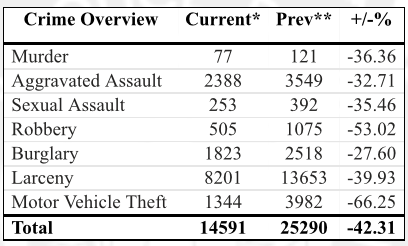
- Murders down 47%
- Carjackings down 48%
- Robberies down 51%.
- Vehicle theft down 80%.
What changed:
1. State troopers took over interstate patrol, freeing up local officers.
2. Police launched focused initiatives targeting fugitives, violent repeat offenders, and gang members.
3. National Guard, federal agents, and US Marshals came in and made 9,000+ arrests, including 400+ gang members. Plus 629 illegal firearms seized, 150 missing children located.
4. Technology filled the gaps. Police deployed license plate readers citywide, expanded drone use, and opened a downtown command center. A cancer center went from a crime attempt every other week to none.
Overall crime is now down more than 43% compared to the same period last year
Memphis has a long way to go and remains a dangerous city. Its DA is still dismissing 3 out of every 4 felony cases. In fact, the state legislature just passed a bill to audit and potentially remove him.
But the city is showing that a rogue DA doesn't have to be a death sentence for public safety. Flood the streets with law enforcement, target repeat offenders, and make arrests faster than he can dismiss them.
A 2024 paper (Spencer, Economics of Education Review) using synthetic difference-in-differences found the full Literacy-Based Promotion Act (LBPA) bundle caused ~0.14–0.23 SD gains in 4th-grade NAEP reading (and slightly larger in math) for students exposed K–3.
Retention explained only ~22% of the treatment effect; the rest came from teacher training/coaching in the science of reading, early screening + interventions, high-quality materials, and parent engagement.
Bulk of Mississippi’s sustained, multi-grade, subgroup (especially Black student) progress traces to the prevention side: better teaching, better materials, and catching kids early
Been researched to depths - over 6 primary studies and more than a dozen secondary plus
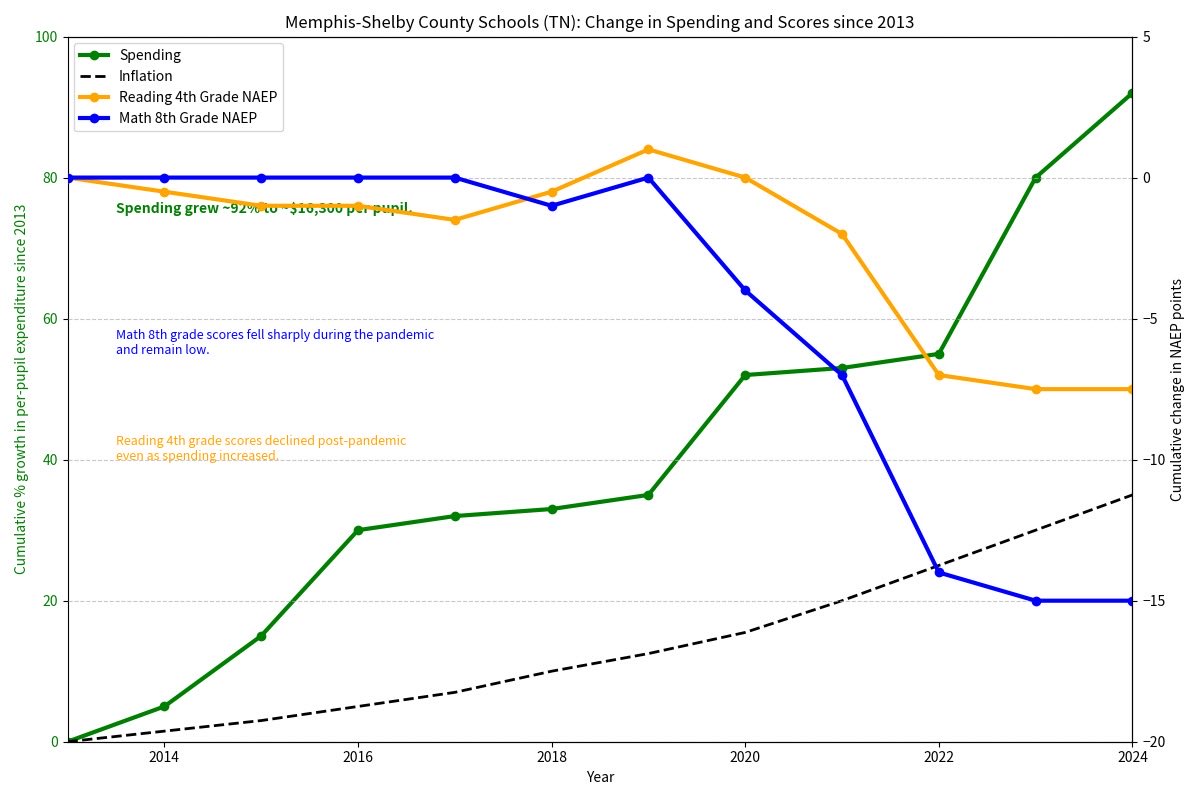
Spending more while getting less is usually a good sign of corruption, fraud, waste and incompetence.
Our education system in California is profoundly broken.
Curriculum is certainly an issue. It’s a priority issue.
Review Mississippi’s progress and replicate it as a comprehensive early literacy reform model—centered on the 2013 Literacy-Based Promotion Act (LBPA) and backed by ExcelinEd’s free policy toolkits
Mississippi’s gains came from a bundled, evidence-based approach (not magic or demographics alone). Key drivers confirmed by studies and implementers:
• Science of Reading (SoR) shift — Full pivot to systematic phonics, decoding, fluency, vocabulary, and comprehension (rejecting whole-language or three-cueing). Teachers trained intensively; curricula vetted for alignment.
• Teacher support infrastructure — State-funded literacy coaches deployed to low-performing schools + mandatory or heavily subsidized SoR training (e.g., LETRS-style) for K-3 educators. ~$15 million/year targeted investment in one of America’s lowest-spending states.
• Early identification + intervention — Universal K-3 screening (3×/year), Individual Reading Plans for struggling readers, and parent notification/involvement.
• Third-grade “gate” with real supports — Students must read at grade level to promote; retention (~5–10% of 3rd graders) paired with specialized teachers, summer programs, and interventions—not just holding kids back. Gains started before peak retention effects.
• HQIM + standards + accountability — High-quality instructional materials (e.g., CKLA, Wit & Wisdom, EL Education—MS has a public vetted list), rigorous standards phased in, and clear school/district reporting.
• Sustained leadership & rollout — Bipartisan, multi-year implementation with heavy communication to educators, parents, and communities. Not an unfunded mandate.
Thanks for the tag! Spot on—the Memphis-Shelby County Schools chart (sourced from NAEP scores and NCES spending data, same as California’s) shows per-pupil spending up ~92% to ~$16,300 since 2013, while 4th-grade reading and 8th-grade math scores have declined or stagnated, especially post-pandemic. Same trend: more dollars, less progress.
I’ve spent a decade telling people to do what I do: "Buy and Hold."
Now I've decided to list my entire real estate portfolio for sale and walk away.
It started slow. The bills, the maintenance, the tax increases... but the final straw was when I tried to develop an ADU to do exactly what the city of LA claims it wants investors like me to do: Create more housing. You'd think they'd make it easier, but after two delayed inspections, a sewer pipe replacement that needed 75 days advance notice, and a city-owned tree that became my responsibility, I'd had enough.
The identity of being a real-estate guy is very hard to walk away from, trust me. For a long time, I stayed just because real estate was my "thing." It’s how I started. It’s what I’m known for. It led to every good thing in my life. But that blinded me to the fact that just because something served me in the past, it doesn't mean things haven't changed in the present.
The reality of 2026 finally stripped the emotion away. My LA rentals are netting about 4-5% after the constant background noise of taxes, insurance spikes, and repairs. Meanwhile, a risk-free Treasury pays 5%. The trade-off just doesn't make sense any more.
I’m reallocating to a liquid portfolio that actually lets me focus on the work I love. I published a deep dive on my Substack about the ADU nightmare that broke my patience, the exact numbers behind the exit, and where I’m moving the money next to buy back my sanity.
I'll drop the link here in a bit.
To those that don’t know - @KingJames comments don’t reflect the quality of the hotel; they reflect the ‘status’ of them
Hyatt Centric Beale Street Awards
1. Hyatt Internal / Brand Award
•“Best New Property” – Hyatt Americas Owners Conference (2021)
•Awarded by Hyatt Hotels Corporation shortly after opening
•Recognizes top-performing newly opened hotels across the Americas
•Signals strong execution on design, positioning, and launch performance
⸻
2. Meetings & Events Industry
•Stella Awards Finalist (2024)
•Category: Best Hotel/Resort Event Space – Southeast
•Recognizes excellence in meetings, event space design, and service quality
•Highlights the property’s ~12,000 SF of indoor/outdoor event space and riverfront setting
⸻
3. Convention & Regional Recognition
•ConventionSouth Reader’s Choice Awards (2025)
•Recognized as a preferred meeting/event destination in Tennessee
•These awards are driven by planners and industry professionals
⸻
4. Travel & Consumer Recognition
•Condé Nast Traveler – Readers’ Choice Awards (2025)
⸻
5. Top 10 “Best New Hotels in the U.S.” – USA TODAY 10Best (2021)
•Final placement: #7 in the United States
Downtown Memphis offers some of the best 4 star properties in the US and its owner’s operate them with great pride like the Peabody Hotel.
Memphis does not have a Four Seasons. The marketplace can’t afford it on its own.
Just like the Memphis market can’t provide the revenue to support an NBA roster in the $400-270mm range or have the team pay for its own NBA stadium alone, hotel owners don’t have the ability to justify a luxury hotel yet.
There are no ping pong balls for commercial real estate.
If Memphians, Grizzlies owners, investors or public officials want to change that reality, investment is required like everything else.
It takes a belief in a city that better days are ahead.
That wealth and opportunity exist around the river bend. That everyone benefits when the river rises…
And if a hotel of that caliber were built, stars like LeBron would visit.
More than a few former NBA players and coaches chose not to visit but instead call Memphis home.
I agree, it’s not the people of Memphis but the lack of investment in its people and economy that matter.
@geoff_calkins@stephenasmith@samhardiman@MayorMemphis@ChrisVernonShow@JasonSmith929@JohnMartin929@WMCActionNews5@JWright929espn@929espn@3onyourside
It’s easy to dish. Whatever. There’s a saying in the restaurant business when it comes to politics, you’re either at the table, or you’re on the menu.
Griz and City have the same menu & relationship seems strong. No one balking at the price of the entree.
Can’t worry about the table creating a noise next to you
Yet execution matters. Can’t be waiting forever for the main dish to arrive or despite the best of intentions someone is leaving unhappy.
After a tough fight to make it on the bracket, we have our finalists! America, we want to hear from you! Tell us what you want to see back on the menu. Voting starts… NOW!
Better luck next time to the Sunroom, Salad SuperBar, Giant JBC, and Trex burger.