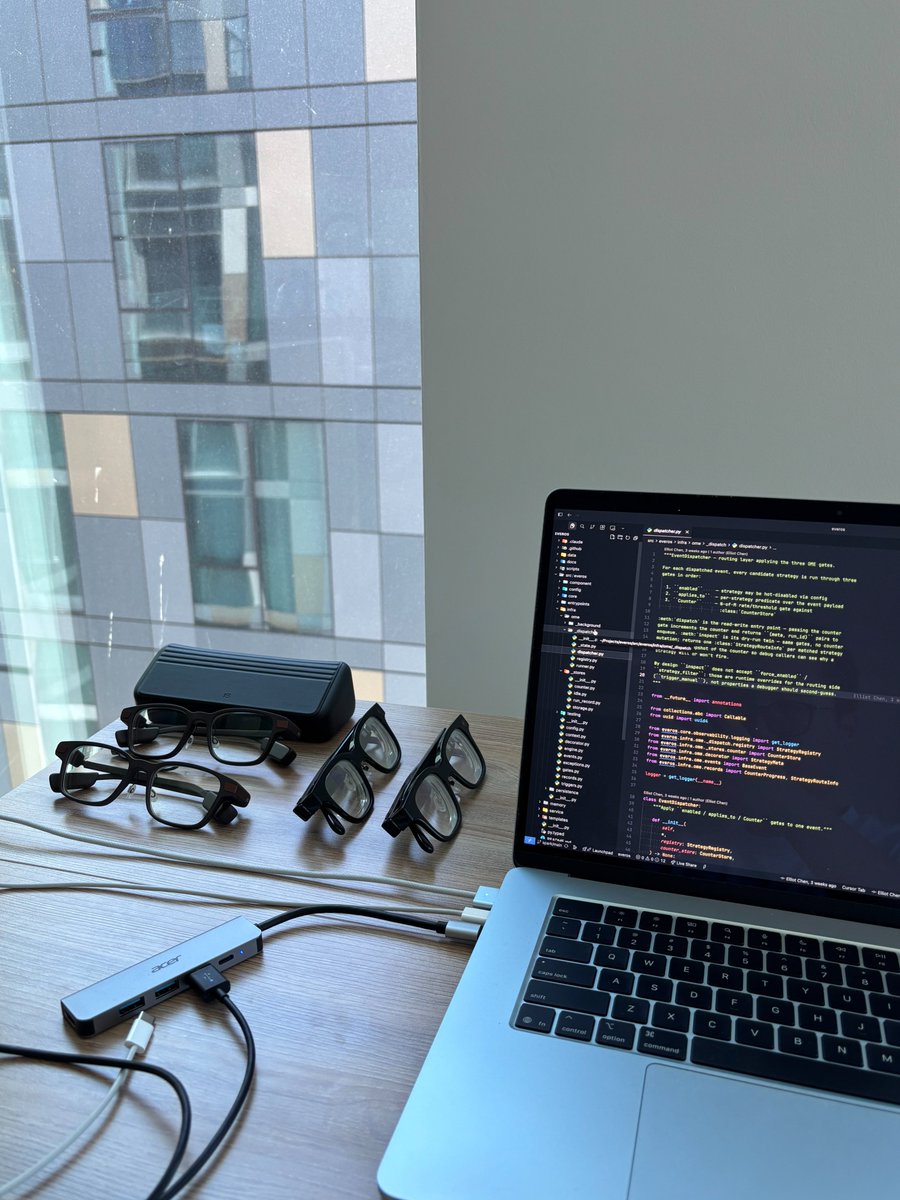
Been building display glasses for a year now. Been back to China a few times too, and it just confirms it, the US market is a different planet
Most people here default to smart glasses = AR display glasses = Meta glasses. Even people working in tech barely know display glasses
To most Americans Rayban Meta just is smart glasses, and plenty assume all the Meta glasses always had a display. A lot of people here have never even heard of another smart glasses brand
Classic glasses demo, three acts, same script in the US and China:
1. put them on expecting magic
2. "whoa omg it's actually rendering in the lens"
3. take them off, rub your eyes, set them down and never touch them again
Most Americans don't even wear glasses day to day. If they do it's sunglasses
Glasses just aren't an everyday object for a huge chunk of people here, and pretty much no women is putting on any current display glasses
One thing US and China builders do seem to agree on:
Glasses, or more broadly all wearables, can collect context and work as the interface to interact with AI
I wrote about AI wearables — not just glasses — and how they make me sometimes feel like a spy. A thing I don’t always feel great about, even though I’m just doing my job by testing them.
https://t.co/zUQq8jAA2A
finally found a decent 'life management' approach
is a notion board w/ 'backlog', 'block on me', 'waiting', 'complete', agents update it as tasks complete
then i have a daily automation with @bot which the status of items, updates them, and pings me on what i need to do
Introducing Phonon-1: a new frontier in speech recognition per byte.
A 782 million param model in a 415 MB download, more accurate than a Whisper 2x its size.
Transcribe an hour of audio in about two minutes on a MacBook Air.
Open weights, Apache 2.0, today.
@fermion_ai
To craft for conversation, timing is everything. Natural conversation is a social dance, and timing matters just as much as tone and delivery.
Most voice AI doesn't do this well yet.
So we built TurnBench: an open benchmark that measures whether voice AI knows when your turn is really over, and when an "mm-hmm" is agreement, not an interruption.
Learn more about how we built this on our blog.
https://t.co/idk8fzJH0W
Today, we're kicking off the first phase of the research preview for Model Hardware Standard (MHS): a new standard for AI agents to safely operate physical equipment in scientific research and advanced manufacturing.
Read more: https://t.co/XQ2y9EW7Af
Every era of computing has had its defining interface. We typed on keyboards. We tapped on screens. In the agent era, we’ll simply speak.
Today Plaud opens Plaud One Explorer Edition for those who are ready for a wearable device that remembers continuous context and keeps work moving.
Plaud One is the wearable AI that helps you capture, think, and get things done through conversations.
What you build with it will shape what it becomes.
Ready to be an explorer? (Limited to 2,000 units)👉https://t.co/QfHSr7VRc6
#Plaud #Wearable #Interface
We’re closing Chargerless orders soon bc too many people are buying it — if you want a health tracker that charges itself in sunlight you should order now on https://t.co/PDPFqQ0TjC
A sneak peek of production:
Introducing Phonon!
Fast, local, open-source voice typing with parakeet and gemma 4. Uses OCR for screen context and stays minimal so you can focus on expressing your thoughts to models.
Download at https://t.co/XpYMXYxGa3 and repo below!
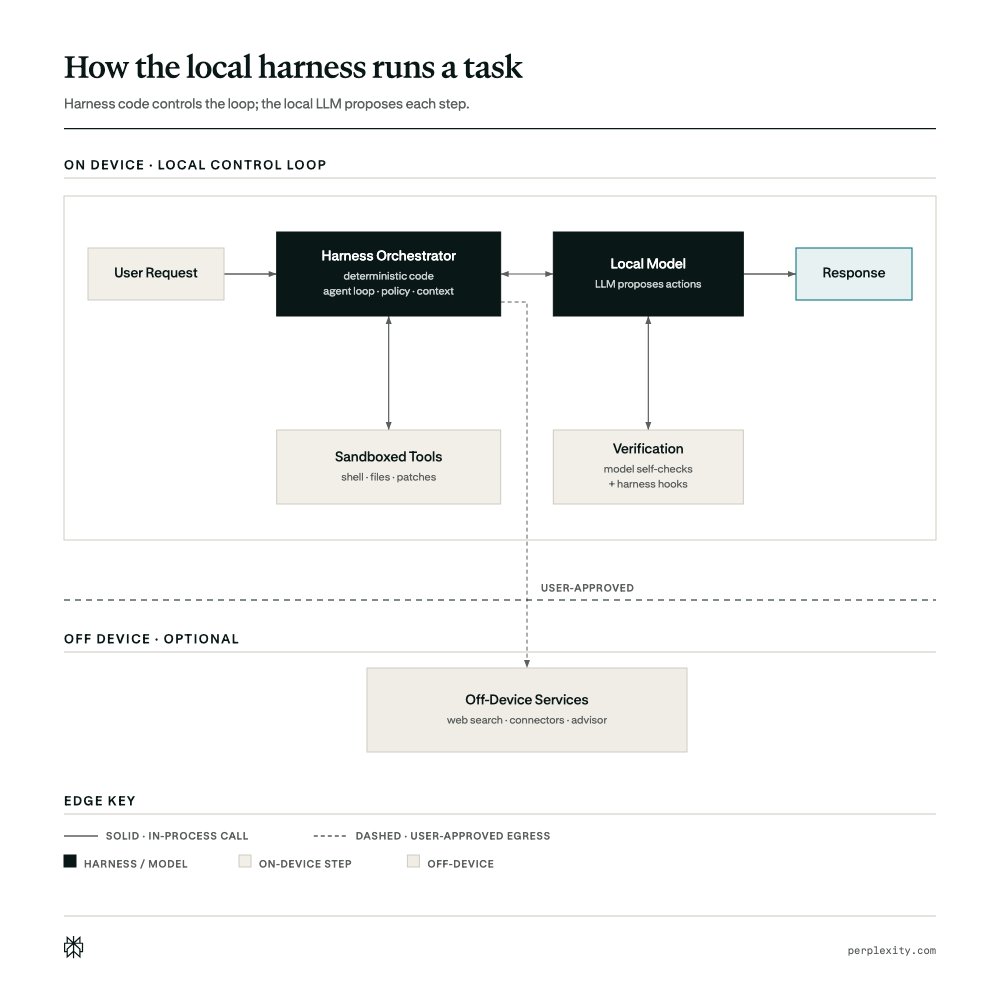
The model and harness are designed together because small models fail in harnesses built for frontier models.
Portable is a minimal system prompt, skills that load on demand, connectors as compact CLI tools instead of MCP servers, self-verification, and an always-on sandbox.
Today we’re launching Portable Computer on @NVIDIA DGX Spark.
Portable Computer is a fully local version of Perplexity Computer, where the entire runtime: orchestrator LLM, subagent LLM, agent harness all run on your local hardware. No cloud dependency.
I’ve really been enjoying Instinct, a personal AI agent. The simplest description for it is: OpenClaw for normal people.
It feels like magic. And contrary to what some people have said, I don’t think the appeal is limited to Silicon Valley types, we are setting my dad up with it too.
I’ve exchanged 677 messages with Instinct in the past five days. Here are some of the things it has done for me:
1) I asked who I should see about fixing my flat feet. It recommended starting with a podiatrist, found a well-reviewed one who takes my insurance, and filled out all the paperwork for me. I HATE finding in-network doctors, so this is a great use case for me.
2) It helped decrease my Comcast bill from $100/month to $60/month. It hit a wall on this one but gave me a number to call and an exact script. The call took three minutes.
3) We’re ordering custom merch for my brother’s wedding. It found vendors and is messaging several of them on WhatsApp- asking questions, comparing options, and negotiating prices while I’m asleep because the vendors are in India.
4) I’m planning his bachelor party. Everyone posted their arrival details in a WhatsApp group, so I asked Instinct to organize everything in a spreadsheet. It has access to my WhatsApp, so there was nothing for me to copy and paste.
5) My wife and I are going a wellness retreat (Miraval) in a couple of weeks, where many of the activities need to be booked in advance. After some back-and-forth about what we’d enjoy, Instinct researched the highest-rated activities and booked them for us. Massage slots appeared to be unavailable online, so it emailed the hotel from my account, found times that worked for us, and booked those too.
6) It did something similar for a girls’ trip my wife is taking with a friend, but booked very different activities for the two of them than it did for us.
7) It booked a DMV appointment for my new driver’s license.
8) It canceled all my Amazon Subscribe & Save subscriptions.
9) It activated all the free offers on my credit cards, just in case. I can't be bothered with those but if it's no work on my end there is no harm
10) It price-shopped my car insurance and concluded that I already have the best rate through Tesla.
11) My wife and I are traveling on the same United flight but booked on separate tickets. Instinct contacted United and linked our itineraries, a task that requires chatting with the airline and can’t be done through self-service.
12) It found and booked a factory tour at an Amazon fulfillment center that I'd been meaning to do, at a time that fit my calendar.
13) It suggested topics for a podcast I was appearing on. I didn’t end up using all of them, but they were pretty good.
14) It reminded me about a bunch of unused gift cards I had forgotten about.
15) I sent it a photo of a toll notice. It paid the toll, discovered another outstanding one, and paid that too.
None of these things is individually life-changing. Some of these things can be done via their own apps... But together, they represent hours of annoying life admin I didn’t have to do, and I have one easy place (imessage!) to do them.
There’s an obvious question: why doesn’t ChatGPT, or, Meta or Google already do all of this?
The underlying technology clearly exists- to use tools and complete multi-step tasks. But they haven't packaged it as a persistent personal operator with this level of access to your accounts and communications. The other AI's are also more cautious about purchases, cancellations, messages, and other external actions, so they will often stop for confirmation, which kills the vibe tbh! Note: I haven't been playing with Grok Bot yet, which I think does a lot of this.
A year ago I thought memory was the killer feature and it was awesome that ChatGPT had it, but Meta and Google had even more context / a natural advantage that they could ride on to be your personal AI agent. Meta's data with WhatsApp, etc...; Google with Gmail, Calendar, Chrome, and Android.
But I've found the data that Instinct gets from being connected to your email to be pretty sufficient to get started and it can fill in the gaps.
And the amount of context Google/Meta have that could make their assistants incredibly useful would also create enormous privacy, compliance, and trust problems for them. Plenty of people are uncomfortable giving those companies this much visibility into their lives, lawyers and lawmakers would come after them like crazy... not to mention there are probably all sorts of T&C's that Instinct is breaking. It is a bit scary how much information Instinct has and what it can do. We're going to start to see a new excuse: "I didn't send that email, it was my AI assistant"
Anyway, good opening for Instinct. Much less about having a uniquely capable model and more about the product harness around it: integrations, permissions, context, persistence, willingness to keep working until the task is finished.
Something like: ChatGPT/Claude still feel like assistants that you operate, but Instinct is an assistant you employ.
Very cool product. It has the potential to make life easier for a lot of people. Excited to see more develop here.
And if you want to sign up go here: https://t.co/Nu8pNhKyiM currently on waitlist. I don't have any more invites. I gave out 100+ invites on here and they were taken in 2 mins. If I get more I'll post them!