90% serious, 20% degen, 100% good maths • personal family investment lab • ₿ Ξ 2017 prom • STEM, environment, energy • short term plays fund long term vision🌳
@hausfath Damn that's impressively good! Its data viz isn't always so creative as some of these designs exist already - and were part of its training - but it's really well made and accurate it seems
Ce qui me surprend ce n'est pas que Cédric le stagiaire ait envoyé une notification à tous les clients du Crédit Agricole....
Non ce qui me surprend c'est qu'il y a encore des clients au Crédit Agricole.
A French engineer who lives quietly in Paris has spent 30 years writing software that the entire internet now runs on without knowing his name.
He wrote the code that streams every YouTube video, every Netflix show, every TikTok clip. He wrote the code that runs the virtual servers underneath AWS, Google Cloud, and Microsoft Azure. He calculated more digits of pi than anyone in history. He has no Twitter. He has no marketing. He just keeps shipping.
His name is Fabrice Bellard.
Here is the story, because almost nobody outside the systems programming world knows what one man has built.
Fabrice was born in 1972 in Grenoble, France. He studied at École Polytechnique, the top French engineering school. He never went to Silicon Valley. He never built a startup empire. He just wrote code.
In 2000 he started a project called FFmpeg, an open-source multimedia framework for encoding, decoding, and streaming video. He was 28. The project did one thing nobody else had done well. It handled every video and audio format that existed, in one library, on every operating system. He led it himself for years.
Today FFmpeg is the invisible engine of the internet. YouTube uses it. Netflix uses it. VLC uses it. Chrome and Firefox use parts of it. Every Android phone, every iPhone, every smart TV, every video editing tool you have ever touched runs FFmpeg somewhere underneath. If you have watched a video on a screen in the last 20 years, Fabrice's code processed it.
He was not done.
In 2003 he started QEMU, a machine emulator and virtualizer. He wrote it solo until version 0.7.1 in 2005. QEMU lets you run any operating system on any other operating system. It became the foundation of modern virtualization. KVM, the Linux kernel hypervisor, runs on top of QEMU. Every major cloud provider, AWS, Google Cloud, Microsoft Azure, IBM Cloud, runs virtual machines on infrastructure built around it. The Quick Emulator is the most cited piece of cloud infrastructure code on Earth.
He kept going.
In 2001 he won the International Obfuscated C Code Contest with a small C compiler that grew into TCC, the Tiny C Compiler. TCC can compile and boot a Linux kernel from source in under 15 seconds. In 2004 he calculated the most digits of pi ever computed at the time, using a personal desktop computer and an algorithm he derived himself called Bellard's formula. In 2011 he wrote a complete PC emulator in pure JavaScript that runs Linux in your browser, a project called JSLinux that engineers still cannot believe is real.
In 2019 he released QuickJS, a small but complete JavaScript engine that fits where V8 cannot. In 2021 he released NNCP, a neural network based lossless data compressor that immediately took the lead on the Large Text Compression Benchmark.
Then he turned his attention to large language models. He built TextSynth Server, a web server with a REST API for running LLMs locally. He released ts_zip and ts_sms, compression utilities that use language models to compress text and short messages at ratios traditional algorithms cannot reach. He released TSAC, a very low bitrate audio compression system. In December 2025 he released Micro QuickJS, a new JavaScript engine for microcontrollers, separate from QuickJS, designed for environments with almost no memory.
Fabrice co-founded a telecom company called Amarisoft in 2012, where he serves as CTO. Amarisoft builds 4G and 5G base station software used by carriers and labs around the world. He has been running it for over a decade while continuing to ship personal projects from his own home page at bellard dot org
He has no Twitter. He has no Instagram. He gives almost no interviews. His personal website is a flat list of projects with no styling, no fonts, no marketing copy. Just titles and links.
A quiet French engineer who never moved to Silicon Valley wrote the code that quietly runs the internet.
He is still shipping.
@romainprieur@NicoGladia C'est pas un avis, que c'est l'UDC qui bloque toute planification raisonnable, c'est un fait aussi.
Suffit de regarder ce que ces écervelés proposent et surtout votent.
@gchampeau Gros taff, bravo et merci! Et déso pour cette situation (doublement connue ici, j'suis en plein dedans 🙃).
Le marché est assez cata depuis un an..
FYI: autre outil, découvert il y a peu de temps sur X aussi, made by @NanoCorpHQ : https://t.co/wEM1RJZp0F
@dadik75@EtienneKlein Merci pour le foutage de gueule mais chez les Verts aussi on parle science, certains d'entre nous sont mêmes scientifiques, ingénieurs etc. Et comme chacun de sensé on réfléchi au cas du CERN aussi, on écoute, se pose des questions, compare, tâche de penser à long terme, etc.
@LeDindonFiscal En 🇨🇭 qu'on prie tant pour son ultralibéralisme & sa liberté d'entreprendre c'est pareil. J'ai une petite activité accessoire et si je comptais vraiment le temps que je passe à fignoler une ptite compta pour les déductions etc.. Mais je la déclare quand même et suis tranquille
@LeDindonFiscal Alors en soit pas surprenant hein, ça reste un revenu. L'équilibre est tjs délicat quand on ne sait pas encore trop si c'est une activité qu'on va fortement dev ou si ça reste un ptit à-côté, mais ya bien un revenu. Le taux auquel il est imposé c'est autre chose.
Selon Opta relayé par la Tribune de Genève du jour c'est l'Espagne qui est favorite. Sur @0xFireLabs c'est la France.
Une asymétrie à parier? 👀 Alors go lance toi !
We've just launched a no-loss yield game for the 2026 World Cup! ⚽️🏆
Deposit tokens for your team, they generate yield into a shared reward pool. After the final, backers of the winning team split the pool. Simple as that! 🔥
No lock-up: withdraw your deposit whenever you want, no questions asked. Fully immutable, trustless, and settled by @Polymarket 's oracles.
Check it out 👇
https://t.co/2j6iY6cf6p
Hard to believe I’m even writing this.
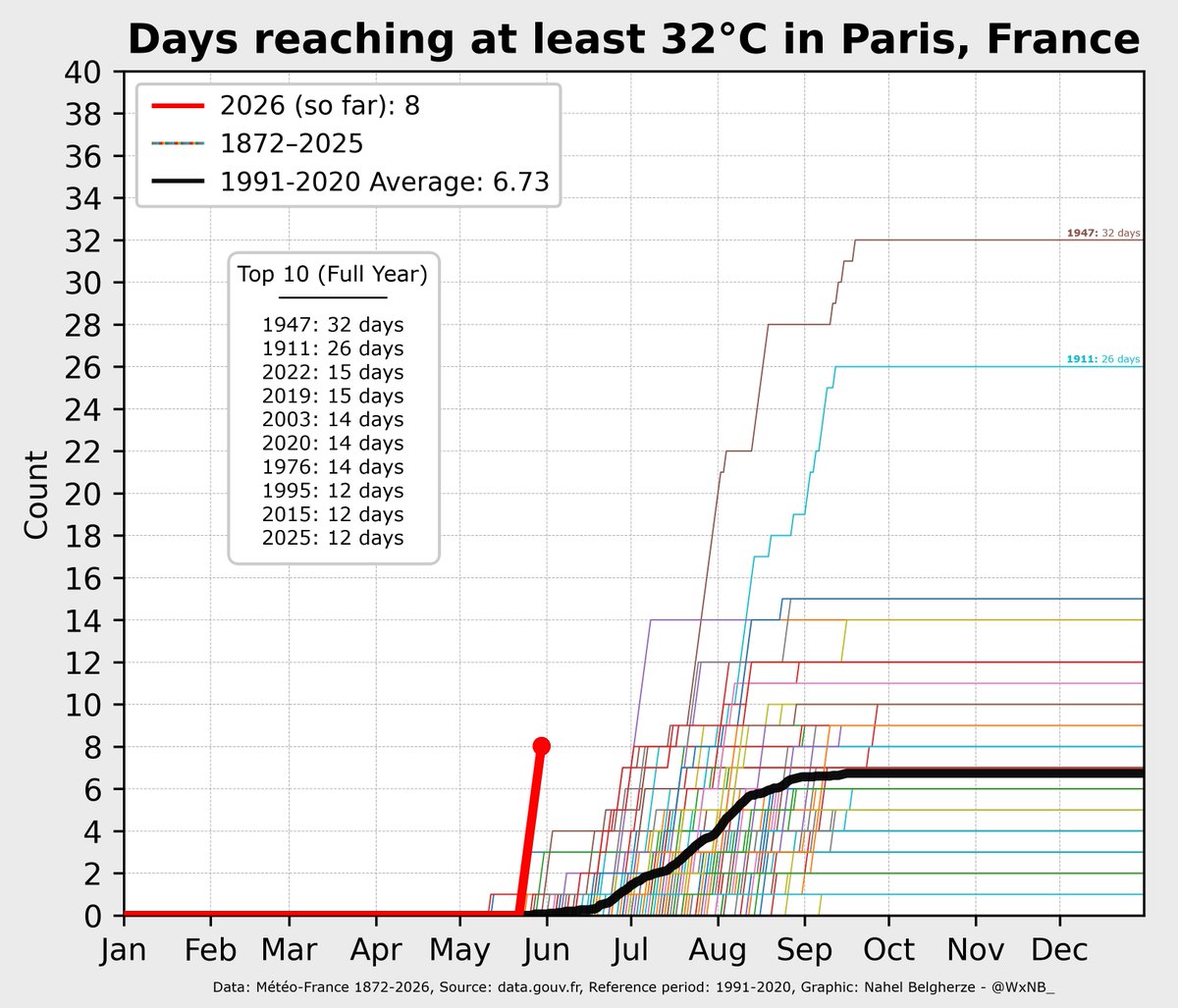
Meteorological summer hasn’t even begun, yet Paris, France has already logged more days above 32°C (89.6°F) than its annual average.
@Reporterre « Il y a une forme de fatalisme, d’abattement, de résignation face à ces vagues de chaleur. On a l’impression qu’elles nous tombent dessus, mais que l’on ne peut rien y faire. Donner aux vagues de chaleur le nom d’une entreprise permet de lutter contre cette résignation. »
Le cookie est mort alors ils ont cuisinés une nouvelle merde pour vous traquer 👉
Utiq, c'est un système de tracking qui n'a pas besoin de cookie. Il utilise votre opérateur télécom.
Le site que vous visitez transmet votre IP à Utiq. Utiq la transmet à Orange, SFR ou Bouygues. Votre opérateur crée un identifiant lié à votre numéro de téléphone. Et cet identifiant vous suit sur tous les sites partenaires.
Vider votre cache ne change rien. La navigation privée non plus. C'est cross-plateforme. Votre IP = votre identifiant publicitaire. Formidable.
Derrière Utiq, on trouve Deutsche Telekom, Orange, Telefónica et Vodafone. Les opérateurs qui transportent vos données depuis 20 ans viennent de décider qu'ils allaient aussi les monétiser.
C'est présenté comme une alternative "éthique et européenne" aux GAFAM. 😂
Vous échangez Google contre votre opérateur télécom. Qui connaît votre numéro de téléphone, votre adresse, et tout votre trafic réseau.
Cliquez sur Rejeter.
@swisscryptocat Et attends: carte journalière velo, 15chf. Monte dans le train avec ton billet pour toi + ton velo, vois que les 2 emplacements vélo pour tout le fcking train sont pris et qu'on est 5 bikes rien que dans ce hall.
Reste debout tout le trajet avec les autres cyclistes.
Catching!💲