It’s been 3.5 years since I moved to Silicon Valley. The journey in the VC space in most crowded area in the world has been teaching me countless “hard things” from just surviving here and capturing opportunities while handling stability financially and juggling multiple projects at the same time.
People call a person like me “first generation” who moves here to build up a new life in the U.S. If you ask me, my home country where I came from is Japan which is a wonderful place to grow up and live. Moving out from the comfort zone required me to downgrade many things such as housing, safety, job opportunities, recognition of education level, background or language barriers; almost resetting all of stuff I’ve built in my life.
If you met me 10 years ago, my language capabilities were limited. My experiences was almost none. I came from a humble family, small town in Japan. My parents invested all for me while they were saving the most to spend everything for education for me and my siblings. Furthermore, my dream at the time was to be an English teacher who is like my father and to get married to a boyfriend who will work at public city hall in my hometown. Then what happened after 10 years? It’s totally different landscape.
I never majored in business, but I somehow ended up working for a startup from the U.S. Why? It’s because my curiosity didn’t fit in a traditional big corporation where people kept asking me why I didn’t pick to be a sales assistant. Well, I just liked to be outgoing and speak with external clients and partners. I never ever imagined to be working in office to do admin tasks and get paid less just because of my gender. Although I have to say, the new graduate training at Japanese corps taught me a lot from business manners to mindset. They take things seriously to train new people just like a family which is very unique aspect compared to other countries as you almost don’t need any experience as long as you have motivation to learn.
When I tried to change my job for the first time, I thought about moving to San Francisco. But then, I didn’t want to downgrade the level of work. I mean I could work at Japanese restaurants, but in a reality, the cost of living is quite high. Also, I really wanted to earn some experience to be competitive enough even among the local so that hiring reason doesn’t need to be associated with only my expertise just because I’m Japanese. Although this means, the path I choose would be much harder.
In Japan, the startup I worked for eventually became unicorn in the U.S. I was fortunate to meet many US startup founders and some VCs based in the U.S. even while I was working in Tokyo. I was the third member of the team in Japan. Gladly the company is still alive @noom
After that, a person from a company reached out to me on Linkedin, looking for a person to found the team in Japan. At the time I thought the message is scam and didn’t care too much about it. I replied back to the message just in case, and briefly looked up the company. This is back in early 2017. I started helping them, and got asked to be a part of team. Although they didn’t have any corporate structure in Japan, so this is how I became a self employed. Apparently the company ranked as the best company to work in Canada in that year, and it made me feel good to work for a Canadian company after you saw how US society behaved when Trump was elected for the first time. That company I started working was @Shopify.
In the U.S. contexts, it was probably more known, but in Japan back in 2017? None. Nobody knew. My friends disagreed the idea to change job or started asking me for concert tickets since they thought I was working for @Spotify. I mean close enough. Their logos are green, and founded in the same year. I don’t know how many times I corrected the company name every time my clients called me Spotify.
Throughout the years I was working for Shopify, we moved to different offices four times in Tokyo.
Companies capture value. Networks distribute it.
For years, crypto builders had to fit network-shaped systems into company-shaped rules. CLARITY changes that.
Mira Murati says human-AI collaboration needs models that can listen while they think:
"The types of models that we work with today, they're very turn-based. You talk, they talk, then they go off and think."
"While they're thinking, it's almost like they're deaf and blind. They cannot perceive anything else about what's going on."
"By contrast, our interactions with each other are very rich. There is a lot of information in our interactions when we are silent, when we're thinking, when we're interrupting one another."
"Interaction models are able to capture all of this nuance. They're not turn-based. They're more like time-based interaction, where they're continuously taking in audio, text, video, and continuously providing output."
"This enables you to catch things like interruptions and simultaneous speech, and really create a rich, high bandwidth interaction between humans and machines."
@miramurati at Bloomberg Tech live with @emilychangtv
True wealth can be only measured in the meaning, values and the impact of building great products. User obsession. Building something not just merely liked but loved by users. It never be materialistic wealth from appearance.
Someone at the SF Standard is going to write a story about how I told people not to go to Slow Ventures Finishing School.
FWIW I really like a bunch of the people who work there, and I have no beef with Slow Ventures.
I remember when I first met Sam Lessin he asked to meet at Soho House and offered to buy Posterous. (He ran a similar seed-stage co https://t.co/jCPZ28PDFa and we thought we were peers.) We were there to make friends and were deciding whether to base it in NYC. This was some other kind of power move.
We decided SF was more our style.
You don't need finishing school. You need to build something great, make your users happy, and have craftsmanship. We're just here to make stuff. We're not here to impress anyone by how fancy our shit is.
The truly wealthy are wealthy in meaningful relationships and the outcome of actually making something people want, not bullshit appearances or impressing people or running power moves or playing zero sum dominance games.
Today, I’m excited to join Andreessen Horowitz as a General Partner and Head of Global Affairs.
This is my next chapter in the mission of securing America at home and ensuring technological innovations are adopted to keep us safe, working together with our allies to build a more secure and prosperous future.
Today, as the U.S. and China compete on the global stage, the spread of technology is tinged with geopolitics and more fragmented.
Security now requires a focus on digital sovereignty, supply chain resiliency, and the trustworthiness of the infrastructure underpinning our economies and our national security.
My full announcement:
https://t.co/GEJA7QbkNS
@garrytan The topic has been popping again even in the Japanese business media, and I just found this post. Thank you for adding your voice. Removing noise for founders is essential. I love how you focus on building great products.
BuilderShip is an AI hackathon co-hosted by @nebiusai, @composio, @tavilyai, and @openclaw. Finals are on a yacht on June 14, San Francisco Bay.
To apply: post something you've built (agent, demo, or repo) and tag all four accounts.
Every builder gets GPU credits, Token Factory inference keys, Composio integrations, Tavily search, and OpenClaw runtime from day one.
Top 30 builders make the finals. Winner takes home $50K in cloud credits and a DGX Spark.
Submit by June 12 → https://t.co/OHzftpPcva
@WeWork Please feel free to comment or share with your community if this inspires you to share your stories. Everyone has their own stories. I’d love to hear yours.
It’s been 3.5 years since I moved to Silicon Valley. The journey in the VC space in most crowded area in the world has been teaching me countless “hard things” from just surviving here and capturing opportunities while handling stability financially and juggling multiple projects at the same time.
People call a person like me “first generation” who moves here to build up a new life in the U.S. If you ask me, my home country where I came from is Japan which is a wonderful place to grow up and live. Moving out from the comfort zone required me to downgrade many things such as housing, safety, job opportunities, recognition of education level, background or language barriers; almost resetting all of stuff I’ve built in my life.
If you met me 10 years ago, my language capabilities were limited. My experiences was almost none. I came from a humble family, small town in Japan. My parents invested all for me while they were saving the most to spend everything for education for me and my siblings. Furthermore, my dream at the time was to be an English teacher who is like my father and to get married to a boyfriend who will work at public city hall in my hometown. Then what happened after 10 years? It’s totally different landscape.
I never majored in business, but I somehow ended up working for a startup from the U.S. Why? It’s because my curiosity didn’t fit in a traditional big corporation where people kept asking me why I didn’t pick to be a sales assistant. Well, I just liked to be outgoing and speak with external clients and partners. I never ever imagined to be working in office to do admin tasks and get paid less just because of my gender. Although I have to say, the new graduate training at Japanese corps taught me a lot from business manners to mindset. They take things seriously to train new people just like a family which is very unique aspect compared to other countries as you almost don’t need any experience as long as you have motivation to learn.
When I tried to change my job for the first time, I thought about moving to San Francisco. But then, I didn’t want to downgrade the level of work. I mean I could work at Japanese restaurants, but in a reality, the cost of living is quite high. Also, I really wanted to earn some experience to be competitive enough even among the local so that hiring reason doesn’t need to be associated with only my expertise just because I’m Japanese. Although this means, the path I choose would be much harder.
In Japan, the startup I worked for eventually became unicorn in the U.S. I was fortunate to meet many US startup founders and some VCs based in the U.S. even while I was working in Tokyo. I was the third member of the team in Japan. Gladly the company is still alive @noom
After that, a person from a company reached out to me on Linkedin, looking for a person to found the team in Japan. At the time I thought the message is scam and didn’t care too much about it. I replied back to the message just in case, and briefly looked up the company. This is back in early 2017. I started helping them, and got asked to be a part of team. Although they didn’t have any corporate structure in Japan, so this is how I became a self employed. Apparently the company ranked as the best company to work in Canada in that year, and it made me feel good to work for a Canadian company after you saw how US society behaved when Trump was elected for the first time. That company I started working was @Shopify.
In the U.S. contexts, it was probably more known, but in Japan back in 2017? None. Nobody knew. My friends disagreed the idea to change job or started asking me for concert tickets since they thought I was working for @Spotify. I mean close enough. Their logos are green, and founded in the same year. I don’t know how many times I corrected the company name every time my clients called me Spotify.
Throughout the years I was working for Shopify, we moved to different offices four times in Tokyo.
We were one of the early users of @WeWork in Japan before SoftBank bought out their company. The team eventually grew to 2, 5, 10, 15, 20… it was incredible experience to learn and interact thousands of different type of eCommerce businesses. So powerful to see small medium sized businesses earning more than top well known companies. My job eventually shifted to launch the Shopify partner ecosystem in Japan. Building eCommerce agencies and connecting them to
collaborate rather than being competitive.
Some U.S. eCommerce agencies moved to Japan after they saw Shopify launched the Japan office. I witnessed a company which does only Shopify related business scaled to their team to be 200 people. From 2 to 30 people. From 10 to 50 people. I saw the growth and kept thinking what would be the most effective and sustainable way to scale business.
This perspective from operational background eventually landed me to the venture capital space in the U.S. Operational background VC have some different perspectives from purely financial background investors. Some told me and tried to hire me back in Tokyo. At the time I strongly doubted the idea as I never imagine myself in that way.
But then, during the journeys to make a pivot from the first hire at Shopify Japan to something else, I thought about many path. It took time but eventually the way I invested my time to pick my full time job was almost like startup investments. The instinct from those decision making told me the possibility to work in the VC industry.
Funny enough, I found an opportunity while I was back to academia in Italy during the covid time. It eventually led me to Silicon Valley. That was January 2023. This is how I started my venture capital journey.
I don’t know how many people I encountered since I moved here. I had never been 100% surrounded by founders. But in Silicon Valley, it happens. In fact, I somehow started living with 100 startup founders and it eventually became a part of my work. 3 years living with 100 founders. Every year, I met probably 500-1000 startup founders who visit Silicon Valley back and forth.
After all, I moved up to San Francisco to merge myself into the city and more communities. This place might be most capitalistic place in the world, but I’m
curious to learn how people here make decisions. If you would like to do for bigger social impact, you gotta be good at money. This is what I was told one day. For now, my vision is to fill the gap between the founders and investors. Understanding how money flows, and make an impactful decision.
My journey just started, and because I came from non business or non tech backgrounds, I see broader perspectives from many different layers in this society. What I vision is to create a collaborative society rather than competitive. Unleashing people’s hidden potentials. Helping people to reach their goals and making them successful. This is my vision and motivation why I’m motivated to keep thriving in this space.
If anyone finds this interesting, please reach out to me for any collaboration, events or media or any project ideas. I enjoy speaking and sharing my stories or exchange ideas.
sf has tons of free events but they're buried across funcheap, eventbrite, reddit, random instagrams. i'm always looking for something fun to do in sf and i'm sure you are too!
built a map that pulls them all into one place - comedy, workshops, art openings, free food, pop-ups. updates daily... check it out! 🧡
https://t.co/j4D8U0HWfc
"@satyanadella was asked in a podcast: is AI kind of like its own species? He laughs and says no, because at the end, an AI cannot own property, cannot take liabilities, cannot enter into contracts, cannot start companies. But that's exactly what a blockchain is intended for."
Blockchains change that. @sreeramkannan on self-sovereign AI:
"A program can own property and take limited liabilities. It can start companies, DAOs. You can have a fully self-sovereign intelligence that comes packaged with a unit of money, it goes and does work and earns money — whether as an influencer, as a scientist, as a programmer, as a teacher."
"It does those jobs and earns money and uses that money to fund its future training and improvement. This is a very sci-fi forward view. But I'm talking about less than a three year time horizon to this happening."
Headless commerce was the thing. Now it’s headless merchants. All online transactions eventually come all together within the eCommerce aspects. It meets agentic payment and micro transactions. All connected.
Most people think agentic commerce = ChatGPT buying you sneakers. The bigger opportunity is headless merchants.
@nlevine19 on @TokenizedPod:
"We see a much bigger opportunity: the next class of developers who maybe have never written a line of code in their life but are coming to this through something like Claude Code or Codex. They're gonna wanna get access to a bunch of different developer tools.
"Because they're maybe building a project on a weekend, they wanna buy things on a per usage basis. And oftentimes their agents are going to ultimately be the actor that's buying.
"There's gonna be a whole new class of what we're calling headless merchants — presented as an endpoint rather than a website with a sales team and long-term contract agreements."
We’re giving away $10,000,000 to founders building agent-first businesses.
Autonomous, proactive agents will run tomorrow's companies.
We're backing 500 founders building them.
The Founding 500.
https://t.co/u8mxRWEXiT
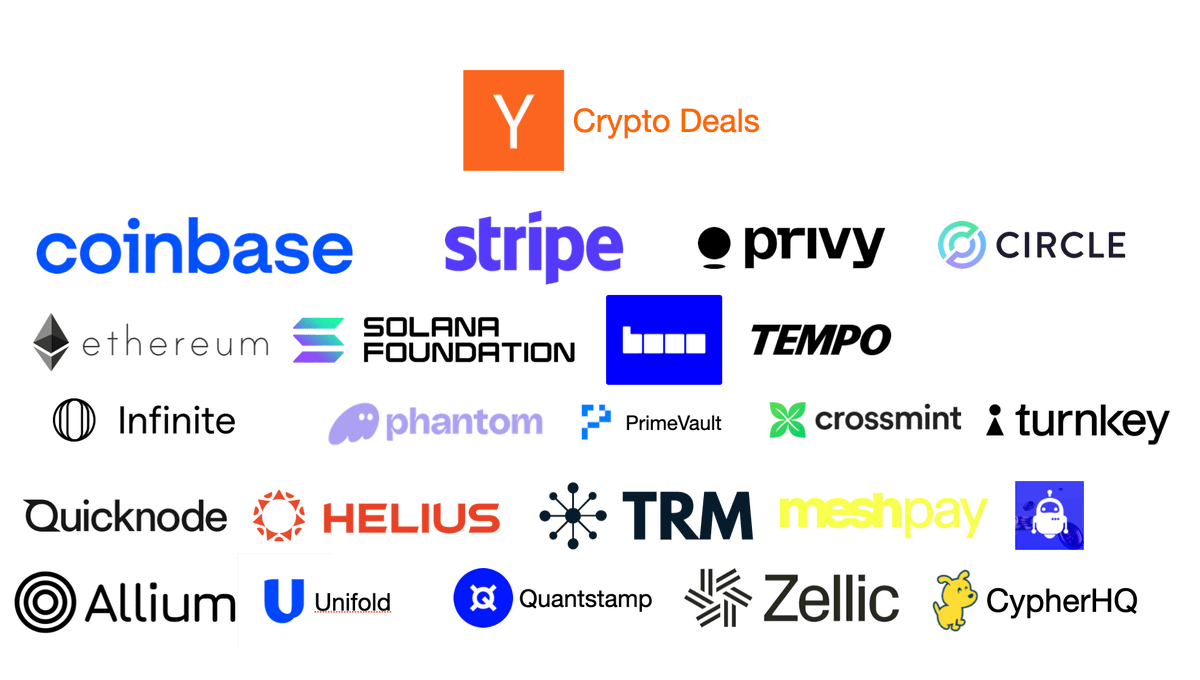
Announcing YC Crypto deals
We're now providing crypto deals to support fintech builders funded by YC: support on tools like wallets, onramps, audits, blockchains, onchain data.