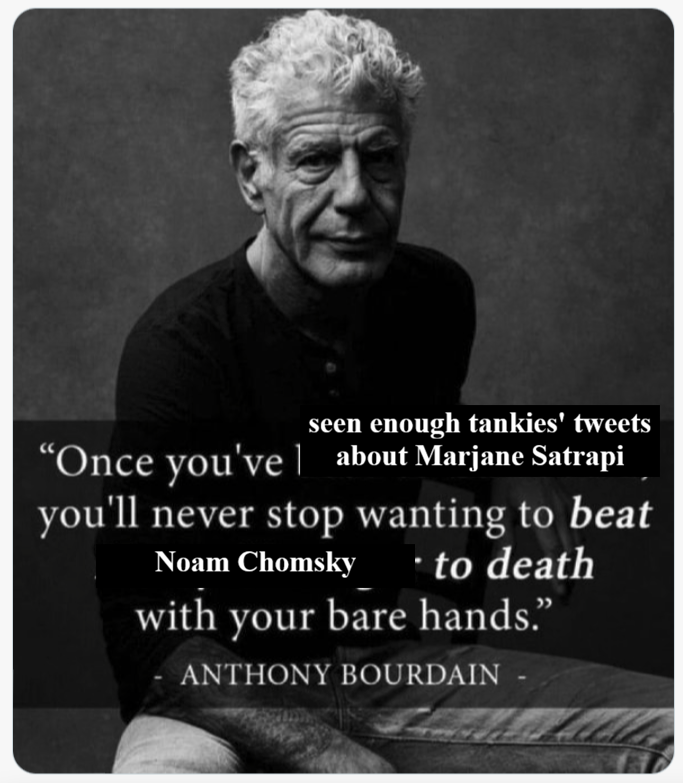
The discourse around Marjane Satrapi’s death has been vile and nauseating.
God forbid a woman with lived experience under a repressive regime writes about her experience.
Iranians are allowed to exist outside of your Israel-Palestine-Islam fantasies btw. Grow up, get educated.
I think it’s always important to share this.
Absolutely brilliant from 2014 by Joan Rivers on Israel and the “Palestinians”
No mincing of words. We really lost a real one with her.
The bit at end about Selena Gomez gets me every time 😂
The abolish police stuff was dumb, and you guys actually believed it. it wasn’t just for shock value there were many op-eds written with full elaborations of what was meant by it. But even those who talked about reform were fundamentally wrong about the topic. You all subscribe to a belief about the nature of criminality, the ability to reform, and human nature that is simply wrong. It doesn’t matter if you were talking about housing, or crime, or addiction, or public transit, you arrive at the wrong side of every issue because of these untrue foundational beliefs. They’re the poison pill that kills any idea stemming from them. Your woke 2.0 will be just as ridiculous.
A story of covid leftism that flew under the radar is that there were local punk bands all over the US that tried to play secret shows during lockdowns, and their fellow punks were ratting them out to the authorities
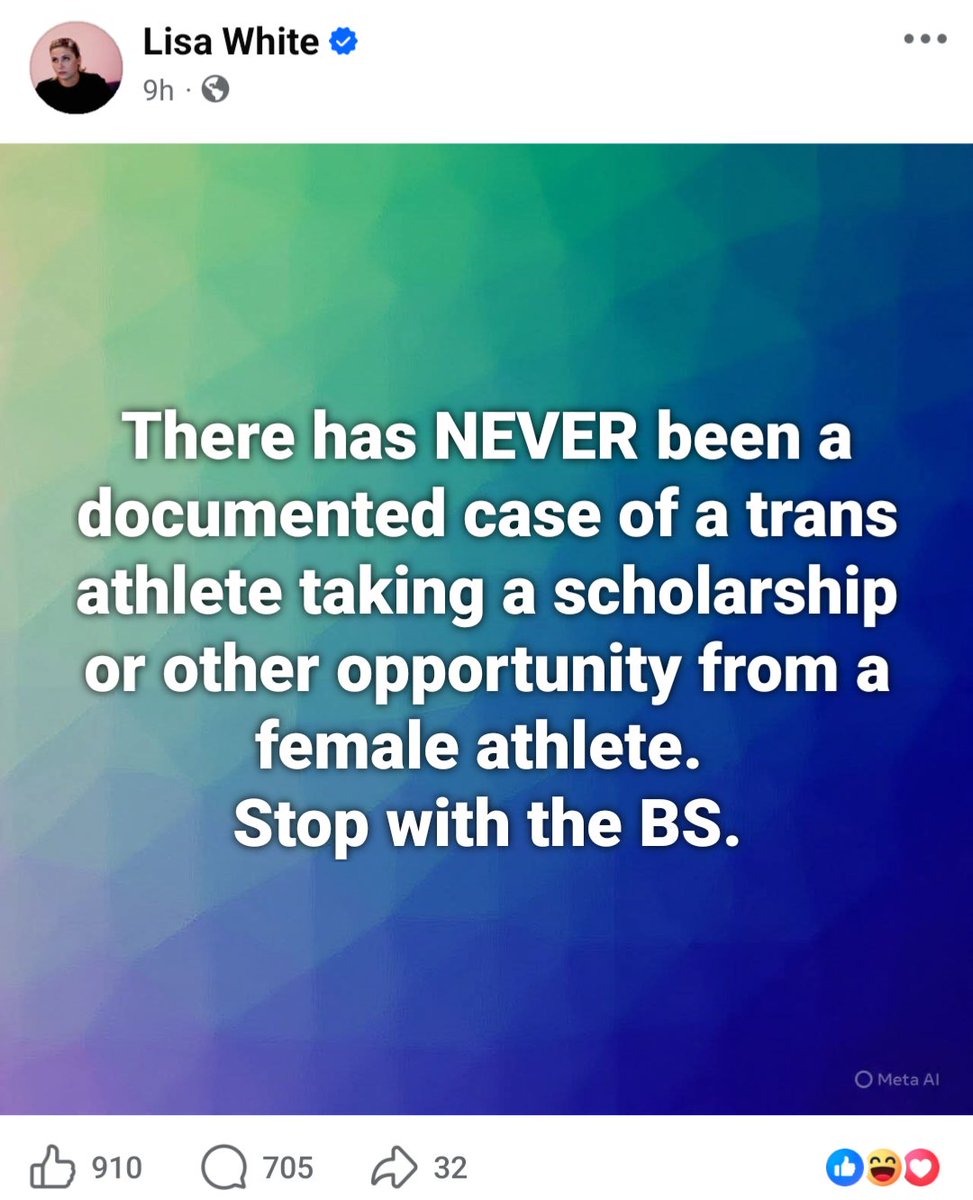
Except for the 6,346 1st place finishes and the 10,888 top three finishes that boys and men have stolen from girls and women, in well documented female sports events.
Except for the 678 well documented female records broken by boys and men, including 39 world records.
Except for the well documented 927 females who were robbed of $2,469,176 in prize money, by males.
In the spring of 2025, 12 State high School girls' championships in Maine, Massachusetts, Minnesota, California, and Washington, were won by boys. AB Hernandez was one of them, he and others struck again this year, including Becky Pepper Jackson, a boy who just won the WV State Girls' Championship in shot put.
Thousands of girls and women have been displaced in their own sports, by boys and men. Many have been sanctioned, threatened, and banned, for complaining about it.
(Numbers above are as of May 28, 2026)
The real version of this scene is worse than the movie.
In the actual event from Kyle's autobiography, insurgents killed a combatant carrying an RPG. Someone came to retrieve the launcher. Kyle shot him too. Then they sent a child. Maybe 10 or 12 years old. Kyle had the kid in his scope and a legal right to fire. Rules of engagement at the time authorized lethal force against anyone holding a crew-served weapon on sight. No warning required.
He didn't shoot. In a TIME interview years later he explained it in nine words: "That day I just couldn't kill the kid."
Eastwood changed the scene for the film. In the movie, the boy wanders over and picks up the RPG on his own, Kyle whispers "don't you pick it up," and the kid drops it. Relief. Clean resolution. The audience exhales.
In reality there was no clean resolution. The combatants deliberately used the child as a retrieval tool because they'd watched Kyle kill two adults in sequence and calculated that a sniper wouldn't shoot a 10-year-old. They were right. Kyle called it one of the hardest moments of his career. Not because he almost pulled the trigger. Because he knew the kid would probably be sent back again tomorrow.
The film made $547M worldwide on a $58M budget, became the highest-grossing war film ever released, and beat Hunger Games as the top domestic earner of 2014. Bradley Cooper got an Oscar nomination. Kyle was murdered at a Texas shooting range in 2013 before the film opened. He was 38.
The scene that traumatized audiences was the version Eastwood made less traumatizing.
ANNOUNCEMENT: WE’RE SAVING SCIENCE!
We’re often told that science is “self-correcting.”
But that’s not really true.
Science doesn’t correct itself like a thermostat adjusting the temperature in your house. Science is a human institution run by human beings. And human beings are vulnerable to career incentives, groupthink, moral fads, political pressure, and fear.
And when those forces capture academic journals, peer review stops being a filter for bad ideas and starts becoming more of a credentialing system for fashionable nonsense.
This isn’t exactly new.
In 1996, the physicist Alan Sokal managed to publish a totally gibberish article in the journal Social Text full of trendy postmodern jargon. His point was simple: if you flatter the ideological commitments of certain academic editors, nonsense can pass as real scholarship.
Two decades later, @ConceptualJames, @HPluckrose , and @peterboghossian pulled off the “grievance studies” hoax, placing over a half dozen absurd papers in peer-reviewed journals. One paper used dog parks to analyze rape culture and queer performativity. Another rewrote parts of Mein Kampf in the language of feminist theory.
The problem wasn’t just that fake papers got published. It was that they were completely indistinguishable from the real thing.
And today, the problem is even worse.
We now have serious SCIENCE journals publishing papers about feminist lesbians marrying brine shrimp. We have disturbing papers that aim to “queer” and sexualize infants. We have scholarship on “lesbian-queer-trans-canine relationalities” and “trans-dog intimacies.”
But while Clown World papers are concerning because it makes a complete mockery of academia, the same broken, ideologically captured system is also publishing research in legitimate science and medical journals that pushes sex and gender pseudoscience, relies on deeply flawed data, and influences policies on the medical transition of children and young adults.
That’s not funny. That affects real people. It affects medicine. It affects law. It affects children.
And when critics try to respond, they often discover there’s no serious mechanism for correction. Submitted Letters to the Editor often go completely ignored. Contrary evidence is rejected without comment. As a result, the best critiques are often relegated to personal blog posts, social media threads, or newspaper op-eds, while the original paper remains in the literature wearing the armor of “peer review.”
That is untenable.
So Kevin McCaffree, editor-in-chief of Theory and Society (@Theory_Society), and I decided to do something about it.
Today, in the Wall Street Journal, we announced a first-of-its-kind article type called “Peer Review.”
The idea is simple: publication should be the beginning of academic scrutiny, not the end of it.
A Peer Review article can critique a paper from any scholarly journal. It can address problems with methods, evidence, logic, definitions, theory, or interpretation. But it has to focus on the claims and arguments, not personal attacks.
Submissions are capped at 2,500 words and go through a straightforward merit review instead of endless gatekeeping and ideological screening. We ask just one basic question: Is this critique coherent, serious, reasonable, or even popular enough to deserve scholarly attention?
If yes, it gets published.
And the authors of the original paper get a built-in right of reply, so readers can see the critique and the response in a legitimate academic venue.
That’s how science is supposed to work.
Science becomes self-correcting only when real people build the mechanisms that allow correction to happen.
That’s what we’ve done.
Now it’s time for academics to use it.
Read our announcement on the @WSJ below.
🔗https://t.co/gqkDE7aaDC