You can use my Tesla referral link for free Supercharging on Model S, Model X or Model 3 Performance. You can also get a 5-year extended warranty on solar panels. https://t.co/7WM2hE8Wef
Naval Ravikant on the importance of hiring high-agency people
Naval defines agency as:
“People who just solve problems without even being asked to solve the problem—they identify the problem, they go solve it, they don’t even necessarily have to update you every step of the way, they’re not asking silly questions, and they’re just coming up with solutions.”
He believes this is important because “building a startup is an infinite set of problems that are being thrown at you.” And there comes a day where you can’t even look at every problem your company is facing—let alone solve every one of them.
He cites the Vinod Khosla aphorism:
"The team you build is the company you build, not the plan you make.”
And your ability to solve problems is based entirely on how many problem-solvers you have at your company. As Naval puts it:
“If you have somebody who takes 10% of your time and management to solve problems, you can only have 10 of those people working with you. But if somebody takes 5%, you can have 20 of those people.”
When building Airchat and AngelList, he thought of each team as a Navy Seal team:
“Everyone is just really good at what they do. They know their job. They do it. They don’t complain. They’re not egotistical about it. And if they have to constantly be corrected, led around by the nose, you have to clean up after them, or you question their judgement, it’s not going to work out.”
Source: @AngelList (Dec 2023)
Demis Hassabis just handed the future of civilization to the philosophers.
Not more engineers. Not more compute. Not more code.
A direct call to arms for the humanities.
Hassabis: “It’s very urgent that we really think about the second-order consequences. Many of you in the humanities subjects, it’s now your time in my opinion.”
The CEO of Google DeepMind. The man further down the road of artificial intelligence than almost anyone alive.
And he’s saying the next chapter doesn’t belong to him.
He laid out the exact sequence of what comes next.
First, get the technology right.
Then, rewrite the economics.
Then, face the philosophical questions about the human condition.
That third layer is where everything changes.
Because we’ve spent all of recorded history defining ourselves by what we can do. Think. Build. Solve. Create.
Intelligence was the currency. The differentiator. The thing that separated us from everything else on this planet.
And we’re about to make it abundant.
When the thing you built your entire identity around becomes something a machine does better, faster, and for free…
You don’t have a technology problem.
You have a mirror.
And the mirror is asking one question.
What are you without the doing?
Most people look at that question and see obsolescence.
Hassabis sees elevation.
Hassabis: “I’m very optimistic that we’re gonna get this right. I’m a big believer in human ingenuity, especially when the pressure’s on.”
This is not a warning about the end of the world.
It’s an invitation to build a better one.
For a century, society pushed the humanities to the margins. We prioritized the mechanics of survival over the philosophy of living.
That era is over.
When artificial intelligence automates the mechanics of survival, philosophy ceases to be a theoretical luxury.
It becomes the most critical applied science on Earth.
Algorithms cannot calculate what constitutes a virtuous life. Code cannot assign meaning.
The technologists are about to hand us infinite leverage. But infinite leverage without human direction is just chaos.
Hassabis: “Humanity has always figured it out when the chips are down. And they are now.”
The chips are down.
But that’s exactly where this species does its best work.
We spent ten thousand years building a machine that could lift the burden of basic survival.
We succeeded.
Now we finally get to figure out what it actually means to be alive.
Ronny Chieng to Harvard Class of 2026:
“I tried introducing my friend to Buddhism with Buddhism Made Simple. Instead of reading it, he asked AI to summarize it in 10 seconds. Believe it or not, he didn’t reach enlightenment.”
Speedrunning Buddhism misses the entire point.
The journey isn’t just how we acquire skills. The journey is the point.
AI gives you the summary. Real growth demands the struggle, the confusion, the reps. In the age of instant answers, choosing the harder path is how you actually build depth.
Maybe the real Harvard was the friends we made along the way, and the work we refused to outsource.
Resist the shortcut.
School taught you to memorise. Nobody ever taught you how to actually learn:
1. The Feynman technique - If you cannot explain something simply you do not understand it yet. Take any concept, strip it down to the plainest possible language and teach it out loud until every gap in your knowledge becomes obvious.
2. Deliberate practice - Repeating what you already know feels productive but changes nothing. Real learning only happens at the edge of your current ability where it is uncomfortable, slow and slightly frustrating.
3. Connecting ideas - The most powerful learners do not store information in isolation, they build webs. Every new thing you learn should be connected to something you already know and that connection is what makes it stick permanently.
4. Spaced repetition - Your brain forgets on a predictable schedule and reviewing on that same schedule rewires memory permanently. Review new material after 1 day, 3 days, 7 days and 21 days and it will stay with you for life.
5. Learning by doing - Reading about something and doing something are two completely different experiences in the brain. Start before you feel ready, make mistakes in real conditions and learn faster than anyone who is still just preparing.
6. Deep focus blocks - Shallow distracted learning is almost entirely wasted time. 90 minutes of complete undivided attention will always teach you more than 4 hours of half focused studying with a phone nearby.
7. Teaching others - The moment you try to teach something is the moment you discover exactly what you do not know. Find someone to explain your learning to regularly and your understanding will compound faster than any course ever promised.
Steve Jobs did not become a billionaire from Apple. He became one from a company he spent years trying to get rid of.
The company was Pixar.
In 1986, nine months after Apple forced him out, Jobs bought a small computer graphics division off George Lucas for ten million dollars. Five million to Lucas, five million in working capital. He renamed it Pixar and set out to sell high-end graphics computers.
The computers did not sell. The flagship machine cost a hundred and thirty five thousand dollars and found almost no buyers outside a few hospitals and government labs. The hardware business lost money, and Jobs eventually sold it off cheap.
What was left was a small group of animators making short films that won awards, including an Oscar, and earned almost nothing.
So Jobs paid for it himself. Year after year he covered Pixar's losses out of his own pocket, writing personal checks to keep the doors open. Over roughly nine years it came to an estimated fifty million dollars of his own money, poured into a company that lost money almost every single year.
He tried to get out. He shopped Pixar to Microsoft. To Paul Allen. To Hallmark. To Larry Ellison. He came within days of shutting the whole thing down.
He said it plainly later. "If I knew in 1986 how much it was going to cost to keep Pixar going, I doubt if I would have bought the company."
This is the man we now hold up as the great visionary, the one who could see what was coming. For nine years he could not tell whether the thing in his hands was worth anything, and most of the time he bet it wasn't.
In 1991, Disney agreed to fund and distribute a few of Pixar's films. The first one took four years to make.
It came out in November 1995. Toy Story. The first full-length computer-animated film ever made, and an enormous hit.
A week later, Pixar went public. Jobs had pushed the bankers to price the stock higher than they wanted. It opened at forty seven dollars a share, the largest public offering of the year. By the end of the first day, his stake was worth about one and a quarter billion dollars.
He owned roughly eighty percent of a company he had spent a decade trying to give away.
One of the men he'd tried to sell Pixar to was Larry Ellison. The night of the IPO, Jobs called him and said, "I made it."
Eleven years later Disney bought Pixar outright for seven and a half billion dollars, and Jobs became the largest single shareholder in Disney.
You can't tell your best decision from your worst while you're still paying for it. The bill comes first. The verdict comes years later, and it rarely matches what you believed while you were signing the checks.
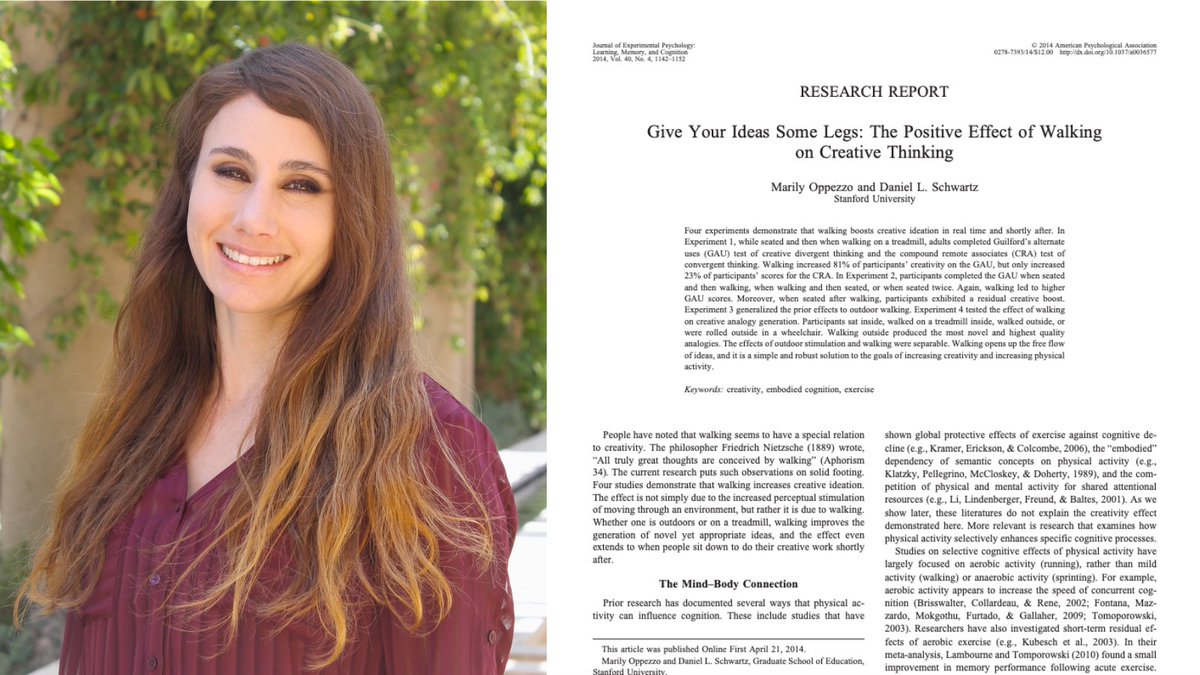
A Stanford psychologist spent 4 years proving that the simple act of walking generates 60% more creative ideas than sitting, and the experiment she designed to kill every alternative explanation is one of the most decisive findings in modern psychology.
Her name is Marily Oppezzo.
She got the idea for the study while walking with her advisor at Stanford to discuss her thesis topic, and the paper she eventually published in the Journal of Experimental Psychology in 2014 is sharp enough that it should have ended the seated meeting on the day it came out.
She ran 4 experiments on 176 people. Same person tested twice. Once sitting, once walking. The creativity tasks were the standard ones psychologists have used for decades to measure how good a brain is at generating novel useful ideas.
The result was almost too clean to publish.
81% of participants in the first experiment produced more creative ideas while walking than while sitting. In the second experiment, 88%. In the third, 100%. Every single person walked into a more creative version of themselves.
On average, people generated 60% more novel useful ideas the moment their legs started moving.
The skeptical question is the obvious one. Maybe it was the fresh air. Maybe it was the scenery passing by. Maybe it was the change of environment doing the work, not the walking itself.
Oppezzo killed every one of those explanations with one experimental decision.
She put people on a treadmill facing a blank wall. No scenery. No fresh air. No environmental change. Just legs moving in place while staring at white drywall. The 60% boost held.
Then she ran the experiment that closed the case completely. She took participants outside in two conditions. Half of them walked through a Stanford courtyard. The other half were pushed through the exact same courtyard in a wheelchair. Same outdoor stimulation. Same scenery passing at the same speed. The only difference was whether the legs were moving.
The walkers produced dramatically more novel high-quality ideas than the wheelchair group. The outdoors did almost nothing on its own. The walking did everything.
This is the part of the study that hit hardest when I read it the first time.
She also tested the opposite kind of thinking. Convergent thinking. The kind where there is one right answer and you have to narrow down to it.
Word puzzles where 3 words share a hidden fourth word that connects them. The seated participants did slightly better on these. Walkers got slightly worse.
Walking is not a general intelligence enhancer. It does one specific thing. It opens up the divergent search inside your brain. The part that generates options. The part that produces unexpected connections. The part that takes a problem and finds five ways into it instead of one.
When you need to converge on the single right answer, sit down. When you need to find the answer in the first place, get up.
The mechanism is now well understood. Walking selectively activates what neuroscientists call the default mode network, the system inside your brain that runs when you are not consciously focused on anything. The DMN is where mind-wandering happens. Where memories cross-reference each other. Where ideas that have been sitting in separate folders inside your head finally bump into each other.
When you sit at a desk and force yourself to concentrate, you suppress the DMN. When you walk at a natural pace, the executive part of your brain gets just busy enough handling the walking that the DMN comes online and starts doing the work that focus was blocking.
The most useful finding in the entire paper is the one almost nobody quotes.
The boost did not turn off the moment people stopped walking. Participants who walked first and then sat back down stayed elevated. Their next round of seated creativity work was still significantly better than people who had been sitting the whole time. The rest lingered for at least several minutes after the legs stopped moving.
You do not need to do creative work while walking. You need to walk before the creative work. The brain holds the state.
The history of this is the part that should haunt anyone who still does meetings in chairs.
Charles Darwin built a gravel loop behind his house in Kent called the Sandwalk and walked it 3 times a day for the rest of his life. The theory of evolution was developed one lap at a time on that path.
Nietzsche walked up to 10 hours a day during the years he wrote his most important books and openly said the work was conceived on his feet.
Beethoven composed for the morning and walked for 5 hours every afternoon with a pencil in his pocket for when something landed.
Kahneman said the best thinking of his Nobel Prize-winning career happened on leisurely walks with Amos Tversky. Steve Jobs refused to take important conversations sitting down. He held them on foot.
Every one of them was using the system Oppezzo would not measure until 2014. They just did not know what to call it.
The question worth sitting with is the one almost nobody asks.
Every meeting you have ever attended sitting around a table was a meeting held at a fraction of the brain power that was actually available to the people in the room. Every brainstorm that got stuck inside a conference room. Every problem you tried to solve at a desk and gave up on. Every idea you could not quite get to.
The intervention is the easiest one in modern science. No supplement. No app. No subscription. No training program. Just a pair of legs and 15 minutes.
The Stanford lab proved it. The philosophers knew it. The neuroscience explains it.
And almost everyone reading this is still trying to think their way out of problems sitting completely still.
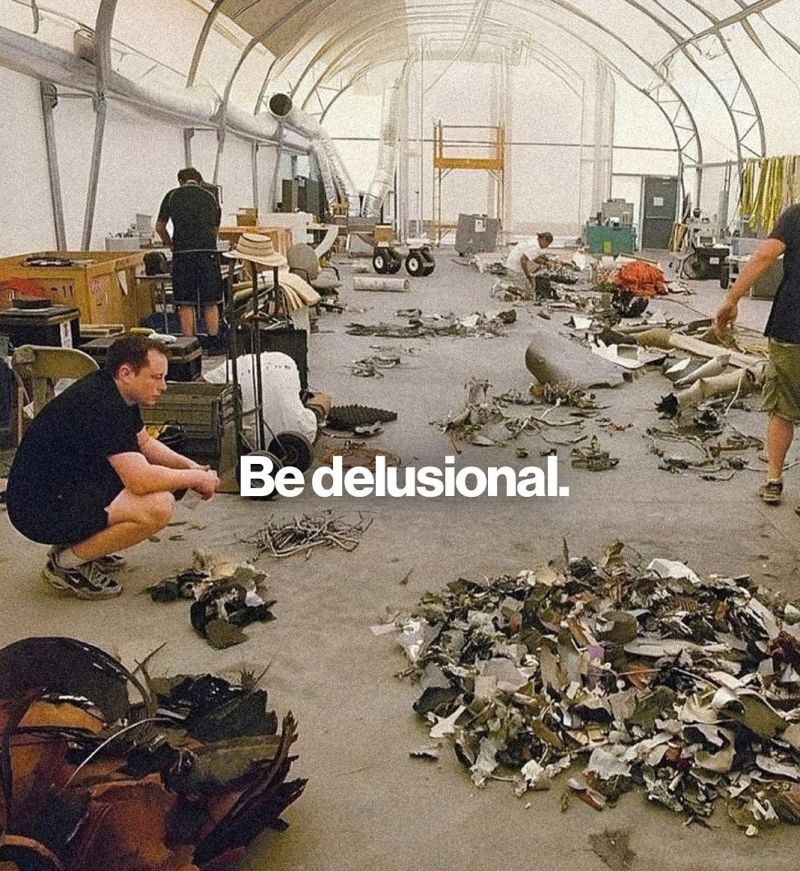
In December 2008, Elon Musk gave Tesla the last money he had. The wire went through at six in the evening on Christmas Eve.
A few hours later and the payroll checks would have bounced.
He'd sold PayPal in 2002 and walked away with about 180 million dollars. He did almost none of the things a person does with 180 million dollars. He put it into a rocket company and a car company, two industries with almost no history of outsiders winning, and then 2008 arrived and started draining what was left.
By the end of the year he was down to a few hundred thousand dollars and borrowing money from friends to make rent. His marriage had fallen apart that year too.
Two companies. Both nearly out of cash. The same month.
The rockets had failed first.
SpaceX had one product, a small rocket called the Falcon 1, and only enough money to fly it three times. That was the whole budget.
The first one caught fire and fell back to the pad. The second reached space and lost control before orbit. The third separated cleanly, and then the spent first stage drifted back up and tapped the second one... a timing error on a new engine, and the rocket was gone.
Three launches, three failures, no money left.
He built a fourth out of the scraps and put the last of the cash on it.
It launched on September 28, 2008, from a small island in the Pacific, and reached orbit. The first privately built liquid fueled rocket that ever had. He said afterward it was the last money they had, and a fourth failure would have ended the company that night.
It didn't save Tesla.
Tesla had been about to close a hundred million dollar round that summer when the banks collapsed and credit froze. A tiny car startup raising money while General Motors itself slid toward bankruptcy had almost no chance. It was burning cash, had no car in real production, and was days from missing payroll.
So he took over as CEO. He put in his last dollars. He talked the existing investors into restructuring the round as debt to get past the one who was blocking it.
That deal closed at six on Christmas Eve. He gave Tesla the last of his cash and, in his words, "didn't even own a house or anything sellable."
The day before, NASA had called SpaceX with a 1.6 billion dollar contract to carry cargo to the space station. He said he could barely hold the phone.
Two companies pulled back from the edge in 48 hours, at the bottom of the worst year of his life.
People look at Musk now and argue about genius. The genius was already there through all three failures, and it didn't save him.
What saved him was a choice he'd made months earlier, when the money was running out. He could have put everything left into one company and let the other one die. That was the sane move. He split his last dollars between both instead, knowing it could mean losing both.
He said later it nearly gave him a breakdown, and that it could have killed both companies at once.
Most people fold at zero for three.
He paid for the fourth and... it worked.
Trust is built around (1) competence, (2) transparency, (3) I've-got-your-back/kindness, (4) sacrifice. AI can only do the first three (when competently programmed).
🚨 FORMER TESLA PRESIDENT ADMITS ELON USED THE DOMINO’S PIZZA APP TO REINVENT HOW PEOPLE BUY CARS — AND THE STORY IS BLOWING PEOPLE’S MINDS
Former Tesla president Jon McNeill is going viral after revealing the bizarre moment Elon Musk pulled up the Domino’s pizza app during a meeting… because Tesla customers needed 64 CLICKS just to buy a car online.
Elon’s reaction?
“How many taps does it take to get a pizza?”
Answer:
• 10 taps
Buying a Tesla at the time?
• 64 clicks
• endless loan documents
• nonstop forms
• massive friction
Elon became obsessed with stripping the process down after realizing most of the paperwork wasn’t even legally required.
So Tesla started going bank-to-bank asking:
Why does buying a car need to feel harder than ordering dinner?
Most banks reportedly refused to cooperate.
Then one Midwest bank CEO finally agreed to test a radically simplified system… and Tesla allegedly eliminated around 40 clicks from the process almost overnight.
Now people online are saying this perfectly explains why Tesla disrupted the entire auto industry while traditional dealerships kept drowning customers in paperwork, waiting rooms, and sales tactics.
Did Tesla accidentally expose how outdated the entire car dealership model really was?
📹: kencoleman
When I was Muslim, man, this verse used to mess me up.
Jesus on the cross saying, “My God, my God, why have you forsaken me?”
As a Muslim, I used to think: how does God feel forsaken by God? That sounds like weakness. That sounds like a prophet in pain.
But then I dug deeper.
And I realized Jesus was not speaking randomly. He was quoting Psalm 22.
That entire Psalm, written by King David centuries before Christ, is a prophecy about the crucifixion:
“They pierce my hands and feet.”
“They divide my garments among them.”
“All who see me mock me.”
In Jewish culture, quoting the first line of a Psalm pointed people to the entire passage.
So Jesus was not crying out in confusion.
He was declaring fulfillment.
He was saying: “This is that.”
And at the same time, He was carrying the full weight of sin, shame, abandonment, and suffering for humanity.
Every moment humanity has cried out, “God, where are you?” Christ stepped into that pain Himself.
That is not weakness.
That is intentional.
That is prophecy unfolding in real time.
That is the King bleeding on purpose so humanity could be brought near to God.
That is the Gospel.
🚨GOOGLE JUST SILENTLY DOWNLOADED A 4GB AI MODEL TO YOUR COMPUTER WITHOUT ASKING.. WITHOUT TELLING YOU.. AND WITHOUT ANY WAY TO STOP IT..
If you use Chrome.. There's a good chance a 4 gigabyte file is sitting on your hard drive right now that you never agreed to download..
It's called Gemini Nano.. Google's on-device AI model.. A security researcher just proved it installs itself with zero clicks.. Zero prompts.. Zero notifications..
Alexander Hanff set up a completely fresh Chrome profile.. Didn't click anything.. Didn't scroll.. Didn't type a single keystroke.. Just opened the browser and watched..
14 minutes and 28 seconds later.. Chrome had silently scanned his hardware.. Read his GPU, RAM, and storage.. Then wrote a 4GB file to his hard drive.. No permission dialog.. Nothing..
Chrome's own logs show the download begins BEFORE the settings page where you could opt out is even loaded.. The file starts installing before the refusal button exists..
As of Chrome 148.. Any website you visit can trigger this download.. One line of JavaScript.. You click a link to read a blog post.. That click counts as "user activation".. And Chrome silently pulls 4GB in the background..
No install prompt.. No consent dialog.. Google's own docs admit this..
Your laptop overheats.. Storage disappears.. Battery drains.. And you have no idea why..
The model doesn't even work well.. Cloud requests take 1.3 seconds.. The local model at worst case takes over 9 minutes for a single response..
Google is using your storage, electricity, and bandwidth to run an AI that's 40 times slower than their own servers..
And the "AI Mode" button in Chrome's address bar.. Doesn't even use the local model.. It sends everything to Google's cloud anyway..
You pay the storage penalty.. The heat penalty.. The bandwidth penalty.. And the visible AI feature ignores the local file entirely..
Because Chrome fails to clean up old versions.. Users are finding 12GB or more of duplicate AI files stacked on their drives..
Palo Alto Networks found a vulnerability where a browser extension could hijack the local AI model's permissions.. Accessing your webcam.. Microphone.. Local files.. Through an AI you never installed..
Here's how to check if it's on your machine..
Windows.. C:\Users\[YourName]\AppData\Local\Google\Chrome\User Data\Default\OptGuideOnDeviceModel\
Mac.. ~/Library/Application Support/Google/Chrome/Default/OptGuideOnDeviceModel/
If there's a file called weights.bin.. Google downloaded their AI to your computer without asking..
To stop it.. Type chrome://flags.. Search "optimization-guide-on-device-model" and disable it.. Search "prompt-api-for-gemini-nano" and disable that too.. Restart Chrome.. Then manually delete the folder..
If you don't disable the flags first.. Chrome redownloads the 4GB file on next launch..
Firefox requires explicit opt-in for AI.. Apple Intelligence requires explicit consent.. Chrome just takes your hard drive..
Google didn't ask to use your storage.. Your electricity.. Your bandwidth..
They just took it.




![EvanLuthra's tweet photo. 🚨GOOGLE JUST SILENTLY DOWNLOADED A 4GB AI MODEL TO YOUR COMPUTER WITHOUT ASKING.. WITHOUT TELLING YOU.. AND WITHOUT ANY WAY TO STOP IT..
If you use Chrome.. There's a good chance a 4 gigabyte file is sitting on your hard drive right now that you never agreed to download..
It's called Gemini Nano.. Google's on-device AI model.. A security researcher just proved it installs itself with zero clicks.. Zero prompts.. Zero notifications..
Alexander Hanff set up a completely fresh Chrome profile.. Didn't click anything.. Didn't scroll.. Didn't type a single keystroke.. Just opened the browser and watched..
14 minutes and 28 seconds later.. Chrome had silently scanned his hardware.. Read his GPU, RAM, and storage.. Then wrote a 4GB file to his hard drive.. No permission dialog.. Nothing..
Chrome's own logs show the download begins BEFORE the settings page where you could opt out is even loaded.. The file starts installing before the refusal button exists..
As of Chrome 148.. Any website you visit can trigger this download.. One line of JavaScript.. You click a link to read a blog post.. That click counts as "user activation".. And Chrome silently pulls 4GB in the background..
No install prompt.. No consent dialog.. Google's own docs admit this..
Your laptop overheats.. Storage disappears.. Battery drains.. And you have no idea why..
The model doesn't even work well.. Cloud requests take 1.3 seconds.. The local model at worst case takes over 9 minutes for a single response..
Google is using your storage, electricity, and bandwidth to run an AI that's 40 times slower than their own servers..
And the "AI Mode" button in Chrome's address bar.. Doesn't even use the local model.. It sends everything to Google's cloud anyway..
You pay the storage penalty.. The heat penalty.. The bandwidth penalty.. And the visible AI feature ignores the local file entirely..
Because Chrome fails to clean up old versions.. Users are finding 12GB or more of duplicate AI files stacked on their drives..
Palo Alto Networks found a vulnerability where a browser extension could hijack the local AI model's permissions.. Accessing your webcam.. Microphone.. Local files.. Through an AI you never installed..
Here's how to check if it's on your machine..
Windows.. C:\Users\[YourName]\AppData\Local\Google\Chrome\User Data\Default\OptGuideOnDeviceModel\
Mac.. ~/Library/Application Support/Google/Chrome/Default/OptGuideOnDeviceModel/
If there's a file called weights.bin.. Google downloaded their AI to your computer without asking..
To stop it.. Type chrome://flags.. Search "optimization-guide-on-device-model" and disable it.. Search "prompt-api-for-gemini-nano" and disable that too.. Restart Chrome.. Then manually delete the folder..
If you don't disable the flags first.. Chrome redownloads the 4GB file on next launch..
Firefox requires explicit opt-in for AI.. Apple Intelligence requires explicit consent.. Chrome just takes your hard drive..
Google didn't ask to use your storage.. Your electricity.. Your bandwidth..
They just took it.](https://pbs.twimg.com/media/HHllpnRbUAA7IOT.jpg)




![EvanLuthra's tweet photo. 🚨GOOGLE JUST SILENTLY DOWNLOADED A 4GB AI MODEL TO YOUR COMPUTER WITHOUT ASKING.. WITHOUT TELLING YOU.. AND WITHOUT ANY WAY TO STOP IT..
If you use Chrome.. There's a good chance a 4 gigabyte file is sitting on your hard drive right now that you never agreed to download..
It's called Gemini Nano.. Google's on-device AI model.. A security researcher just proved it installs itself with zero clicks.. Zero prompts.. Zero notifications..
Alexander Hanff set up a completely fresh Chrome profile.. Didn't click anything.. Didn't scroll.. Didn't type a single keystroke.. Just opened the browser and watched..
14 minutes and 28 seconds later.. Chrome had silently scanned his hardware.. Read his GPU, RAM, and storage.. Then wrote a 4GB file to his hard drive.. No permission dialog.. Nothing..
Chrome's own logs show the download begins BEFORE the settings page where you could opt out is even loaded.. The file starts installing before the refusal button exists..
As of Chrome 148.. Any website you visit can trigger this download.. One line of JavaScript.. You click a link to read a blog post.. That click counts as "user activation".. And Chrome silently pulls 4GB in the background..
No install prompt.. No consent dialog.. Google's own docs admit this..
Your laptop overheats.. Storage disappears.. Battery drains.. And you have no idea why..
The model doesn't even work well.. Cloud requests take 1.3 seconds.. The local model at worst case takes over 9 minutes for a single response..
Google is using your storage, electricity, and bandwidth to run an AI that's 40 times slower than their own servers..
And the "AI Mode" button in Chrome's address bar.. Doesn't even use the local model.. It sends everything to Google's cloud anyway..
You pay the storage penalty.. The heat penalty.. The bandwidth penalty.. And the visible AI feature ignores the local file entirely..
Because Chrome fails to clean up old versions.. Users are finding 12GB or more of duplicate AI files stacked on their drives..
Palo Alto Networks found a vulnerability where a browser extension could hijack the local AI model's permissions.. Accessing your webcam.. Microphone.. Local files.. Through an AI you never installed..
Here's how to check if it's on your machine..
Windows.. C:\Users\[YourName]\AppData\Local\Google\Chrome\User Data\Default\OptGuideOnDeviceModel\
Mac.. ~/Library/Application Support/Google/Chrome/Default/OptGuideOnDeviceModel/
If there's a file called weights.bin.. Google downloaded their AI to your computer without asking..
To stop it.. Type chrome://flags.. Search "optimization-guide-on-device-model" and disable it.. Search "prompt-api-for-gemini-nano" and disable that too.. Restart Chrome.. Then manually delete the folder..
If you don't disable the flags first.. Chrome redownloads the 4GB file on next launch..
Firefox requires explicit opt-in for AI.. Apple Intelligence requires explicit consent.. Chrome just takes your hard drive..
Google didn't ask to use your storage.. Your electricity.. Your bandwidth..
They just took it.](https://pbs.twimg.com/media/HHllsTWaYAA1fe0.jpg)


