An LLM workflow that reproduces, improves, and extends economics research has been applied to over 4,000 published replication packages, from Matthew Schwartz, Isaiah Andrews, and Jesse M. Shapiro https://t.co/jrWNP9wOlf
Okay, it's been 3 months since I took the plunge into Claude Code and 2 months since I created Claude Blattman to help other non-coding, non-technical, forever-behind people like myself learn how to use these tools. This is a
Here's what I've developed and created since then. 🧵
I am sharing a set of slides from my lecture on agentic AI tools for Applied Economists at @penn_state. Materials are available here: https://t.co/2tcpPY4uhS
This builds on this thread and great work by Paul Goldsmith-Pinkham, @aniketapanjwani, and @VelikovMihail
4w ago I was a Claude Code skeptic. I'm not a coder. None of the use cases were relevant. I managed teams & projects, drowning in email & overdue reminders. So I tried creating tools that would help me and... holy crap.
Now I'm sharing the tools I built:
https://t.co/5z9nDcwVno
Making a list of a hundred papers in economics which fill me with wonder, joy, and excitement. Your suggestions are urgently solicited, my memory is not infallible and I'd like to make this really good.
https://t.co/V3rzW1bZgZ
Skills do not evolve as higher levels of a fixed set of abilities. New skills emerge with development, from James J. Heckman, Haihan Tian, Jin Zhou, and Zijian Zhang https://t.co/fTe1KPFS8z
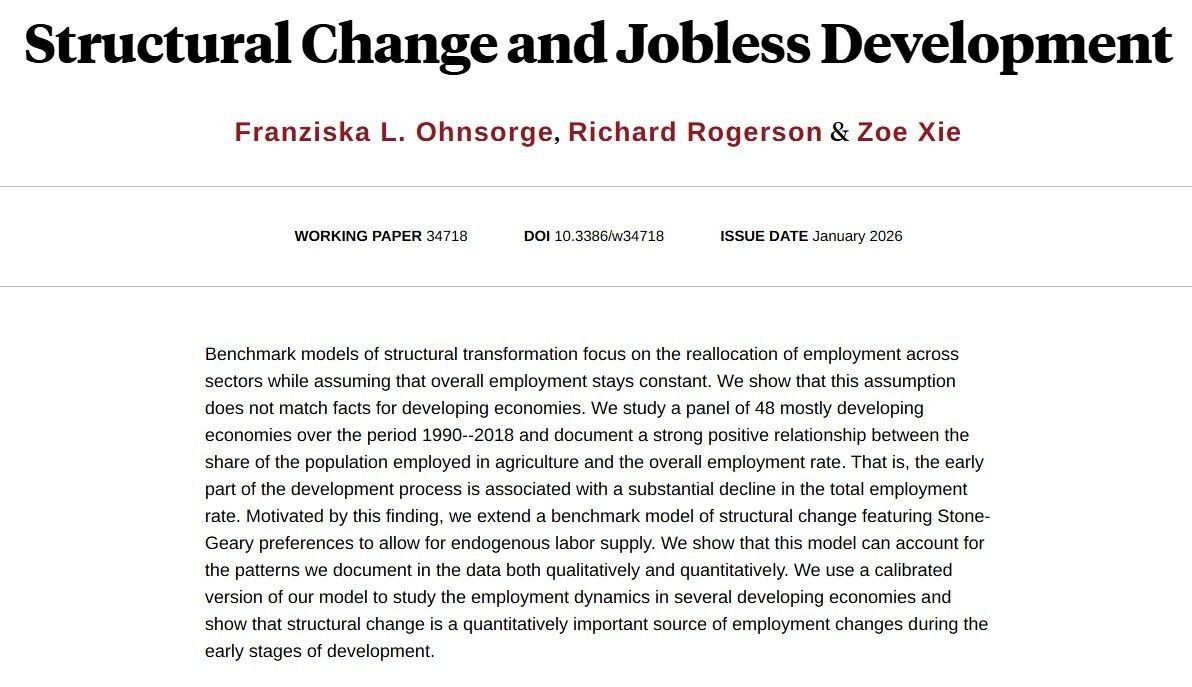
Structural change is associated with substantial declines in employment, from Franziska L. Ohnsorge, Richard Rogerson, and Zoe Xie https://t.co/urwlujPrqs
New survey evidence on how household spending changes in response to fiscal transfers, from @eichmartin, @jptguerreiro, and Jana Obradovic https://t.co/QiVJY37zEv
Discussing the distinctive concerns of household finance in relation to other fields of financial economics, and outlining directions for the future growth of the field, from John Y. Campbell and @TRamadorai https://t.co/Oq7tDSiKGF
A persistent puzzle in development economics is why calorie consumption has fallen among India's poorest despite ⬆️ incomes & ⬇️ poverty rates.
Today's article shows that rising inequality is a big part of the answer - inequality alters what poor households perceive as necessary
Dynamic comparative advantage is important for occupational choice and inequality, from Andrés Erosa, @Luisa_Fuster, @gkambourov, and Richard Rogerson https://t.co/4ilAlub6TZ
🚨 Job Market Paper 🚨
Wealth Inequality and Labor Mobility: The Job Trap
Does wealth affect workers’ ability to move to better jobs? Why do some remain stuck with low wages?
My answer: The Job Security Premium
Paper: https://t.co/PB3iKxtsju
1/12 #EconTwitter#EconJobMarket
It's job market season for PhD economists, and my inbox is filling up with requests for advice. Given the tight PhD job market this year, I understand why people are seeking guidance wherever they can find it.
But let's be honest: I'm probably the last person you should ask. My job market record speaks for itself—150 applications, one interview. Not exactly the success story you'd want to emulate!
That said, my abysmal experience sparked curiosity: what does determine who gets interviews? The year after my job market, I channeled my frustration into research. I went to the AEA meetings, collected data, and published the results here: https://t.co/ypid6BuUlF
So while I can't offer personal success secrets, I can offer data. I usually like that better anyways!
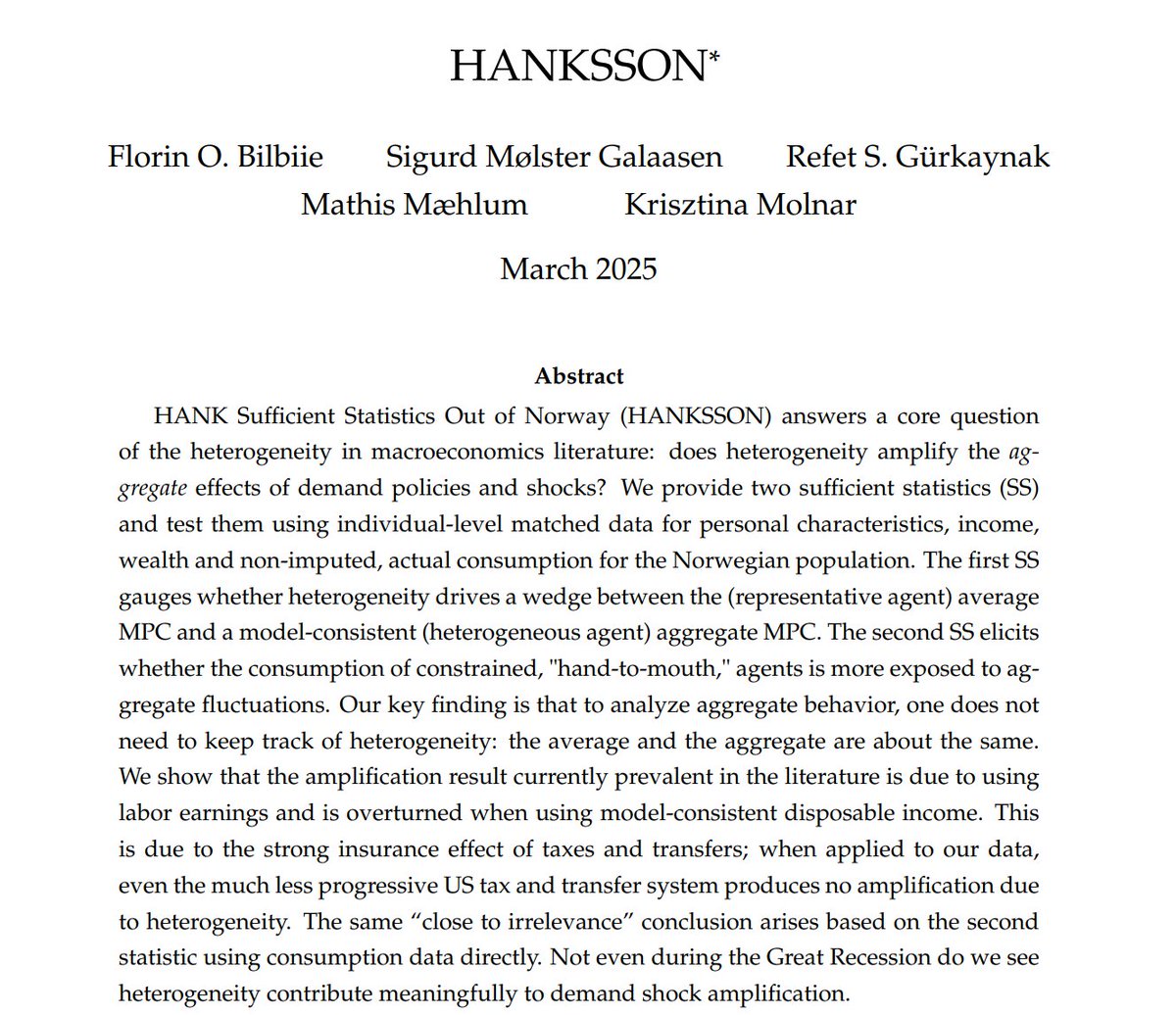
In one of the more jaw-dropping papers of the year, these economists used the complete consumption data of every single person in Norway from 2006-2018 to answer the biggest question in contemporary macroeconomics: how much does inequality matter? Maybe -- not so much! 1/
A study how parents respond to children’s genetic endowments and to sibling differences in endowments. In the September issue, by Anna Sanz-de-Galdeano and Anastasia Terskaya @Asia_terskaya https://t.co/44P8Uz0WMj
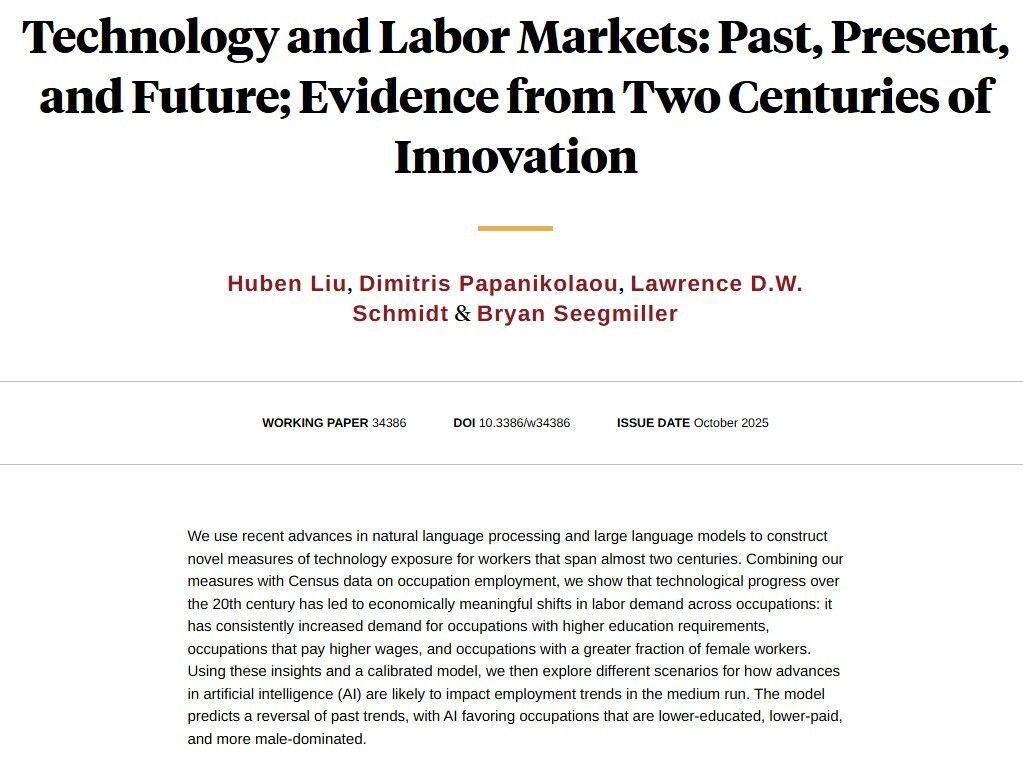
Technological progress over the 20th century has consistently increased demand for occupations with higher education requirements, occupations that pay higher wages, and occupations with a greater fraction of female workers, from Huben Liu, @DimitrisPapan20, @L_Schmidt_Econ, and Bryan Seegmiller https://t.co/tcDZLFXmwc
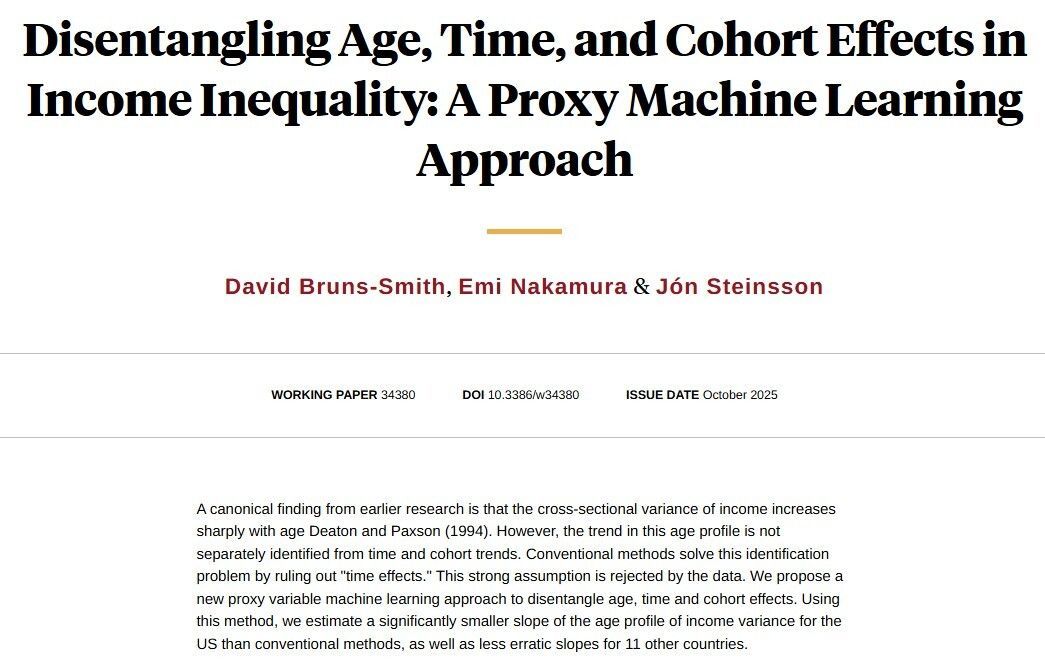
A new approach to handling the age-time-cohort problem based on proxy variables and machine learning, from David Bruns-Smith, @eminakamura2, and @JonSteinsson https://t.co/3vjfrFk8on
I’ve started an ongoing project to collect all the datasets which economists can use, all in one place, organized by topic. Started with 50, further suggestions are extremely welcome. It will grow considerably.