JUST IN: 🇺🇸 Senator Cynthia Lummis says "Some community banks are suggesting stablecoins are driving deposit flight. The data says otherwise." 👀
"Killing the Clarity Act won’t help community banks. It just protects the status quo they say is broken."
Pass it in September 👏
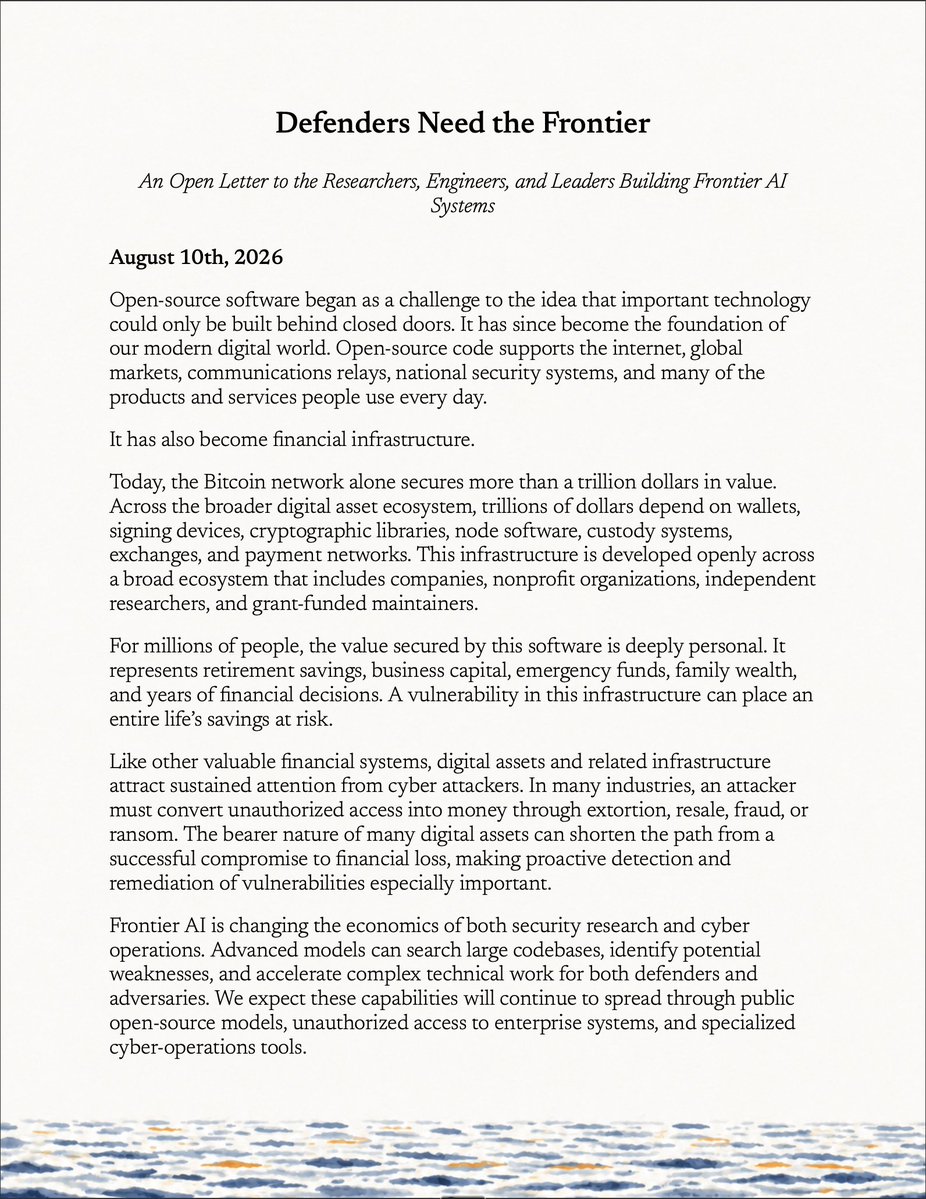
Today, Bitcoin Policy Institute and a broad coalition from across the digital-asset ecosystem are publishing an open letter calling on the world’s leading AI labs to provide qualified open-source defenders with trusted access to frontier AI models.
The past several weeks have made the need for this abundantly clear. The people defending digital-asset infrastructure and open-source software need access to the latest AI capabilities to perform comprehensive security reviews and stay ahead of increasingly sophisticated adversaries.
The coalition includes open-source development organizations, major custodians, treasury companies, payment services, security firms, capital allocators, and others whose businesses and customers depend on the integrity of open-source infrastructure and libraries.
Open-source defenders often occupy the least privileged position in the AI security landscape. They have limited access to the strongest internal cyber models and are frequently blocked by guardrails when using publicly available frontier systems for legitimate security research. As a result, they often resort to less capable open-weight alternatives.
We are urging frontier AI labs to establish a clear, trusted pathway for qualified open-source and digital asset defenders to access their strongest capabilities, with sufficient compute and secure environments to conduct meaningful security reviews. Frontier AI could become one of the most powerful defensive technologies ever developed, but only if defenders get fair access to those systems.
It’s time to give defenders the tools they deserve.
Read the open letter, add your organization, or sign as an individual on our website at https://t.co/cUTwQ5ugXJ
Speaking of $20 burritos on the internet last week, meat prices are up about 25 percent in the last five years.
That is inflation, and it is connected to deficit spending and unbalanced budgets. In fact, the cumulative inflation rate right now is 23%.
The cumulative inflation rate is the total percentage change in prices over a specific period, driven by compounding and the loss of purchasing power.
Twenty-first-century Federal Reserve policy has abandoned any notion of money as a scarce commodity. The predictable results are chronic inflation and public uncertainty about the dollar’s future purchasing power.
Web3 coin gives freedom back to people on decentralized blockchain.
Crypto or No Crypto, let's use all the money metrics onchain/Offchain .
#Pinetwork#Picoin#Pioneers
Web3 coin gives freedom back to people on decentralized blockchain.
Crypto or No Crypto, let's use all the money metrics onchain/Offchain .
#Pinetwork#Picoin#Pioneers
The word “affordability” implies the citizen has failed to earn enough. In truth, chronic deficit spending expands the money supply and dilutes the dollar.
What is framed as a personal shortcoming is the direct result of government devaluing the currency.
Say inflation.
The word “affordability” implies the citizen has failed to earn enough. In truth, chronic deficit spending expands the money supply and dilutes the dollar.
What is framed as a personal shortcoming is the direct result of government devaluing the currency.
Say inflation.
Moving $0.001 through Algorand's x402 facilitator costs the same as moving $10,000. A hundredth of a cent, either way.
In production over the past few weeks:
99.75% payment success rate
0.4s settlement
$0 to the merchant
$0.0001 to the buyer, currently sponsored by the facilitator
1,000+ endpoints live in a few weeks
Built by @GoPlausible.
How @dfnsHQ lets banks choose where their signing keys live when they move wallets onchain
> The default setup runs on cloud-hosted MPC infrastructure, where Dfns manages a network of signing servers that handle key generation and transaction signing
> Banks that need more control can deploy those same signing servers in a hybrid setup, splitting key management between their own infrastructure and Dfns's
> Institutions that want full physical custody can bring their own HSM, whether on-prem hardware they own or cloud HSMs they manage, and use it as the key management layer for their wallets
> A single bank can run MPC for some use cases and on-prem HSMs for others, choosing the right key management configuration per wallet type
Chris Sutton, CPO at DFNS, walking through the setup during the Demo Day segment of the live show.
BREAKING: Your collateral on @jupiter_earn can now earn from TWO sources at once.
Jupiter just launched Lend V2 with Smart Vaults - introducing Dual Stream Liquidity 👇
Until now:
→ Deposit collateral: earn a supply APY
→ Borrow against it: pay interest
Now, you can let that same position provide DEX liquidity to earn trading fees on top.
Those fees work in one of two ways:
✅ Smart Collateral
→ Trading fees stack on top of your existing yield
→ One deposit but two income streams
✅ Smart Debt
→ Trading fees are routed toward your debt
→ Reducing the interest you need to cover
DEX liquidity is completely optional, by using the Smart Vaults.
Your collateral earns more & your debt costs less 🪐
Some community banks are suggesting stablecoins are driving deposit flight. The data says otherwise: BofA shows household deposits rising across income groups this year, and the FDIC reports domestic deposits grew for a seventh straight quarter. Community banks actually outperformed the industry, posting 5% deposit growth.
If the worry is the Clarity Act compromise itself, that’s backwards. Section 404 bars stablecoin issuers from paying anything that functions like interest, even disguised as rewards or points, and bans marketing stablecoins as deposits or FDIC-insured. It’s actually tougher than current law, not looser.
The real story behind closing community banks isn’t stablecoins. It’s consolidation: 2,000 community banks lost in a decade, only 62 new ones formed, and the buyers are super regional banks, not crypto companies.
The Banking Committee already built a nine-provision community bank package into the housing bill to help with deposit retention, on top of tightening stablecoin yield rules under Clarity.
Killing the Clarity Act won’t help community banks. It just protects the status quo they say is broken.
Some community banks are suggesting stablecoins are driving deposit flight. The data says otherwise: BofA shows household deposits rising across income groups this year, and the FDIC reports domestic deposits grew for a seventh straight quarter. Community banks actually outperformed the industry, posting 5% deposit growth.
If the worry is the Clarity Act compromise itself, that’s backwards. Section 404 bars stablecoin issuers from paying anything that functions like interest, even disguised as rewards or points, and bans marketing stablecoins as deposits or FDIC-insured. It’s actually tougher than current law, not looser.
The real story behind closing community banks isn’t stablecoins. It’s consolidation: 2,000 community banks lost in a decade, only 62 new ones formed, and the buyers are super regional banks, not crypto companies.
The Banking Committee already built a nine-provision community bank package into the housing bill to help with deposit retention, on top of tightening stablecoin yield rules under Clarity.
Killing the Clarity Act won’t help community banks. It just protects the status quo they say is broken.
LayerZero moved $6.2B in a month and kept $131,000
LayerZero (@LayerZero_Core) processed $6.195B in bridge volume over 30 days while generating $121,095 in fees and $131,592 in revenue, per @DefiLlama. The protocol takes a 0% cut of V2 messaging fees, with revenue coming from $ZRO buybacks funded by the Stargate (@StargateFinance) ecosystem allocation.
Quarterly revenue has fallen from $1.14M in Q1 to $172.8K so far in Q3.
Five more days of early bird pricing 🐣
Meridian 2026 will be here before you know it.
Two days of connection with founders and institutions building the future of finance on Stellar.
Grab early bird tickets ⬇️
https://t.co/lRAGVzFe1N
Yes, the gold is there all (approximately) 147 million ounces. It is impressive, but the real point is what it still teaches in 2026.
In 1971 we severed the dollar from gold. Since then the currency has lost roughly 85% of its value. Prices are higher because the money itself is weaker.
A family making $50,000 with two kids that has not received a 25% raise in the last five years is falling behind.
This is now often called “affordability,” but the the accurate word is inflation.
We run annual deficits of two trillion dollars. The Federal Reserve buys about a third of that debt by creating new money. Every new dollar dilutes the value of the dollars already in people’s pockets. Gold does not expand when Congress spends. Paper does.
That is the difference.
Yes, the gold is there all (approximately) 147 million ounces. It is impressive, but the real point is what it still teaches in 2026.
In 1971 we severed the dollar from gold. Since then the currency has lost roughly 85% of its value. Prices are higher because the money itself is weaker.
A family making $50,000 with two kids that has not received a 25% raise in the last five years is falling behind.
This is now often called “affordability,” but the the accurate word is inflation.
We run annual deficits of two trillion dollars. The Federal Reserve buys about a third of that debt by creating new money. Every new dollar dilutes the value of the dollars already in people’s pockets. Gold does not expand when Congress spends. Paper does.
That is the difference.