"Bioinformaticien, je développe des outils pour retrouver les chemins que tu empruntis... en te spécialisant" Quelle joie d'expliquer son métier avec humour ! InVivo, merci @FondationARC et @KarimDuvalShow.
@Univ_CotedAzur@discovAIR_HCA
https://t.co/9oUfboQZE6
(1/n) The first preprint from our lab is now out in @NatureGenet! We tried to tackle a key challenge in spatial biology to quantitatively characterizing cellular niches by learning spatial gene programs using NicheCompas led by @SebastianBirk_.
Paper: https://t.co/5geev3s0mV
Urgent pour les Lillois ! Je vends 3 places pour les J.O.. Il s'agit de deux matchs de poule de basketball, demain (dimanche 28) à 11h, accès en First au Stade Pierre Mauroy. 1er (Hommes) Soudan-Porto rico. 2eme (Femmes) Espagne-Chine. 100€ la place (negociable, acheté 150€)
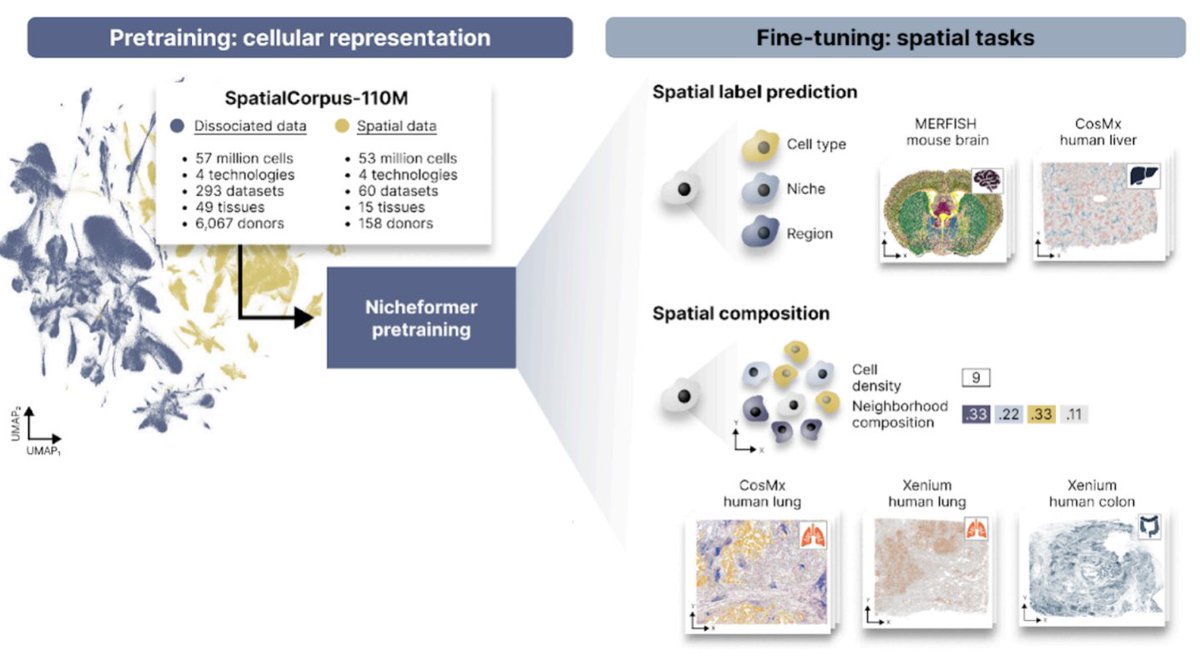
Excited to share Nicheformer! Led by @Alejandro__TL & @AnnaCSchaar, Nicheformer is a foundation model for single-cell & spatial omics. Its innovation is going beyond disassociated analysis to capture & predict local tissue context at single-cell level. https://t.co/WFFzppmLSW
L'article "IA et bioinformatique : exploitons les réseaux convolutionnels (CNN)"
https://t.co/S4tiNg9R6W est maintenant disponible ! Suite de "Bioinformatique et IA : un premier pas", nous explorons ici les classifications à classes multiples.
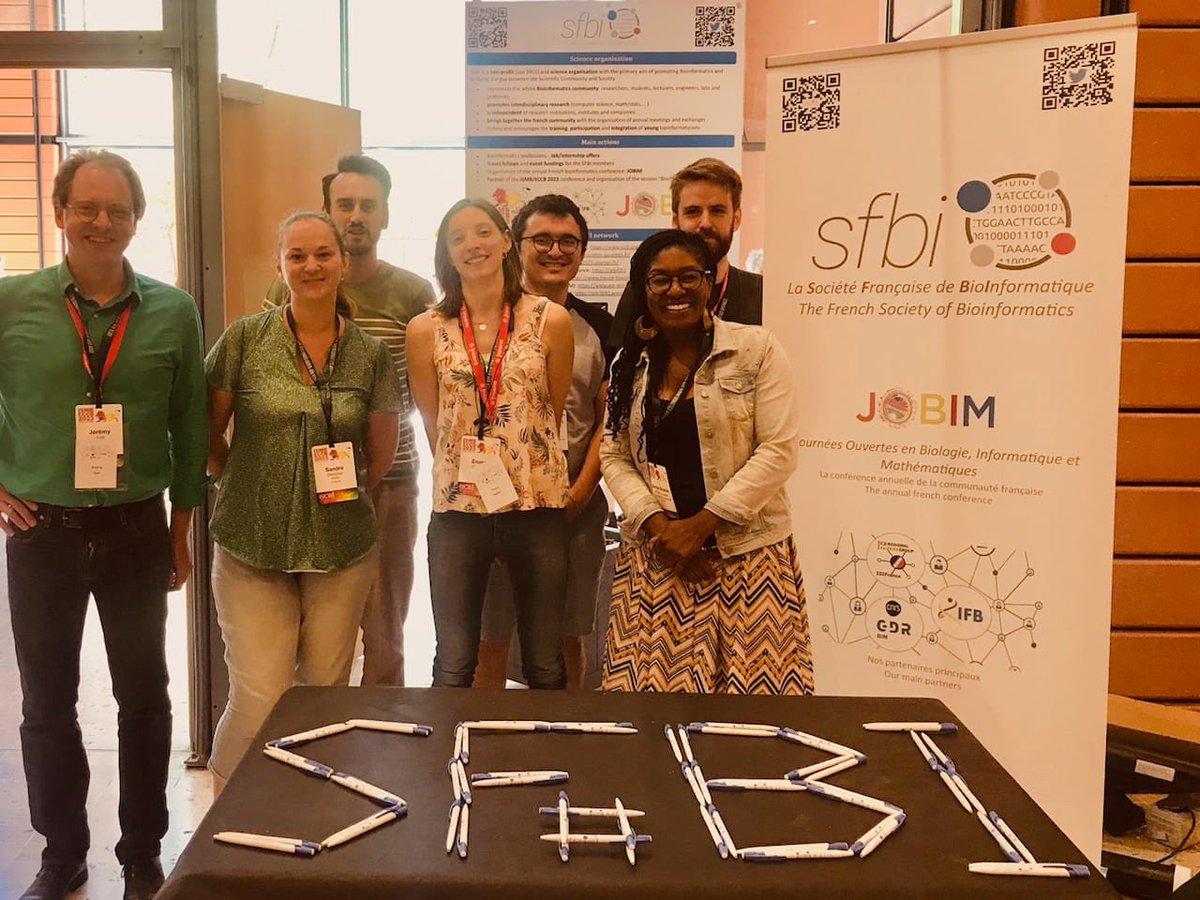
Thank you to all the volunteers who manned the #sfbi stand throughout the #ISMBECCB2023 conference. Thank you to the "Bioinformatics in France" session organizers and especially to our president @afiston for her commitment.
@EG_bioinfo@CorentinMarco34@Seajulll Jérémy Riwan
#ISMBECCB2023, you want to make a quick quality control of your single-cell atlases ? Perfect ! I have the tool for you !
Check poster B-135 (on-site and online), for Checkatlas: A one liner quality control too for your single-cell atlases.
This morning at #ISMBECCB2023 kicked off by a Dana Pe’er keynote on ML meeting single-cell biology. Started with a disclaimer that she went to Paul Bocuse last night and it was a late one
Ever analyze a scRNAseq dataset and wonder if a specific cell state has been seen before? And if so, where in the human body? Under what conditions? Well, now you can use our lightning fast SCimilarity search and foundational model for that! ⚡️🔎🧬 https://t.co/t8L1xFOffd (1/11)
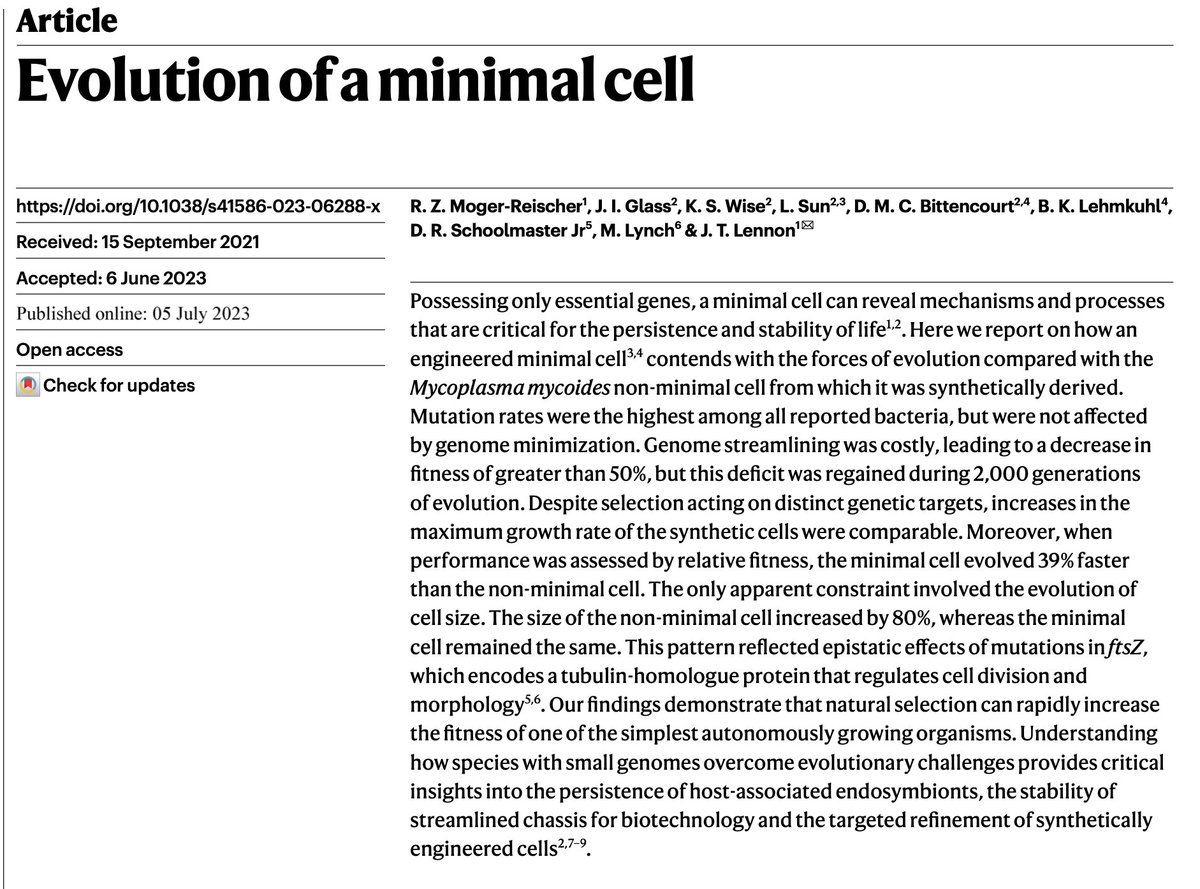
A mind-blowing paper has come out today in @Nature
In 2016, JC Venter Institute scientists trimmed a bacterial genome to its barest minimum required for life to synthesize what they called a "minimal genome" (https://t.co/Rk8oZJ0bUj).
Today, a group of scientists from Indiana University reports how that minimal genome evolved over 2000 generations in comparison to the non-minimal genome.
The authors found that even when you reduce a bacterial genome to its absolute minimum where every nucleotide matters, the genome undergoes mutational events generation after generation as much as the non-minimal genome. One simply cannot stop the evolution.
Just over 300 days of evolution (equivalent to 40,000 years in humans) the minimal cell has gained everything it lacked in fitness on day one in comparison to the non-minimal cell.
When comparing the evolved traits between the minimal and non-minimal cells, the scientists found something striking. The evolutionary process increased the cell size of non-minimal cells but not that of the minimal cell. But that is not the striking part.
The scientists were able to identify the key mutation that resulted in cell size evolution. And it turned out that the mutation that helped the non-minimal cells to grow bigger is the same that helped the minimal cells to stay smaller. Growing bigger had a survival advantage for non-minimal cells and not growing bigger had a survival advantage for minimal cells. So, the mutation had a context-dependent effect. This just demonstrates that the evolutionary effects on traits have no absolute direction. All that matter is what is beneficial for the organism's survival.
The conclusion of the paper is metaphorically a quote from the Jurassic Park movie:
“Listen, if there’s one thing the history of evolution has taught us is that life will not be contained. Life breaks free. It expands to new territories, and it crashes through barriers painfully, maybe even dangerously, but . . . life finds a way". (https://t.co/UlxRlb86CT)
https://t.co/zA9OAqSoAu