Huge news today at Isomorphic Labs!
We have secured $2.1 Billion investment to advance the most important mission that AI can unlock: to change the way we can improve human health and create new medicines for patients around the world.
This funding milestone was built on the strength of our AI drug design engine (IsoDDE), which has already proven its worth (aside from smashing benchmarks) by designing breakthrough new molecules and creating new scientific breakthroughs across our drug discovery programs.
Our IsoDDE is giving us a repeatable way to design new medicines for a wide range of diseases, building a future of medicine that we couldn’t unlock until now.
A massive thank you to our incredible team across London, Boston and Lausanne, whose relentless work made this possible, and to our partners who share our ultimate vision.
Now we have so much more to build together!
I’ve always believed the No.1 application of AI should be to improve human health.
That work started with AlphaFold, and now at @IsomorphicLabs with the mission to reimagine drug discovery and one day solve all disease!
We are turbocharging that goal with $2.1B in new funding.
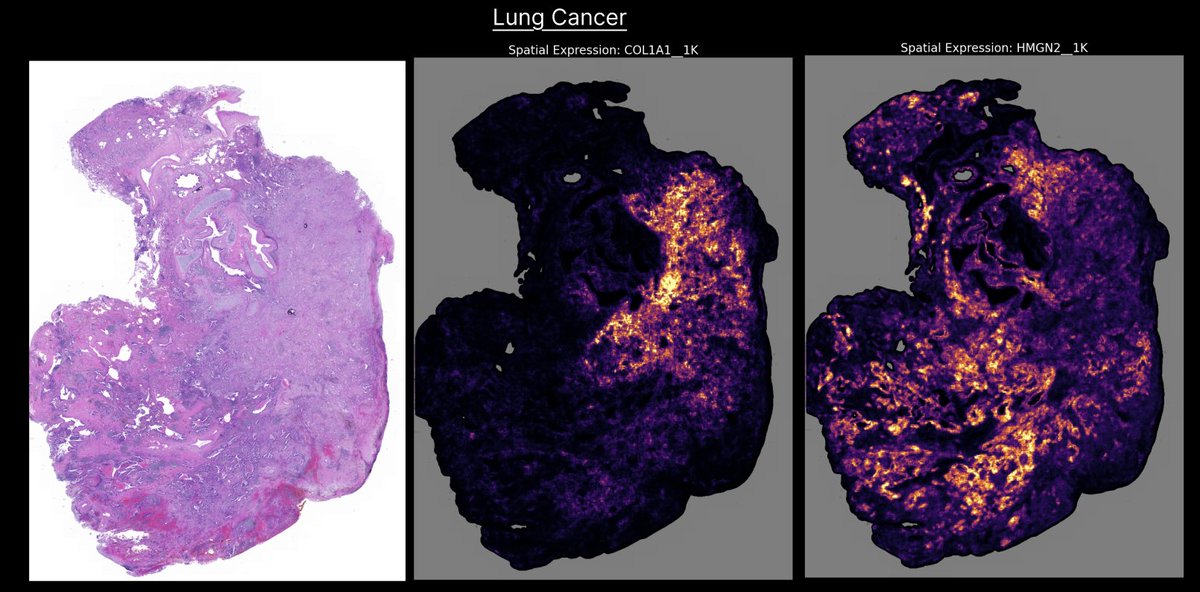
Wow this is trained on 21 patients data in 1 cancer. 😬
For context we are training these types of models on almost 4,000 patients across all modalities paired.
“Our training data comprises of data collected from 21 patients across different stages of lung adenocarcinoma.”
labs will publish details on arch, optim, objectives, scaling, kernels, literally everything except data
and academia will be astounded for the hundredth time, wondering to itself where the secret sauce is
Across many labs, SCALING single cell foundation models has had mixed success.
We think the key is CONTEXT.
*Spatial* single cell RNA data preserves the natural biological context of gene expression within animal tissue — in our case, tissue from human patients.
When we train models on large, diverse spatial datasets (100M cells across a dozen cancer types) we see BIG benefits from bigger models and longer context (effectively how much patient data the models see at once.)
Interestingly, the bigger the model, the better it gets with longer context. Maybe only larger models can capture complex spatial gene expression patterns across large regions of tissue.
We think that scaling SPATIAL single cell models is the way — maybe the only way — to discover new, therapeutically actionable biology across patients and solve the CLINICAL TRANSLATION problem that plagues drug development.
Big day for @NOETIK_ai ! We're licensing our OCTO-VirtualCell models in lung and colorectal cancer to @GSK, one of pharma's best at using AI to help patients.
@Ronalfa is not being licensed at this time.
We're excited to release tcellMIL, an attention-based multiple instance learning model for predicting patient outcomes after CAR T cell therapy for lymphoma and nominating cell design strategies in #neurips2025 AI4D3! https://t.co/3WJBQmJ3W5
🧬 Excited to share Nicheformer out now in Nature Methods!
A transformer foundation model linking single-cell & spatial omics, learning spatial context from gene expression to map tissue organization.
Led by Ale Tejada & Anna Schaar 👏
👉 https://t.co/ba9DX7h2xg
Want your biology AI model to learn spatial relationships? Add images as a modality!
scPortrait enables fast, standardized generation and use of single-cell image datasets, powering AI/ML-based discovery.
GitHub ⭐️: https://t.co/EEiqWnkLgZ
Preprint 📚: https://t.co/uVmfKdp93X
🚀 Excited to share scPortrait! Led by Sophia Mädler & Niklas Schmacke w/ the Mann lab — a new @scverse tool for standardized single-cell image data. Enables ML-ready extraction, >1B cell processing, cross-omics, & cancer macrophage insights.
🔗 https://t.co/VXHrCBgdDh
CAR T cells showcase the enormous potential of cell therapies, but often fail due to lack of evolutionary optimization. Today in @Nature, we use #CELLFIE to engineer cell therapies at scale and share the largest resource of CRISPR screens in CAR T cells. https://t.co/uaqwhcuiXM
Great company and exciting times! Very proud of the collaboration, the @NOETIK_ai team, and the OCTO-Virtual Cell work highlighted here — but it feels like an eternity ago!
On to simulating patients and clinical trials. Stay tuned.
🛡️How do macrophages tailor their defenses to different pathogens? Our new paper in @CellSystems combines dense multi-omics time series with high‐content CRISPR screens (CROP-seq) to map the regulatory landscape underlying macrophage immune responses. #Immunity#Screening (1/9)