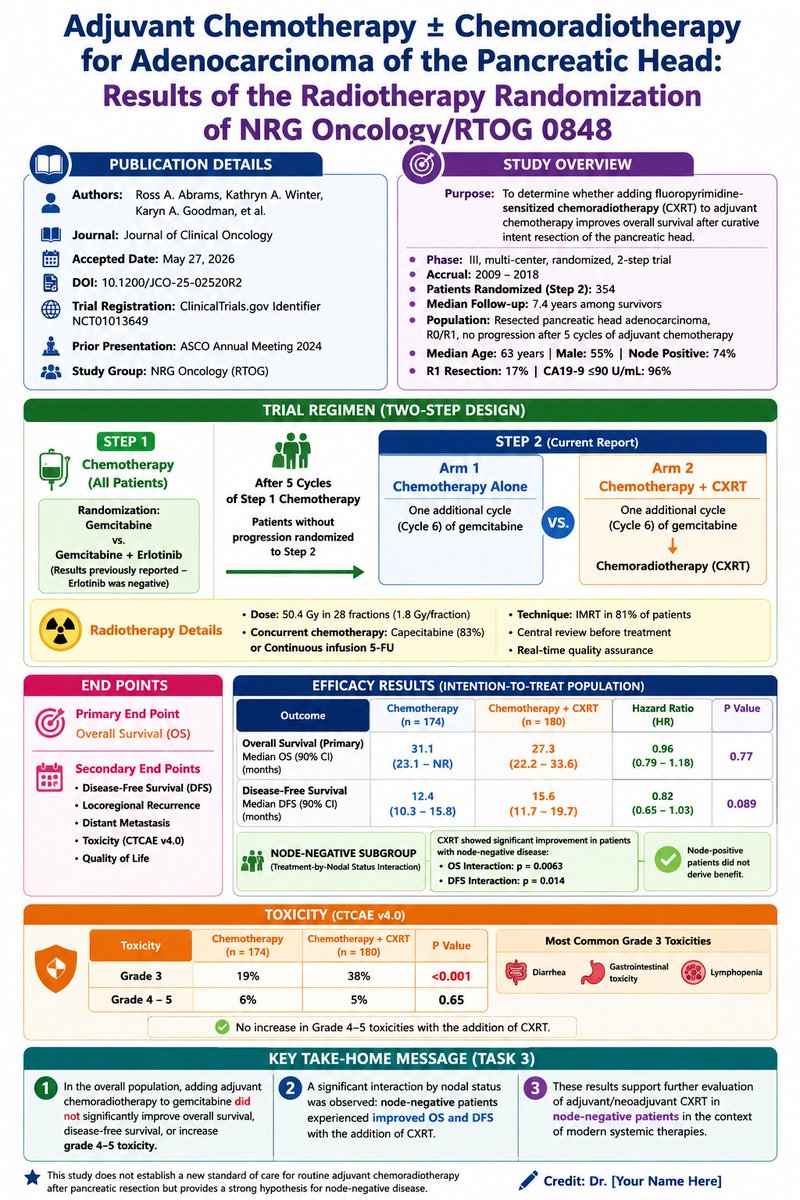
"Adjuvant Chemotherapy ± Chemoradiotherapy for Adenocarcinoma of the Pancreatic Head: Results of the Radiotherapy Randomization of NRG Oncology/RTOG 0848
Highly practical ESTRO guidelines. Re-RT for locally recurrent rectal cancer should no longer be the "exception."
W thoughtful planning, re-RT (often 30–40 Gy BID, w SBRT in select cases) can safely 1) improve resectability, 2) definitively tx or 3) palliate symptoms. @OncoAlert
Que la vida siempre te sorprenda con cosas bonitas, con momentos que te devuelvan la calma y con caminos que lleguen justo cuando más los necesitas. Lo mejor muchas veces aparece cuando menos lo esperas.
Local salvage therapies alone for #ProstateCancer recurrence after radiotherapy maintained >75% androgen deprivation therapy–free survival at 2 years with manageable rates of severe adverse events, supporting their use in selected patients. https://t.co/3PYHf4AFp4
La mayoria de las personas exitosas en algo son un trastorno de ansiedad con sueños obsesionados con la productividad. Conforme creces en algo y eres reconocido en un nicho desbloqueas privilegios que quieres conservar y no renunciar.
Probablemente casi nada de lo que hagas será recordado dentro de unos siglos, y eso es una buena noticia. Liberarte de la necesidad de dejar una huella permanente te permite centrarte en algo más importante: disfrutar del tiempo compartido, cuidar de las personas que quieres y dedicar tus semanas a aquello que consideras significativo. Con eso ya es suficiente
CHHiP vs PROFIT for Localized Prostate Cancer: A Retrospective Dosimetric Comparison of Organs at Risk
🔗 Find the full research article: https://t.co/IYf1mWsqGr
Moderate hypofractionation for localized prostate cancer has become a standard of care in many radiation therapy centers worldwide. Several fractionation and planning protocols exist, with CHHiP and PROFIT (60 Gy in 20 fractions) being 2 of the most commonly used. We retrospectively compared the doses received by organs at risk (OARs) using these 2 protocols.
#ProstateCancer #RadiationOncology #RadOnc #MensHealthMonth #MHM26 #CaseStudy #RadOncEd #MedEd
Executive summary of American Radium Society Appropriate Use Criteria for the treatment of locoregionally recurrent rectal cancer.
https://t.co/DaiRnU9340
Tumor recurrence or radiation injury? Post-SBRT, IMRT, and proton therapy lung changes can mimic cancer recurrence—know key imaging patterns, timing, and pitfalls to improve diagnostic accuracy. @MedicinaPUJ@OmarPantojaB97 https://t.co/PYLqikJxrn
The smarter women are, the more hostility they face.
In the U.S. & China, the higher women’s IQs, the less they're liked—and the more they’re undermined by coworkers. Men pay no price for being bright.
It's long past time to recognize female intellect as an asset, not a threat.
New in Advances in Radiation Oncology:
Wallach et al. propose “curative oligometastatic radiotherapy” (CORT) as a distinct treatment-intent category for carefully selected patients with oligometastatic disease when cure, or exceptionally durable disease control, may be attainable.
The concept goes beyond metastasis-directed therapy alone: all known disease, including the primary when needed, is addressed with curative intent.
Proposed favorable features include limited metastatic burden, favorable disease biology or effective systemic options, controlled extracranial disease, good performance status, low tumor markers or favorable ctDNA, and a long disease-free interval.
The nuance: this is a terminology and clinical framework, not a validated prognostic model. CORT may improve communication, shared decision-making, trial design, and data collection, but selection must remain individualized and disease-specific.
A useful reminder that metastatic disease does not automatically make every course of radiotherapy palliative.
#radonc #OligometastaticDisease #OncTwitter
New in #practicalRO: Stereotactic Body Radiotherapy for Locally Advanced Pancreatic Adenocarcinoma: A Systematic Review and Meta-Analysis of Prospective Trials. https://t.co/D2ovTKWyJe