People get rewarded in public for what they practice in private.
Tony Robbins dropped this on Theo Von’s podcast while talking about Steph Curry:
The greatest 3-point shooter in NBA history has taken over 2.5 million shots in practice — 500 shots every single day for years. That’s why he releases the ball and turns around before it even goes in. He already knows.
That level of unseen work is insane. We celebrate the highlight, but greatness is built in the boring, repetitive hours no one sees.
Real success isn’t luck or talent alone, it’s the compound effect of consistent private practice.
An MIT professor taught the same math course for 62 years, and the day he retired, students from every country on earth showed up online to watch him give his final lecture.
I opened the playlist at 2am and ended up watching three of them back to back.
His name is Gilbert Strang. The course is MIT 18.06 Linear Algebra.
Every machine learning engineer, every data scientist, every quant, every self-taught programmer who actually understands how AI works learned the math from this one man. Most of them never set foot on MIT's campus. They just opened a free playlist on YouTube and let him teach.
Here's the story almost nobody tells you.
Strang joined the MIT math faculty in 1962. He retired in 2023. That is 61 years of standing at the same chalkboard teaching the same subject to 18-year-olds.
The interesting part is what he did when MIT launched OpenCourseWare in 2002. Most professors were skeptical. They worried that putting their lectures online would make their classrooms irrelevant. Strang did not hesitate. He said his life's mission was to open mathematics to students everywhere. He filmed every lecture and gave it away.
The decision quietly changed how the world learns math.
For decades linear algebra was taught the wrong way. Professors started with abstract vector spaces and proofs about field axioms. Students drowned in the abstraction. Most never recovered. They walked out believing they were bad at math when they had simply been taught in an order that nobody's brain is built to absorb.
Strang inverted the entire curriculum.
He started with matrix multiplication. Something you can write down on paper. Something you can compute by hand. Something you can see. Then he showed his students that everything else in linear algebra eigenvectors, singular value decomposition, orthogonality, the four fundamental subspaces was just a different lens for understanding what the matrix was actually doing under the hood.
His rule was strict. If a student could not explain a concept using a concrete 3 by 3 example, that student did not actually understand the concept yet. The abstraction was supposed to come last, not first. The intuition was the foundation. The proofs were just confirmation that the intuition was correct.
The second thing Strang changed was the classroom itself. He said please and thank you to his students. Every single lecture. He paused mid-derivation to ask "am I OK?" to check if anyone was lost. He never used the word "obviously" or "trivially" because he knew exactly what those words do to a student who is one step behind. He treated 19-year-olds learning math for the first time the way he treated his own colleagues. With patience. With respect. With the assumption that they belonged in the room.
For 62 years.
The result is something that has never happened in the history of education. A single math professor became the default teacher of his subject for the entire planet.
Universities in India, China, Brazil, Nigeria, every country with a computer science department, started telling their own students to just watch Strang's lectures. The University of Illinois revised its linear algebra course to do almost no in-person lecturing. The reason was honest. The professor said they could not compete with the videos.
His final lecture was in May 2023.
The auditorium was packed with students who had never met him before. He walked to the chalkboard, taught for an hour, and at the end the entire room stood and applauded. He looked confused for a moment, like he genuinely did not understand why they were cheering. Then he smiled and waved them off and walked out.
His written comment under the YouTube video of that final lecture was four sentences long. He said teaching had been a wonderful life. He said he was grateful to everyone who saw the importance of linear algebra. He said the movement of teaching it well would continue because it was right.
That was it. No book promotion. No farewell speech. No legacy management.
The man whose teaching is the foundation of modern AI just thanked the audience and went home.
20 million views. Zero ego. The entire engine of the AI revolution sits on top of math that millions of people learned for free from one quiet professor in Cambridge.
The course is still on MIT OpenCourseWare. Every lecture, every problem set, every exam, every solution. Free.
The most important math course of the 21st century is sitting one click away from you. Most people will never open it.
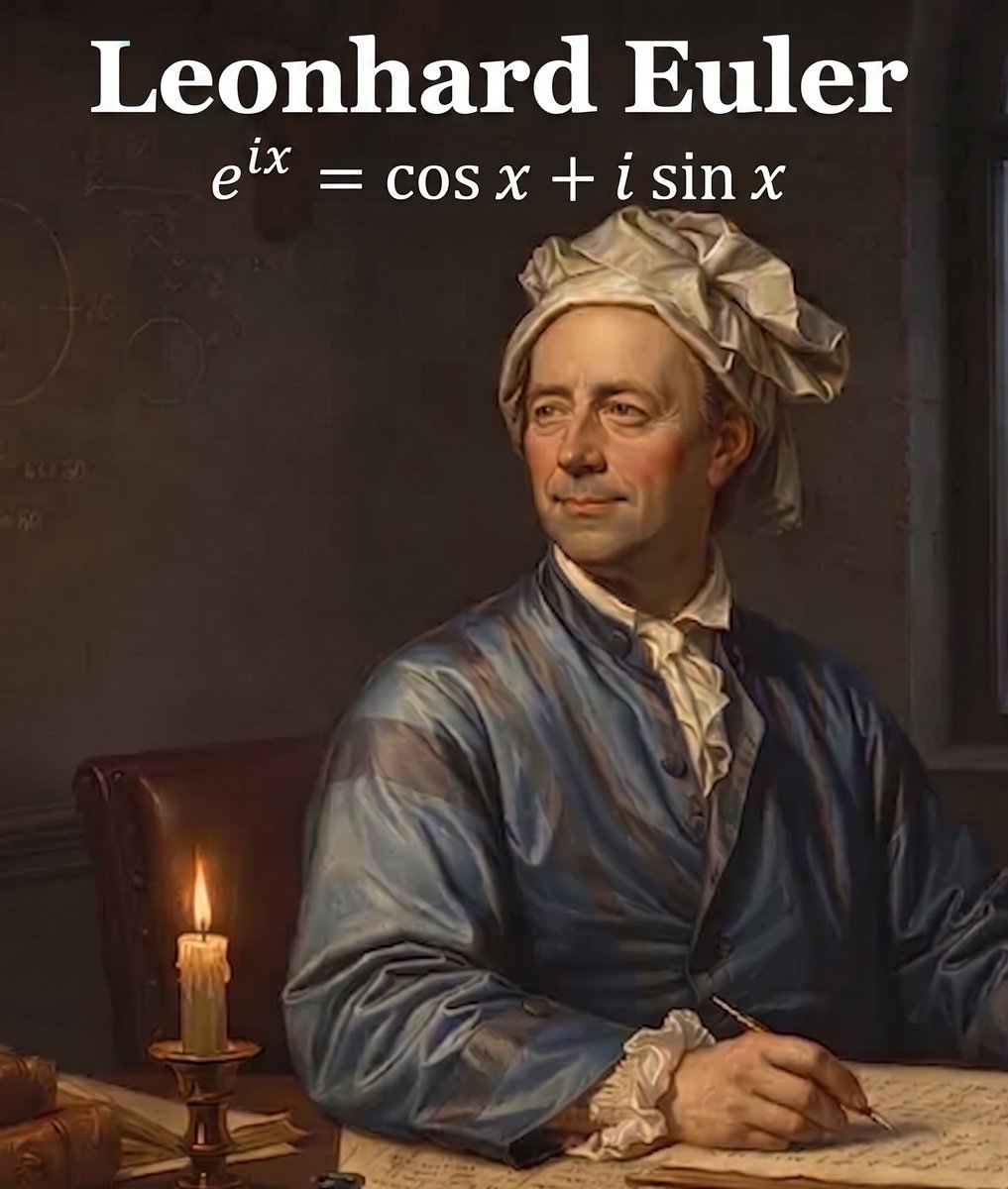
The most productive mathematician who ever lived.
Leonhard Euler. Born April 15, 1707.
His collected works fill between 60 and 80 large volumes. The project to publish them all began in 1911.
It is still ongoing.
Laplace told his students:
"Read Euler, read Euler, he is the master of us all."
What he actually built:
1/. The language of all mathematics
Every formula you have ever written uses Euler's notation.
He introduced:
e - the base of the natural logarithm
i - the imaginary unit, √−1
f(x) — the modern notation for a mathematical function
Σ — sigma notation for summation
π - he didn't invent pi, but popularized it.
If you have ever taken a mathematics course, you have been writing in Euler's handwriting.
2/. Graph theory - from a bridge puzzle
In 1735, the citizens of Königsberg had a puzzle. Their city sat on the banks of the Pregel River, connected by seven bridges. Could you walk through the city crossing each bridge exactly once?
Euler stripped away everything irrelevant - streets, distances, geography, and kept only the connections. Landmasses became nodes. Bridges became edges.
He proved the walk was impossible because all four landmasses had an odd number of bridges. A valid Eulerian path requires exactly zero or two nodes of odd degree. Königsberg had four.
His 1736 paper Solutio problematis ad geometriam situs pertinentis is the founding document of graph theory.
He was almost apologetic about it, writing to a colleague that it "bore little relationship to mathematics."
He was spectacularly wrong.
That paper today underlies modern network and routing systems.
3/. Euler's Formula
e^(ix) = cos x + i sin x
This single equation unifies exponential functions and trigonometry through complex numbers.
Richard Feynman called it "our jewel" and "the most remarkable formula in mathematics."
When x = π, it produces:
e^(iπ) + 1 = 0
Euler's Identity. Five fundamental constants - e, i, π, 1, 0 - united in a single equation using only addition, multiplication, and exponentiation. Each exactly once.
In 2004, Physics World readers voted it the greatest equation ever written. A 2014 neuroscience study found it activates the same region of the brain as great music or art.
Benjamin Peirce said of it:
"Gentlemen, that is surely true, it is absolutely paradoxical; we cannot understand it, and we don't know what it means. But we have proved it, and therefore we know it must be the truth."
4/. Euler's Formula for Polyhedra
V − E + F = 2
For any convex polyhedron: vertices minus edges plus faces always equals 2.
A cube: 8 − 12 + 6 = 2. A tetrahedron: 4 − 6 + 4 = 2. Always.
This result helped lay the foundation of topology, the mathematics of shape and connectivity that now underlies data analysis, neural network geometry, and computational mesh processing.
5/. The output
From 1725 to 1783, Euler averaged 800 pages of mathematics per year.
He was completely blind for the last 17 years of his life. His output increased.
In 1775, totally blind - he produced on average one mathematical paper per week.
Estimated to have authored roughly a third of all mathematical output of the 18th century. One man. One third.
Where Euler lives in the systems you build today:
e^(ix) = cos x + i sin x → Fourier transforms → signal processing → audio AI, image compression, every frequency-domain operation
Graph theory → network routing, GPS, social graphs, recommendation engines, transformer attention patterns
e → sigmoid, softmax, cross-entropy loss - every neural network activation and loss function
Σ → the notation inside every gradient descent update ever written
V − E + F = 2 → topological data analysis, mesh processing, graph neural networks
f(x) → the notation of every function in every codebase ever written
319 years later.
The language of mathematics is still his.
There is a shape in mathematics that can hold a finite amount of paint, yet would require an infinite amount of paint to coat its surface. It is called Gabriel’s Horn.
Imagine rotating the curve y=1/x around the x-axis. The result is a long, tapering surface that stretches infinitely, like a tunnel that never ends.
Here’s where the paradox appears. The volume of this shape converges—if you add up all its infinitesimal slices, the total stops growing. In other words, you can completely fill it with a finite amount of paint.
But the surface area diverges. No matter how far you go along the horn, there is always more surface to cover. The outer “skin” keeps extending, demanding more paint without end.
So while you could pour paint inside and fill it entirely, you would never finish painting the outside.
This is not a trick, but a consequence of how infinity behaves. The radius shrinks quickly enough for the volume to remain finite, yet not fast enough to keep the surface area from growing without bound.
It reveals a deeper truth: infinity does not simply mean “very large”—it means unending. And sometimes, the infinite can exist within the finite in ways that defy our intuition, even while remaining perfectly consistent in mathematics.
Andrew Santino just blew my mind with one simple comparison.
A million seconds = 11 days.
A billion seconds = 31 years.
Let that sink in.
We throw around “billionaire” like it’s just “millionaire but with more zeros,” but the actual gap is insane. A million seconds is less than two weeks. A billion seconds is longer than most people’s entire adult lives.
It’s a perfect reminder of how detached our brains are from what these numbers actually mean.
Next time someone casually says “he’s a billionaire,” just remember: that’s not “a lot of millions.” That’s an entirely different universe of scale.
Mind officially blown.
🚨In 1990s, Stanford researcher Dr. Robert Sapolsky discovered something that should have broken the internet by now.
He was studying dopamine pathways in primates and found that the brain doesn't just adapt to repeated stimulation. It actively fights back.
When you flood dopamine receptors consistently, the brain deploys what neuroscientists call "opponent processes." For every artificial high you create, your nervous system generates an equal and opposite neurochemical low. Not eventually. Immediately. The system is designed to maintain balance, so it starts producing compounds that directly counteract dopamine while you're still experiencing the dopamine hit.
This means every notification, every scroll, every digital reward doesn't just give you a high followed by a return to baseline. It gives you a high followed by a crash below baseline. You end up in neurochemical debt.
Tech companies never publicized this research. They probably never read it. They were too busy discovering that variable ratio reinforcement schedules could keep users engaged for hours. They built addictive systems by accident, then refined them into addiction machines once they realized what they'd stumbled onto.
Your phone delivers an average of 80 dopamine hits per day. Your ancestors got maybe 5. Each hit triggers opponent processes that create a corresponding low. By the end of a typical day of normal phone usage, your baseline dopamine is running in negative territory. You feel flat, restless, vaguely unsatisfied, and hungry for stimulation because your brain chemistry is literally below zero.
You think you're bored. You're chemically depressed by artificial highs.
The opponent process theory explains why nothing feels interesting anymore. Your brain isn't broken. It's precisely calibrated to maintain neurochemical balance, and you keep throwing that balance off with artificial intensity. Every Instagram hit requires an equal Instagram crash. Every TikTok high gets paid for with a TikTok low. Every notification rush gets balanced with notification emptiness.
Your reward system is running a neurochemical deficit that grows larger every day.
Sapolsky's research revealed something even more disturbing: opponent processes don't just create temporary lows. They become permanent changes to your baseline dopamine production. Chronic overstimulation doesn't just make you tolerant to digital rewards. It makes you insensitive to natural rewards.
The sunset that would have captivated your great-grandfather becomes invisible to you not because sunsets got worse, but because your dopamine system needs intensity levels that sunsets can't provide. A good conversation becomes boring not because conversations got less interesting, but because your brain requires the rapid-fire stimulation of social media to register engagement.
You've accidentally trained your reward system to ignore everything that isn't artificially amplified.
This connects to research from Dr. Anna Lembke at Stanford, who found that people who undergo complete digital fasting for just 30 days show measurable increases in dopamine receptor density. Their brains literally regrow sensitivity to natural rewards. Food tastes better. Music sounds more complex. Social interactions become genuinely engaging again.
But there's a catch that nobody talks about: the first two weeks of dopamine detox feel like clinical depression. Your brain has been chemically dependent on artificial stimulation for years. Removing that stimulation creates actual withdrawal symptoms. Restlessness, anxiety, inability to focus, emotional flatness, and desperate cravings for digital input.
Most people interpret these symptoms as evidence that they need their phones. Actually, they're evidence that they've been neurochemically dependent on their phones without realizing it.
The withdrawal period isn't a bug. It's proof the reset is working.
What happens after week three is remarkable. Colors become more vivid. Conversations become genuinely absorbing. Simple pleasures like hot coffee or cool air become satisfying in ways you forgot were possible. Your brain rediscovers that reality contains enough complexity and beauty to hold your attention without artificial amplification.
You don't need more interesting content. You need more sensitive reward systems.
The solution isn't better apps or more engaging entertainment. The solution is restoring your brain's factory settings for what constitutes a worthwhile experience.
Sapolsky's opponent process research suggests this can happen faster than anyone expected. Every day you don't artificially spike your dopamine, your baseline moves a little higher. Every natural reward you pay attention to rebuilds receptor density. Every moment of boredom you endure without reaching for stimulation strengthens your capacity for sustained focus.
Ancient humans lived in a world that provided exactly the right amount of stimulation to keep their reward systems healthy. Enough challenge to stay engaged, enough calm to stay balanced, enough novelty to stay curious, enough routine to stay stable.
We built a world that provides 10 times too much stimulation and wonder why nothing feels rewarding anymore.
Your brain is not the problem. Your environment is the problem.
Change the environment, and the brain heals itself automatically.
Bumrah at 32: I am injured
Lee at 36: Done
Steyn at 37: Retired
McGrath at 37: Retired
Years pass. Legends retire. The game moves on… But somewhere in Lancashire, a man still runs in, ball after ball, still taking Fifer at 44, his heart as young as ever.
James Anderson
This TED Talk changed my life.
When I was 16, I was the kid at school nobody listened to.
I would say something in class. Silence. Someone else would say the exact same thing two minutes later. The room would react.
I thought it was confidence. I thought it was personality. I thought some people were just born with the ability to command a room and I wasn't one of them.
I was wrong about all of it.
Then I found this.
Julian Treasure has spent his career studying one of the most powerful instruments on earth — the human voice. Not music. Not machines. Your voice. The one thing you use every single day and have almost certainly never been taught to use properly.
Here is the framework that made me audit every conversation I had been having since I was that kid in school.
He opens with what he calls the seven deadly sins of speaking. Not as metaphor. As a literal checklist of habits that cause people to tune you out before you finish your first sentence. Gossip. Judging. Negativity. Complaining. Excuses. Exaggeration. And dogmatism delivering your opinions as facts and expecting people to simply accept them.
Most people commit at least three of these every day. Some do all seven before lunch.
But the insight that stopped me cold was not the list of sins. It was what he said we are actually competing against every time we open our mouths.
Noise.
We live inside an environment of constant, aggressive, badly designed noise. Open offices. Restaurants built for aesthetics not acoustics. Phones that fracture every thought. And into that environment we send our words and then wonder why nothing lands the way we intended.
The problem is almost never what you are saying. It is everything surrounding how you are saying it.
His framework for doing it right spells a single word: HAIL. Honesty, authenticity, integrity, and love. Not love in the soft sense. Love as genuinely wishing the person in front of you well because if you actually want good things for someone, it becomes almost impossible to judge them at the same time.
Then he opened what he called the toolbox. And this is the part nobody talks about when they share this talk.
Register. Timbre. Prosody. Pace. Silence. Pitch. Volume.
These are not performance tricks. They are instruments. Sitting inside you right now, completely unplayed, because nobody ever told you they existed.
The research on register alone is striking. We vote for politicians with deeper voices. Not because of their policies. Because depth signals authority at a neurological level that moves faster than rational thought. Your voice is landing on people's nervous systems before their minds have processed a single word you said.
The 16 year old version of me didn't have a confidence problem.
He had a toolbox he didn't know existed.
Nobody taught us that the voice is an instrument. Nobody told us to use its registers deliberately, to let silence do the work that words cannot, to understand that how you say something rewires how people feel about what you said.
The most important TED Talk about communication isn't about what you say.
It's about everything you've been doing with your voice your entire life without ever once stopping to look at it.
What makes a classical performance truly unforgettable?
In this iconic duet, Victor Borge and Leonid Hambro transform Minute Waltz into something utterly unique.
It’s not just the dazzling technique — though the velocity, precision, and control are nothing short of masterful. It’s the way they bend expectations: turning a virtuosic showpiece into a brilliantly choreographed interplay of timing, humor, and musical intelligence. What feels spontaneous is, in fact, a stunning display of control and ensemble awareness at the highest level.
This is classical music reimagined — where wit enhances virtuosity, and the familiar becomes unforgettable.
#ClassicalMusic #Chopin #PianoDuet #VictorBorge #LeonidHambro
Whatever lies you were told in class, there was never much "Privilege" & many of the boys here would be killed or wounded in the coming Great War while the girls would have a life of lonely toil because their future husbands were killed in the War.
Physicist Brian Cox reminds us of a truth so profound it’s almost impossible to grasp: we are not just observers of the universe; we are a part of it that has finally woken up.
Every atom in your body; the carbon in your skin, the iron in your blood, the oxygen you breathe; was forged in the intense, ancient furnaces of dying stars. For billions of years, those atoms drifted through the cold void, only to find themselves, by some miracle of cosmic chance, arranged in a pattern that can think, feel, and dream.
As Carl Sagan famously said, we are a way for the cosmos to know itself. We are the means by which a universe of dust and gas suddenly starts writing symphonies, painting masterpieces, and asking where it came from.
It sounds unlikely, perhaps even impossible. But here we are, sitting on a small blue rock, having a conversation about it. And that might be the most extraordinary thing of all.