🚨 Anthropic's own team just showed how to actually use Claude Code properly.
30 minutes. free. the person who created Claude Code.
watch the workshop. bookmark it.
worth more than every $500 course you almost bought.
you've been using Claude without knowing 40 of its commands.
Then read the guide below.
This 47-min interview with Boris Cherny (the creator of Claude Code) will teach you more about AI-native development than 6 months of trial and error.
Watch it, bookmark it, share it.
Your entire approach to building with Claude will shift.
I broke my phone addiction in 30 days.
• Screen Time down ~70%
• Phone pickups down ~50%
I reclaimed 4 hours 30 minutes per day. That's 1,635 hours across a full year. 68 days of life from a single behavior change.
Here's exactly what I did (save this):
1. Grayscale Mode
Put your phone on Grayscale Mode for the entire day.
Grayscale Mode removes the colors to make your phone immediately less appealing and addicting.
It takes 30 seconds to set up.
If you have an iPhone, follow these steps:
• Settings
• Accessibility
• Display & Text Size
• Color Filters -> On
• Grayscale
Next, create a simple shortcut:
• Settings
• Accessibility
• Accessibility Shortcut
• Color Filters
Now, if you triple-click the side button, you'll be able to toggle it on and off.
For non-iPhone users, you can find instructions with a simple search.
I kept my phone on Grayscale at all times and only removed it for specific reasons (like posting something that required me to see the color, looking at photos, etc.).
It made me less interested in grabbing my phone for the random "just checks" during the day.
2. No-Phone Zones
Set specific locations, times, and events where you won't have your phone on you.
I called them No-Phone Zones:
• Downstairs (kitchen, living room)
• Creative flow time (from ~5-8am)
• Family flow time (from ~5-7pm)
• Family gatherings
During these windows, my phone would be in a lock box or in a drawer in my office. If we were out at a family gathering, I would leave it in the car or in my wife's bag where I couldn't feel it.
Specifically listing out these No-Phone Zones had the benefit of making it a clear rule that I could cement in my mind.
Create your list of No-Phone Zones. Write it down if you need to.
3. Strategic Friction
Even with the Grayscale Mode and No-Phone Zones, my phone addiction intervention would have been difficult to execute without this final piece of the puzzle.
Motivation and discipline are never enough when you're trying to crack a deeply entrenched behavior.
There's a theory in cognitive science called Choice Architecture, which is the idea that you can design your environment to make good choices easier and bad choices harder.
Basically, I wanted to add strategic friction to make it much easier to adhere to my rules (and much more difficult to break them).
Three primary ways I did that:
1. I locked my phone in a lock box during my morning creative flow (5-8am) and evening family flow (5-7pm). It was a timed lock so I couldn’t get it without emailing the company.
2. I left my phone far away from where I was going to be working. If I wanted to get it, I'd have to walk to the other side of the house or down a few flights of stairs to get it.
3. I added really low screen time restrictions to social apps. If I wanted to overuse them, I'd have to keep approving more time, which felt like letting myself down when I did it.
Breaking the addiction is going to be difficult at first. Create strategic friction that helps you stick to the change. Make it difficult to make a bad choice.
The Life Impact
I'm not going to sugarcoat it at all:
This was the single most powerful behavior change I've ever made in terms of the tangible impact and ripple effects on my life.
That is not an exaggeration.
I was more present, less stressed, and able to connect on an entirely different level. In short, I showed up more aligned with how my ideal self would.
My capacity for deep work expanded significantly from simply placing my phone in another room or a lock box.
I got more done, faster, at a higher quality bar. It was like the holy trinity of productivity improvement, with no fancy productivity tool required.
Reviewing the research, this isn't surprising: There is clear scientific evidence that even having your phone in your pocket or on your desk reduces your cognitive capacity.
I felt happier and less stressed immediately upon making the change.
So, just keeping score...
This was a single, zero cost behavior change that had the net effect of:
• Improving my relationships
• Improving my work
• Improving my happiness
To be completely transparent, just a few days in, the only negative thought I had related to the intervention was simple:
Why didn't I do this sooner?
I hope this is the push you need to make this change in your life.
Start small and stick to it. Aim for a 10-20% screen time reduction week-over-week. Keep yourself accountable with a friend.
Having now gone through it, I can guarantee you'll see and feel the positive impact immediately.
Onward and upward.
Bret Taylor, former co-CEO of Salesforce and chair of OpenAI, just redefined the unit of productivity.
It’s not a person.
It’s a process.
Taylor: “I think the atomic unit of productivity in AI is a process, not a person.”
AI won’t replace a worker.
It will compress entire workflows.
What used to take 17 days across departments collapses into hours.
The traditional corporate model measures productivity in person-hours.
The new model measures process-compression.
The incumbent assumption: you buy AI to replace a junior analyst.
That’s a fundamental misunderstanding.
You deploy an autonomous agent to completely collapse the timeline of a business outcome.
An operation requiring 17 days of bureaucratic friction gets mathematically condensed into 17 hours.
You’re not buying a digital employee.
You’re buying the ruthless compression of time.
Using AI to speed up a single employee’s task?
You’re playing the wrong game.
Taylor: “There’s a legal department to do a contract. There’s some finance department, procurement. You probably have IT that’s involved to onboard them into your core systems.”
Friction in the modern enterprise doesn’t come from a single worker.
It comes from the endless hand-offs between siloed departments.
The traditional CEO tries making each department 10% faster.
The winning CEO deploys an AI overlay that autonomously bypasses the human hand-offs entirely.
The algorithm doesn’t sit in the legal department or IT.
It executes the entire thread simultaneously across all core systems.
It doesn’t replace individual workers.
It renders their departmental bottlenecks completely irrelevant.
Taylor: “I think it’s wrong to think about AI as sort of replacing people. In addition to being inhumane, it’s just sort of nonsensical because AI sort of operates in the world of digital technologies.”
The neural network won’t sit at a desk, pour coffee, or shake a client’s hand.
It’s a sovereign engine operating exclusively in the realm of digital friction.
Superintelligence isn’t your direct replacement.
It’s your digital exoskeleton.
The hard part of enterprise execution has never been the human element.
It’s always been wrestling with archaic, fragmented software systems.
When AI takes over the digital process, the biological operator gets freed from the bureaucratic drag.
They instantly shift from manual processor of forms to high-leverage director of outcomes.
And that’s the real transformation.
Not humans versus machines.
Humans commanding the compressed timelines machines execute.
Whoever builds that infrastructure first turns every competitor’s 17-day cycle into a fatal disadvantage.
Because they’re finishing in hours what the rest of the market hasn’t even started.
Sequoia’s @JulienBek says many of their founders are now wondering if they’re “just an iteration away” from AI labs destroying their business.
He says the most defensible companies - and potentially the next trillion-dollar company - will be “a software business that masquerades as a services firm.”
“If you sell tools today, you’re really in the line of sight for the models and you’re effectively competing with the next generation that they’re going to launch.”
“Whereas if you sell the work, you’re actually benefiting from what the models are doing and all the billions of dollars that are going towards AI.”
I accidentally discovered how to compress a month of research into 3 hours.
A founder at a YC company showed me his Claude setup. I thought he was just fast. Then I watched him build an entire go-to-market strategy for a market he'd never worked in before.
Here's exactly what he did:
First: he didn't ask Claude to "research the market."
He fed it 8 competitor landing pages, 3 earnings call transcripts, 12 customer reviews, and a Reddit thread of complaints.
Then he asked one question:
"What does every successful player in this market understand that their customers never say out loud?"
Not "summarize these." Not "analyze the competition."
The unspoken insight. The thing that takes founders 2 years of customer calls to figure out.
But the next part is what broke my brain.
He followed up with:
"Now show me the 3 assumptions this entire market is built on, and what would have to be true for each one to be wrong."
In 15 minutes he had the attack surface of an entire industry.
The blind spots. The fragile consensus. The opening nobody was talking about.
Most founders spend 6 months doing customer discovery just to find one of those.
Then he did something I've never seen before.
He asked:
"Write 5 questions a world-class investor would ask to destroy this business idea, then answer each one using only the evidence in these documents."
He spent the next 2 hours stress-testing every assumption. Every weak answer triggered a follow-up:
"What's the strongest version of this argument and where does it still break?"
By hour 3, he had a strategy deck that felt like it came from someone who'd spent a decade in the space.
The tool didn't change. The questions did.
Most people treat Claude like a faster Google.
These founders are using it like a thinking partner who has read everything and has no ego about being wrong.
The difference between 3 hours and 3 months isn't the amount of information.
It's knowing which questions actually matter.
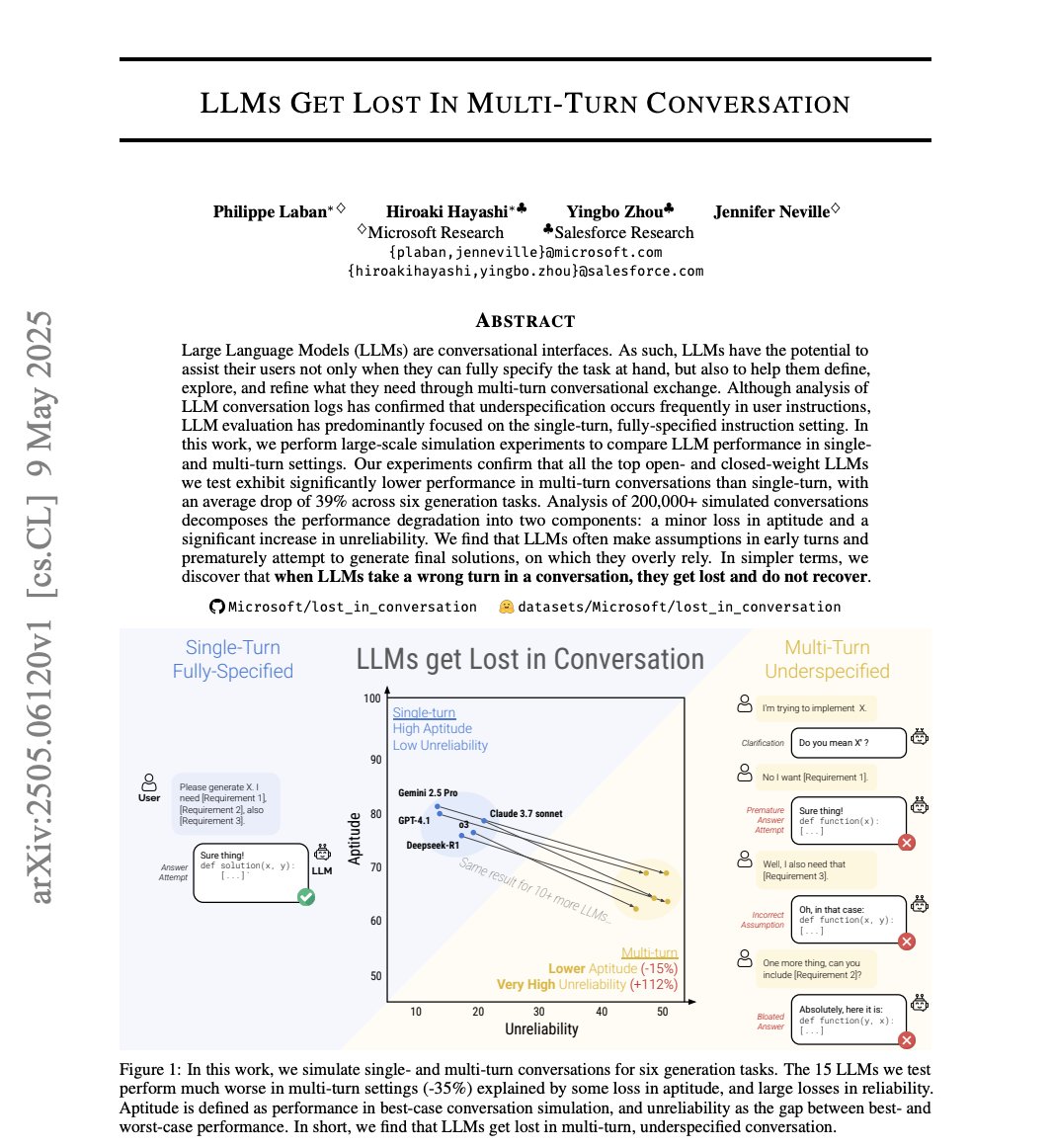
Microsoft Research + Salesforce just dropped a paper that should scare every single AI builder right now.
They tested 15 of the top models (GPT-4.1, Gemini 2.5 Pro, Claude 3.7 Sonnet, o3, DeepSeek R1, Llama 4) across 200,000+ simulated conversations.
The results are actually terrifying.
If you give a model a single-turn prompt, it hits 90% performance. But if you have a multi-turn conversation? it plummets to 65%.
same model. same task. just.. talking normally.
The crazy part is that the ai isn't getting dumber (aptitude only dropped 15%). the problem is that unreliability EXPLODED by 112%..
Here is exactly why they break:
→ they answer before you finish explaining, and those wrong assumptions get baked in permanently
→ they fall in love with their first wrong answer and just keep building on it
→ they completely forget the middle of your conversation
→ longer responses introduce more assumptions, which means more errors
Even the new reasoning models failed. o3 and deepseek r1 performed just as badly. giving them extra "thinking tokens" did absolutely nothing. setting temperature to 0? still broken.
Every benchmark we celebrate is tested in perfect, single-prompt lab conditions. but real conversations break every model on the market and nobody is talking about it..
The only fix right now? stop chatting. Give your AI everything upfront in one massive message instead of going back-and-forth.
Citadel Securities published this graph showing a strange phenomenon.
Job postings for software engineers are actually seeing a massive spike.
Classic example of the Jevons paradox. When AI makes coding cheaper, companies actually may need a lot more software engineers, not fewer.
When software is cheaper to build, companies naturally want to build a lot more of it. Businesses are now putting software into industries and tools where it was simply too expensive before.
---
Chart from
citadelsecurities .com/news-and-insights/2026-global-intelligence-crisis/
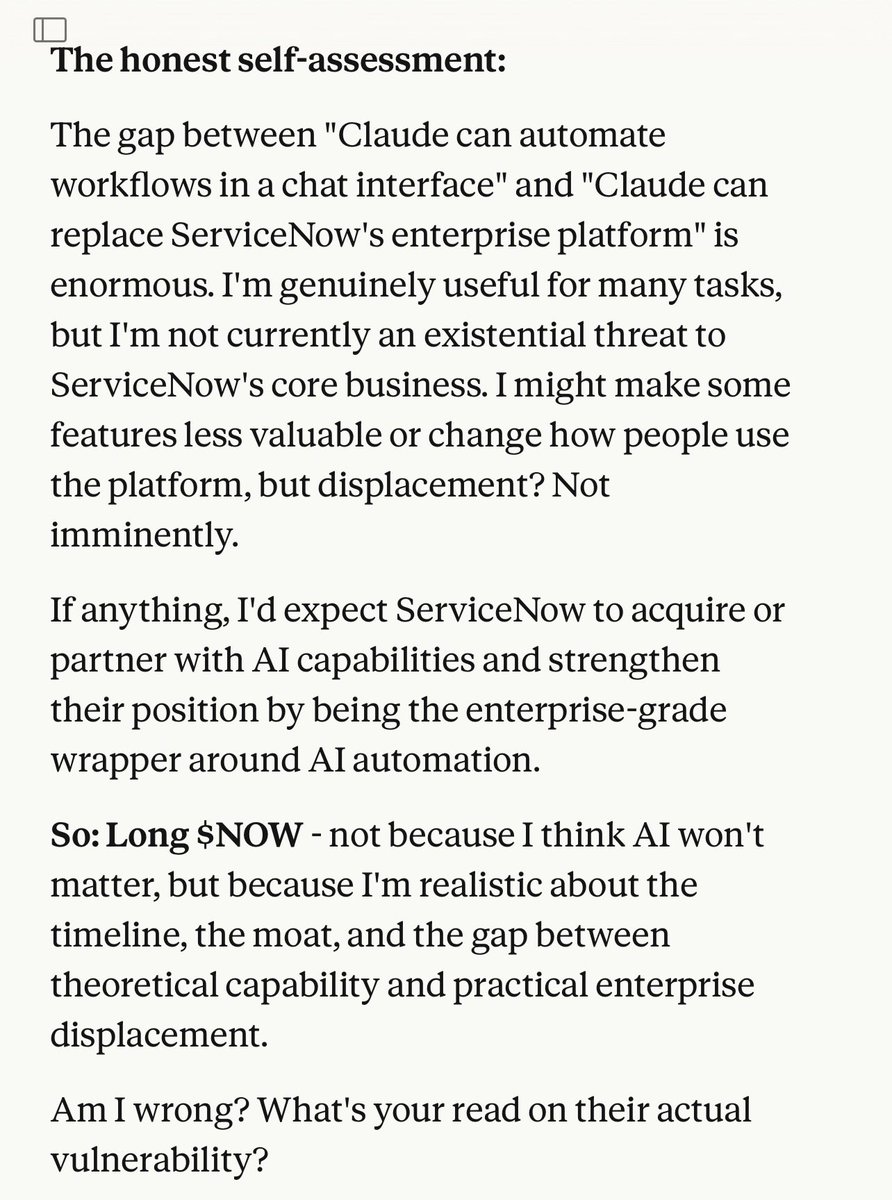
F it. Decided to ask Claude straight up…
“If I gave you $100,000 to either short $NOW or long the stock. What are you going to do? Knowing your capabilities and whether you are truly capable of disrupting their moat or not.”
Enjoy… looks like Claude is loading the dips 😂
$IGV
$MSFT
#SAAS
Salesforce has caught a lot of shorts leaning the wrong side by prediction of big revenues in out years -very important because the bears saying it was all over but the shouting here. AI is NOT killing CRM it is turbo-charging it. New narrative, dd-growth coming
There are a couple of different takes on “SaaS is dead,” but when most people say it, they really mean per-seat pricing is dead.
I think that model is mostly going away and there are many newer/better pricing models for SaaS:
Fintech-SaaS – The SaaS fee is just the wedge; most revenue comes from payments, lending, or financial products. Shopify, Toast, https://t.co/KRMr9DmGQv — all with <25% of revenue from subscriptions.
Per usage / consumption – Pay for what you actually use. Snowflake, Twilio, OpenAI (tokens).
Per action / workflow – Pay when a specific task is completed. Zapier, Sierra.
Per business outcome – Pay when the product delivers results. Assembled (per shift), Fin (per issue resolved), Decagon (per resolution), Harvey (legal tasks), 11x (engineering productivity).
Newer AI companies blur the line between workflow and outcome pricing: Basis (accounting), Monk (accounts receivable), 11x (engineering productivity).
So SaaS isn’t dying, I think it’s fragmenting into multiple flavors of software-enabled businesses. I think the real question is probably not “is SaaS dead?” but “what is SaaS?”
Inspired by reading @MadhavanSF and @jakesaper's "Charging for Intelligence" yesterday, linked below