I just launched a competitor gap finder in my Grok Bot Template.
You want to see how your page stacks up against the top three for your keyword. I analyzed page-1 results from 344 real searches across dozens of niches: flooring, roofing, injury law. The same 50 things kept showing up on top-ranking pages. I built them into a free Grok bot.
Add the template and chat with your own copy. No commands. Give it your keyword, your page, and three competitor pages (it helps you pick them). It asks before visiting, reads all four pages, and shows where most competitors have more than you. Takes 15 to 60 seconds.
It also runs a full technical audit of your site. Every item is something top pages commonly have, and each one is an idea to test.
Add it here: https://t.co/pCH3odArBN
How to make Grok Bot find what your competitors have that you don't:
Add my free template.
Chat with your own copy of the bot. Give it your keyword, your page, and 3 competitor pages (it helps you pick them).
It reads all 4 pages and shows where most of your competitors have more than you.
That's it. No commands. No tools to install.
It checks 50 on-page factors, found in the page 1 results of 344 real searches across dozens of niches. Flooring contractors. Roofers. Even personal injury lawyers, where a single click costs hundreds of dollars.
Every gap it finds is an idea to test on your own page. The same bot also runs a full technical audit of your site.
Here: https://t.co/pCH3odArBN
Your Google Business Profile has a GPS.
And most local businesses typed in the wrong address.
Here’s what I mean:
Your primary category is you telling Google, “THIS is what I do.”
Google takes you at your word. So when a vehicle wrapping company lists “sign shop” as the primary category, Google sends it into the map to fight every sign shop in town. Banners. Yard signs. Business cards.
Meanwhile, your actual competitors, the vehicle wrapping services, are eating the calls that should be yours.
I often see “sign shop” on wrap companies. The primary category is the first thing I check.
The fix:
Your primary category must best match your main service. Not what sounds impressive. What makes you money.
3 to 5 secondary categories behind it. Each one opens a new set of keywords Google will show you for.
If a secondary service isn’t your main revenue source, it goes in a secondary category, never the primary.
One field. It’s the single most impactful field you control.
A surfer doesn't paddle out when the wave arrives. He paddles out before it.
Same rule for local SEO.
Most seasonal business owners look at their keyword, see it has search volume, and launch a campaign whenever they feel like it. Then they wonder why the phone isn't ringing.
The problem: they're paddling out as the wave passes.
Here's what I tell every client before we start: we begin the SEO campaign 3 to 4 months BEFORE the seasonal peak. Not during it. Not after it.
Want proof the peak is real?
Go to Google Trends. Type in "Christmas light installation." Watch that line hit 100 every single December, then drop right back down for the rest of the year.
That 100 isn't 100 searches. Google Trends scores a keyword against its own history. So 100 means: this is the moment people are searching for this service the most.
That's your wave.
And you can't show up to it with a website that's still being indexed. You want your money page the page built specifically to rank for that keyword already ranking when the peak hits.
That takes 3 to 4 months of paddling.
It's late October. Some of you are already late. Some of you are perfectly early for your peak.
Every time I audit a local business I find the same mistakes over and over.
The Google Business Profile services section.
We looked at thirteen hundred Google Business Profiles. The ones that won did one boring thing. They listed fifteen services and added a description to every single one. That alone beats close to ninety percent of your competition.
You cannot do both in the same pass.
First list the service and save it. Then go back and put a description on each one. Two to three sentences. Do not overthink it.
Do not build the whole list in one sitting. Start with five, then ten, then get fifteen on there.
On a garage door company’s Google Business Profile, you want to list the services your company offers.
Garage door repair.
And aim for all of the services you offer.
Then consider the keyword variations and the service variations.
What do I mean by that?
People go into Google and they search just slightly different than everyone else.
So you are going to have instances where you see some of the keywords in reverse order.
You are going to see some of them in the verb tense.
Those go on the profile in your services too.
A good goal to consider is getting at least fifteen with your primary services.
And a good source of these is your own profile.
If you have had it for a while, go to Performance, scroll down a little bit, and you will start to see the keywords and search terms people are using that your profile is appearing for.
If those are relevant to the services or products you offer, start to include them on the Google Business Profile as services.
Then after you have added the service and saved it, go back and add a description.
The description does not have to be complicated.
It is just two to three sentences describing the service you offer.
Behind each of those fifteen you have placed, that is what you add.
When a new client gets onboarded, I go and fill out those services and those descriptions myself.
Your Google reviews are not just stars.
They're content.
Here's what most local owners miss:
When you pull reviews off your Google Business Profile and display them on your website, you now have that content on your page.
That means:
→ Keywords on your page
→ Your entity count goes up
→ Your LSI terms go up
And here's the part that actually moves rankings:
You can go through that review text and bold certain terms. Bolding keywords, entities, or LSI terms is a ranking factor.
You can also pull images from your reviews. From those images, you make the file name and alt text carry keywords, entities, geographic relevance, LSI terms.
95% of websites will dramatically improve SEO by adding more content and backlinks.
You're already showing up for stuff. You just don't know what. Google Search Console knows. Go look.
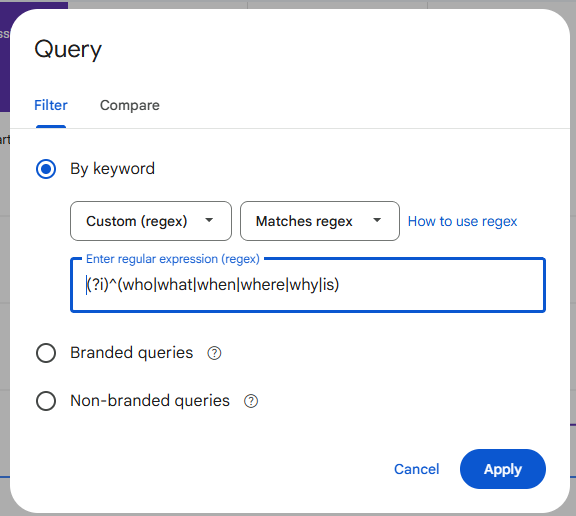
Open Search Console. Hit Performance. Add a filter on Query. Choose Custom (regex). Drop this in. Apply.
(?i)^(who|what|when|where|why|is)
Now you're looking at searches that start with a question word. Real questions. From real people. People who already find you.
Write blogs or shoot videos answering those questions. Google already ties those topics to your site.
Then send backlinks to those posts. Anchor text should match the question. Anchor text is the clickable words in a link.
this feels like cheating.
Google already knows the information. You link it so it is relevant to you.
An entity is something Google already knows about. A Wikipedia article, a Wikidata page, or a Knowledge Graph node they have their own information on.
Schema is where you say what you know about. In your knows about schema, link those other URLs. You are saying you know about that.
Link the Wikipedia URL. Google knows all of that information already.
Find the Google Knowledge Graph ID or the Freebase ID tied to it. Those are codes. Link them and this links to a Knowledge Graph node Google is aware of.
Wikidata is another source of relevance. A majority of the time the Knowledge Graph ID is right there. Do not just link the code. Link the URL. It goes to https://t.co/pjVEvawq2l with the Knowledge Graph ID in it. The AI overview shows Google already knows a ton.