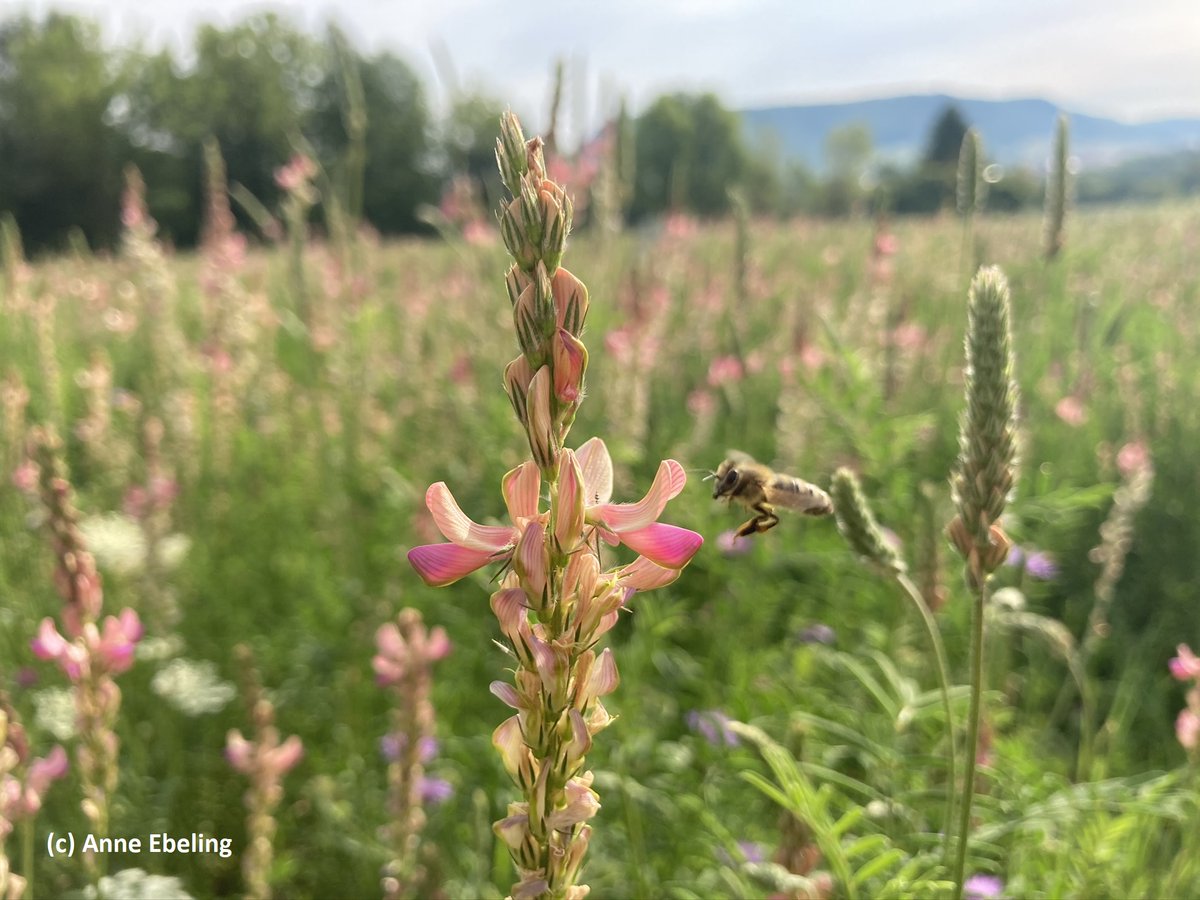
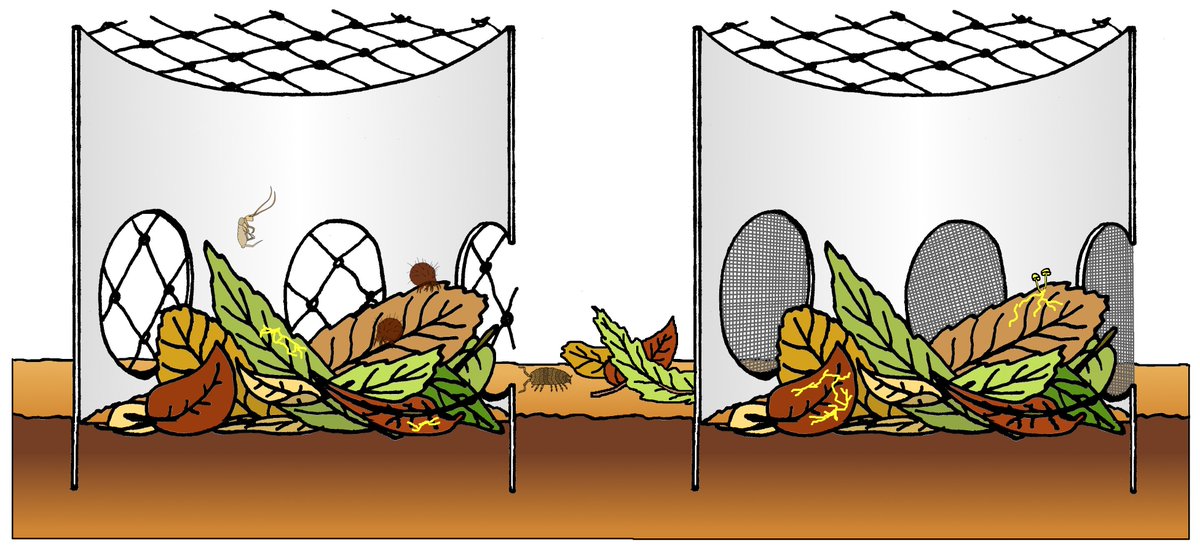
Einer der artenreichsten Lebensräume steht heute an: der Boden! Koordinator der Kapitelgruppe „Bodenbiodiversität“ des #Faktencheck|s #Artenvielfalt Dr. @ChristianRistok stellt euch ein paar spannende Fakten und Zahlen vor, mit Bildmaterial von @terra_aliens. (1/10)
New ideas for #biodiversity research: Jonathan Chase @Jon_Chase03 from iDiv and @UniHalle receives the @ERC_Research Advanced Grant! His research project "MetaChange" will be funded with 2.5 mio euros over the next five years. Congratulations! https://t.co/JqfdBmpdrW
iDiv and @UniJena are recruiting a new W3 (full) professorship for 'Biodiversity in the Anthropocene'! The professorship will be one of iDiv's 9 'core' professorships and based at the core centre in Leipzig. Application deadline: 30 April; more info: https://t.co/bEsVzS3rzp
New mechanistic framework for future experimental research. How soil community composition plays an important role in ⬇️herbivory rates w. ⬆️plant diversity by changing plant metabolomes @ChristianRistok @AlexWein_iDiv @EisenhauerLab @jena_experiment @idiv https://t.co/x00nO232kl
#Artenvielfalt schwindet auch unter der Erde. Die @idiv-geführte Gruppe "Bodenbiodiversität" im Projekt "Faktencheck – Artenvielfalt" erfasst Wissenstand zur Bodenvielfalt sowie deren Haupttreiber und Gefahren in Deutschland. #WorldSoilDay@FEdA_Biodiv https://t.co/ihGIVHCJWy
Are you interested in applying #ecometabolomics to study the volatile and non-volatile #metabolome and the impact of tree species diversity? Then join us in @idiv and @TreeDi1 for a #PhD. https://t.co/pigYm63ZpG
@fonsvanderplas @EisenhauerLab Agreed. However, molecular traits such as defensive compounds are a good predictor for growth-defense trade offs and can be used to predict herbivore resistance and potentially inform about the potential to establish in a community
Plant species richness elicits changes in the metabolome of grassland species via soil biotic legacy, by Ristok et al.
Read online: https://t.co/6IN3kcCwU5
@ChristianRistok @EbelingAE @EisenhauerLab @AlexWein_iDiv
Happy to share the 1. published results from my PhD thesis 🥳 It's a story about #PSF, plant #diversity & #metabolomes and #herbivores. Thanks to @jena_experiment for the opportunity and all @idiv for the help. You can find the #OA paper in @JEcology here: https://t.co/KKB5HjxJ3p
I've got a new publication on #soil macrofauna, #litter decomposition, and secondary #metabolites. I would be thrilled for you to have a read. You can download the paper for free for the next 50 days here: https://t.co/QDkAnCjaOu
Tiny "astronauts". #Insects are passively transported through the air at heights of 3500m a.s.l. This may constitute an important mode of transport during #species#migration. Andreas Macke @idiv seminar series.
Do you want to make it rain? Bio(diversity) is important. "Pollen and bacteria in the air are needed to form clouds and thus rain" Andreas Macke in today's @idiv seminar series.
Are you a bioinformatician, who would like to work on integrative novel projects? NOW is your chance! @idiv is looking for a Post-doctoral researcher in -omics, #bioinformatics and #statistics. Application deadline: 9 Oct! (Please share and Retweet)
https://t.co/C6hf5ZOR69
This is my life currently. Going through my Phospholipid fatty acid GC chromatograms. Quality control and manual identification/assigment. All to answer the question if and how #soil#microbiota alters the #chemistry in #plants?! #plantsoilfeedback
The unique secondary #metabolome defines not only species #interaction. Here, after an extraction with methanol the color of the extracts differs due to the secondary metabolites (Geranium pratense, Ranunculus acris, Leucanthemum vulgare; left to right)
It is oddly satisfying that you can still distinguish the three #plant#species Ranunculus acris, Geranium pratense, and Leucanthemum vulgare (from left to right) even after they were freeze-dried and ground to a powder. All that just by the color. #Diversity