An MIT professor taught the same math course for 62 years, and the day he retired, students from every country on earth showed up online to watch him give his final lecture.
I opened the playlist at 2am and ended up watching three of them back to back.
His name is Gilbert Strang. The course is MIT 18.06 Linear Algebra.
Every machine learning engineer, every data scientist, every quant, every self-taught programmer who actually understands how AI works learned the math from this one man. Most of them never set foot on MIT's campus. They just opened a free playlist on YouTube and let him teach.
Here's the story almost nobody tells you.
Strang joined the MIT math faculty in 1962. He retired in 2023. That is 61 years of standing at the same chalkboard teaching the same subject to 18-year-olds.
The interesting part is what he did when MIT launched OpenCourseWare in 2002. Most professors were skeptical. They worried that putting their lectures online would make their classrooms irrelevant. Strang did not hesitate. He said his life's mission was to open mathematics to students everywhere. He filmed every lecture and gave it away.
The decision quietly changed how the world learns math.
For decades linear algebra was taught the wrong way. Professors started with abstract vector spaces and proofs about field axioms. Students drowned in the abstraction. Most never recovered. They walked out believing they were bad at math when they had simply been taught in an order that nobody's brain is built to absorb.
Strang inverted the entire curriculum.
He started with matrix multiplication. Something you can write down on paper. Something you can compute by hand. Something you can see. Then he showed his students that everything else in linear algebra eigenvectors, singular value decomposition, orthogonality, the four fundamental subspaces was just a different lens for understanding what the matrix was actually doing under the hood.
His rule was strict. If a student could not explain a concept using a concrete 3 by 3 example, that student did not actually understand the concept yet. The abstraction was supposed to come last, not first. The intuition was the foundation. The proofs were just confirmation that the intuition was correct.
The second thing Strang changed was the classroom itself. He said please and thank you to his students. Every single lecture. He paused mid-derivation to ask "am I OK?" to check if anyone was lost. He never used the word "obviously" or "trivially" because he knew exactly what those words do to a student who is one step behind. He treated 19-year-olds learning math for the first time the way he treated his own colleagues. With patience. With respect. With the assumption that they belonged in the room.
For 62 years.
The result is something that has never happened in the history of education. A single math professor became the default teacher of his subject for the entire planet.
Universities in India, China, Brazil, Nigeria, every country with a computer science department, started telling their own students to just watch Strang's lectures. The University of Illinois revised its linear algebra course to do almost no in-person lecturing. The reason was honest. The professor said they could not compete with the videos.
His final lecture was in May 2023.
The auditorium was packed with students who had never met him before. He walked to the chalkboard, taught for an hour, and at the end the entire room stood and applauded. He looked confused for a moment, like he genuinely did not understand why they were cheering. Then he smiled and waved them off and walked out.
His written comment under the YouTube video of that final lecture was four sentences long. He said teaching had been a wonderful life. He said he was grateful to everyone who saw the importance of linear algebra. He said the movement of teaching it well would continue because it was right.
That was it. No book promotion. No farewell speech. No legacy management.
The man whose teaching is the foundation of modern AI just thanked the audience and went home.
20 million views. Zero ego. The entire engine of the AI revolution sits on top of math that millions of people learned for free from one quiet professor in Cambridge.
The course is still on MIT OpenCourseWare. Every lecture, every problem set, every exam, every solution. Free.
The most important math course of the 21st century is sitting one click away from you. Most people will never open it.
Katherine Johnson held lives in her equations - zero margin for mistake.
Born in 1918 in segregated West Virginia, she outran every barrier placed in her path. By age 15 she was already in college, devouring mathematics while the world tried to limit what Black women could dream.
At NACA (later NASA), she became a "human computer," plotting trajectories by hand in an era when electronic machines were distrusted and doors stayed locked for people who looked like her.
Yet when the stakes were orbital and then lunar, her precision became non-negotiable.
John Glenn, first American to orbit Earth in 1962, refused to strap in until Katherine Johnson double-checked the new IBM computer's numbers herself. His words?
“If she says they’re good, I’m ready to go.”
Her calculations cleared the way for:
> Alan Shepard’s first American spaceflight
> John Glenn’s historic orbit
>Apollo 11’s moon landing
She never stood on the pad. She never rode the rocket.
But without her slide rule and unerring mind, those men would never have come home.
History loves the astronauts who touched the stars.
It too often forgets the mathematicians who charted the way through impossible odds.
Katherine Johnson didn’t just compute paths through space.
She carved paths through prejudice. And the sky has never been the same.
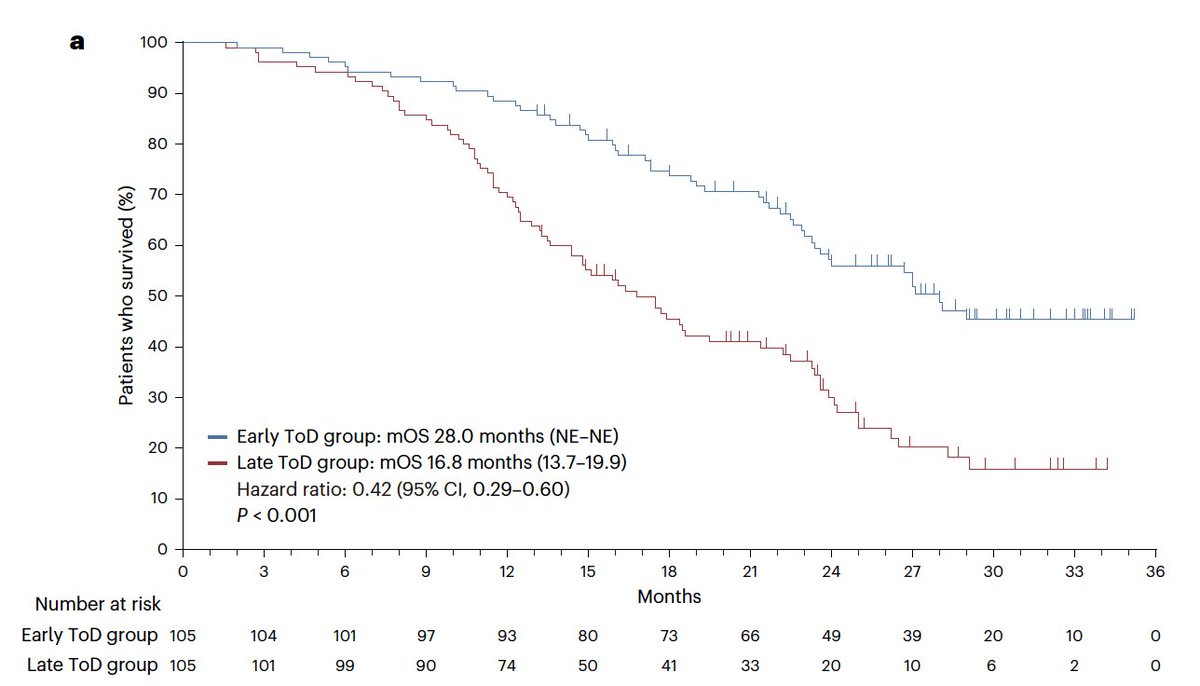
The time of day for cancer immunotherapy is associated with major outcomes. Early is better. Results from a randomized trial of lung cancer, backs up the importance of our circadian rhythm and immune system
https://t.co/bHqUZ3U83O
BREAKING: In a stunning moment, Jimmy Kimmel just unearthed footage of Stephen Miller from high school. And it confirms what we already knew: Miller’s an a**hole.
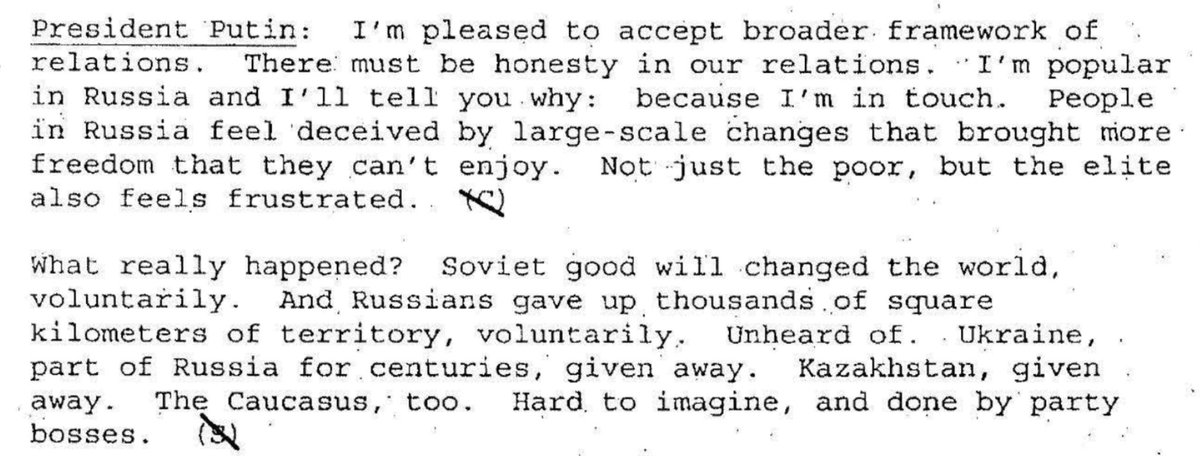
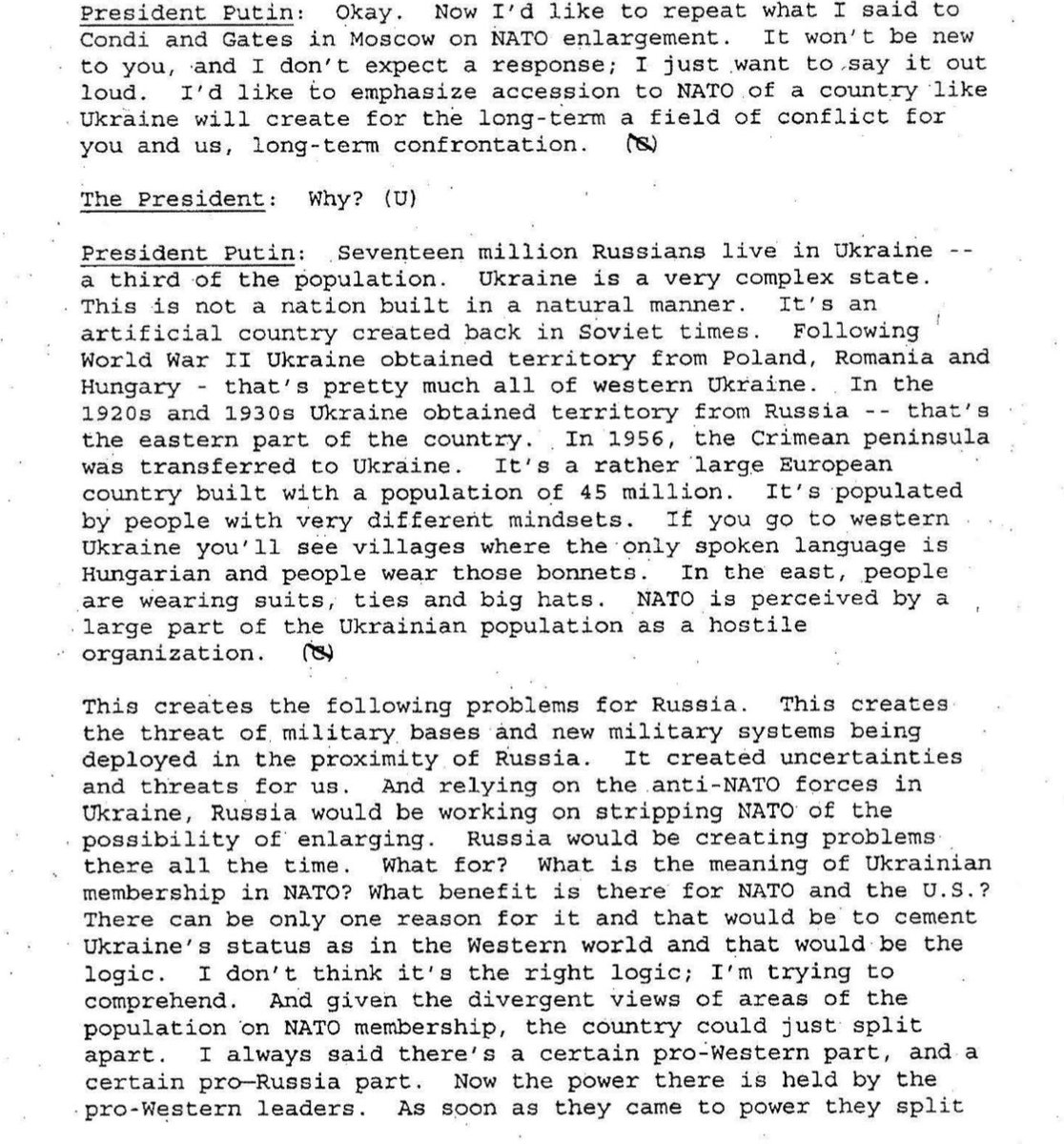
The inevitable conclusion from the released Putin-Bush transcripts:
Putin didn’t invade Ukraine because he opposed NATO enlargement.
Putin opposed NATO enlargement because it would have prevented his goal of invading and eliminating Ukraine.
The ideas he had a quarter century ago - that Ukraine (and Kazakhstan) are “artificial countries” that have been “given away” by Russia and therefore must return — are the ideas he still holds today.
Nobel Peace Prize laureate and human rights defender Oleksandra Matviichuk @avalaina:
"We have 1,6 million children under Russian occupation. Their identities are being erased. They are militarized starting from kindergarten. Their parents are forced to send their children to camps where they wear military uniforms, line up, live in barracks, and are taught how to use weapons.
Russia is preparing the new generation of Putin's soldiers from these 1,6 million Ukrainian children because at the age of 14, they will receive the Russian passport. At the age of 18, they will be forcibly recruited to the Russian army, which means that they will go to fight and to die in any country that Russia sends them to fight and to die.
Because Russia is an empire, and an empire has a center but has no borders. An empire always tries to expand. And that is why when we speak about deported children, children under Russian occupation, it's not just a human rights problem. It's a security problem."
This might be the most insane p-value I've ever seen published:
<1.00e-300
It's for the association between a coronary artery disease (CAD) polygenic score and CAD itself, and it's like the odds of instantaneously teleporting into your neighbor's shower.
I've been reading @matthewcobb's new biography on Francis Crick. It contains many surprises, especially regarding the solving of DNA's structure.
I finished reading through 1953. Here my notes so far:
1. Photograph 51 was not taken by Rosalind Franklin. It was taken by Raymond Gosling, a PhD student working with Franklin, in May 1952.
2. Also, Photograph 51 played no role in Watson/Crick's model.
Writhes Cobb: "Crick did not see the photo until weeks after they had discovered the structure, nor did it provide Watson with any new information beyond a very rough idea of the itensity distribution [of the x-ray crystallography data.]"
Franklin's real contribution to the structure, and an idea which she discussed as early as 1951, was instead that the crystalline form of DNA was "a face-centred monoclinic unit cell with the C-axis parallel to the fibre axis." In other words, her crystallography data showed that there were two strands in DNA, and that those strands ran antiparallel with the bases inside. Again, she publicly disclosed this in a 1951 lecture, but apparently all Watson could recall about that lecture was Franklin's appearance, as he later described in his book.
3. It's widely thought that Watson and Crick, after building their model, walked into the Eagle pub in Cambridge and told "everyone within hearing distance that [they] had found the secret of life." This came from Watson's book, The Double Helix, but it is entirely made up. Crick said it did not happen, and Watson admitted the same in 2016.
4. Around the same time that Max Perutz was trying to solve a protein structure for the first time, a researcher in New York named David Harker received a $1 million grant to try to become the first instead. This is surprising for two reasons: a) I had never heard of Harker and b) $1 million was a HUGE sum at the time; a typical house in England cost ~$1,800 at the time. TL;DR The best-funded labs do not always get the spoils.
5. Between 1947 and 1949, "nearly two hundred papers were published on DNA." This at a time when papers were much less frequent than they are now. This was surprising because the structure, let alone proof that DNA was the genetic material, did not come until many years later! The lesson, of course, is that just because a field seems "hot" does not mean you should not work on it; the big discovery may still be there for the taking.
6. Freeman Dyson warned Crick against migrating from physics into biology. "If you switch to biology now, you will be too old to do the exciting stuff when biology finally takes off," Dyson told him.
7. Watson and Crick (and many other molecular biologists who came from physics) explicitly said they decided to pivot into biology after reading Schrodinger's small book, "What is Life?"
In short, writing can have a huge influence on the trajectory or invention of scientific fields. I recommend reading this book. My short social media posts cannot do the story justice.
I finally read the Kosmos "AI Scientist" paper from FutureHouse. Here is a bit about what they did and what I think about it.
> The general idea behind this paper, and others like it, is that science follows a series of steps and that much of these steps can be automated. Those steps are:
- Search the literature. Read stuff.
- Use your reading to come up with new hypotheses. Try to draw connections between things.
- Analyze data to draw conclusions. Write up your results.
- Repeat.
Kosmos uses two separate agents — one for data analysis and another for literature searches — to go out and do these tasks while sharing information with each other. The agents can see what the other agents have learned, in other words, which is super useful. They exist within a single "world model." A single run of Kosmos can execute up to 42,000 lines of code across 166 different data analysis agents, and also read 1,500 scientific papers using 36 literature review agents. Each run takes up to 12 hours.
So that’s the gist. You spin this thing up, give it a huge prompt, and then let it cook. In this preprint, they report seven discoveries that they say were made by Kosmos; “three discoveries made by Kosmos reproduce findings from preprinted or unpublished manuscripts,” which are not in its training dataset, “while the remaining four make novel contributions to the scientific literature.”
FutureHouse handed Kosmos to researchers around the world, working in myriad fields (electronics, neurology, materials, etc.), and let them test it out. Here are some of the “discoveries” they reported:
1. By feeding Kosmos some mouse brain metabolomics data, it suggested that cooling the brain’s temperature might activate nucleotide-salvage pathways, which basically preserves neurons during hypothermia. This had been shown in an unpublished paper and was later re-confirmed.
2. Using environmental sensor data from a recent arXiv paper, it identified a linear relationship between the solvent vapor on a solar cell and that cell’s current. In other words, humidity matters a lot? Not sure if this is surprising or not, as I have no background in this field. But again, it was a sort of “re-discovery” to see if Kosmos could find results that humans had already identified (but had not yet published.)
3. Higher levels of an enzyme, called superoxide dismutase 2, in the blood may reduce myocardial fibrosis. Published papers had previously identified a correlation between SOD2 and myocardial fibrosis, but Kosmos re-pointed at it and humans followed up to show it’s causal.
Here are my quick thoughts:
1. Many other AI scientists (both at nonprofits and for-profits, which have not yet been released) are trying to do the same thing. We clearly need better benchmarks to know what is real and what is fake. It seems like Kosmos is real, but how does this compare to Google etc?
2. I’m not wholly convinced that the idea of extremely long runs will be palatable to most biology researchers. My take is that researchers are looking for more of a real-time collaborator, where you’re constantly prompting and getting immediate feedback, rather than just delegating huge, open-ended tasks to agents. If a “general user” tests out Kosmos, pays the large price tag, and is disappointed by the results, will they keep using it? The wait time is a huge barrier, as is the price (even though academics get generous access.) Also difficult to prompt engineer?
3. This paper tries to quantify “the time it would take for a human scientist to complete the work that Kosmos performs in an individual run,” but I find it a bit hand-wavy. They say it takes a typical researcher 15 minutes to read a paper and 2 hours to write a Jupyter notebook for data analysis and, since Kosmos can read 1,500 papers per run, it offers a huge time savings.
But human scientists don’t need to read hundreds of papers to make a discovery! The best scientists have an innate ability to “triangulate to innovation;” to find the right combo of papers and discussions that enable them to make conceptual advances. This seems difficult to replicate.
I'd like to have more discussions about AI Scientists, if any of you are interested.
We’re thrilled that base editing, developed by researchers in the lab of Broad member @davidrliu, is having such a profound impact in the clinic. Congratulations to former Broad postdoc @kiranmusunuru and @ChildrensPhila for their groundbreaking work. https://t.co/jTQJ69aTST
🤖 #ChatGPT wrote the ‘Discussion’ section of an @MDPIOpenAccess paper in the 𝘛𝘰𝘹𝘪𝘯𝘴 journal?! The authors may have failed to remove the “Regenerate Response” label of the button when they copy-pasted ChatGPT's output 🤡 #fail Reported on @PubPeer https://t.co/6tAumNd9ym
In a prospective cohort of 1,127 patients with non-small cell lung cancer and ctDNA-guided therapy, ctDNA detection was associated with shorter survival, independently of clinicopathologic features. #NSCLC#LungCancer#LCAM22@MSKCancerCenter
https://t.co/iCBFeFtTDB
I'm impressed by our #Artemis I team's dedication - their care for @NASA_SLS and @NASA_Orion is keeping us on track. Designing for this environment is challenging, and our design stood up to the test of the storm. We are pressing toward launch on Nov 16: https://t.co/GGHeKcp0yQ







![NikoMcCarty's tweet photo. I've been reading @matthewcobb's new biography on Francis Crick. It contains many surprises, especially regarding the solving of DNA's structure.
I finished reading through 1953. Here my notes so far:
1. Photograph 51 was not taken by Rosalind Franklin. It was taken by Raymond Gosling, a PhD student working with Franklin, in May 1952.
2. Also, Photograph 51 played no role in Watson/Crick's model.
Writhes Cobb: "Crick did not see the photo until weeks after they had discovered the structure, nor did it provide Watson with any new information beyond a very rough idea of the itensity distribution [of the x-ray crystallography data.]"
Franklin's real contribution to the structure, and an idea which she discussed as early as 1951, was instead that the crystalline form of DNA was "a face-centred monoclinic unit cell with the C-axis parallel to the fibre axis." In other words, her crystallography data showed that there were two strands in DNA, and that those strands ran antiparallel with the bases inside. Again, she publicly disclosed this in a 1951 lecture, but apparently all Watson could recall about that lecture was Franklin's appearance, as he later described in his book.
3. It's widely thought that Watson and Crick, after building their model, walked into the Eagle pub in Cambridge and told "everyone within hearing distance that [they] had found the secret of life." This came from Watson's book, The Double Helix, but it is entirely made up. Crick said it did not happen, and Watson admitted the same in 2016.
4. Around the same time that Max Perutz was trying to solve a protein structure for the first time, a researcher in New York named David Harker received a $1 million grant to try to become the first instead. This is surprising for two reasons: a) I had never heard of Harker and b) $1 million was a HUGE sum at the time; a typical house in England cost ~$1,800 at the time. TL;DR The best-funded labs do not always get the spoils.
5. Between 1947 and 1949, "nearly two hundred papers were published on DNA." This at a time when papers were much less frequent than they are now. This was surprising because the structure, let alone proof that DNA was the genetic material, did not come until many years later! The lesson, of course, is that just because a field seems "hot" does not mean you should not work on it; the big discovery may still be there for the taking.
6. Freeman Dyson warned Crick against migrating from physics into biology. "If you switch to biology now, you will be too old to do the exciting stuff when biology finally takes off," Dyson told him.
7. Watson and Crick (and many other molecular biologists who came from physics) explicitly said they decided to pivot into biology after reading Schrodinger's small book, "What is Life?"
In short, writing can have a huge influence on the trajectory or invention of scientific fields. I recommend reading this book. My short social media posts cannot do the story justice.](https://pbs.twimg.com/media/G5qigqTbkAAtLGD.jpg)