Advocate of the High Court of Kenya.⚖️
MCIArb.
Sports and Sports Law Enthusiast.
Legal Researcher and Writer..
Recreational Runner;
Ordained to CONQUER
If you can't afford @kwskenya Nairobi National Park entry fees, just loiter around Maasai Lodge area at ungodly hours. You'll take as many selfies with the big Cats.
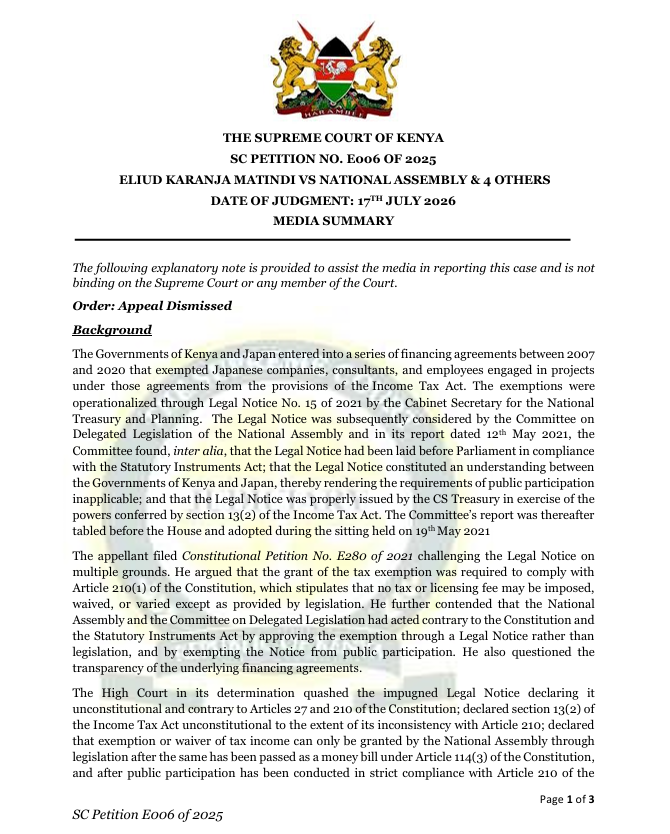
Link to the Judgement, Media Summary and Rulings delivered by the Supreme Court of Kenya on 17/07/2026.
https://t.co/6GwAYL7BgP
You can access all our decisions from our website: https://t.co/c0MGznIfQn
Judgement in:
SCPT/E006/2025
Eliud Karanja Matindi -vs- The National Assembly & 4 Others (Media summary attached)
Rulings in:
1) SCREF/E001/2026
The Speaker, County Assembly of Meru; IEBC & EACC – Proposed Interveners
2) SCAPP/E011/2026
The Speaker, National Assembly -vs- The Bloggers Association of Kenya (BAKE) & 6 Others
https://t.co/6GwAYL7BgP
In a game full of ego, Olise chose to stand by the people who stand by him ❤️
About a month ago, Olise deleted all his photos on Instagram. People thought he was putting pressure on Bayern Munich’s management after the media started talking about Real Madrid’s interest. But the story turned out to be something else entirely.
Olise has a private photographer named Florence Pernet who attends all his matches with him and takes special photos that are different from what the other journalists shoot. He always posts only her photos on his Instagram. The thing is, during the World Cup, the U.S. authorities refused her entry.
As a result, Olise decided to delete everything. In support of her, he chose not to post anything on his account except the photos she takes from the TV screen. If you open his account now, you’ll see that all the photos look like they were taken from a screen — not live shots.
She’s sitting at home, respected and well taken care of, watching him on the television and photographing the screen. And the player, in turn, completely ignores all the high-quality 4K photos and fancy professional shots that are taken for him — he only posts hers.
Honestly, after this whole situation, my respect and admiration for Olise has grown even more. Bless his parents for raising such a decent, grounded guy who never forgets anyone who works with him and always has their back ❤️
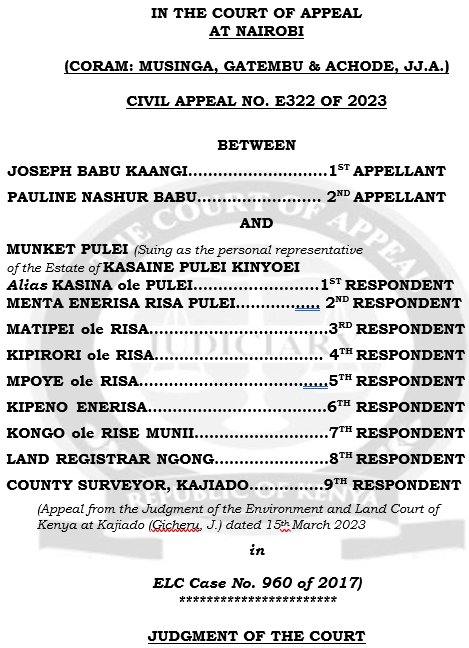
🚨🚨GROUNDBREAKIING FROM THE COA: YOUR TITLE DEED CAN'T BE CANCELLED WITHOUT YOU BEING HEARD
The Court of Appeal has delivered a landmark decision that will reshape how land disputes are litigated in Kenya. In Joseph Babu Kaangi & Another v Munket Pulei & Others (Civil Appeal No. E322 of 2023), a landowner successfully obtained a judgment in the Environment and Land Court declaring several subdivisions fraudulent and cancelling the resultant titles. The problem? Some of those parcels had long been sold to third parties who held their own title deeds, yet they were never joined to the case or given an opportunity to defend their interests. When those purchasers later discovered that their titles had effectively been wiped out by a judgment in proceedings they knew nothing about, they moved the Court seeking to be heard.
The Court of Appeal agreed with them. It held that once the court is aware that land has been transferred to third parties whose proprietary rights stand to be affected, those parties are necessary participants in the proceedings. A court may even direct their joinder on its own motion. Having found that the purchasers' constitutional right to be heard had been violated, the Court set aside not only the ruling refusing to join them, but also the entire judgment that had cancelled the titles. The dispute will now be heard afresh before a different judge with all affected proprietors participating.
The jurisprudential significance of this decision cannot be overstated. It reinforces that no matter how strong a claim of fraud or illegal acquisition may be, Kenyan courts will not permit proprietary rights to be extinguished through proceedings conducted in the absence of those whose titles are directly under attack. The right to be heard is not a procedural technicality; it is a constitutional safeguard capable of undoing an entire judgment. Going forward, litigants seeking cancellation of land titles must ensure that every person whose registered interest may be affected is brought before the court, or risk seeing years of litigation collapse on appeal.
Kindly repost widely 🙏
In Mwangi v ABSA Bank Kenya PLC [2024] KEELRC 2399 (KLR), the Employment and Labour Relations Court considered whether an employer's surveillance of an employee's private life violated the constitutional right to privacy under Article 31 of the Constitution.
The claimant, a senior branch manager, had been suspended and later dismissed following investigations into alleged breaches of banking procedures. During the suspension, the bank engaged a private investigator who monitored the claimant's movements in public places, including restaurants and pubs, and sought personal information from third parties unrelated to the disciplinary allegations.
The Court held that although the claimant's dismissal was substantively and procedurally fair due to his breach of fiduciary duties and conflict of interest, the employer's intrusion into his private life was unjustified. It emphasized that an employee does not forfeit the constitutional right to privacy merely because disciplinary proceedings are underway.
Where an employer seeks to rely on an employee's conduct outside the workplace, the proper course is to confront the employee through established disciplinary procedures rather than undertake covert surveillance.
The Court reaffirmed that Article 31 protects individuals from unwarranted collection of personal information unrelated to their employment and that privacy is a fundamental constitutional value essential to dignity and autonomy.
Consequently, the Court declared that the claimant's right to privacy had been violated and awarded KSh 5 million in general damages for the constitutional breach.
#KatibaWednesday
#ProgressiveLawReform
🚨🗣️ Arsene Wenger: "When you analyze the World Cup today, the game is moving at a pace you have to be able to keep up with."
"For instance, the Asian teams were all eliminated because they couldn't match the INTENSITY and SPEED of the game. Nor do they have the technical quality to really compete."
"For me, the real question mark is Spain. If any team is capable of beating France, I’d say it’s Spain."
"That's because they have a higher level of technical skill than France and a culture of collective football that is unmatched anywhere else in the world."
🚨 FIFA has reached an agreement with former France midfielder Lassana Diarra. Diarra had been seeking €65m in compensation.
Back in 2014, FIFA fined Diarra €10m after he left Lokomotiv Moscow one year into a four-year contract. The CJEU ruled in October this was in breach of EU law.
🗣️ FIFA spokesperson: "Following the global agreement they have reached, Mr Lassana Diarra and FIFA have settled all legal proceedings between them.
"FIFA has not made any admission of liability nor payment by way of compensation. FIFA will not be providing any further comment at this time."
🔴🚨ELRC Sends Blunt Message to Employers as Ex-Employee Wins Kshs.1.25 Million After Unfair Dismissal
In Kagai v Kenga Equatorial Hotels Limited t/a Mombasa Continental Resort, the Employment and Labour Relations Court ruled in favour of Benson Muriithi Kagai, a Procurement Manager who had been dismissed barely five months into employment without being told why. The employer later attempted to justify the dismissal using allegations surrounding a delayed Kshs.2.7 million linen procurement deal. However, evidence before the court showed that the purchase orders, payment approvals, and cheques had all been authorized by senior management and company signatories. The court found that the termination letter itself contained no accusation, no misconduct claim, and no explanation beyond a vague reference to a contractual clause allowing termination by notice.
Justice Agnes Kitiku Nzei held that an employer cannot dismiss an employee first and then begin constructing reasons during trial. The court emphasized that Sections 41, 43, and 45 of the Employment Act require employers to provide valid reasons for termination and accord employees a fair hearing before dismissal. Since the Respondent neither informed the Claimant of any accusations nor subjected him to disciplinary proceedings, the dismissal was declared both procedurally and substantively unfair. The court further clarified that paying salary in lieu of notice does not excuse an employer from complying with statutory safeguards under employment law. Kagai was consequently awarded Kshs.1.25 million as compensation for unfair termination.
The decision carries major implications for ordinary employees and employers across Kenya. To the common mwananchi, the judgment reinforces that employers cannot use intimidation, office politics, or sudden dismissal letters to sidestep due process. Even short-term employees remain protected by the law and are entitled to dignity and fairness at the workplace. For employers, the ruling is a warning that internal frustrations, management conflicts, or boardroom pressure cannot replace lawful disciplinary procedures. Once termination occurs without proper reasons and hearing, the court is unlikely to rescue the employer later through afterthought explanations raised during litigation.
Kindly retweet🙏
🚨🚨BREAKING: COURT BACKS EMPLOYER, SAYS YOU DON’T NEED A CRIMINAL CONVICTION TO FIRE AN EMPLOYEE FOR MISCONDUCT
In a major decision likely to shake workplaces across Kenya, the Employment and Labour Relations Court in Mombasa in Ogola v Bamburi Cement PLC (Cause E056 of 2025) [2026] KEELRC 1294 (KLR) has upheld the dismissal of a long-serving employee of who was accused of attempting to leave the company premises with electrical spares hidden in his bag. The employee fought back hard, arguing that police investigations found no criminal case against him and that he was never charged in court. He claimed the dismissal traumatized him, caused anxiety and mental distress, and insisted the CCTV footage never showed him actually stealing anything. But the court still sided with the employer. Justice ruled that an employer is legally allowed to dismiss an employee once internal investigations create a genuine and reasonable belief that gross misconduct occurred, even if no criminal charges are ever filed.
The judgment now sends a chilling warning to employees across the country: your job can still disappear even when the police do not charge you. The court emphasized that workplace disciplinary processes are completely separate from criminal proceedings. According to the court, an employer only needs to show that it genuinely believed misconduct happened after following proper disciplinary procedure. In this case, the company proved that the employee was issued with a show-cause letter, invited to disciplinary hearings, allowed representation, and given a right of appeal. The court also noted that the recovered items matched company stock and that the employee already had previous warning letters on record. Once trust and confidence break down in employment, the court said, the employer is entitled to terminate the relationship.
For employers, the ruling comes as a powerful message of confidence and authority. The court has effectively reaffirmed that companies are not helpless when handling internal misconduct, theft allegations, or breaches of trust. As long as due process under the Employment Act is followed, employers do not have to wait for the police, the DPP, or criminal courts before taking action against an employee. The former employee walked into court seeking millions in compensation and damages. Instead, his entire case was dismissed with costs. The message from Mombasa is loud, sharp and unforgiving: if an employer can demonstrate a fair process and reasonable grounds for suspicion, Kenyan courts will stand behind workplace discipline - even where no criminal conviction exists.
Kindly retweet 🙏
A hospital cannot detain a discharged patient for non-payment of medical bills. Detention on account of an outstanding hospital bill amounts to unlawful self-help, violates the patient’s constitutional rights to liberty, dignity and freedom of movement, and cannot be justified as a debt-recovery mechanism. A hospital policy that permits detention after discharge, or refusal to discharge until the accrued bill is settled, is not constitutionally sound.
In Gicheru v Nairobi Hospital & another (Constitutional Petition E258 of 2026) [2026] KEHC 5341 (KLR), a ruling delivered on 28 April 2026, R.E. Aburili J considered two interlocutory applications by Stephen Ndwaru Gicheru, who sought an interim mandatory order for his release from Nairobi Hospital. He had been discharged after open-heart surgery but remained at the hospital because of non-payment of the balance of his medical bill, after the insurance company declined to settle it. The petitioner argued that his continued detention was unconstitutional and violated his rights under Articles 28, 29, 39 and 47 of the Constitution. His family had shown good faith by paying KShs 1,000,000 and had undertaken to settle the outstanding lawful bill, but the hospital declined to release him.
The Court held that the right to personal liberty is one of the most fundamental human rights and that any detention not authorised by law, where used to procure payment of a contractual debt, violates the right to liberty and affronts human dignity. Relying on earlier authorities, including Ndegwa v Republic, Sonia Kwamboka Rasugu v Sandalwood Hotel & Resort Ltd, Maina v Registered Trustees of the Sisters of Mercy (Kenya) t/a Mater Misericordiae Hospital, and international human rights instruments including the ICCPR, the Court reiterated that liberty cannot be curtailed merely because a person is unable to fulfil a contractual obligation.
The Court emphasised that hospitals are entitled to recover lawful medical bills, but they must do so through lawful debt-recovery mechanisms, not by detaining discharged patients. It stated that it cannot be a hospital policy to detain patients after discharge, or to refuse discharge until the accrued bill is settled, because such a policy is not constitutionally sound. Since the petitioner had already been discharged, part of the bill had been paid, and his family had undertaken to settle the outstanding lawful bill, the Court found that this was an exceptional case justifying an interim mandatory order.
The Court therefore ordered Nairobi Hospital and its Chief Executive Officer to immediately release Stephen Ndwaru Gicheru, together with all his medical records, to his next of kin for post-operative follow-up care, upon the next of kin signing an undertaking to settle any outstanding lawful medical bill incurred at the hospital.
Read full ruling here: https://t.co/kD6Weirpop
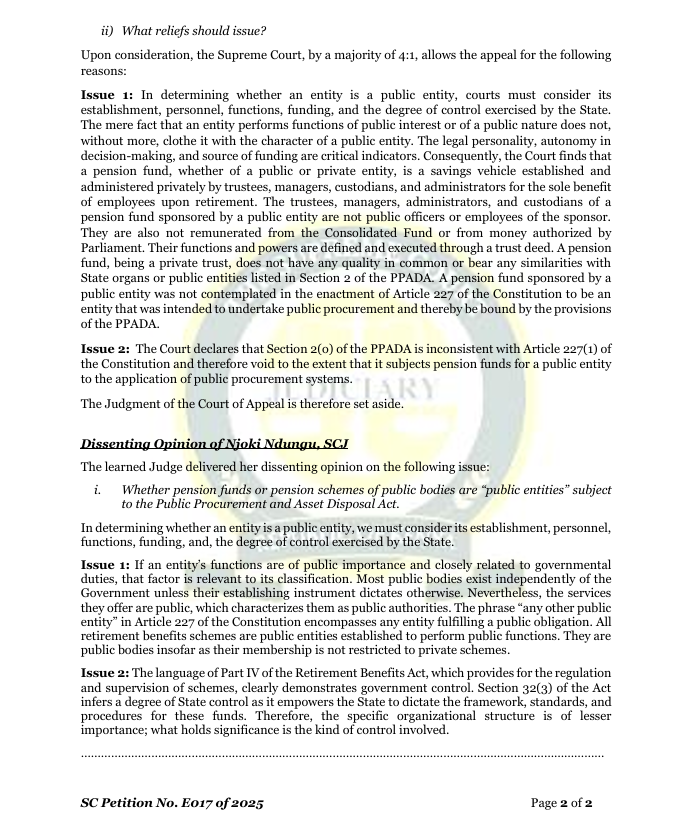
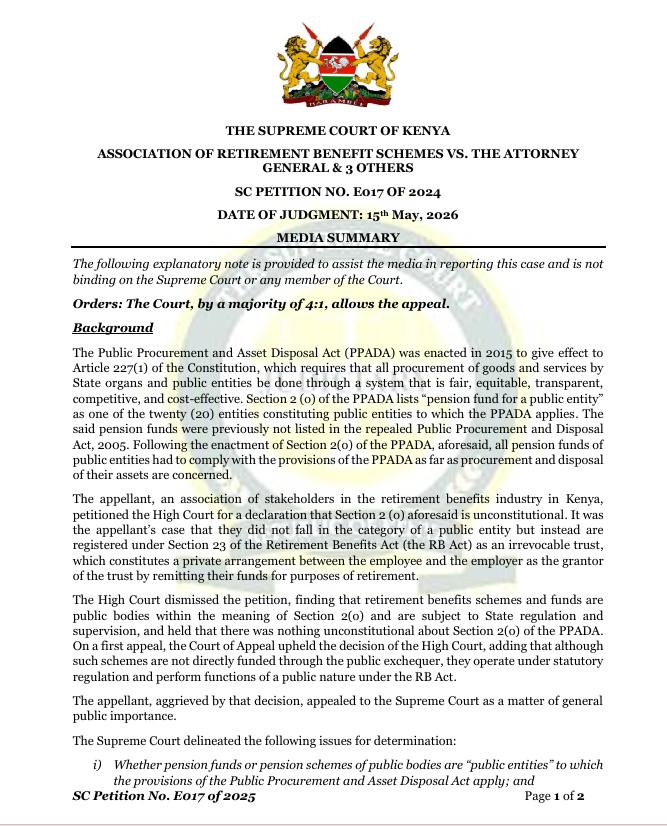
Judgements and Rulings delivered by the Supreme Court on 15/5/2026.
Link:https://t.co/YrKJ3WpU2N
Remmember to get all our decisions from our website: https://t.co/NMRIbloY9q
1) SCPT/E017/2024 The Association of Retirement Benefits Schemes -vs- The Hon. Attorney General & 3 Others
2) SCPT/E047/2024 Erick Kibinu (Suing as the Legal/Personal Representative of the Estate of Loise Gachiku Kinuthia (Deceased) -vs- Josephat Gacheru Rugiri & 3 Others
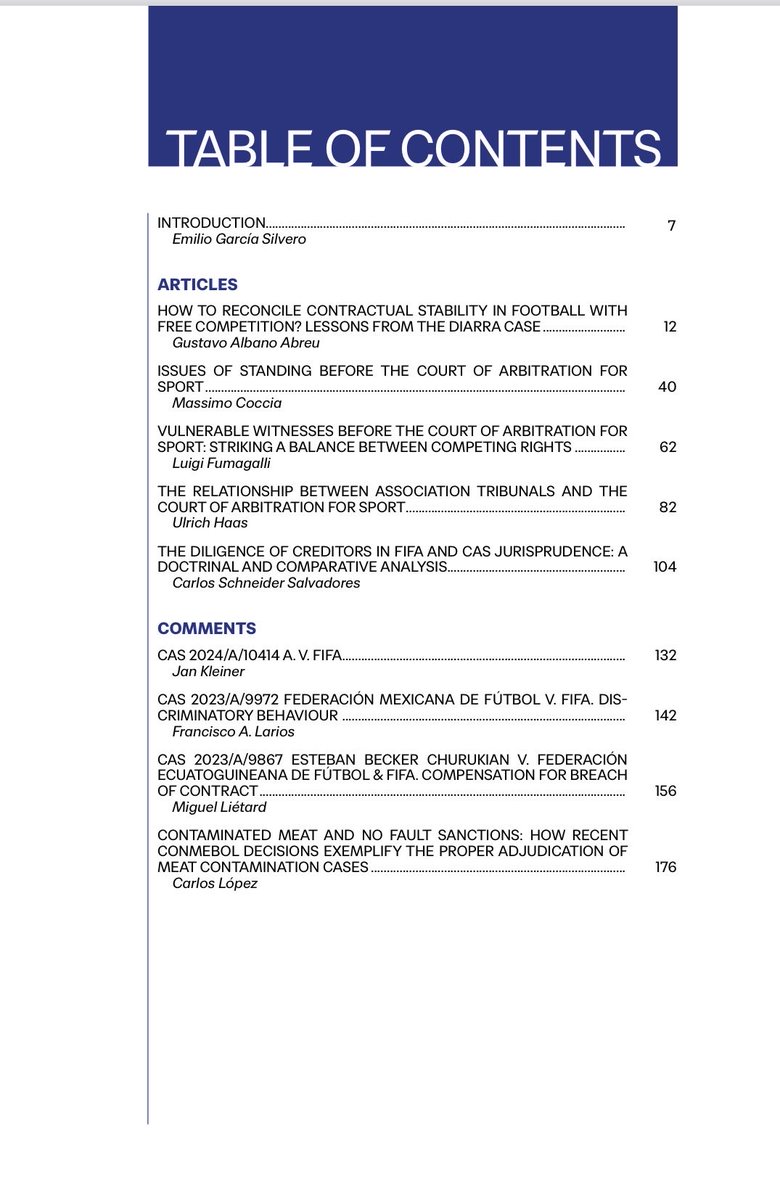
Today, we are launching a new initiative to further promote transparency & knowledge sharing: the FIFA Legal Journal.
✅ Published twice a year;
✅ Our goal: to enhance legal understanding in ⚽️.
Issue 1/2026 with great contributions 👇
https://t.co/CXinVPtwLK
A big win for our Client at the ELC Court at Kajiado. The Court struck out the entire suit we challenged for want of locus standi. The court agreed with our position that where proceedings are brought on behalf of a deceased person, a Limited Grant Ad Litem is mandatory. Without it, the suit is incompetent and a nullity ab initio. It is not curable by amendment or the overriding objective.
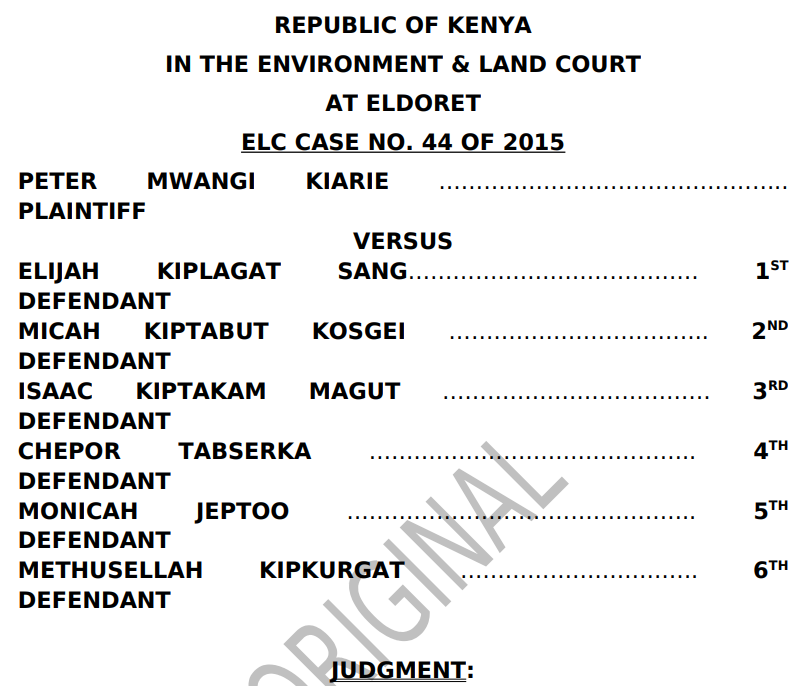
BREAKING FROM THE ELC: COURT DECLARES LAND BUYERS TRESPASSERS AFTER WIDOW SOLD ESTATE LAND
This is the nightmare many Kenyans quietly live with. You buy land from a widow, she shows you the title, takes you to an advocate, signs agreements, receives your money, and even allows you to take possession. You fence, farm, build, and raise your family for years; believing the land is yours. That is exactly what happened in Peter Mwangi Kiarie v Elijah Kiplagat Sang & 5 Others (ELC No. 44 of 2015, Eldoret). Several buyers purchased portions of a 50-acre parcel from a widow who was an administrator of her late husband’s estate. They paid hundreds of thousands, took possession, and some stayed on the land for nearly two decades. Then years later, the deceased’s son walked into court and called them trespassers.
The ELC delivered a painful but powerful ruling: one administrator cannot sell estate land alone. The court held that where there are co-administrators, they must act jointly. Since the widow sold the land without the consent or participation of her co-administrator son, the sale agreements were declared invalid, despite buyers having agreements, witnesses, advocates, and years of occupation. Even worse, the court found that the purchasers could not rely on the doctrine of innocent purchaser, because they failed to conduct proper due diligence, confirm ownership, or verify authority to sell estate land. Years of possession, development, and even sympathy could not override the law.
This judgment is a harsh wake-up call across Kenya. Many families quietly sell inherited land before succession is properly finalized. Many buyers trust widows, elders, brokers, and even some lazy advocates, then move in and develop the land. But this ruling sends a chilling reminder: if the seller lacked legal authority, your land can disappear years later. And to families quietly selling estate land without full authority, the court has spoken: culture, family arrangements, and informal consent cannot replace legal capacity. For those already caught in such disputes, this judgment is both a warning and a beacon, because where illegal sales occur, courts are increasingly stepping in to untangle the mess, refund buyers, and restore lawful ownership.
Kindly repost widely🙏🙏
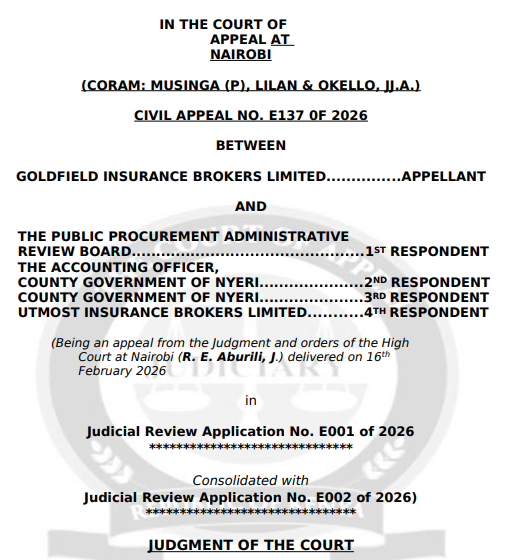
🔴🚨 BREAKING FROM THE COURT OF APPEAL: SEE AN IRREGULAR TENDER? CHALLENGE IT IMMEDIATELY OR LOSE YOUR RIGHT FOREVER
Across Kenya, many businesses walk away from public tenders feeling cheated; irregular bid openings, unexplained clarifications, sudden changes, yet they wait, hoping the issue will be corrected during evaluation or after the award. In Goldfield Insurance Brokers Limited v Public Procurement Administrative Review Board & Others (Court of Appeal, 2026), the Court of Appeal of Kenya has delivered a stark and dramatic reality: if you see a procurement irregularity and fail to challenge it within 14 days, the law shuts the door, completely! In this case, a bidder noticed that during tender opening, a competitor’s bid security was read out as significantly lower than required, only for the procuring entity to later “clarify” the figure through SMS and calls. The bidder waited until the final award before challenging the process, but by then, time had already run out.
The Court of Appeal ruled that procurement timelines are unforgiving and strictly enforced. Once a bidder becomes aware of a breach, even at the tender opening stage, the 14-day clock begins to run immediately. The judges emphasized that a bidder does not need to wait for the final award, disqualification, or outcome before challenging a flawed process. Waiting to see whether you win or lose before filing a complaint is not strategy, it is fatal. The Court held that once the complaint is filed late, the Review Board has no jurisdiction at all, meaning even a strong complaint collapses purely on timing.
This judgment delivers both a warning and scattered hope to businesses navigating public procurement. The hope lies in the Court’s clarity: the law protects bidders against irregular procurement, but only for those who act quickly. The warning is equally powerful: silence, hesitation, or delay can permanently lock you out of justice. For businesses across Kenya, the message from the Court of Appeal is unmistakable: When you see a flawed tender process, act immediately, because in procurement law, time is not just important… time is everything.
Kindly repost.🙏
.@PoliceFCKE CEO @ChuTsi1 has urged FKF PL clubs to lead the fight against match-fixing and hooliganism, as the federation met with the football clubs for a strategic workshop in Nairobi on Thursday.
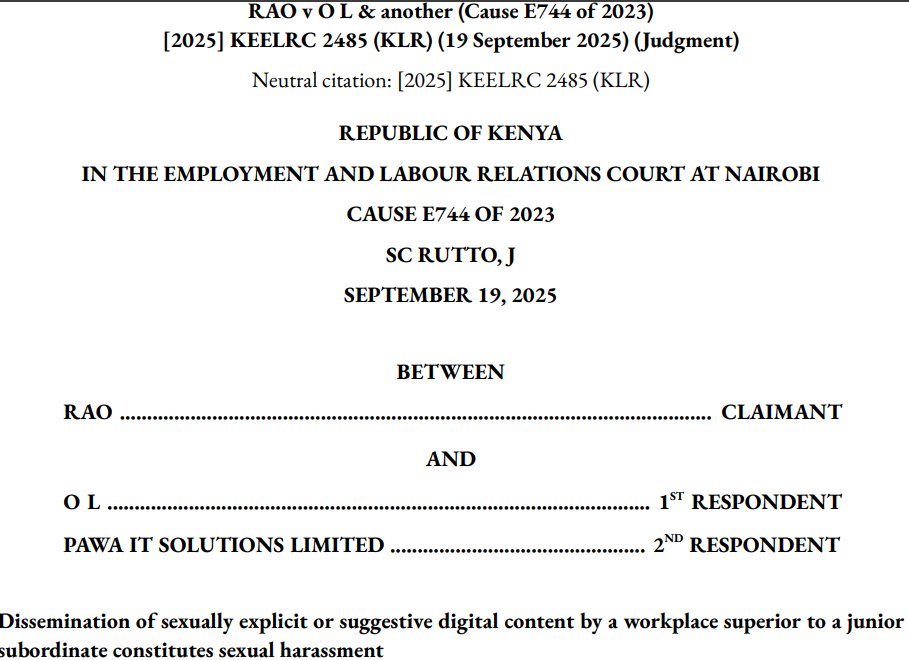
🔴🔴BREAKING FROM ELRC: Sexual Suggestive Memes, Jokes and WhatsApp Messages at the Workplace Amount to Sexual Harassment
Many employees endure uncomfortable workplaces in silence - the late-night WhatsApp messages from a boss, sexually suggestive memes disguised as “just jokes”, inappropriate familiarity masked as workplace culture. In RAO v O L & Another (2025), the ELRC confronted this reality head-on. A female employee began receiving sexually suggestive WhatsApp messages, TikTok videos, and inappropriate communication from her CEO. What started as “casual” interactions soon became uncomfortable and distressing. She later resigned, stating the working environment had become unbearable. The employer argued she had left voluntarily. But the Court looked beyond the resignation letter and examined the power dynamics, the digital messages, and the psychological toll. It found that what seemed like a resignation was actually an employee pushed out of a toxic workplace.
Justice S. C. Rutto delivered a ground-breaking finding: Sexual harassment does not have to be physical. The Court held that sexually suggestive memes, jokes, and WhatsApp communications from a superior to a junior employee amount to sexual harassment under Section 6 of the Employment Act. The judge emphasized that such conduct creates a hostile and intimidating work environment, especially where there is a power imbalance. The Court further clarified that an employee in such circumstances does not need to prove criminal wrongdoing; establishing harassment on a balance of probabilities is sufficient in employment disputes. In the end, the Court found constructive dismissal and awarded the employee Kshs 1,320,000 in compensation.
This is a major warning to employers and a huge relief for ordinary Kenyan workers. The Court has now confirmed that workplace harassment can happen on WhatsApp, through memes, or “harmless jokes.” If those actions make the workplace intolerable, the law treats resignation as constructive dismissal, and compensation follows. The message from the Employment Court is loud and clear: Workplace professionalism does not end at the office door; it extends to your phone, your jokes, and your memes.
Kindly retweet widely 🙏










![klrcKE's tweet photo. In Mwangi v ABSA Bank Kenya PLC [2024] KEELRC 2399 (KLR), the Employment and Labour Relations Court considered whether an employer's surveillance of an employee's private life violated the constitutional right to privacy under Article 31 of the Constitution.
The claimant, a senior branch manager, had been suspended and later dismissed following investigations into alleged breaches of banking procedures. During the suspension, the bank engaged a private investigator who monitored the claimant's movements in public places, including restaurants and pubs, and sought personal information from third parties unrelated to the disciplinary allegations.
The Court held that although the claimant's dismissal was substantively and procedurally fair due to his breach of fiduciary duties and conflict of interest, the employer's intrusion into his private life was unjustified. It emphasized that an employee does not forfeit the constitutional right to privacy merely because disciplinary proceedings are underway.
Where an employer seeks to rely on an employee's conduct outside the workplace, the proper course is to confront the employee through established disciplinary procedures rather than undertake covert surveillance.
The Court reaffirmed that Article 31 protects individuals from unwarranted collection of personal information unrelated to their employment and that privacy is a fundamental constitutional value essential to dignity and autonomy.
Consequently, the Court declared that the claimant's right to privacy had been violated and awarded KSh 5 million in general damages for the constitutional breach.
#KatibaWednesday
#ProgressiveLawReform](https://pbs.twimg.com/media/HMsEH-UXsAAylGu.jpg)




![AssociatesRoba's tweet photo. 🚨🚨BREAKING: COURT BACKS EMPLOYER, SAYS YOU DON’T NEED A CRIMINAL CONVICTION TO FIRE AN EMPLOYEE FOR MISCONDUCT
In a major decision likely to shake workplaces across Kenya, the Employment and Labour Relations Court in Mombasa in Ogola v Bamburi Cement PLC (Cause E056 of 2025) [2026] KEELRC 1294 (KLR) has upheld the dismissal of a long-serving employee of who was accused of attempting to leave the company premises with electrical spares hidden in his bag. The employee fought back hard, arguing that police investigations found no criminal case against him and that he was never charged in court. He claimed the dismissal traumatized him, caused anxiety and mental distress, and insisted the CCTV footage never showed him actually stealing anything. But the court still sided with the employer. Justice ruled that an employer is legally allowed to dismiss an employee once internal investigations create a genuine and reasonable belief that gross misconduct occurred, even if no criminal charges are ever filed.
The judgment now sends a chilling warning to employees across the country: your job can still disappear even when the police do not charge you. The court emphasized that workplace disciplinary processes are completely separate from criminal proceedings. According to the court, an employer only needs to show that it genuinely believed misconduct happened after following proper disciplinary procedure. In this case, the company proved that the employee was issued with a show-cause letter, invited to disciplinary hearings, allowed representation, and given a right of appeal. The court also noted that the recovered items matched company stock and that the employee already had previous warning letters on record. Once trust and confidence break down in employment, the court said, the employer is entitled to terminate the relationship.
For employers, the ruling comes as a powerful message of confidence and authority. The court has effectively reaffirmed that companies are not helpless when handling internal misconduct, theft allegations, or breaches of trust. As long as due process under the Employment Act is followed, employers do not have to wait for the police, the DPP, or criminal courts before taking action against an employee. The former employee walked into court seeking millions in compensation and damages. Instead, his entire case was dismissed with costs. The message from Mombasa is loud, sharp and unforgiving: if an employer can demonstrate a fair process and reasonable grounds for suspicion, Kenyan courts will stand behind workplace discipline - even where no criminal conviction exists.
Kindly retweet 🙏](https://pbs.twimg.com/media/HIv_fMyWcAAjUm_.png)
![pmpaulmukiibi's tweet photo. A hospital cannot detain a discharged patient for non-payment of medical bills. Detention on account of an outstanding hospital bill amounts to unlawful self-help, violates the patient’s constitutional rights to liberty, dignity and freedom of movement, and cannot be justified as a debt-recovery mechanism. A hospital policy that permits detention after discharge, or refusal to discharge until the accrued bill is settled, is not constitutionally sound.
In Gicheru v Nairobi Hospital & another (Constitutional Petition E258 of 2026) [2026] KEHC 5341 (KLR), a ruling delivered on 28 April 2026, R.E. Aburili J considered two interlocutory applications by Stephen Ndwaru Gicheru, who sought an interim mandatory order for his release from Nairobi Hospital. He had been discharged after open-heart surgery but remained at the hospital because of non-payment of the balance of his medical bill, after the insurance company declined to settle it. The petitioner argued that his continued detention was unconstitutional and violated his rights under Articles 28, 29, 39 and 47 of the Constitution. His family had shown good faith by paying KShs 1,000,000 and had undertaken to settle the outstanding lawful bill, but the hospital declined to release him.
The Court held that the right to personal liberty is one of the most fundamental human rights and that any detention not authorised by law, where used to procure payment of a contractual debt, violates the right to liberty and affronts human dignity. Relying on earlier authorities, including Ndegwa v Republic, Sonia Kwamboka Rasugu v Sandalwood Hotel & Resort Ltd, Maina v Registered Trustees of the Sisters of Mercy (Kenya) t/a Mater Misericordiae Hospital, and international human rights instruments including the ICCPR, the Court reiterated that liberty cannot be curtailed merely because a person is unable to fulfil a contractual obligation.
The Court emphasised that hospitals are entitled to recover lawful medical bills, but they must do so through lawful debt-recovery mechanisms, not by detaining discharged patients. It stated that it cannot be a hospital policy to detain patients after discharge, or to refuse discharge until the accrued bill is settled, because such a policy is not constitutionally sound. Since the petitioner had already been discharged, part of the bill had been paid, and his family had undertaken to settle the outstanding lawful bill, the Court found that this was an exceptional case justifying an interim mandatory order.
The Court therefore ordered Nairobi Hospital and its Chief Executive Officer to immediately release Stephen Ndwaru Gicheru, together with all his medical records, to his next of kin for post-operative follow-up care, upon the next of kin signing an undertaking to settle any outstanding lawful medical bill incurred at the hospital.
Read full ruling here: https://t.co/kD6Weirpop](https://pbs.twimg.com/media/HIwMc7_WUAAS_Ci.jpg)