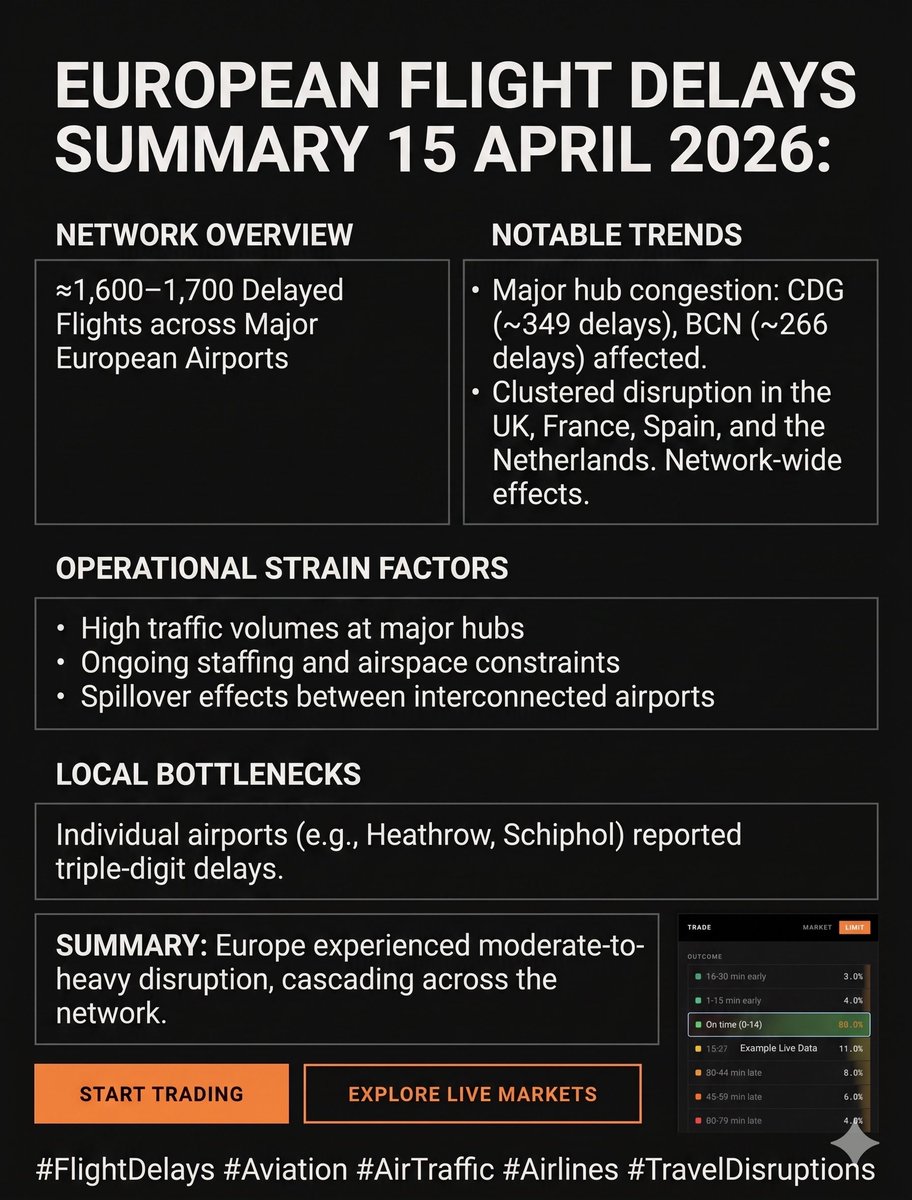
European flight delays summary 15 April 2026:
≈1,600–1,700 delayed flights across major European airports
Notable trends:
Major hub congestion:
Airports like Paris Charles de Gaulle (~349 delays) and Barcelona (~266 delays) were among the worst affected.
Clustered disruption in key countries:
The UK, France, Spain, and the Netherlands saw concentrated delays, indicating network-wide ripple effects rather than isolated incidents.
Operational strain factors:High traffic volumes at major hubs
Ongoing staffing and airspace constraints
Spillover effects between interconnected airports
Local bottlenecks:
Individual airports (e.g., Heathrow, Schiphol) reported triple-digit delays, reinforcing that disruption was driven by hub saturation rather than a single event.
Summary:
Europe experienced moderate-to-heavy disruption yesterday, with delays concentrated at major hubs and cascading across the network rather than caused by one single incident.
https://t.co/8lSpnOpGGl
#DelayMarket
#FlightDelays
#Aviation
#AirTraffic
#Airlines
#TravelDisruptions
IBM says AI cut brownfield migration time by 50%. Fujitsu ran their own POC and got 20%. The distance between a vendor case study and your actual project is where budgets go to die.
@f1tym1 Nobody wants to fix it because fixing it means production downtime. And downtime costs more per hour than the breach they're betting won't happen. The math is wrong but the incentive structure makes it rational.
@GISEd The hard part of that migration wasn't picking ArcGIS. It was getting 20 years of facility data out of the old CAFM in a format that still made sense. The tool choice is the easy decision.
The "just rewrite it" conversation is always 20 minutes long. The actual rewrite is always 18 months, two missed deadlines, and a feature freeze nobody agreed to.
$100K deployment cost for AI predictive maintenance sounds accessible until you add the integration work, data cleanup, and change management nobody quoted. The tool got cheaper. The hard part didn't.
@irvinxyz "Filled their technical debt" is doing heroic work here. Nobody fills technical debt. You just pick which parts to live with and which ones will kill you first.
@fogoros Mostly agree but removing the PLC assumes your safety logic can live in the drive. It can't, not at SIL 2+. The iron stays, but so does the safety PLC. Software-defined works for process logic, not for the stuff that keeps people alive.
98% of manufacturers exploring AI. 20% ready to actually run it. The other 78% have fragmented data, legacy PLCs, and no plan. That's not an AI problem.
GAO called out 10 critical federal IT systems in 2020. 7 still untouched in 2026. At some point you have to admit the blockers aren't technical. Nobody wants to own the outcome when things go wrong.
Brownfield sites for data centers makes sense until you hit the remediation costs. Seen enough contaminated industrial land to know: the cleanup timeline alone will lose the AI race they're worried about.
On Tuesday, Chairman @USRepGaryPalmer led an Environment Subcommittee hearing on potential uses for America’s Brownfields Sites.
By remediating and reusing these sites, America can greatly expand its efforts to win the AI race and improve infrastructure in our communities.
@housecor Copy/paste avoids changing old code but now you've got two copies of every bug. The risk just moved, it didn't disappear. Isolation is the right instinct though - just use it at the boundary, not the file level.
@yimbyalliance Brownfield done right. Hardest part won't be the build - it'll be the remediation nobody sees. Same in software, same in land. The unglamorous work under the surface is what determines if it holds up.
Predictive maintenance adoption dropped in 2025. Alert fatigue. Systems crying wolf 50 times a day until the maintenance team stops looking. More sensors didn't fix that. More sensors caused it.
@mattdykema Missing one: faster discovery of why that one machine does something weird every third shift that nobody's documented. That's usually the actual bottleneck.
@zanehengsperger Biggest risk is the buyer thinks they're acquiring equipment and customers. They're actually acquiring undocumented processes, tribal knowledge, and 30 years of "it works don't touch it." Due diligence doesn't cover that.