News, opinion, and analysis about all things urban: art, architecture, culture, business, finance, enterprise, history, government, transit, parks, waterfront.
"no thanks to glorified jail cells"
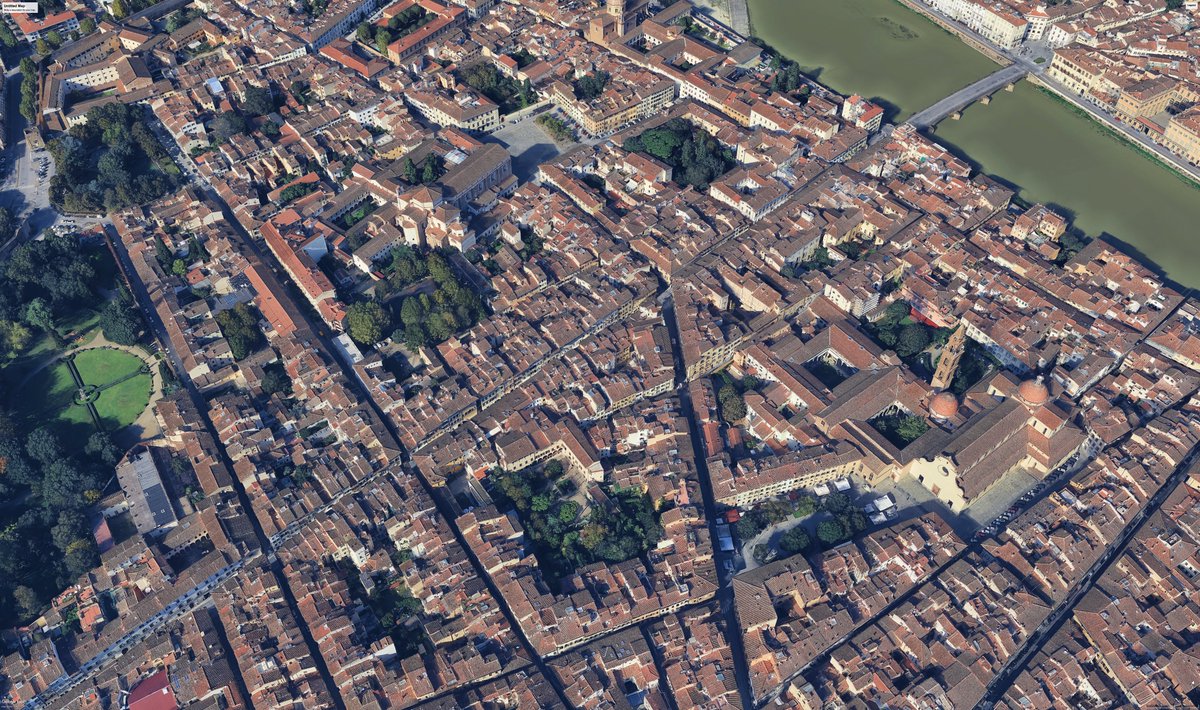
When, at 22, I moved from a single-family house in drive-everywhere suburban Michigan to an apartment in hyper-walkable Florence, Italy, the experience was like liberation from a jail cell.
I could step outside my door and walk to meet any need. Shops, libraries, cafés, restaurants, parks, churches, and piazzas were woven into the neighborhood. The train station connected me to cities across Europe -- and to the beach, the mountains, and ski resorts. I no longer faced a mandatory drive of ten minutes to several hours every time I wanted to do something beyond the walls of my home.
I did not need to own a car, maintain it, insure it, buy gas for it, or pay to store it. I did not have to bear the spatial consequences of living in an environment designed around every household owning multiple cars ... the seas of parking lots, the sprawl that forces people to commute to community, the unbearable ugliness of car infrastructure.
Florence offered the extraordinary freedom and beauty that emerge when a city is composed of many small, mixed-use apartment buildings, green courtyards, and narrow residential streets. Notably, people had lived this way, with continual adaptation, though periods of abundance and scarcity, for thousands of years.
Newburgh, NY was never the engine of New York, but it was once a city with real cultural and historical weight. George Washington made the Hasbrouck House his longest-serving Revolutionary War headquarters from 1782 to 1783, where Martha Washington joined him, the Continental Army waited nearby, and decisions were made that helped shape the republic.
Lucille Ball and Desi Arnaz later debuted their stage act at the Ritz Theater in 1941, helping plant the seeds for I Love Lucy. That same stage hosted Frank Sinatra with Tommy Dorsey, Ella Fitzgerald, and Louis Prima. Newburgh was never a forgotten backwater.
It was a prosperous Hudson River city with industry, commerce, architecture, nightlife, and civic pride. Then jobs left, retail hollowed out, investment fled, the tax base weakened, crime rose, homelessness deepened, and government planners bulldozed more than 1,100 homes and businesses in the name of “renewal.”
Today, Newburgh still carries the scars with a 24.3% poverty rate and median household income of $56,960, far below Orange County’s $97,178.
NYC should pay attention. Great cities do not collapse overnight. They are hollowed out one bad policy at a time.
Detroit is one of my favorite places to visit in the states. Yes, everything Patrick says is true, the history and architecture are awesome. The art museum and Motown museums are gems.
But also for one of the best living art scenes. You can see incredible electronic music, then a killer punk/post punk show in a tiny venue (protomartyr are hometown heroes). Then take shots and 4 dollar beers with the band. End the night with a coney (or 3). Amazing artist run galleries and art spaces everywhere, in lofts and warehouses.
If you like art/music/history/fun, highly recommended.
"Tug and I drove to the ballpark together before Game 6 of the 1980 World Series and I made him promise that if he was on the mound for that final out to wait for me.
Both of us knew whoever was on or near that mound for the final out would probably be on the cover of 'Sports Illustrated'.
Sure enough, it worked.
Tug struck out Willie Wilson and then turned to look at me at third base.
Of course I came running in and jumped on him.
Tug got more out of his time on earth than anyone could imagine.
I have the photo of Tug allowing me to jump in his arms following the last out of the 1980 World Series on my wall.
I will take it with me this summer, hang it on my office for all to see, and look at it a split second longer each day."
Mike Schmidt.
"Tug McGraw was the epitome of what Philadelphia was all about - a hard worker, dedicated, he never gave up.
The picture of him jumping off the mound after the last out of the 1980 World Series is one of the most memorable moments in Phillies history.
He was truly a great person, and he'll be sorely missed."
Phillies Mgr. Larry Bowa.
"He was inspirational, had a lot of fun, was happy-go-lucky guy.
He lived life to the fullest.
He was a fighter.
He has been fighting all year and didn't want to give up.
Every time I saw him he had a positive attitude.
He was flamboyant, excitable, extroverted, he would do anything for a laugh.
I'm going to miss him.
He was full of life."
Ed Kranepool on Tug McGraw.
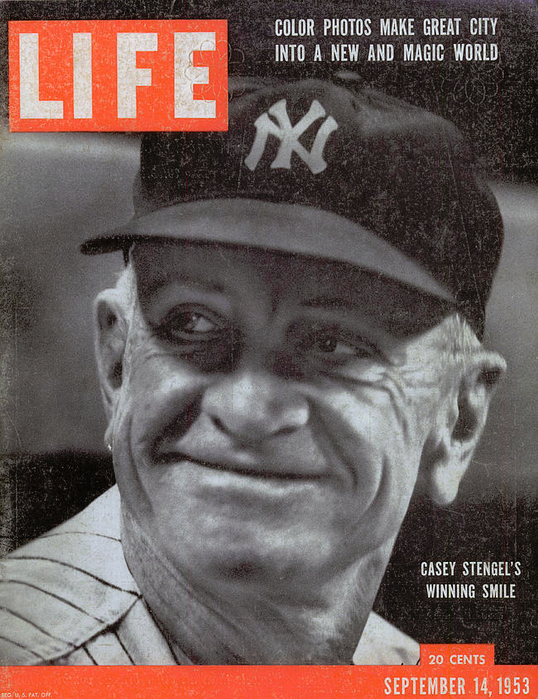
"The irreplaceable departing manager was Casey Stengel, who died this summer at the age of eighty-five.
His quirks and triumphs are so familiar to us all that they need no recapitulation here, but I think that a demurrer should be entered on the subject of 'Stengelese', which too many of his biographers seemed to consider as nothing but a comical difficulty with the English language.
It always seemed to me that Casey’s non-stop disquisitions—stuffed with subclauses, interruptions, rhetorical questions, addenda, historic examples, shifted tenses, and free-floating “which”s constituted a perfect representation of the mind of a first-class manager.
Almost every managerial decision during a ballgame, the lineup, who is to pitch, when to pinch-hit and with whom, when to yank a pitcher, who should pitch to the new pinch-hitter is, or should be, the result of a dozen or two dozen pressing and often conflicting reflections, considerations, and ancient prior lessons.
Perhaps it is best to say goodbye with a garland of Stengel-flowers:
To himself, in 1921, on entering the Polo Grounds after being purchased by the Giants from the Phillies:
"Wake up, muscle—we’re in New York now."
After winning still another pennant as manager of the Yankees:
"I coulda done it without my players."
On being seventy-five:
"Most people my age are dead, and you could look it up."
Concluding his acceptance speech at Cooperstown, when he was taken into the Baseball Hall of Fame:
"And I want to thank the treeeemendous fans.
We appreciate every boys’ group, girls’ group, poem, and song.
And keep goin’ to see the Mets play."
Roger Angell, on Casey Stengel`s death.
Loathed by many urbanists for wiping out an entire neighborhood of small businesses, the World Trade Center on 9/11 took on a whole new--and terrible--meaning.
The total collapse of any even pretence of creating humane and loveable buildings and places in the growing Cambridge is heart-breaking. This is not economics. Cambridge is one of Britain's richest places. It is a profound cultural failure. We set out a better route for the beautiful & popular growth of Cambridge which you can read ....
When New York City opened commercial waste collection to private companies in 1957, an unexpected group rushed in: organized crime families.
For decades, the mafia controlled NYC’s trash industry through intimidation and carefully orchestrated cartels. By the 1990s, carters were pulling in $1.5 billion a year, with $300–$500 million in overcharges—making New York’s trash the most expensive in the country.
But their empire didn’t last forever. Large companies like Waste Management and Browning-Ferris slowly broke the mafia’s grip through legal pressure and market competition.
This is the story of the billion-dollar underworld hidden in plain sight—literally on the curb.
Stream NYC Revealed: Trash https://t.co/RzOY7Xcrnf - on CuriosityStream.
.
.
.
#NewYorkCity #NYC #History #NYCRevealed #HistoryDocumentary
#TrueCrime #MafiaHistory #OrganizedCrime #MobStories #TrueCrimeCommunity
#WasteManagement #DidYouKnow #LearnSomethingNew #CuriosityStream #WatchAndWonder