Formal verification of software is having a moment. Thanks Vitalik🫡!
But most unfortunately, assume Lean is the only path. It's one of many approaches & each comes with very different trade-offs.
Let's look at the trade-offs in four axis:
1) Spec depth: how much of a program can be formally verified using the tool.
2) Security: all possible outputs proven safe.
3) LLM ease: how easily an LLM produces code that meets spec.
4) Succinct verification (probably nothing 🤷): verifying the whole chain — natural language → spec → formally verified code — end-to-end in <1s. *A superpower only cryptography (ZK proofs) can deliver.
Before: machine speed coding, human speed verification. Lots of bugs, lots of hacks.. lots of pain.
After: machine speed coding, machine speed verification. Provably correct, end-to-end, in under a second.
We have Vericoding working at ICME Labs.
DM to try it or collab!
How to Read a ZK Protocol? How to find High impact Vulnerability in zkp?
- When reading any ZK protocol, ask these questions:
- What is the statement?
- What is the witness?
- What is public?
- What is private?
- What does the prover control?
- What does the verifier check?
- Where does randomness come from?
- What is committed?
- What is challenged?
- What is revealed?
- What remains hidden?
- What assumptions are required?
- What happens if inputs are malformed?
- What edge cases exist?
- What exactly does verification guarantee?
These questions are simple. But they are powerful.
They turn you from a passive reader into an active reviewer.
That is how you begin thinking like a ZK engineer.
And eventually, like a ZK security researcher who find High impact bugs!!
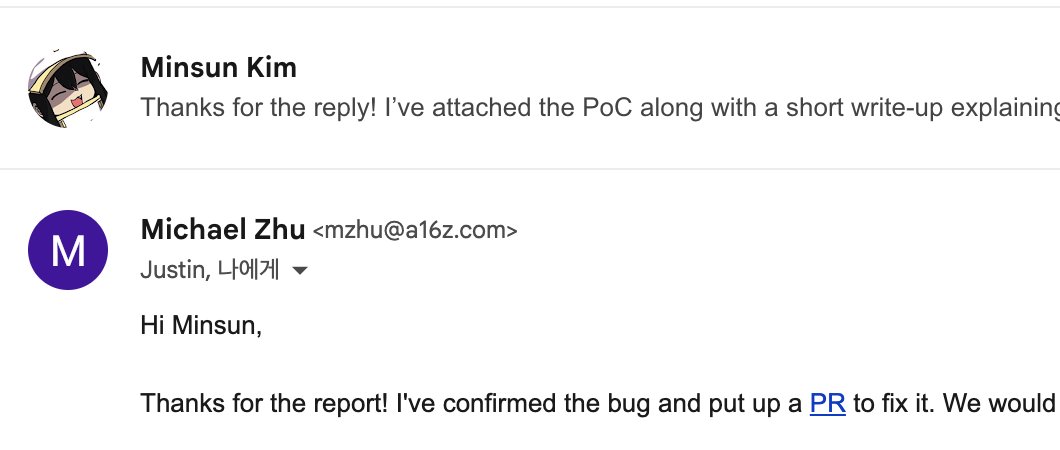
I found a critical soundness bug from Jolt zkVM by @a16zcrypto , and successfully exploited it by proving 1333337 == 1333338, which is the highest impact for a zkVM.
Deatils and PoC at https://t.co/QWPNmOqq6v , please check it out!
It was resolved at https://t.co/2ZmI464xZP.
In Denver.. atm. If you are a VC and just want to chat about current Sota of any technical area in web3. I or anyone of my PhD team mates will give you time..
PhD meet MBA type mini sessions ;)
It’s amazing how much nonsense floats around, from things people thought two years ago..
Let’s update our brains to understand SoTa and then see where it is finding pmf.
If you are a non-technical VC let's chat about TEE in Denver.
It's in many specs for agentic web3 and is generally the easiest g2m.. but there are drawbacks & caveats.
TEE are not a silver bullet.
1. TEE proofs are generally not succinct. So to prove on ETH/SOL/other, or on constrained devices you need to wrap in zk (zkDCAP)
*You are going to have to pay more gas, use other chains, or have a zk overhead in any case. @_weidai
2. TEEs are expensive. To order a GPU-enabled TEE, it can cost upwards of $30,000 per GPU with lead times of 6 months or more .. or $2–8 per GPU-hour to rent in the cloud. Or you can use @PhalaNetwork.
3. zkML was super slow.. years ago. Modern ZKML is finding traction in real world use-case across various sectors and companies.
As shown with Layer_Zero and more generally 'mathed out' by @SuccinctJT .. sumcheck based lookup centric architectures are blazing fast.
1gpu realtime proving of 1cpu is likely happening this year.
*A noble endeavor with strong technical foundations 🦾
By extension our zkML variant of JOLT; Jolt-Atlas is benching at amazing speeds..speeds that even a year ago people would say it's IMPOSSIBLE.
4. Different security assumptions. You can look into this for whatever tech (ZK, TEE, FHE, whatev).. trust hardware providers, trust math.. trust slashing.. etc.
---
The golden grail 🥛 is use-case.
Users pick what they need and operators *should* pick the tech to match.
Do the users care about cost (price elastic)?
Can they afford TEE?
Do they trust NVIDIA?
Do users even want blockchain?
Do we need ZKML?
As some smart skeptical people have asked. @VitalikButerin
✅Yes for very specific use-case.
For our users.. we wrap a well known big cloud approach to agentic guardrails (AR); in a very web3 way (zkML).
Natural language -> to formal logic (special SLM) = protects up to 99%.
This is compared to human-in-the-loop, heuristics, and observability.. which at best get up to 88%..
12% of the time the airplane crashes.✈️🫣 windy day...
The issue with this approach is that AR is not succinctly verifiable. Its black boxed. The policy needs to be public.
But with the tech we have at @icme_labs / @NovaNet_zkp makes it succinctly verifiable with minimal trust assumptions 🥁
When we meet.. we can talk about some economics around agentic guardrails.
TL;DR.
The only way we will have secure machine speed agentic commerce — is with machine speed verifiability.
Humans (principals) will never be able to keep up with agents moving at machine speed.
Reputation, human tracing, stopping to check spooky looking transactions.. will not scale.
This economic fact REQUIRES succinctly verifiable proofs (ZK).. if you want e2e verifiability with private policies it REQUIRES zkML.
zkML is the standard, for guardrails.
https://t.co/iOvlM1T3Ru
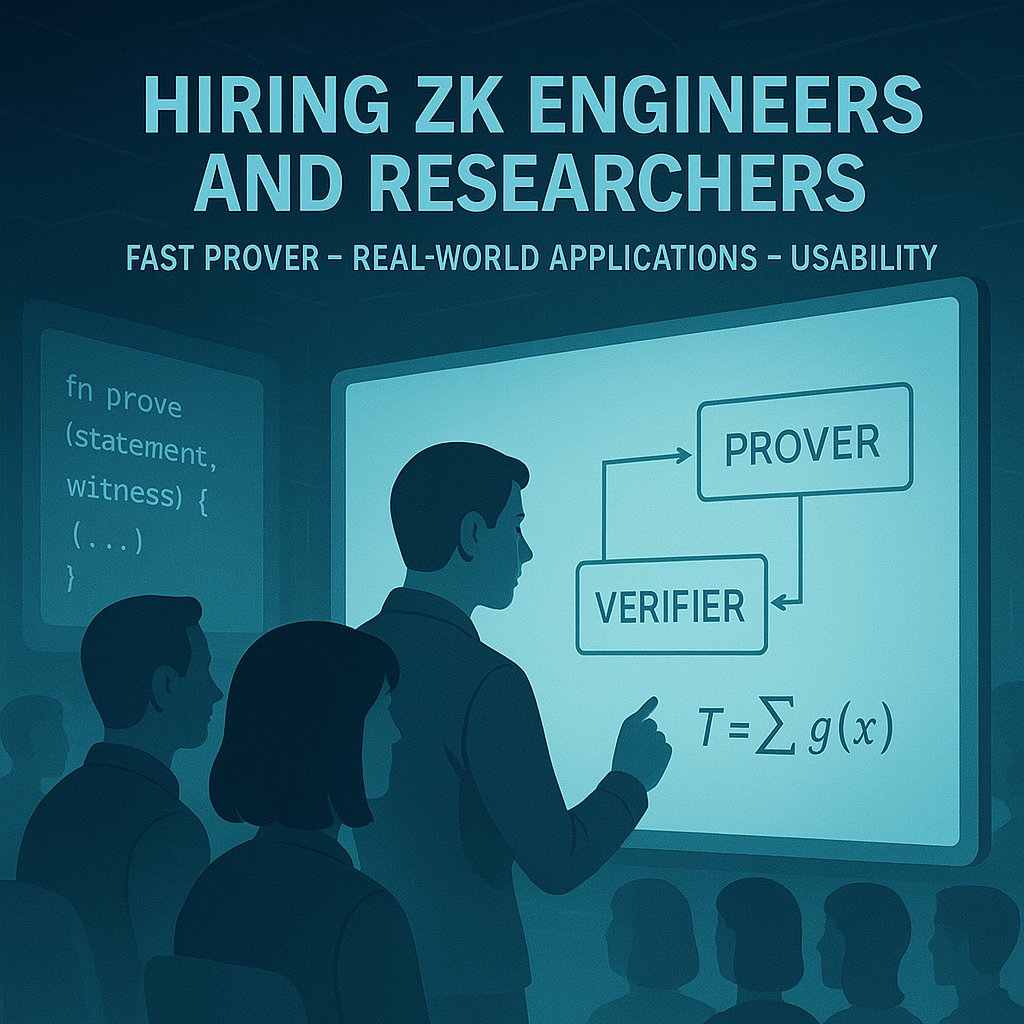
Hiring ZK engineers & researchers to build next-generation provers and real-world applications!
We’re looking across the ZK stack: prover design & implementation, circuits, and smart contracts.
DM if you have questions!
Links to apply 👇
1/ Quantum computing predictions lately range from "public key cryptography will be broken in 2 years" to "it's a century away." Both are wrong.
My latest post explains what publicly known progress actually supports — and what blockchains should do about it.
Thread below 🧵
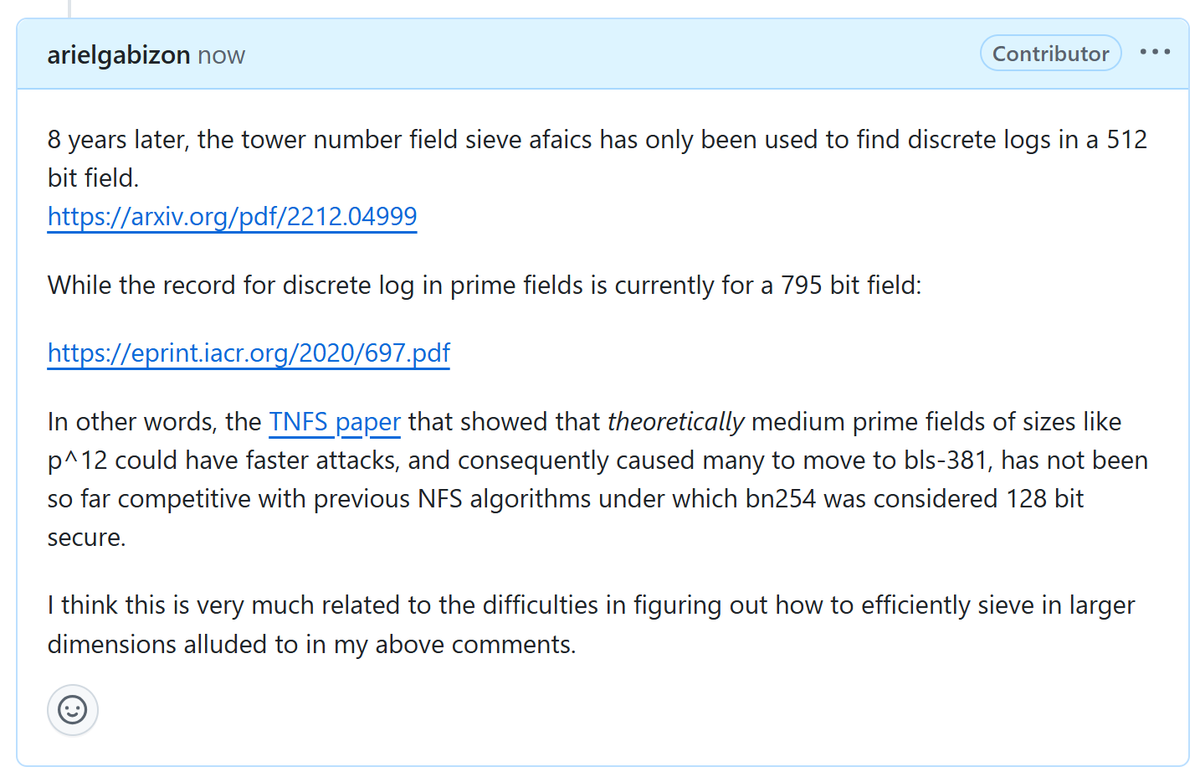
NFS experts:
Was the tower number field sieve in hindsight a false alarm causing many to move to larger curves because of over-optimistic estimates to its practical performance?
https://t.co/EQSCdlhY2f
Privacy cannot be solved at the technological layer alone; The appropriate level of privacy in shared systems is ultimately a social choice, mediated by legal norms and political legitimacy, with technology merely expressing the boundaries we collectively decide.
My rough math based on average difficulty stats suggests that Bitcoin mining crossed the total 2**96 hashes milestone very recently?
Seems like a good reason to insist on (close to) 128 bit security (ie. @drakefjustin was right)
New work with @asanso!
We present an attack against hash based SNARGs using small fields that reduces conjectured security by around 10 bits.
Most hash-based systems using 31-bit (or smaller) base fields are affected.
https://t.co/OL6NhNevNZ
I believe it was Henry David Thoreau who once said:
> The cost of a thing is the amount of what I will call _privacy_ which is required to be exchanged for it, immediately or in the long run.
A shoutout to @jedodinh from the @ligero_inc team. Our goal is to scale ZK so you can prove anything from a device in your pocket, which crucially requires memory efficiency for the prover.
Jérémi from our team pushed an update to plonky3 that helps exactly with that. Hash-based ZK needs to run parallel FFTs, which typically require pre-computed twiddle factors. With this update, plonky3-based programs can share the same DFT instance across multiple threads and reuse the same precomputed twiddles, eliminating redundant computation and unnecessary memory usage.