1/6 The market loves big words about privacy, but confuses ‘secrecy’ with ‘black box’
There is another way: when your data is not exposed, but the correctness of actions is visible to everyone.
This is @zama
Below — in simple terms, how it works and where $ZAMA comes in🧵
Strong integrations are not about logos, but about points where UX changes.
@zama 's partners are not random names: for example, @OpenZeppelin is a provider of security standards in Web3, with which Zama has announced a partnership to bring confidential smart contracts to DeFi and digital assets.
It's about “working on top of EVM, without a new L1” and relying on proven security practices.
As for “success in practice” the latest testnet update shows a transition from concept to production architecture — a network of 13 independent MPC nodes that maintain a threshold KMS.
In other words, it's not “works in theory” but a real infrastructure with operators, where confidential actions remain private and correctness is publicly verifiable.
This builds trust and opens up applications:
- orders without peeking;
- auctions without strategy leaks;
- scoring without data disclosure;
Hence, the simple logic for the audience: Zama adds a layer of confidentiality to familiar networks (EVM) without breaking the stack.
The partnership with OpenZeppelin provides standards and a security foundation, and the testnet with independent nodes demonstrates readiness for load.
If you're a builder: make a demo of “private input → public proof”;
if you're a creator: explain use cases in human language.
These are the things that survive any market sentiment.
gBillions 🌅
Sometimes the best upgrade for life is not a new device, but the absence of unnecessary hassle.
In this sense, @billions_ntwk is purely about “removing unnecessary actions.”
Once you've passed Proof of Unique Human, everything else is smooth sailing:
subscriptions, tickets, small payments → without having to “send your passport, fill out a form, confirm again” every time.
Fewer forms, fewer KYC quests, fewer chances of leaking your data somewhere you don't want it to go.
As a result, you can really relax:
the weekend is not about going through the KYC process, waiting for us to check everything, and worrying that everything will be fine and your data won't be leaked.
Now you just press one button and you can freely spend your time or binge-watch a series.
Most L1s have the same problem — they try to be universal.
NFTs, DeFi, games, social apps — all on the same infrastructure level.
And under load, it always ends the same way: queues, delays, crashes.
@fogo has a different approach.
They don't chase after multifunctionality, but build a network where the trading stack works modularly and doesn't compete for resources with everything else.
Orders, prices, on-chain services, calculations — everything is separated so that no single element creates delays for another.
It's simple logic: if your network has to work in real time, it can't be "all in one."
Many people talk about speed.
But few talk about how this speed is consistently maintained.
Fogo solves this with architecture, not promises and renting new servers.
----------------------------------------
Want an alternative option: shorter, more aggressive, or meme-worthy?
I can do 2-3 more styles with the same meaning.
gBillions
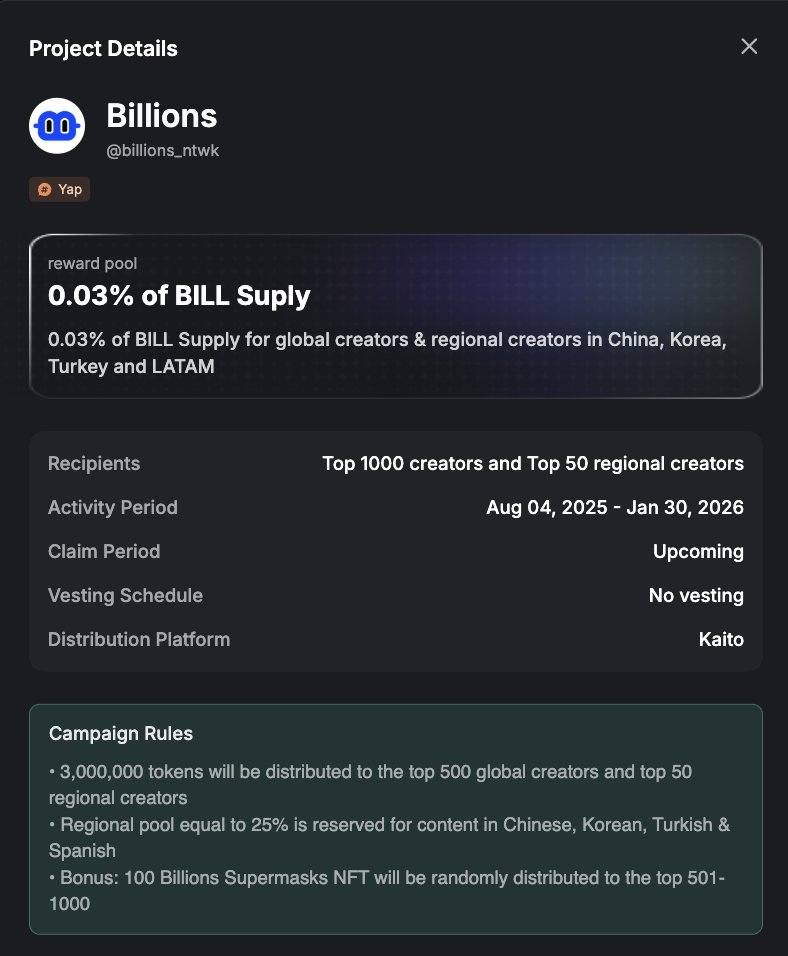
Kaito has launched rewards for Yappers, and it's nice to see Billions in focus here.
3M $BILL in the pool, top 500 globally, top 50 in regions, plus a chance to get a Supermask NFT if you're in the 501–1000 range.
I like this approach, because everyone who owned masks received a bonus in Kaito, and those who diligently finished the leaderboard will also receive their reward.
The campaign runs until January 30, 2026. If you haven't started yet, now is the time.
Rewards for Kaito yappers are here! 🏆
With a total of 3M tokens in rewards for Season 0:
- Top 500 global creators
- Top 50 creators in China, Korea, Turkey and LATAM
Plus, 100 Supermasks NFT will be randomly distributed to the top 501-1000
Running until January 30, 2026!