A collection of papers, articles etc evidencing there is no anthropogenic climate crisis and that many "eco/green" ideas are not all they are cut out to be.
Sea level has risen 400 feet, yet we still have beaches, coral reefs and polar bears.
Nature adapts to changes in sea level without trillions of dollars scammed from taxpayers.
Tom Nelson Podcast #439: Dave Burton: “Lifetimes Of Atmospheric CO2 And Heat” is now published.
David Burton argues recent warming (~1.25°C since 1870) is small and often overstated, while CO2 benefits crops and ecosystems by boosting growth and water efficiency, reducing famine risk alongside fossil-fuel-based nitrogen fertilizer. He says storm and sea-level data show little acceleration, citing linear long-term tide-gauge records like Honolulu and noting local land motion dominates. His paper discusses multiple CO2 “lifetimes”: turnover (3–5 years), bomb-spike radiocarbon (~20 years), and the climate-relevant adjustment time he estimates at ~55±10 years, with a long tail he deems currently unimportant. He criticizes IPCC “cumulative emissions/TCRE” and “carbon budget” concepts as unphysical, analyzes direct waste heat as negligible (~52–58 days), and promotes his https://t.co/k6yL4nl0RS tools and archived Climategate emails.
00:00 Meet David Burton
00:23 How Much Warming Really
02:04 Ice Ages And Freezing Thresholds
03:06 CO2 Greening And Crop Gains
05:28 Famine History And Fertilizer
07:48 Storms Tornadoes And Sea Level
11:00 Paper Overview CO2 Lifetimes
11:55 Turnover Bomb Spike Adjustment
14:31 Cumulative Emissions Myth
15:38 Heat Pulse Lifetime
19:45 Suess Effect Carbon14 Confusion
27:03 Why CO2 Rises Negative Feedbacks
30:03 Linear Removal Rate And Limits
34:14 Why Plant Uptake Stays Linear
35:30 CO2 Boosts Crop Yields
37:03 Airborne Fraction Myth
39:16 Emissions Plateau Math
42:14 Long Tail Lifespan Debate
43:40 Cumulative Emissions Critique
48:49 Carbon Budget Pushback
50:50 How Long Heat Lasts
55:10 Where to Find More
56:39 Sea Level Tools vs NOAA
01:01:05 Climategate Archive Access
01:02:56 Ocean Chemistry and Carbonate
01:08:08 Climate Industry FUD Wrap
Burning hydrogen to produce heat is like burning a Louis Vuitton handbag to keep warm. - Samuel Furfari
The comparison with the handbag may sound provocative. It is nevertheless a useful way of summarising one of the fundamental misunderstandings surrounding today’s hydrogen policies.
Hydrogen is a remarkable molecule. It is indispensable to modern industry and has been used for more than a century in processes essential to our prosperity.
Precisely because it is valuable, manufacturing it at considerable energetic and economic cost merely to burn it is difficult to justify.
Read the full article "Hydrogen: a remarkable molecule, but a poor fuel", link in reply.
Note the sneaky sleight of hand in the left hand chart.
Where the cold axis goes from 0 to 250, the hot goes only from 0 to 40. Makes hot look 6 times worse than it is.
We can tell the Climatistas are desperate. They have to lie in plain sight
I despise them
Goed nieuws : klimaatalarm-crisis-noodtoestand verhaal is aan het instorten. Afgevaardigden van 195 lidstaten van VN Klimaat groep IPCC, hebben tijdens hun recent 12-16 oktober feestje in Ethiopië geen overeenstemming bereikt over hoe ze volgende klimaat report AR7 gaan schrijven. Iets met tijdsvenster voor inclusie&diversiteit en vooral met budgettaire tekorten...USA doet niet meer mee en heeft alle geldelijke bijdragen gestopt. 🤣Klimaat Feestje is voorbij.
https://t.co/4flClmRIE5
Het manipuleren van temperatuurmetingen is blijkbaar een wereldwijde consensus praktijk. In NL was er KNMI dat hittegolven uit verleden verwijderde; nu in Australië doen de collega's van KNMI vergelijkbare dingen. Tja, als de metingen het consensus dogma niet ondersteunen, dan moeten de metingen maar worden aangepast.
10 years ago, you were constantly told Great Barrier Reef was essentially dead
Wrong at the time
Today, spectacularly wrong, with last 5 years top 5 for coral cover
Sources: https://t.co/pwyeeA9ikL
Wrong already then: https://t.co/ItNJpRdNi5
China emits as much CO2 in 16 days as Canada emits in an entire year. Australia's annual total takes China just 12 days to emit, while Britain's takes barely 9 days.
Combined, Canada, Australia and the UK emit about 1.23 billion tonnes a year. China emits that much in roughly 37 days.
So, even if all three countries eliminated every tonne of fossil CO2, closing every factory, power station and banning every gas vehicle, China would replace the entire annual reduction in little more than five weeks.
Yet, Western governments are deliberately making energy scarcer and more expensive, by dismantling dependable sources, restricting oil and gas exploration and loading industry with carbon taxes and net zero mandates.
Steel, chemicals, fertilizers, refining and manufacturing are driven overseas, often to countries burning more coal. So the emissions do not disappear. Only the jobs, tax revenues and energy security do.
The West impoverishes itself. China profits.
La narrazione sui giornali della crisi climatica è una cosa.
La realtà scientifica è un altra. Vediamo perché
Questo è la ricostruzione dell’Albedo dal 1880 ad oggi. E’ ovvio che se l’albedo diminuisce aumenta la quantità di radiazioni solari che giungono a Terra.
Vogliamo vedere a cosa corrisponde in termini di temperatura?
Ecco qua:
1/3
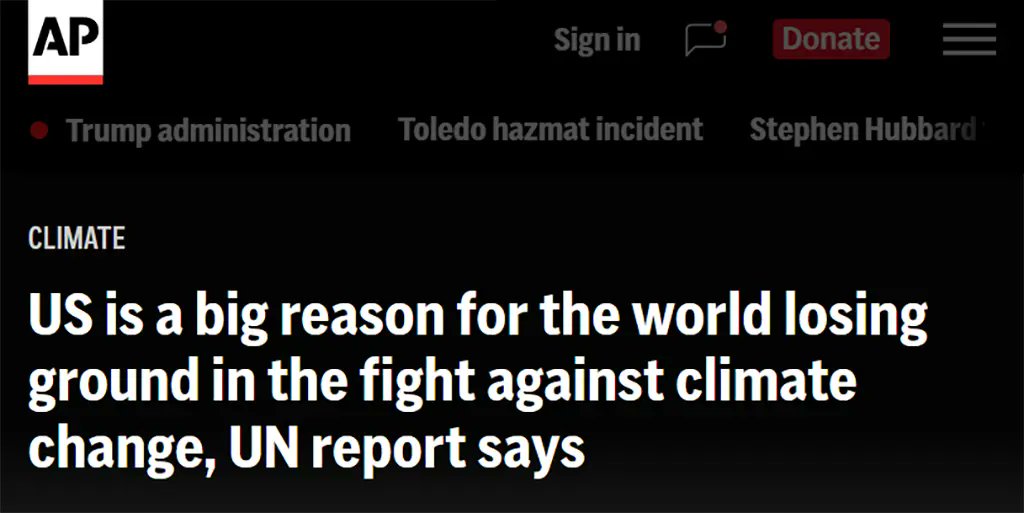
𝗔 𝗧𝗲𝗻𝘁𝗵 𝗼𝗳 𝗮 𝗗𝗲𝗴𝗿𝗲𝗲 𝗼𝗳 𝗦𝗲𝗽𝗮𝗿𝗮𝘁𝗶𝗼𝗻. 𝗔𝗣 𝗧𝘂𝗿𝗻𝘀 𝟬.𝟭°𝗖 𝗶𝗻 𝟮𝟭𝟬𝟬 𝗶𝗻𝘁𝗼 𝘁𝗵𝗲 𝗔𝗺𝗮𝘇𝗼𝗻, 𝗚𝗿𝗲𝗲𝗻𝗹𝗮𝗻𝗱 𝗮𝗻𝗱 $𝟭.𝟮 𝗧𝗿𝗶𝗹𝗹𝗶𝗼𝗻
The Associated Press claims the US leaving the Paris Agreement adds 0.1°C by 2100.
They say this means Amazon collapse, Greenland ice sheet loss, and $1.2 trillion in damages.
The UN report pins the whole tenth on the US withdrawal.
Yet the projection for the actual current emissions path stayed identical to last year.
That tenth only exists between two model runs of 2100.
No measurement will ever confirm it.
Read the full article:
https://t.co/KCf9lEbuAo
We zijn 4 jaar verder en klimaatwetenschappers van VN Klimaatpanel ipcc hebben het nu ook bevestigd: doemscenario's zijn niet realistisch. Beter laat dan nooit.🤣
Sea level appears to be falling at Stockholm because the land surface is rising. If actual sea level rise rates were increasing, there would be an upwards curvature to the graph. That curvature does not exist.
https://t.co/zVnjrP2Edv
Denmark spent decades building nearly 5,000 wind turbines
Together, they produced 21.6 TWh in the last 12 months
One nuclear plant in Sweden made 23.3 TWh
Oh, and nuclear runs 24/7 — wind doesn’t
There's one big reason Denmark has some of the most expensive electricity in the world
https://t.co/SiPeo0tE9Z
https://t.co/hvsqEWOpuJ
https://t.co/HyQp2owXAX
https://t.co/8ggd62dywW
How many young vulnerable minds have made poor life changing choices due to Climate Alarmists hysteria? As Profesdor Happer points out 'There is no Climate emergency.' CA is a dangerous dogma and scam. #auspol#BBCNews
Opmerkelijk: een hele maand gekopieerde temperatuurgegevens, een historisch hitterecord geschrapt en vergelijkende metingen grotendeels achter slot en grendel.
@JennMarohasy legt de Australische temperatuurarchieven onder de loep:
▪️ Alle 31 minimumtemperaturen van augustus 1907 staan óók bij augustus 1867. De originele meetboeken laten andere waarden zien.
▪️ De 51,7 °C die in Bourke op 3 januari 1909 werd gemeten, is uit het officiële bestand verwijderd.
▪️ Andere historische hitte-extremen zijn nooit gedigitaliseerd.
▪️ Parallelmetingen met kwikthermometers en elektronische sensoren zijn nauwelijks openbaar.
Haar scherpe conclusie: het Australische Bureau of Meteorology heeft liever dat de warmste jaren recente jaren zijn. Daarom moest volgens haar dat oude hitterecord verdwijnen.
Een weerbureau hoort de meetgeschiedenis te bewaren. Niet de geschiedenis die het beste uitkomt.
Hi Senator,
Here’s some science for ya.
The southwestern U.S. has experienced multiple droughts that eclipse the current drought in terms of both intensity and duration.
One of the most significant southwestern “megadroughts” lasted over 400 years from ~900–1300 AD during the Medieval Warm Period.
Do you care to explain to us how that could have happened with pre-industrial atmospheric CO₂ levels?