👏🎉Congratulations to Biology of Aging PhD student Christopher Litwin on his first, first-authored paper, published in Nature Communications!
https://t.co/8p3yIGYppu
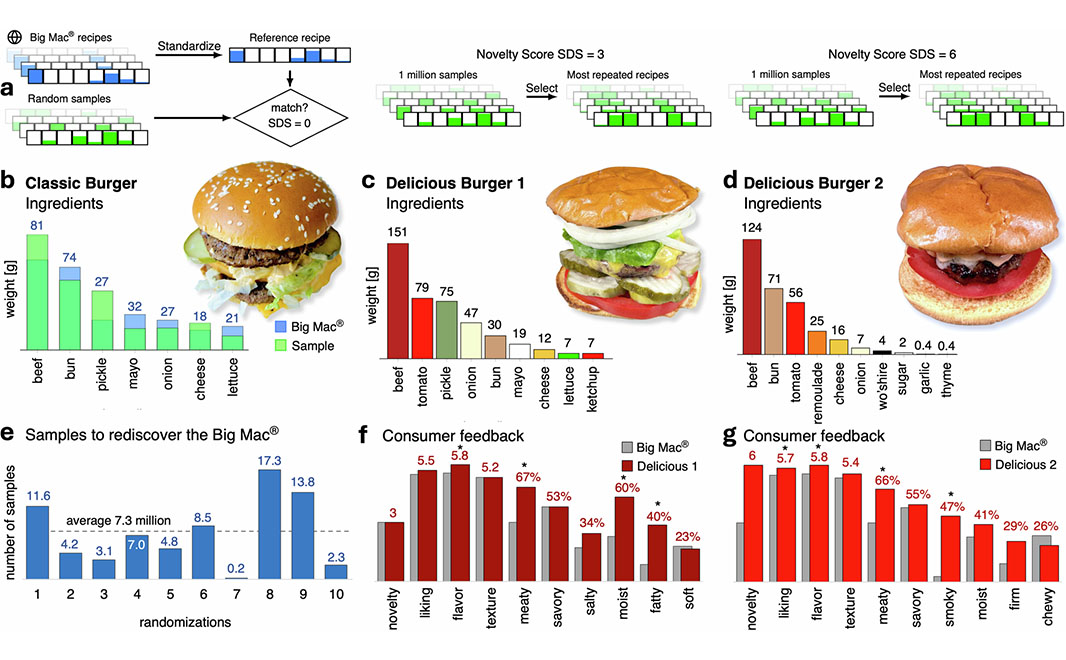
Using burgers as a model system, a generative AI system rediscovers the classic Big Mac without explicit supervision and generates novel burgers optimized for deliciousness, sustainability, or nutrition, according to a paper in npj Science of Food. https://t.co/rrgUL1uQzj
New paper online now at Nature Communications!
https://t.co/bDqA75pL5u
When I joined the @chewinclock lab we started my dissertation with a simple question in mind:
Does the liver clock regulate when and what proteins enter the bloodstream?
This work supports a model in which peripheral clocks coordinate physiology through a network of timed secretion and timed responsiveness, creating windows of inter-organ communication across the day.
How animals sense Earth’s magnetic field is one of biology’s enduring mysteries.
Researchers in Science have now identified superparamagnetic macrophages in the livers of rock pigeons to be crucial for magnetic sensing. The finding uncovers an unexpected role for immune cells in sensory perception and may fundamentally change our understanding of animal navigation.
Learn more in this week's issue: https://t.co/JS9qBFZHcP
I like the splitting of appraisal and curation. This makes the peer review process itself more visible and quantifiable, a critical gap that addresses the dissonance between incentives and improving the scientific process. Peer-review scores for authors and reviewers?
Scientific publishing needs to change. In a new preprint, HHMI President Erin O'Shea and Bodo Stern argue that the incentives are misaligned. Researchers should be evaluated on what they choose to share, not what journals select. I’m proud that @hhmi_science is leading the way. Read the preprint here: https://t.co/CV1iiwgIvY
Delighted to share our latest research from the @23andMeResearch Team, just published in @Nature
! We looked at data from >27,000 participants to uncover how human genetics influences weight loss efficacy and side effects of GLP-1 medications like semaglutide. A thread 🧵👇
Im pleased to announce that I finally received a notice of award for my Ruth L. Kirschstein National Research Service Award (NRSA) Individual Predoctoral Fellowship.
@chewinclock It has been a long road, with resubmissions and government shutdowns punctuating the journey. By now, much of the work has already been accomplished and will (hopefully) be published very soon: https://t.co/ncXCdy40AE.
The first approved GLP1 (Byetta) came from a desert reptile, the Gila monster. Inspired by this, our work on Burmese pythons 🐍🐍 is now out @NatMetabolism. An “extreme”-ly fun collaboration with Leinwand and @DrYongXu1. Congratulations @Shuke_Xiao!
https://t.co/Qwqd71JQYb