Matias, Alveti, Walton, Lanham, and Merriweather were named to the @CollSportsComm Academic All-District Baseball Team 🎩⚾️
🅱️🅰️🆖❗️ | #LetsGoPeay
https://t.co/kBv8cfhv7t
If your playing ⚾️ in the summer heat & your not tired or uniform is dry after a game..
Simple Truth: You are not playing hard enough
⚾️Hustling on & off field between innings ✅
⚾️Turning singles in 2 doubles ✅
⚾️Going first to third✅
⚾️Diving for balls✅
Etc.
You vs You
This is absolutely nuts
Baseball Transfer Portal Day 1 Recap
1,400 players enter including almost 700 pitchers
That’s a whole conference of players. A lot of these kids will never play again.
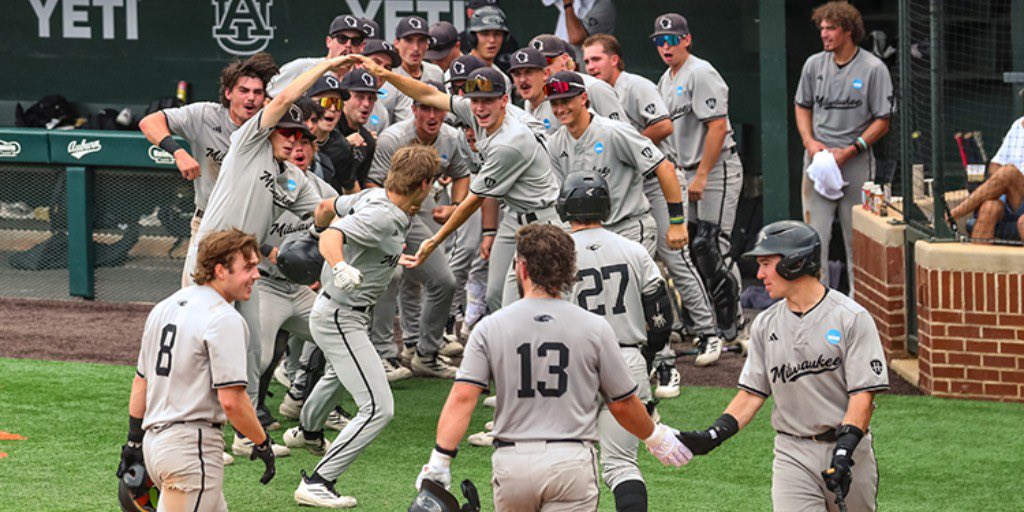
On April 3rd, Milwaukee was 5-22 and one of the worst teams in the country.
Some of their losses:
Run-ruled 21-7 by LSU
Run-ruled 20-3 by Duke
Run-ruled 14-4 by Minnesota
Run-ruled 12-2 by SEMO
Run-ruled 17-1 by Purdue
Run-ruled 14-1 by NKU
Run-ruled 13-2 by Wright State
Run-ruled 16-2 by Notre Dame
Run-ruled 14-4 by UNLV
They finished the regular season 22-31, but won the Horizon League tournament and earned an autobid to the NCAA tournament.
Milwaukee beat #4 Auburn 13-8, beat UCF 13-6, and is now in a regional final, one win away from going to supers.
College Baseball.
The Scouting Classroom #16
What Scouts Watch During Infield/Outfield
Pregame Defense Matters
Pregame defense matters. A lot!
Most fans don’t pay close attention during infield/outfield. They’re finding their seat, checking the lineup, or waiting for the game to start. But scouts are already working, because a player can tell you a lot before the first pitch is ever thrown.
Infield/Outfield Is Not Just Warmup
To a scout, infield/outfield is part of the evaluation. It is a chance to watch feet, hands, exchange, arm action, carry, accuracy, body control, first step, angles, rhythm, and energy. The throw is only the last part of the play. The real evaluation starts before the ball ever reaches the glove.
How does the player move into position? Does he work through the baseball? Are his feet active or heavy? Are the hands soft or stiff? Does the exchange happen naturally? Does the arm work clean? Does the ball carry with life, or does he have to max out to make the throw?
That’s what scouts are watching
The Feet Tell the First Story
Before the arm, before the glove, before the throw, I’m watching the feet. Bad feet usually create bad throws. A player can have arm strength, but if his feet don’t work, the arm may never play the way it should.
Infielders have to create rhythm, read hops, get their body in position, and play through the ball instead of letting the ball play them.
Outfielders have to show reads, routes, angles, body control, and the ability to get behind the baseball.
A big arm is nice, but a big arm with bad feet is not the same as a playable defensive tool.
It’s More Than Just Arm Strength
Fans love the big arm. Scouts do too. But scouts are not just asking, “Was it hard?” We’re asking if it carried, if it was accurate, if the arm action was clean, if the ball stayed true, and if the player can make that throw again and again.
There is a difference between a player who can air one out in pregame and a player whose arm is a real tool. A real arm plays with carry, accuracy, and consistency.
Hands and Exchange Matter
For infielders, hands tell you a lot. Are they soft? Are they confident? Does the player receive the ball cleanly? Can he adjust to an in-between hop? Does he funnel naturally? Does the exchange happen quickly without panic?
Some players look athletic until the ball gets to them. Then the game gets loud, the hands get hard, the feet stop, the exchange gets long, and the throw rushes.
That’s evaluation
A scout is not only looking for the routine play. He is looking for how clean the body works when the play speeds up.
Outfielders Get Evaluated Too
Outfield defense is not just catching fly balls and throwing to the cutoff man. Scouts are watching reads off the bat, first step, route efficiency, closing speed, body control near the wall, ability to play through the ball, throwing mechanics, carry, accuracy, and comfort moving in space.
A fast player is not automatically a good outfielder. Speed helps, but reads and instincts are what make the speed play. That is the difference between raw tools and baseball tools.
And there is a difference
The Lesson for Players
Never sleepwalk through infield/outfield. You may think nobody is watching, but a scout probably is, and he may learn more than you realize.
Pregame defense is not the time to be casual. It is the time to show pride in your position, to show that your actions are real, and to prove that your tools can play.
Because defensive evaluation doesn’t start when the ball is hit in the game. It starts in pregame.
The feet, the hands, the exchange, the arm, the carry, the accuracy, the rhythm, the body control, and the energy all matter.
Scouts are not just watching the throw
They are watching everything before it
That’s where evaluation begins
That’s Scouting
#BehindTheRadarGun 🔎
Mercer missing the field is bad for college baseball.
If a mid-major can win 44 games, finish top 30 in RPI, rank among the national leaders in homers and still miss, what exactly is the path supposed to be outside the power conferences?
Column: https://t.co/S37EUPSVzn