As #hurdle#coaches, data should guide our eyes, not replace them.
Hurdle unit splits, touchdown times, and velocities tell us what happened.
Posture, limb timing, rhythm, and mechanics tell us why it happened.
The best coaches analyze both.
#Hurdles#TrackAndField
A recent study found max sprint speed was highly sensitive to hip flexor and adductor strength, with improvements driven mostly by step frequency rather than step length.
If you want to see how to strength train for speed…
Speed Kills gives you 8 weeks of sprinting,
Bill Walsh built one of the greatest football dynasties ever.
• He won 3 Super Bowls in 10 years.
• He had a 71% winning percentage in the playoffs.
• He built a culture and dynasty that lasted beyond him.
Here are 6 of Bill Walsh's Culture Guidelines that any team can use:
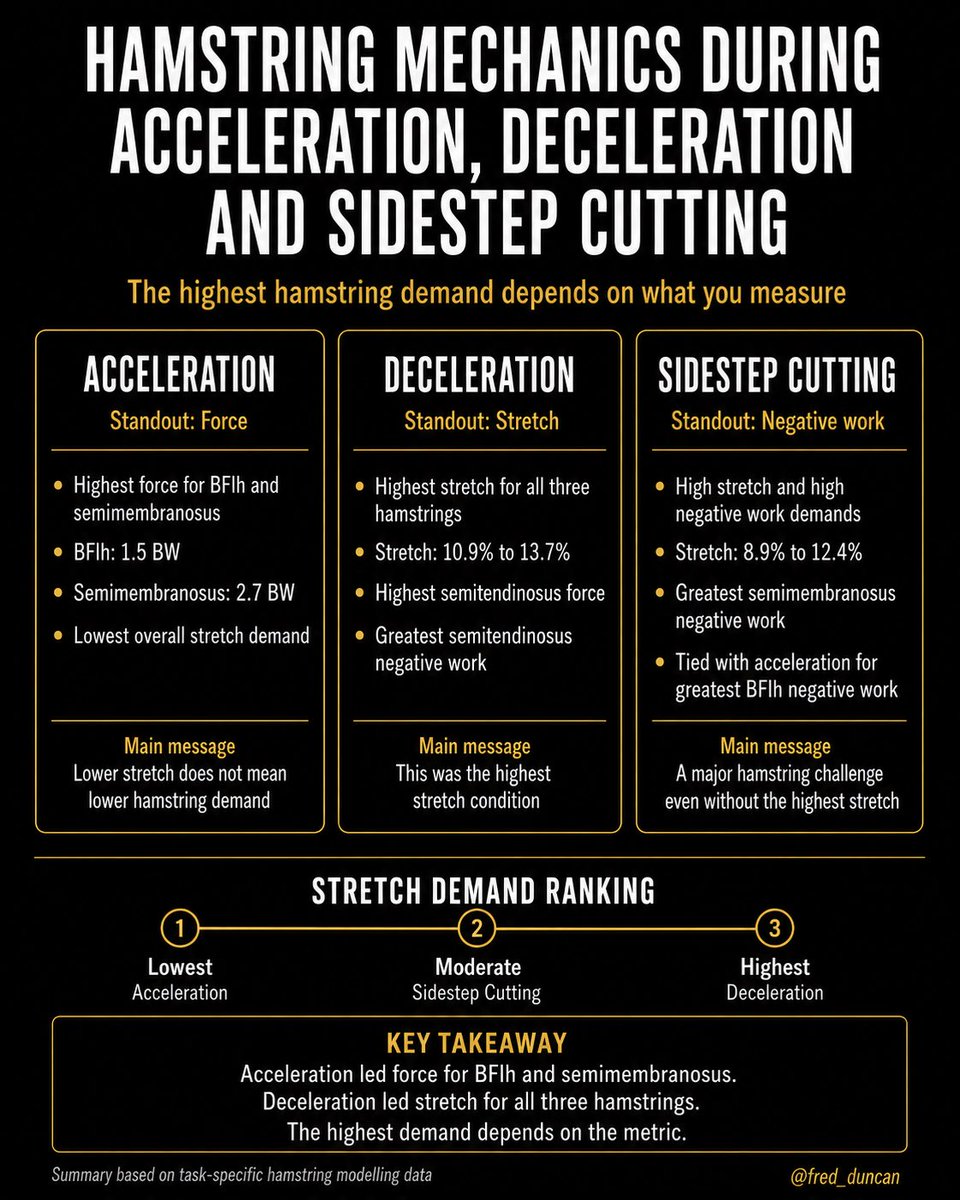
Acceleration, deceleration and cutting all involve the hamstrings, but they don’t challenge them in the same way
This is why we need to understand the mechanical demands of specific movements and skills so we can prepare athletes for what they are going to face.
These are
SENATOR JOHN KENNEDY: "It strikes me as breathtakingly ironic that that the people who are screaming so loudly about President Trump's decision to audit federal spending, are the very same people who wanted to hire 80,000 new IRS agents with guns to audit the American people."
FOLLOW ME, THE NEXT DROP WILL BE SHOCKING
Stop Getting Into Your Back Glute.
One of the biggest mistakes pitchers make is thinking that putting force into the ground means pushing hard into the quad.
A lot of guys think they need to stick the knee out, load into the quad, and drive from there.
What we actually wanna do is get into the back hip and the back glute.
The problem is that people constantly tell pitchers to “get into the glute,” but nobody really explains how to do it.
The easiest way I think about it is creating a pinch at the hip.
There’s a diagonal line between the thigh and the abs.
What you wanna do is pinch that area together.
If you put something like a pen there, you should be able to hold it in place without it falling.
Once you create that pinch, all you need to do is get into that same position during the pitching delivery.
Now you’re automatically loaded into the back glute.
So during the leg lift, I’m thinking about getting into that pinch position.
When you create that pinch, you can’t really load heavily into the quad at the same time.
That pinch helps counter rotate the pelvis, gets you into the glute, and puts you in a really good position to move down the mound and unload at foot plant.
A man spends 50 years teaching at MIT.
He knows his time is running out.
So he records one last lecture — everything he knows, distilled into a single hour.
He died 5 months later.
This is that lecture.
The most important hour you'll watch this week. 👇
Bookmark it for later
“The path to success is not a straight line. Success is not possible without a firm foundation built on two things, BELIEF and HARD WORK, not talent. Definitely not luck. Belief and work,” Lindsey Vonn
Nobody can tell you how to win unless you learn from failure.
There are very few plyometric drills that have as clear a relationship to acceleration as bounding.
The athlete has to project forward, create/manage force from step to step and maintain their rhythm.
It’s not sprinting, but it’s one of our closest options.
The Scouting Classroom #12
THE WHOLE BALL PLAYER
One of the biggest mistakes young scouts, parents, coaches, and even players make is believing evaluations start and stop with tools.
Velocity.
60 times.
Exit velocity.
Bat speed.
Power.
Arm strength.
Those things matter.
But if you spend enough years in scouting, eventually you learn something:
The easiest part of evaluating a player is often the part everyone sees.
The difficult part is finding everything else.
For years in scouting circles there was a phrase that always stuck with me:
The Whole Ball Player
Because great evaluators weren't simply trying to identify who had the biggest arm, loudest tools, or best workout.
They wanted to know who the player really was.
Not just physically.
Completely.
THE PART EVERYBODY SEES
Some things jump out immediately.
You can see them from behind home plate or during batting practice.
For pitchers:
• Arm strength • Fastball • Breaking ball • Off-speed feel • Command
For position players:
• Speed • Hands • Actions • Power • Arm strength • Range • Athleticism
Those are measurable.
Those become report grades, stopwatch times, and radar gun readings.
And they matter.
But they only tell part of the story.
WHERE SCOUTING GETS HARD
The second half of the player rarely reveals itself immediately.
You don't always see it in batting practice.
You don't find it from Trackman or Rapsodo.
You definitely don't find it from a stat line.
Because some of the most important parts of a player live underneath the surface.
Questions like:
How does he handle failure?
Does he compete when things go bad?
Can he make adjustments?
How does he react after an 0-for-4 day?
How does he treat teammates and coaches?
How does he carry himself when nobody is watching?
Because now you're no longer scouting tools.
You're scouting people!
THE INVISIBLE TOOLS
Some of the biggest separators in baseball are difficult to see:
• Desire • Drive • Competitiveness • Baseball sense • Teachability • Confidence • Instincts • Maturity • Intelligence • Habits • Family background
Those traits don't show up on a stopwatch or a radar gun.
Yet over time they often determine who survives.
Everybody eventually faces adversity.
Everybody struggles.
Talent may open the door.
But what happens after the door opens?
That's where these traits start showing up.
THE LESSON
Anybody can scout the player everyone sees.
The difficult part is finding the player underneath.
Because the whole ball player isn't just speed, power, or arm strength. 👇👇
It's tools + makeup = All-Star
Ability + competitiveness.
Skill + instincts.
Talent + character.
The best scouts never simply looked for players. They looked for complete players. They looked for the whole ball player.
That's scouting.
#BehindTheRadarGun 🔎
Early on, you’re taught that getting stronger is the answer. Then you coach long enough to see the limits of that idea.
Strength still matters, but maximal speed is constrained by much more than what an athlete can produce in the weight room.
If youre ready to see a
At a certain point, something interesting happens.
An advanced athlete’s training starts to resemble a beginner’s again.
Not because they’ve regressed or may not use some special strength work, but because they’ve achieved sports mastery.
They know what works and how they
John Wooden said, "Champions never complain, they are too busy getting better.
But most leaders make one fatal mistake.
They let the complaining go unchallenged.
Here's why that destroys teams and what you need to know:
How valuable is speed endurance without speed?
Marita Koch is most known for her 47.60 world record in the 400m, but look at the speed she brought with her:
60m – 7.04
100m – 10.83
200m – 21.71
300m – 34.14
400m – 47.60 world record
Her coach heavily valued speed and ran a
Springy athletes aren’t just bouncy, they’re prepared…
Before the foot hits the ground, the body is already organizing. The tendon has to tolerate high force without excessive elongation. The muscle has to create active stiffness before contact. The nervous system has to
Wanting to win isn't enough. 🔥
Brian Kight nailed it.
If you're only in it for the trophy, you're already losing.
The grind. The pressure. The setbacks. The growth.
Champions embrace all of it.
Which part tests you the most? 👇