As an Athletic Director, I constantly remind our athletes to embrace hard and embrace adversity because it is coming whether you want it or not.
Life does not promise comfort. It promises challenges. The athletes who grow the most are not the ones who avoid difficult moments, but the ones who face them head on.
Hard builds discipline. Adversity builds character. Failure builds resilience. Those lessons will carry you much further than any trophy, scholarship, or championship ever could.
Don’t run from the struggle. Lean into it. The person you become through adversity is far more valuable than the success you achieve because of it.
@CoachMarcusHill We have it easy in Iowa with school ball being played in the summer.
Easy for me as a football coach. Our baseball guys lift all season anyway. We lift in AM and go 4 Sunday nights for 1.5 hours. We end when BP starts and our practice field is right next to the baseball field.
@CoachDanCasey@_CoachFerrari@chlkapp 11 personnel super counter with the triple option off the read! Pistol back, counter goes to the solo receiver side, triple to the twins side.
3 pullers to the front side, reading two defenders to the backside 🤤
You don’t have to draw on Visio anymore 🚀
We're giving 3 coaches a free year of Chlk for iPad.
That’s a full season of plays that don't look like they were drawn in 2009 on an outdated PC architecture app.
You know the drill:
→ Follow @chlkapp
→ Retweet to Enter the Giveaway
→ Drop your favorite play to double your chances!
Winners announced on Sunday!
“My confidence comes from my work ethic.”
Sounds like Jalen Brunson read The Way of Excellence. Confidence comes from evidence. Give yourself the evidence. Trust your training. Let it rip. https://t.co/QMMhSCRaNL
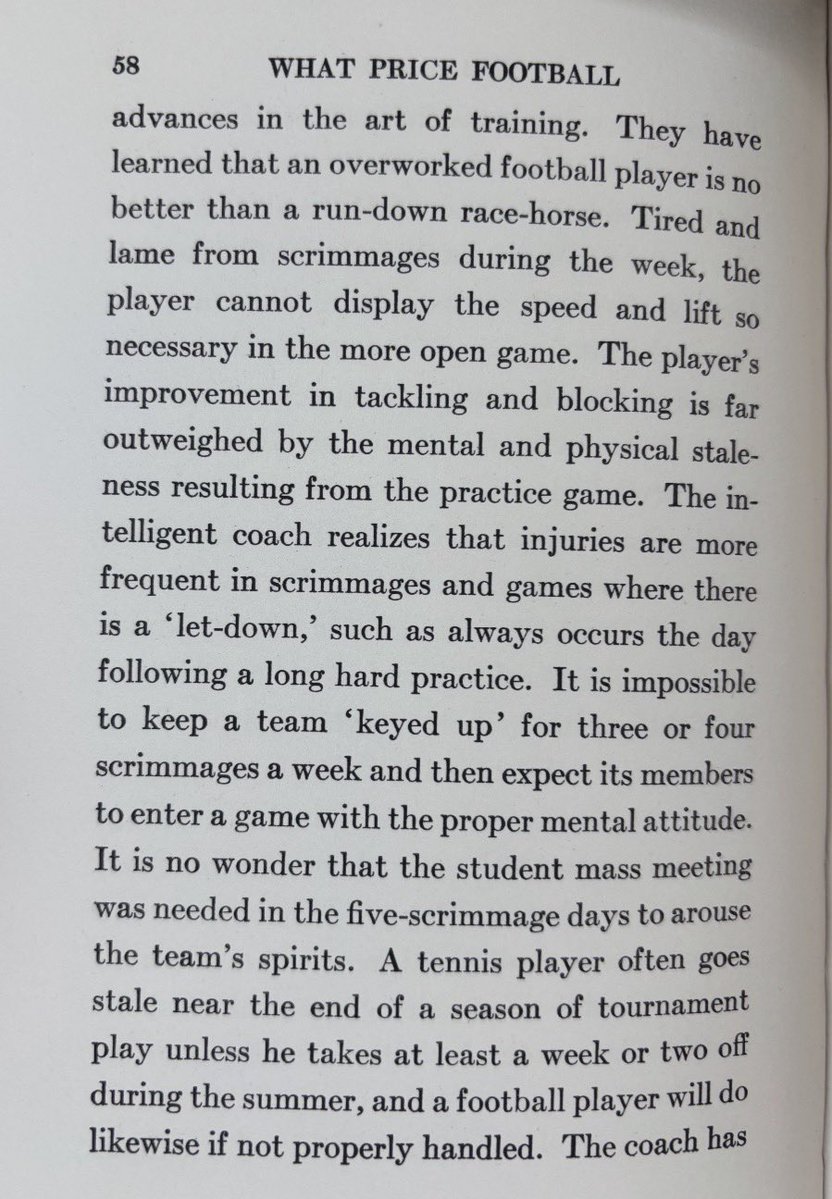
Coach Scott Mallien sent me two pages from “What Price Football”, a book published almost 100 years ago (1931).
“They have learned that an overworked football player is no better than a run-down race-horse.”
💥 Racehorses > Workhorses
“The intelligent coach realizes that injuries are more frequent in scrimmages and games where there is a let-down, such as always occurs the day following a long hard practice.”
💥 Fully-charged, healthy players with alert minds are nearly bulletproof.
“Football itself is full of vitality and it must be played by those who carry vitality to the field - vitality both mental and physical.”
💥 Speed is a barometer of health.
“One of the leading football players of the 1920s upon finishing his college career denounced the laborious grind of practice, and even went so far as to liken football to a gladiatorial combat.”
🚫 Grind
If you hear “Sport Specific Training” it’s 100% a sign to run the other way.
Athletes should not view their S&C as a Player, but as an ATHLETE.
Bigger, Faster, Stronger Athletes thrive in all arenas. S&C should improve Global Force capabilities, NOT practice skills.
One of the quickest ways to stay frustrated in life is believing you are owed something. Respect, success, playing time, promotions, trust, opportunities… none of it is guaranteed. The people who keep growing are the ones who show up, work, stay accountable, and earn it daily.
We certainly wouldn’t want any creativity now would we?
What unfair advantage? The one that requires the defenders to know where the eligible players are & account for them? Perhaps we should require every offensive formation to use 2 backs & 3 TEs so we know who’s eligible.
As a Registered Dietitian and Certified Sports Nutritionist , I’ve seen this conversation pop up constantly. Blaming creatine for cramping? Let’s look at the science instead of headlines.
I empathize with any athlete dealing with painful, performance-limiting cramps especially a full-body episode like Darryn Peterson described.
That sounds truly traumatic and frustrating.Clear on the evidence:
✅Creatine monohydrate does not cause muscle cramping, and neither does a high-protein diet.
✅It actually promotes intracellular hydration by drawing water into the muscle cells (cell volumization).
✅This supports performance, recovery, and in some studies, may even help reduce cramping.
The outdated myth linking creatine to dehydration or cramps has been thoroughly debunked, including in reviews from the British Journal of Sports Medicine and multiple International Society of Sports Nutrition (ISSN) position stands.
Muscle cramping in athletes is typically multifactorial. Common real culprits include:
❌Inadequate fluid intake (especially heavy sweaters)
❌Electrolyte imbalances (low sodium, potassium, magnesium, etc.)
❌Deconditioning or sudden spikes in training intensity/volume
❌Overtraining without proper recovery
❌Alcohol consumption (dehydrating)
❌Poor sleep, stress, or other factors
Blaming creatine alone oversimplifies things. Extremely high doses without adequate hydration, electrolytes, or smart programming can compound issues but that’s not the same as creatine “causing” cramps.
Recommendations for athletes:
• Prioritize hydration with electrolytes especially sodium (500–1500+ mg as needed for heavy sweaters). Replace 16–24 oz fluid per lb lost during training.
• Use evidence-based dosing: 5-7g/day of creatine monohydrate for most (larger athletes may need 5–10 g to maintain stores). No need for massive ongoing loads.
• Focus on consistent fueling, sleep, and progressive training.
• Work with a sports RD for personalized guidance.
Performance nutrition is about nuance, not blame. We don’t have full details on Darryn’s labs, training history, hydration practices, or other factors his doctors would have the complete picture.
Assumptions help no one. If you’re struggling with cramps, look at the full picture rather than eliminating one well-researched supplement. Evidence-based strategies beat fear-based avoidance every time.
https://t.co/4KSr96vgeH
The worst part is, people have been convinced it’s necessary and it’s taken over their identity. It’s taken the place of church, family time, and true community. Absolutely makes me sick for the future of families.
NEW: Youth sports is now costing parents as much as $25,000 a year.
Private equity and corporations are turning a childhood pastime into something only the wealthy can afford.
Youth sports has become a $40 billion industry, and the steep costs are crushing American families.