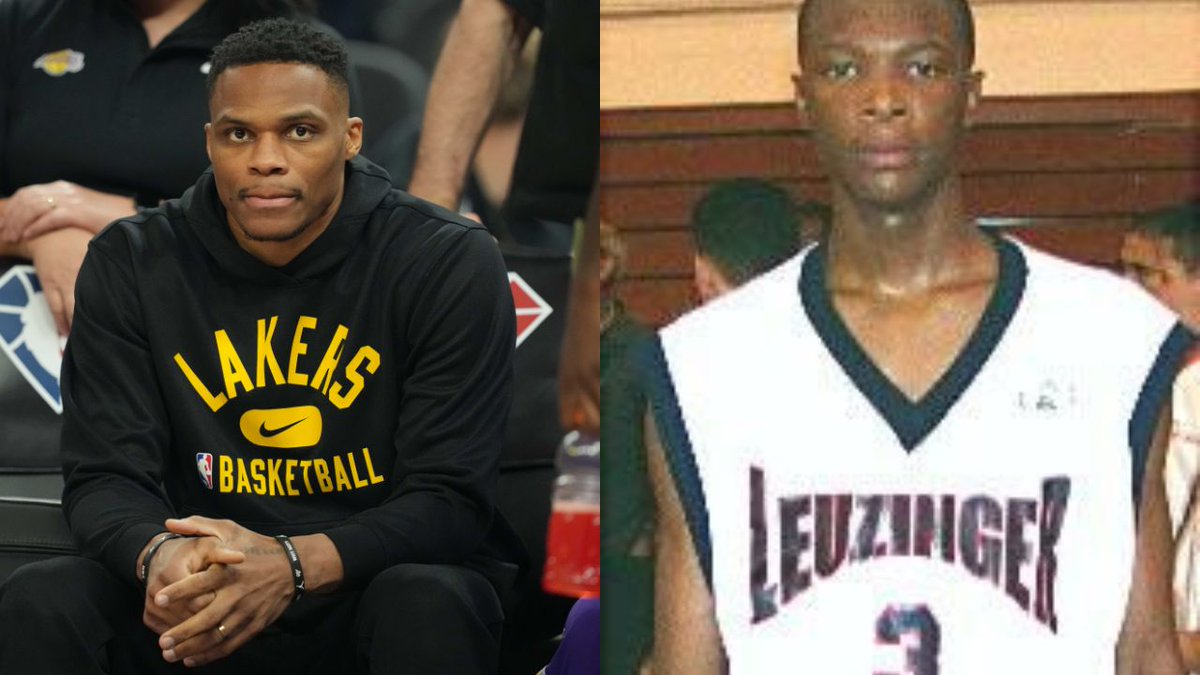
Russell Westbrook retired today with the most triple-doubles in NBA history. The name written on his wrist for all 18 seasons belongs to the kid UCLA actually wanted. That kid died at 16, and Westbrook spent two decades playing for both of them.
Westbrook was a 5'8", 140-pound freshman that no college recruited. The call UCLA's head coach made to his high school in 2004 was about Khelcey Barrs III, Westbrook's best friend from across the street in Hawthorne. A 6'6" phenom pulling scholarship offers as a sophomore. The two had a pact to play at UCLA together, then the NBA.
In May 2004, during a pickup game at LA Southwest College, Barrs collapsed on the court. An undiagnosed enlarged heart.
Westbrook walked across the street every morning after that to do his friend's chores at his grandmother's house. Then he grew 7 inches, averaged 25 a game as a junior, and took the UCLA offer they were supposed to accept together. From that point on he played like a man carrying two careers.
The numbers he put up look like typos.
209 triple-doubles is the most in NBA history, and it took breaking Oscar Robertson's record that stood for 47 years. In 2017 he averaged a triple-double across an entire season, something no human had done since 1962, then did it three more times. 27,176 points, 14th all time. 10,351 assists, 5th all time, behind only Stockton, CP3, Kidd, and LeBron. He did all of it at 6'3" in a league of giants, and outlasted the franchise that drafted him. Seattle picked him 4th in 2008 and stopped existing before he played a game.
And in every one of his 1,301 games, he wore two wristbands. One said KB3. The other said "Why not?"
People spent 18 years asking why he played every possession like the building was on fire. He was playing for two.
Andre Iguodala says load management came from Tim Duncan's Spurs playing five seasons in four years and the "players don't want to play" narrative only started when teams that never made the playoffs copied it
"Load management came from the Spurs. Because they kept going to the Finals every year. You go to the conference finals four years in a row, you added an extra season onto those four. You played five seasons in four years…"
"Duncan's year 13, 14, 15, 16, his body can't take the same beating. So load management makes sense. Then we come into the fold, we go to the Finals five years in a row, six years in a row… and we're playing six, seven seasons in five years. Load management makes sense."
"The problem is all these other teams look at analytics like, 'our guys need to rest', yeah, you never made the playoffs. You get bounced in the first round. You actually don't need load management."
"And so the term just got thrown around. And now you have the narrative that players don't want to play. And now you're building rules into the CBA, 'alright, 65-game minimum.'"
A second former NBA player plans to join the WNBA.
Royce White – a first-round NBA Draft pick in 2012 – told me he will be declaring for the 2027 WNBA Draft. The only thing that will stop him is if the WNBA makes a "definitive statement" that males can't play in the league.
Maybe I’m late, but there is an AMAZING YouTube channel that has complete Michael Jordan games from college, through his seasons with the Wizards, all digitally remastered.
Channel 23: The Complete Michael Jordan Archive
Iman Shumpert reveals the moment Jason Kidd scrapped the coach's play in a huddle and called his own
"Jay Kidd huddled us right back up. 'We're not running that. When you get ready to do this, they about to try and do this. You going to set a back screen this man's going to be wide open in the corner.'"
"If you don't do what Jason Kidd say and get out my face, you don't get it."
"Everybody ran to Tyson, threw it to the corner. We up out of there. I'm like, this is crazy."
Draymond Green says Carmelo Anthony was a tougher player to guard than Jayson Tatum because of the relentless pressure he put on the rim.
Jeff Teague : “You’ve guarded both Melo and Jayson Tatum. Who was the tougher cover?”
Draymond Green : “Melo.”
“JT is my guy, and I’ve even told him this personally. Sometimes he settles for jumpers too much.”
“After we beat Boston in the Finals, I told him our whole defensive game plan was built around him settling.”
“When Tatum attacks the basket, he’s almost impossible to stop. He’s 6’10”, has the handle, and once he gets downhill, there’s not much you can do.”
“But Melo was different.”
“He constantly put pressure on the rim. Every possession felt like he was coming right at you.”
“I remember starting against him early in my career at Madison Square Garden after David Lee was suspended.”
“Melo caught it in the mid-post, drove straight through me, missed the layup, then came right back to the exact same spot on the next possession and did it again, this time drawing the foul.”
“That’s the kind of pressure he put on defenses every night.”
“That’s what made Carmelo Anthony the tougher cover.”
Larry Brown rejects the idea that coaching a new generation requires lowering the standard or avoiding uncomfortable truth
“I’ve had some of the greatest coaches coach me. Some of the greatest coaches sit by me. Some of the brightest players that I coached shared their knowledge with me.”
“As long as you’re right… And the kids trust you… You’ve got to be relentless in teaching them what you think they need to do to get better. To help our team be successful.”
“If you let them win… You have no chance.”
“The one thing I know… If you develop trust in players… And they know you care… You can do anything.”
“Some days are hard. Ultimately, all we’re trying to do is get them to be better. To help them understand how serious this is… If you’re really trying to make it to the next level.”
🏀 Utah State head coach Jerrod Calhoun teaches a defensive communication drill while players must recognize offensive actions and call out defensive coverages — emphasizing constant talk.
Philadelphia Eagles coach, Nick Sirianni: “Effort is free. You can control your effort”
No it’s not and no you can’t!
Effort is metabolically costly. You can say ‘effort is free’ every single day and players will still slack off; drop in intensity; give into distractions; be avoidant…to name a few behaviours.
Effort is far from free. With every ounce of effort, sugars and glucose that power the brain deplete. Neural fatigue sets in throughout the course of the day. Anxiety is rife in competitive environments meaning effort can be quicker to atrophy.
Effort is far from free…
It’s also not completely under your control, not only for the very reasons above. Psychology offers us the law of least work: given a choice between similarly rewarding options, organisms learn to avoid those that require more work or effort.
A better message?
“To high perform and win, we have to put in enormous effort. And this is very, very hard. We’re going to support you to put in effort by giving you the environment, the education, and the skills to ensure that you can optimise your effort daily. By giving you this support we will be demanding. We will stretch you more than any other group of players in the NFL. This won’t be a comfortable process…but we will help you put more effort in that you thought possible…”
What can be done?
-education and support plans on nutrition; training; sleep; effective rest and recuperate; and lifestyle tools for daily planning
-daily training structures that optimise periods during the day where effort can be optimised
-engagement tools that help players engage during meetings and training…that help them exert effort appropriately and optimally
-learning skills that help players apportion effort during training…that help them self-regulate their learning and practice deliberately
-competitive mental skills that optimise player ability to compete while reducing the stress of competition
By sending the message that effort is hard, but then providing the environment and skills to train and compete with enormous effort you are helping players develop ‘learned industriousness’ where effort can be experienced as valuable or rewarding in its own right.
Effort is neither free nor controllable. But through environmental intervention and upskilling, coaches can help players take control of their effort and experience effort as rewarding.
Iman Shumpert says Steph Curry changed how every NBA team plays, but James Harden changed how players build their individual offensive game.
“People tried arguing with me on Twitter, saying I claimed James changed the game more than Steph. That’s not what I said. They belong in the same conversation.”
“Steph made the three-pointer a necessity. If your team can’t shoot threes today, you’re not surviving in this league.”
“Before Steph and Klay, the three was something you used when you needed to catch up. They turned it into a weapon.”
“I remember in the Finals, my teammates were getting on me for passing up open threes. I kept thinking, ‘I’ve never played like this.’ Then you realize you have to because they’re counting by threes.”
“You’d see a missed shot and your first thought wasn’t where the rebound was going. It was, ‘Where’s Steph?’ Because if he got it, you knew what was coming.”
“Steph changed the game because he made everyone add the three-point shot to their game.”
“James Harden changed something different. He made his style of play become people’s package.”
“There’s a difference between being good at basketball and having game. The great ones have a complete package they can go to at the end of a game.”
“That’s what Kobe had. You knew he was going to get to his spots. You just didn’t know how.”
Gilbert Arenas opened up about the intimidating reality of playing alongside Michael Jordan, through Kwame Brown.
According to Arenas, Brown was still trying to find his confidence while playing with Jordan.
One night at a bar in Chicago, after a few drinks, Brown spotted Jordan sitting by himself and convinced himself it was finally time to confront him.
"I'm gonna whoop his ass," Brown kept saying as he ordered more shots to build up the courage.
Then Jordan walked over.
Looking completely unfazed, he greeted Brown before casually saying one sentence:
"Oakley's downstairs."
That was all it took.
The mention of Charles Oakley instantly erased every bit of confidence Brown had built up.
The fight never happened.
For Arenas, it perfectly captured just how intimidating Jordan's presence was.
Sometimes, all it took was a few words to remind everyone exactly who they were dealing with.
📽️-justRealGold
I get so tired of people that claim they know basketball using the word space. In 1983 there were 20 NBA teams averaged over 100 points per game without a three-point line and no space. Yet little guards and big Guards scored at the rim.