The origin and purpose of Thanksgiving is not what most people think…….👇
You’ll be surprised to know that George Washington's proclamation was not simply a call to be thankful, but a call to acknowledge God, express gratitude to Him, seek His forgiveness, and ask for His guidance and protection.
Take a minute and read this and pass it on so generations to come will know the faith of our founders.👇
By the President of the United States of America.
A Proclamation.
Whereas it is the duty of all Nations to acknowledge the providence of Almighty God, to obey his will, to be grateful for his benefits, and humbly to implore his protection and favor
….and Whereas both Houses of Congress have by their joint Committee requested me to recommend to the People of the United States a day of public thanksgiving and prayer to be observed by acknowledging with grateful hearts the many signal favors of Almighty God especially by affording them an opportunity peaceably to establish a form of government for their safety and happiness.
Now therefore I do recommend and assign Thursday the 26th day of November next to be devoted by the People of these States to the service of that great and glorious Being who is the beneficent Author of all the good that was, that is, or that will be.
That we may then all unite in rendering unto him our sincere and humble thanks—for his kind care and protection of the People of this Country previous to their becoming a Nation—for the signal and manifold mercies, and the favorable interpositions of his providence, which we experienced in the course and conclusion of the late war—for the great degree of tranquillity, union, and plenty, which we have since enjoyed
….for the peaceable and rational manner in which we have been enabled to establish Constitutions of Government for our safety and happiness, and particularly the national One now lately instituted—for the civil and religious liberty with which we are blessed, and the means we have of acquiring and diffusing useful knowledge—and in general for all the great and various favors which he hath been pleased to confer upon us.
And also that we may then unite in most humbly offering our prayers and supplications to the great Lord and Ruler of Nations, and beseech him to pardon our national and other transgressions
….to enable us all, whether in public or private stations, to perform our several and relative duties properly and punctually—to render our national government a blessing to all the People, by constantly being a Government of wise, just, and constitutional laws, discreetly and faithfully executed and obeyed—to protect and guide all Sovereigns and Nations (especially such as have shewn kindness to us) and to bless them with good government, peace, and concord
…to promote the knowledge and practice of true religion and virtue, and the increase of science among them and us—and generally to grant unto all Mankind such a degree of temporal prosperity as he alone knows to be best.
Given under my hand at the City of New York the third day of October in the year of our Lord 1789.
George Washington
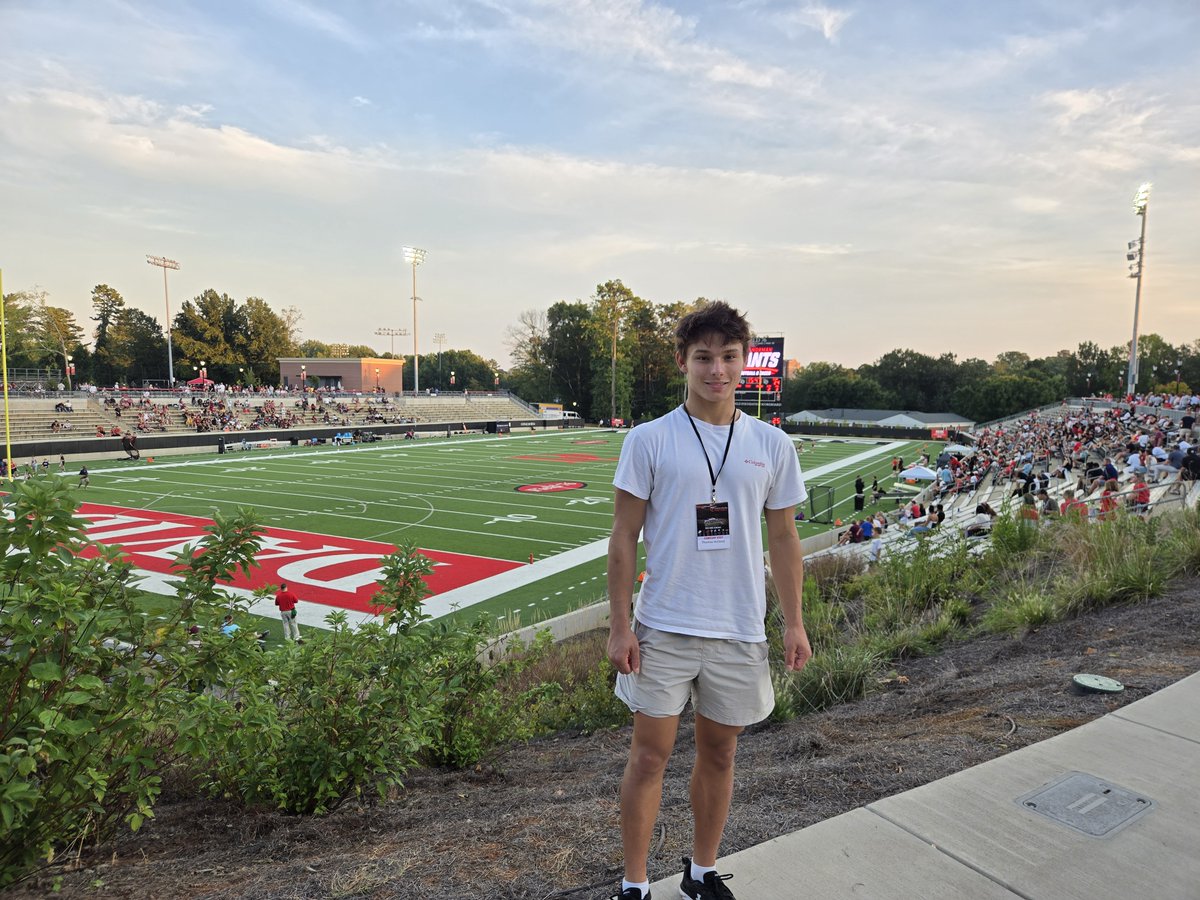
I’m excited to announce that I’ve committed to Davidson College to continue my academic and football career.
Thank you to my family, teammates, and coaches at Savannah Country Day for helping me get here, especially Coach Blackmore for everything he’s done for me. Thank you to Coach Gibson, Coach Thakkar, Coach Jenkins, and the Davidson staff for believing in me.
Go Wildcats!
@Jblackcky44@TerryMotl@CoachShirek@SCDS_Athletics@DavidsonFB@DSGBCoachCam@Coach_Thakkar@CoachLukeJenks
Final, @SCDS_Athletics 20, @BethesdaBlazers 16. Bethesda drove to goal line, ruled inches short. Then holding penalty erased a TD run. Hornets broke up pass on fourth down on final play.
Division I Schools that did not opt into revenue sharing. Mainly because they didn't want to limit their sports rosters.
For 2026–27, current reporting indicates that 37 of 365 Division I schools are not participating in revenue sharing.
A missed layup is nearly as bad as a live ball turnover because a missed layup many times leads to a made layup by the opponent. Finishing Matters! 4 Point Swing
Kurt Warner shares the lesson that changed his entire career and it applies to everything.
He sat on the bench for 4 years in college. When a friend asked the coaches why he wasn't playing, the answer wasn't what he expected:
"The reason I wasn't playing was because I was not very good in practice."
His first reaction? Allen Iverson mode.
"Practice? What're you talking about, practice?"
But then he did the math.
"In college we play 12 games in 365 days. In the NFL we play 16 games in 365 days."
That's less than 5% of your year.
"95% of our lives are lived in practice. And the biggest impression we make on people, the way people can understand and really realize who we are, is what we do every day in practice."
This is the 95% Rule. And it applies to everything - sports, business, relationships, life.
1: Show Up With Your Best Effort - Compete and give your best every single day. People can't question how you show up - your effort, attitude, and actions. Consistency removes doubt.
2: Trust Is Built In Practice, Not Games - Trust is earned in the thousands of moments before it's given. Before you can be trusted, people want to know you're dependable. Every day. Not just when it matters.
3: Master Daily Consistency - Success isn't about intensity - it's about consistency. Your habits compound. What you do daily defines who you become.
4: Big Moments Are Earned In Small Moments - The little details make the biggest difference. Greatness starts with preparation - it's earned in the boredom of doing the work when no one's watching.
Excellence isn't an event - It's a habit.
Practice is where trust is built.
How you show up daily is who you really are.
(🎥 @pttorch)
(🎥@kurt13warner)
This might be the best quote I have EVER heard
“There’s two kinds of people in the world. Those who are humble. And those who are about to be.”
(Via @JoshChambers 🎥)
There is a reason why @CoachJayWright started EVERY practice at Villanova with jump stops and shot fakes
Playing off two, and under control at the rim, is a cheat code for good hoopers
Richie Zweigenhaft is an 81-year-old psychology professor who still plays pickup basketball twice a week. He's run the same game for 51 years.
We talked about about aging, Warren Zevon, and a simple idea: The secret to happiness is pickup hoops:
https://t.co/Z4sZmpCs0C
Norway wins the most medals at the Winter Olympics, with a population of just 5.6 million. People say it’s because Norway is a winter wonderland, but they’re also elite at triathlon, beach volleyball, cycling, and as the world is now seeing, soccer.
A big part of their success is how they treat youth sports—and it’s the opposite of what we do in the US and Canada. Here’s what we can learn from Norway:
1. Scorekeeping:
In the US: Youth sports tend to be hyper competitive even at early ages. Leagues almost always keep score.
In Norway: Scorekeeping isn’t even allowed until age 13.
Removing winners and losers keeps the focus on the process not outcomes. It keeps kids engaged longer because it minimizes pressure (and tears) and maximizes fun, learning, and growth. The goal isn’t to win a third grade championship. It’s to love sport and keep playing.
2. Trophies:
In the US: If you give everyone a trophy, you’re creating snowflakes who will never gain a competitive edge.
In Norway: Whenever trophies are awarded, they are handed out to everyone.
If getting a trophy makes young kids feel good, we should give them trophies. Maybe they’ll come back and play again next year!!
As for the creation of snowflakes with no competitive edge—Norway’s athletes are tough as nails and all they do is win.
3. Prioritizing Fun:
In the US: Far too often, the goal is to win.
In Norway: The national philosophy is “joy of sport.”
Youth sports in the US are driven by adults, ego, and money. Youth sports in Norway are driven by fun.
Only half of kids in the US participate in sports. The number one reason they drop out: because they aren’t having fun anymore. In Norway, 93% of kids participate in youth sports. Fun is the foremost goal.
4. Playing Multiple Sports:
In the US: There’s pressure to specialize early and play your best sport year round.
In Norway: Try as many sports as you can before specializing as late as college.
Norway encourages kids to try all types of sport. This reduces injury and burnout and increases all-around athleticism. It also helps promotes match quality, or finding the sport you are best suited for as your body develops, which is impossible if you commit to a single sport too early.
5. Affordability
In the US: There is increasingly a pay-to-play model with high fees for leagues, equipment, and travel. This excludes many kids from playing.
In Norway: It’s a national priority to keep youth sports affordable and therefore accessible for all.
Kids aren’t priced out, which creates opportunities for everyone to participate (and develop into athletes), regardless of their parents’ income level.
Norway’s sporting success isn’t just speculation or a nice story. A large body of research supports their approach:
• Studies show athletes who specialize later in life have a significantly higher chance of becoming elite.
• Soccer players whose motivation is primarily internal (versus external) have more than a 3x better chance of making it to an elite level.
• The number one predictor of whether or not kids stay in sport is are they having fun.
• Parents connect winning to having fun whereas kids say having fun is about being with their friends and learning.
We could learn a lot from Norway:
In the US, 70% of kids drop out of youth sports by age 13. This not only diminishes an elite-athlete pipeline, but it also destroys an opportunity for healthy habits and all the character lessons kids can learn from sport.
In Norway, lifelong participation in sport is the norm. The goal isn’t to have the best 9U team. It’s to develop the best athletes. Those are two very different things. And Norway has the medals to prove it.
Rajon Rondo closed his AAU timeout by preaching one thing — play off two feet.
Not a play. Not a trick. Just jump stops.
And watching his son Pierre and his teammates execute it is all the proof you need that this concept works at every single level of the game.
The jump stop puts you in control. Not the defense.
Soon after Charlie Strong was fired at Texas in November 2016, he went home and isolated himself in his office. He picked up a yellow legal pad and started writing. Day after day, page after page:
What could I have done better?
What really happened?
What are you going to change?
Sean McDermott is doing something similar right now. After nine seasons and a 98–50 record in Buffalo, he built a new routine from scratch, including six to eight hours of self-assigned film study daily.
Dan Quinn, fired by Atlanta after a 0-5 start in 2020, put it plainly: "I wasn't going to be the blame person or a victim. I've got to gain something from this."
The thread running through these men is the willingness to treat failure as a curriculum.
Many people, when they get knocked down professionally, either rush to the next thing or retreat into bitterness. The coaches who come back stronger tend to do something harder: they sit in the discomfort long enough to learn from it, and they ask the questions that have no flattering answers.
When was the last time you sat with a difficult question long enough to fully answer it?
When things go wrong, do you reach for the next opportunity, or reach for the honest question first?
As McDermott told The Athletic: "When you stop asking questions, that's when you get yourself into trouble."