Today, Coastal Assembly is featured in The New York Times.
A decade ago, we started asking a simple question: instead of fighting the ocean, could we understand the forces and learn how to work with them to grow coastlines?
That question began as research at MIT’s Self-Assembly Lab. Today, it has become Coastal Assembly PBC, with a mission to grow the world’s coastlines.
We’re building a new approach to coastal resilience, one that combines satellite based intelligence, engineered reef systems, and living marine ecosystems to grow and protect coastlines around the world.
We’re excited to share the story of how we got here, and where we’re going next.
Read the full story: https://t.co/v6hsg21fhc
Today, Coastal Assembly is featured in The New York Times.
A decade ago, we started asking a simple question: instead of fighting the ocean, could we understand the forces and learn how to work with them to grow coastlines?
That question began as research at MIT’s Self-Assembly Lab. Today, it has become Coastal Assembly PBC, with a mission to grow the world’s coastlines.
We’re building a new approach to coastal resilience, one that combines satellite based intelligence, engineered reef systems, and living marine ecosystems to grow and protect coastlines around the world.
We’re excited to share the story of how we got here, and where we’re going next.
Read the full story: https://t.co/v6hsg21fhc
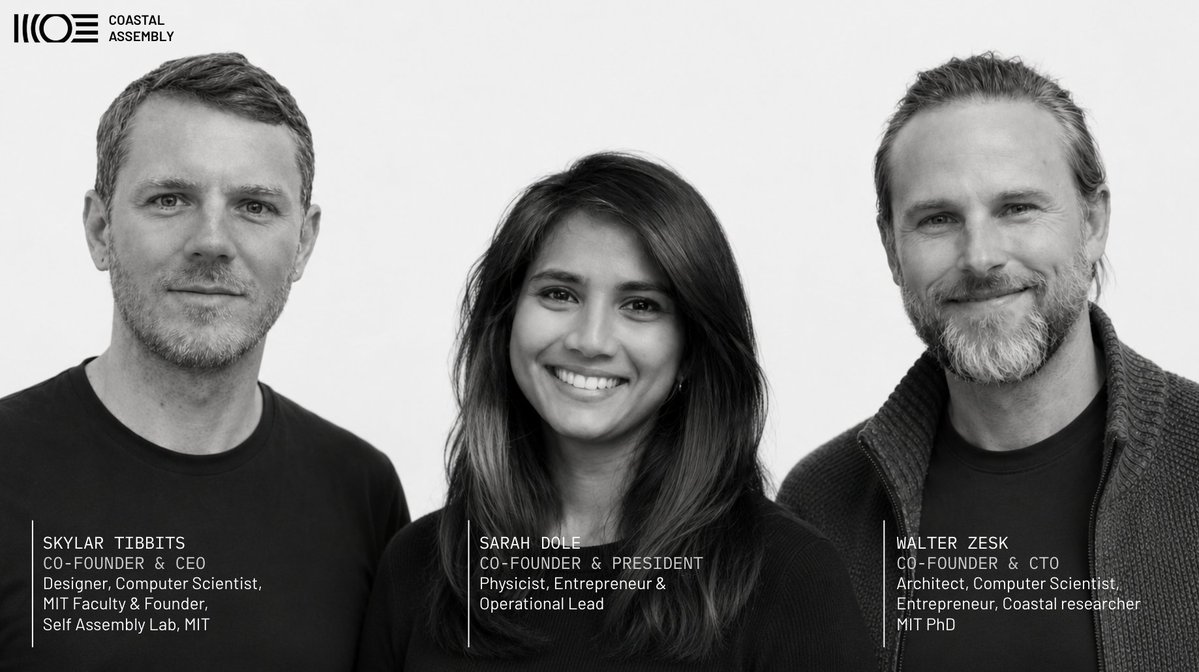
We realized we haven't formally introduced ourselves. We're Coastal Assembly, a team founded by three of us, each with a different entry point into the same question: how can we regrow coastlines around the world?
Skylar Tibbits, Co-Founder & CEO. A designer and computer scientist, MIT faculty who founded the Self-Assembly Lab. His lab started running tank experiments, simulations and deploying structures in the Maldives, long before there was a company attached to them, research that's still the foundation the team builds on today.
Sarah Dole, Co-Founder & President. A physicist and entrepreneur who came in with her own founder experience already behind her, she now leads commercial strategy at Coastal Assembly, everything from partnerships to figuring out how this business actually grows.
Walt Zesk, Co-Founder & CTO. An architect, computer scientist, and coastal researcher with a PhD from MIT, he spearheaded the technology behind the intelligence platform, modeling and optimization of the reef structures that coastlines and build marine habitats.
More from each of them soon as well as the rest of the amazing team we are building full of designers, fabricators, deployment engineers, roboticists, marine biologists, computer scientists, commercial and government sector leads etc.
We spent the last week in the Maldives meeting with resort partners, surveying new sites, and preparing for our next round of deployments.
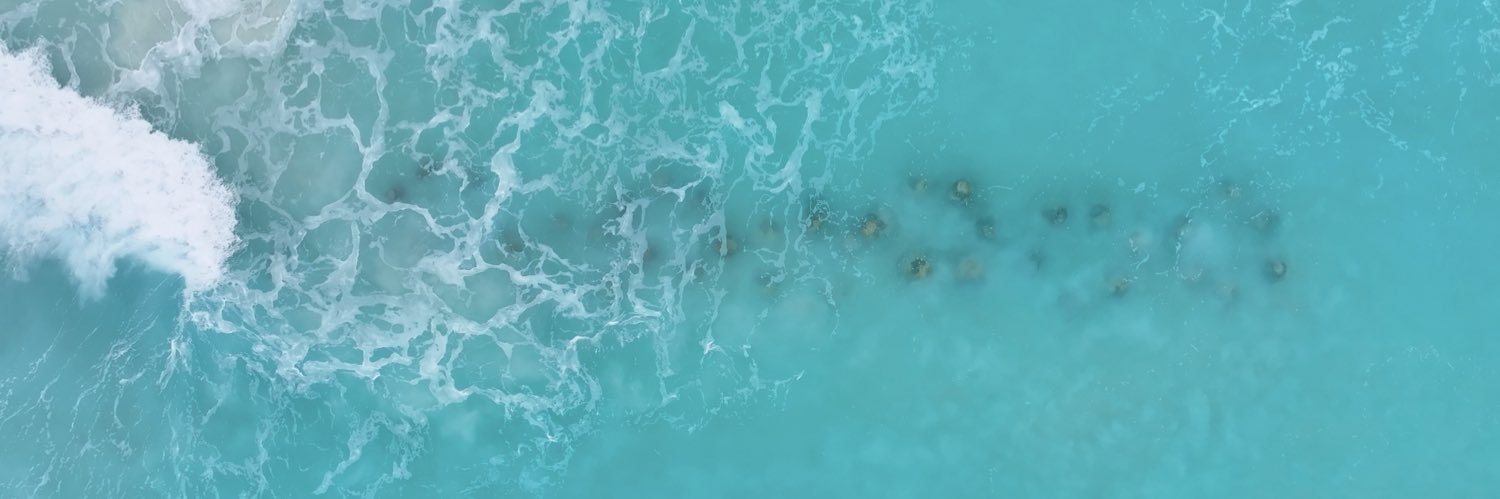
One of the highlights was returning to the JW Marriott Maldives Kaafu Atoll Island Resort, where we deployed our latest reef structure, designed to work with waves and currents to grow the beach. Based on our aerial surveys, the beach behind the structure grew by around 90 feet in the first six months and has roughly doubled in depth since deployment, while a reef community develops underwater.
We saw hundreds of corals growing across the structures, many now around 6 inches in diameter, surrounded by fish, sponges, urchins, shrimp, cushion sea stars and other marine life.
This trip we collected eDNA samples, mapped the bathymetry, completed aerial surveys and installed tilt sensors to capture how the reef interacts with waves, tides and currents across multiple sites.
That data feeds into our intelligence platform, which combines Earth observation with ground-truth data so we can learn from what's happening in the field, improve our predictions, and refine every new deployment.
That's what made this trip particularly exciting. Two years ago we were testing whether this could work, and now we're scaling it!
Over the past week we've been working in the Maldives with the team at Aqua Terra, NGO Soneva CSM, to test new smaller scale reef units designed specifically for coral outplanting. Over the coming months, the team plans to outplant thousands of nursery-grown corals onto the reef units and monitor their survival, growth and development.
Our previous deployments relied on the natural recruitment of corals and other marine life that establish on the structures over time. Now we're looking at whether active coral restoration can accelerate that process, working with some of the best science and marine ecology practices available today.
By combining coral outplanting with reef structures designed to influence waves and currents for sediment transport, we're working toward a new kind of coastal infrastructure that can grow beaches while providing the substrate and habitat for thriving reef communities.
We're creating a foundation for reefs that can grow and thrive over time, with the goal of coming as close as possible to a healthy natural reef. Natural reefs are the benchmark and something we aim to catalyze, not replace. We see this as just the beginning!
A huge thank you to the AquaTerra team for welcoming us to their home and being amazing collaborators. Looking forward to growing the future together.
Aqua Terra Team: Johanna Leonhardt, Benedict Yuen, Aishath Naeem, Ayla Kroon, Matthew Forshaw, Alex Barnes, Ahmed Vishah, Oliver Klompe, Rose Clarke, Lorenzo Romagnoli, Rens Raggers, Madison Gladwin, Nikole Gualdron, Eliza Cantacuzene, Thushar Babu
Coastal Assembly Team: Farida Moustafa, Jacob Zhao, Jared Laucks, Sarah Dole, Walter Zesk, Skylar Tibbits
If your resort or property is dealing with erosion, we'd like to talk about growing the coastline back.
What if building a reef could grow the beach at the same time?
At the JW Marriott Maldives, we grew 90 feet of beach in the first six months. That beach has since doubled in size.
Underwater, the same structures have become a home for thousands of fish, coral, and other marine life.
The idea is simple: don't fight the ocean, collaborate with it. Our structures work with waves and currents to grow coastlines and build marine habitat at the same time.
We use our intelligence platform to monitor and predict how a coastline behaves, then simulate and optimize a reef structure for that specific site. From there, we fabricate and deploy it, and keep monitoring and adapting as the beach grows.
If erosion is a problem where you are, reach out and we'll walk through what that could look like for your site.
This all started when we went to a sandbar in the Maldives that naturally had emerged over just a few weeks. A meter above sea level, hundreds of meters in one direction, tens of meters in the other. You can pull up a boat to the island, yet it grew out of nowhere.
Why did this happen? When does it happen? And most importantly...how could we make it happen in strategic places?
This became the fundamental question:
Could we work with the forces of the ocean, waves, currents, tides, and sediment transport, to naturally guide sand back onto beaches, growing coastlines and new islands over time?
We saw first-hand the harmful effects of dredging on the marine environment. We saw how sand pumping washed away after the first season. We saw rock boulder groins and hard infrastructure designed to fight the ocean, yet fail over time. We knew there had to be a better way, we just needed to understand it.
That question led to nearly a decade of research at MIT, studying coastal geomorphology, running CFD models, flume experiments, and ultimately ten large-scale field deployments to refine and test the technology.
That effort is now an intelligence platform, with remote sensing data and a multi-tier hydrodynamic and morphodynamic modeling pipeline driving a reinforcement learning cycle as we analyze and optimize for each site.
And we've shown that it's possible in the field, growing 90ft of shoreline at the JW Marriott in just six months. Now we're scaling our approach around the world.
We believe this is one of the largest and most important challenges facing coastal communities globally, and the answer has been sitting in front of us all along.
The ocean is our collaborator.
Growing Coastlines with Intelligence.
Coastal Assembly is building intelligent, autonomous systems that protect shorelines against erosion and sea level rise while creating entirely new land for the coastal cities of tomorrow.
#coastalassembly#coastal#growingislands
@ph0rque@RegenerativeCo Program the coastline, let nature take over (given the right conditions and ecosystems)! Would be happy to talk more details. Drop us a line at [email protected]