In the interview with David Lin, Benjamin Cowen analyzes Bitcoin's four-year cycle, predicting a peak in 2025 followed by a bear market in 2026. He discusses Ethereum's potential, the start of altcoin season possibly after Bitcoin dominance peaks, and correlations with stock market trends like the S&P 500. For full details, check the video.
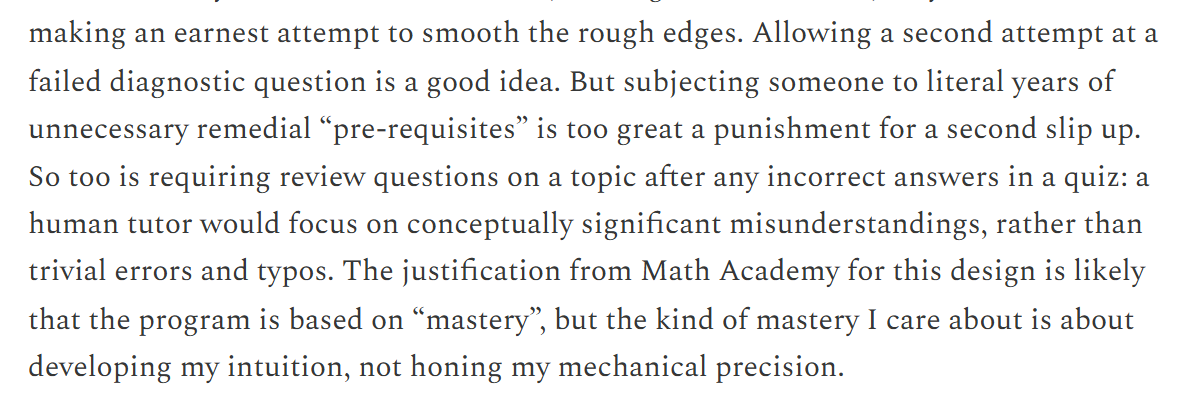
Maybe it's not what you intended to convey, but the attached screenshot from your article seems to argue against the necessity of procedural fluency. Either that or your bar for procedural fluency is so low that someone can meet it despite not being able to execute procedures correctly, comfortably, and consistently.
It's ultimately up to you what you want out of your math education and I don't want to argue about it, but I will say this: our mastery learning system will work if you're willing to start at a level where you're able to solve problems correctly, comfortably, and consistently, and then stick with the process consistently for a long enough time horizon that you could reasonably expect a body transformation if you were physically working out at the gym.
It's true that it can be a rude awakening to realize how low your appropriate starting level is compared to the highest level of math you've seen before, or even compared to the level at which you can sometimes solve problems correctly if you strain your hardest but you're inconsistent and/or it takes you an excessively long time (the intellectual equivalent of a one-rep max). And it's true that any lesson you do, it might not feel perfectly intuitive right away, and you might not notice all the connections there are to see.
But if you stick with the process and continue periodically reviewing and layering more knowledge on top of that topic, you'll continually increase your intuition for it, all the way up to a deep level of understanding. The more knowledge you build on top of that topic, the more connections you make, the more deeply ingrained it becomes, the greater your level of automaticity, the more intuitive it feels, the more easily you're able to see connections to other topics.
You're right that there is a ton of room for us to improve. We need to
-- continue refining our curriculum, add more tidbits about intuition, connections to other topics, historical importance (without cluttering things up for students who want it as streamlined as possible), add tons of cool projects that pull lots of skills together into exciting contexts,
-- add an "I already know this" button to lessons where we ask a couple questions from the last knowledge point and the student can get credit if they solve both correctly,
-- set up notifications, goals, user groups, progress reports, and more generally help students stay motivated and consistent...
... this list could go on for pages, it's a long road and we're well aware of that. That's why we're in beta.
But one thing that will never change is that all of the system's decisions will be based on a student's demonstrated ability to solve problems. We're not going to turn a blind eye to a demonstrated lack of ability. If a student can't solve diagnostic questions correctly and in a reasonable time frame, we're not going to place them ahead of their skis. If a student misses a question on a quiz, they're going to have to do a bit of extra practice afterwards.
Yeah, that's all a bit hard-ass, but there is no other way to reliably build a student's skills. There are plenty of ways in which we aspire to better support learners, but none of those ways involve lowering the bar. The most effective coaches are supportive hard-asses, and that's what our system needs to become.
ANN aired simulated footage of an eruption of Mt. Fuji: if an eruption occurs, it could blanket most of the Tokyo metropolitan area with volcanic ash, disrupting roads and railways. Viewers were reminded to prepare 2 weeks of emergency food for disasters.