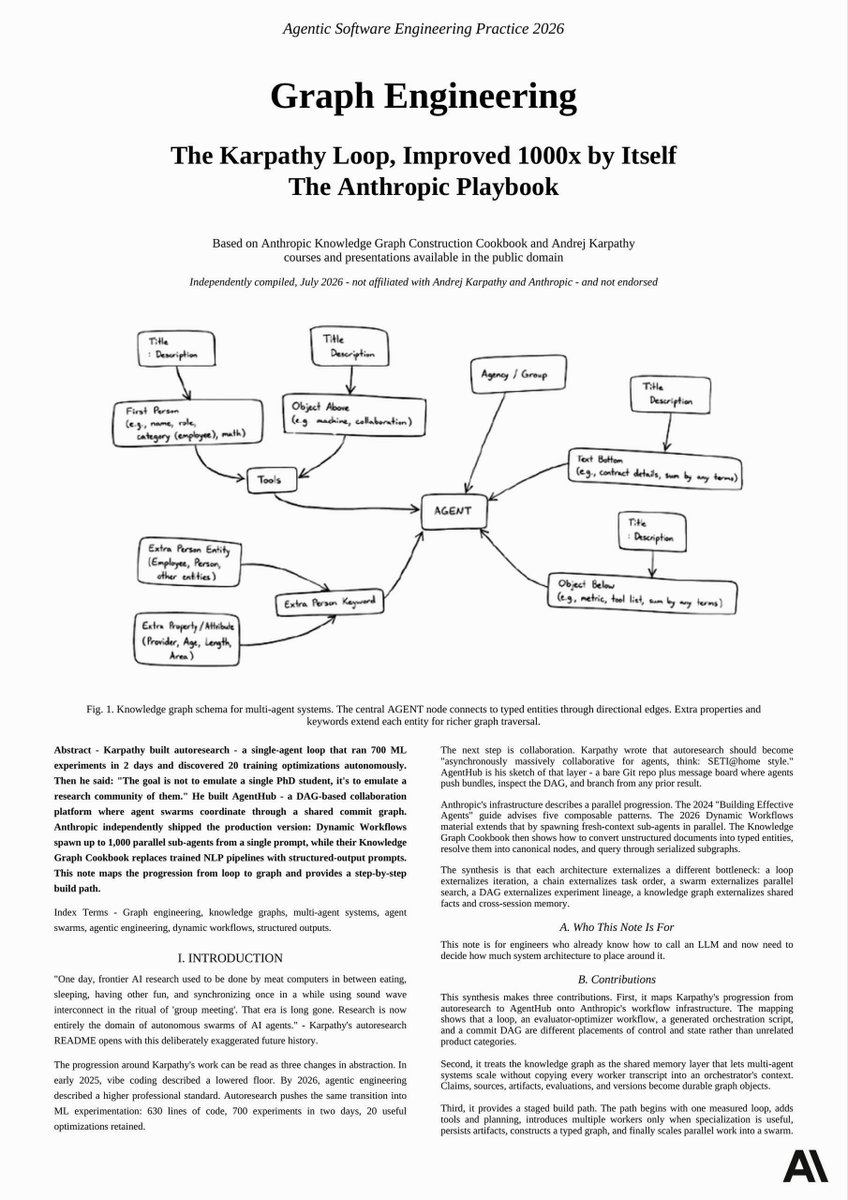
Two Anthropic seniors just made Karpathy's loop 1000x better with "Graph Engineering" - dropped 11-page PDF
the shift: the agentic systems got 1000x better the moment you wired agents into a graph
here's the playbook in 6 steps:
step 1 → build one loop: generate, critique, revise - one self-review cycle beats a smarter model with none
step 2 → add tools: search, code execution, database - thinking without tools is hallucinating
step 3 → go parallel: spin up agents in separate worktrees - same repo, different branches, no conflicts
step 4 → add a graph: agents write findings as typed nodes and edges - not transcripts - every claim keeps its source
step 5 → ground your evaluator: it checks claims against graph edges, not vibes - "Triple not found" beats "seems off"
step 6 → the graph survives every session - your agents stop rebuilding context from scratch
the result: Karpathy ran 1 agent in 1 direction - this system runs 1,000 with shared memory - same model, it's the architecture
read this 11-page PDF and paste it into your Claude - you won't regret it
bookmark - then read the article on building graphs from scratch ↓
Agent skills are becoming a popular way to extend LLM agents with reusable, domain-specific knowledge, but how well do they actually work when agents must find and use skills on their own?
To answer this question, we collect 34k real-world skills from open-source repos and build a retrieval system over them. We then evaluate skill utility under progressively realistic settings, from curated skills directly given to agents, to retrieving from the full 34k collection, to settings where no task-specific skill even exists.🧵
Today we’re excited to release Muse Spark. It’s our first end-to-end test of the new stacks we’ve built at MSL, and a true testament to this incredible team. We’re eager to learn from your feedback!
https://t.co/PPWBgewWQx
Auto-research for ML training models is all the rage now, but underrated is: auto-research for data!
Sure, you can squeeze out a bit of model performance by optimizing hyperparameters, but code agents can do data work that has been very labour intensive and required a lot of attention to a lot details effortlessly:
> download data from many different data sources
> bring all the data sources into uniform format
> do detailed EDA: find patterns and outliers
> look at 100s of samples and take detailed notes
> make beautiful infographics rather than mpl plots
> iterate on data filtering by looking at more samples
> make a simple pipelines robust and scalable
It's now possible to write data pipelines for dozens of data sources in hours that would have taken weeks of reading many docs, debugging APIs and data formats, wrangling outliers and missing data.
A few weeks ago we gave Claude access to the CPU partition of our cluster and it iteratively refined filters to retrieve a domain subset of FineWeb. This would have taken me 2-3 days to work through while it took Claude just a few hours with almost no babysitting and with a nice logbook.
Thus the long tail of small, niche data sources becomes more accessible and can be aggregated to even larger high quality datasets for cool applications.
Data has been fuelling LLM progress more than model architecture innovations, so I am very excited about this!
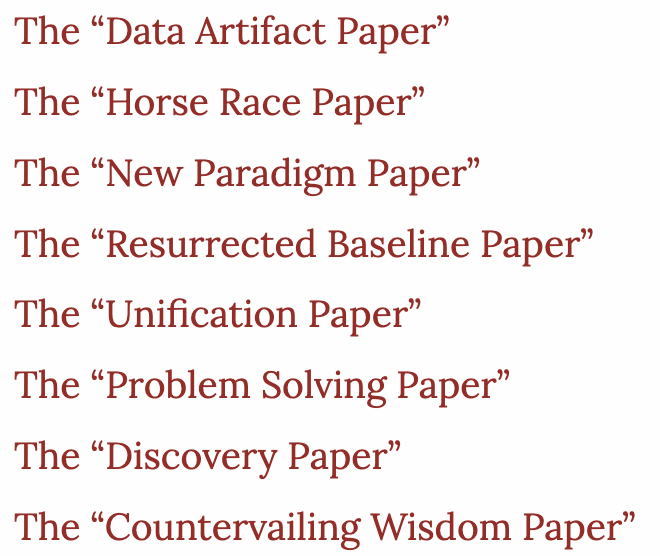
I wrote a blogpost about writing machine learning research papers (e.g., NeurIPS, ICML, ICLR, etc.). The core idea is that most papers follow one of a predetermined set of templates. The post talks about each template, describes their rules, and offers examples...
Introducing TurboQuant: Our new compression algorithm that reduces LLM key-value cache memory by at least 6x and delivers up to 8x speedup, all with zero accuracy loss, redefining AI efficiency. Read the blog to learn how it achieves these results: https://t.co/CDSQ8HpZoc
Robust Safety Monitoring of Language Models via Activation Watermarking: Large language models (LLMs) can be misused to reveal sensitive information, such as weapon-making instructions or writing malware. LLM providers rely on $\emph{monitoring}$ to … key.https://t.co/TVb3Ol9lpb
People struggle to differentiate fluid intelligence from knowledge because, given enough preparation, memorized templates become a solid substitute for on-the-fly adaptation
Today we're releasing MolmoWeb, an open source agent that can navigate + complete tasks in a browser on your behalf.
Built on Molmo 2 in 4B & 8B sizes, it sets a new open-weight SOTA across four major web-agent benchmarks & even surpasses agents built on proprietary models. 🧵
Slides for my lecture “LLM Reasoning” at Stanford CS 25: https://t.co/eApGUHyIDo
Key points:
1. Reasoning in LLMs simply means generating a sequence of intermediate tokens before producing the final answer. Whether this resembles human reasoning is irrelevant. The crucial insight is that transformer models can become nearly arbitrarily powerful by generating many intermediate tokens, without the need of scaling the model size (https://t.co/HO2seV6vVl).
2. Pretrained models, even without any fine-tuning, are capable of reasoning. The challenge is that reasoning-based outputs often don’t appear at the top of the output distribution, so standard greedy decoding fails to surface them (https://t.co/75h2QQzT9M)
3. Prompting techniques (e.g., chain-of-thought prompting or "let’s think step by step") and supervised finetuning were commonly used to elicit reasoning. Now, RL finetuning has emerged as the most powerful method. This trick was independently discovered by several labs. At Google, credit goes to Jonathan Lai on my team. Based on our theory ( see point 1), scaling RL should focus on generating long responses rather than something else.
4. LLM reasoning can be hugely improved by generating multiple responses and then aggregating them, rather than relying on a single response (https://t.co/BA5MUzg3PR).