Most people use AI as a glorified Google search.
The top 1% use it to build automated digital systems that generate cashflow.
Here is the exact 3-step framework to transition from a casual AI user to an AI systems builder 👇
1. Stop Prompting, Start Systemizing
Don't ask ChatGPT for single answers. Create structured workflows with clear inputs, constraints, and multi-step execution logic.
2. Automate the Friction
Identify repetitive high-value tasks in your workflow and map them to dedicated LLM agents and API integrations.
3. Build Scalable Digital Assets
Turn your validated workflows into repeatable prompt templates, micro-SaaS ideas, or automated content engines.
📌 I breakdown daily AI prompt architecture, workflows & monetization cases.
Follow @CodeToCashAi to stay ahead.
Stop assigning every task to the same AI agent.
Here’s a smarter routing setup using Claude:
- Research & exploration → Claude Haiku 5.5
- Implementation & code review → Claude Sonnet 5.5
- Complex debugging → Claude Opus 5.5
The rules that matter:
Split only genuinely independent tasks.
Give every agent a clear scope.
Escalate when a task gets harder.
Measure cost per successful task — including retries and review.
More agents mean more tokens and coordination overhead.
Don’t maximize agent count. Maximize useful work per dollar.
That’s orchestration.
@alwayspriyesh The industry obsession with theoretical leaderboards is hilarious. Give me a model with 90% performance and 99.9% API uptime over a ghost model I can't even test.
@JamesMalsawm Not dumb. A 23% savings isn't worth the architectural thrashing if Opus hits first-try accuracy on your specific stack. ROI is built on execution speed, not marginal token discounts.
@tQuietEngineer Scaling agents without a coordination layer just scales review debt. Clear module boundaries and automated validation are non-negotiable once you go multi-agent.
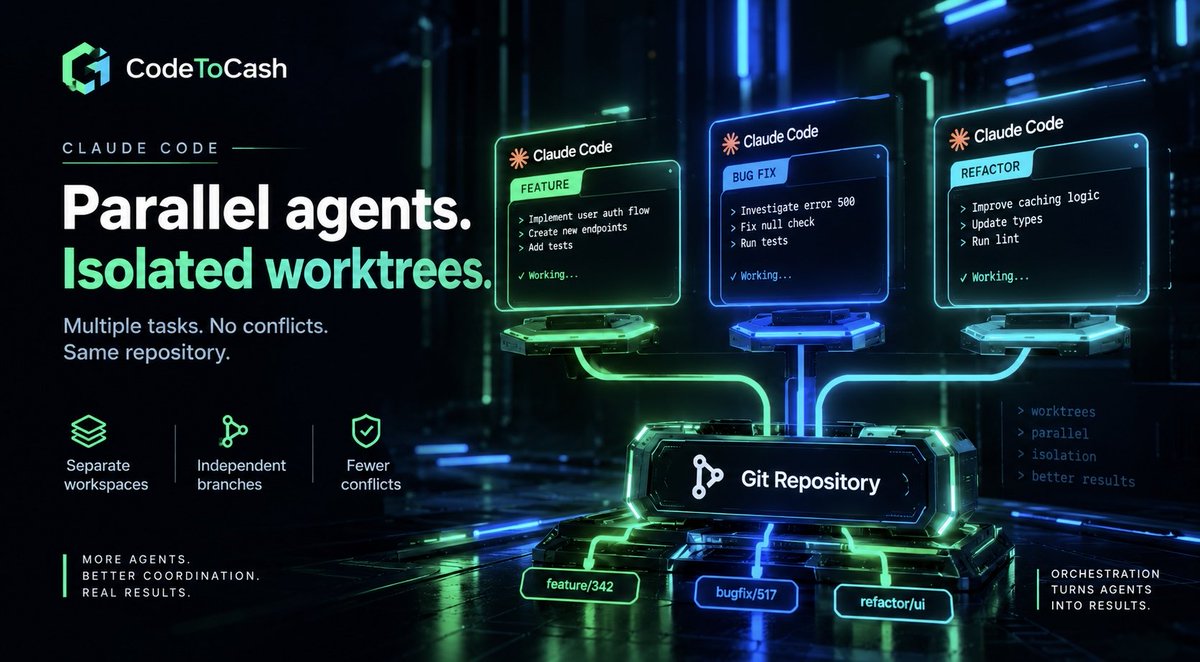
Most AI coding setups have a hidden bottleneck: agents stepping on each other’s code.
Claude Code worktrees solve part of that problem.
One agent builds a feature.
Another fixes a bug.
Each gets its own isolated workspace.
But spawning more agents isn’t the same as getting more work done.
You still need task routing, testing, and clean integration.
Parallel agents are easy. Coordinating them efficiently is the real engineering. ⚡
That’s where AI orchestration matters.
@IndependentEco Anthropic is definitely winning the dev workflow right now. Though keep in mind, Claude Code was actually burning tokens faster than normal this week because subagents were inheriting max effort levels by default. They found the issue, so just waiting for the fix now.
@sashikantsingh_ The secret model cycle is exhausting. I’ll care when it integrates into a stable multi-agent orchestrator with predictable cost-per-task. Until then, it's just more leaderboard noise.
@StatsWire Cheap tokens mean nothing if a model burns 5x more retries to fix a simple hallucination. I only benchmark cost per resolved issue, not price per million tokens
@ayoub_el77927 100%. Opus is for architecture and complex debugging. For writing code and running tests, Sonnet is more than enough. Set up proper tier routing.
@tQuietEngineer Thin wrappers die every benchmark cycle. True moats are built around infrastructure, fallback design, and execution workflows - things vendors don't commoditize overnight.
Exactly where most setups break. Isolation solves file locking, but orchestration needs strict interface boundaries. To keep visibility high without drowning in code, I only monitor high-level diff summaries and event logs - stepping in only when a boundary contract breaks or tests fail.
🚨 Gemini 4 Carbon just dropped — 2 weeks after Argon.
But there’s a catch: access is still limited to selected cybersecurity experts and trusted partners.
The early numbers look impressive:
• AI Index: 59 vs 50
• Terminal-Bench: 65.2% vs 57.1%
But benchmarks only tell part of the story.
The real question is whether better models mean fewer retries, faster workflows, and lower cost per successful task.
Smarter AI is great. Cheaper execution is better.