I made some changes to T3 Code to make it local-first.
A new page in Settings > Inference, allows you to directly add your local models, and then attach it to Pi (or others), so it's not depended on what models are configured in Pi on your host.
I've also added an actual Dark theme, and made the previous dark theme as OLED. "Dark" theme was too black for me.
I'll continue modifying it and adding more features.
Full list of changes:
- Local models are the default, cloud is the backup
- Register your own GPU servers, live health & cache
- Link Pi / OpenCode / Codex to a server in one click
- A gateway queues requests, so threads never swamp the GPU
- Automatic fallback when a server goes down
- Titles, commits & PR text written by your local model
- Per-server stats: tokens, cache hits, TTFT, tok/s
- Local runs show "Local", never a fake $ cost
- Lean tool set: ~40% fewer prompt tokens for local models
- Two-tone Dark theme + true-black OLED
Get my fork here:
https://t.co/uhu99arOCA
big gpu doesn’t want you to know this but setting an 80% powerlimit will remove all coil whine, make temperatures tolerable and extend your gpu’s lifespan while maintaining 98% of stock performance
If you've ever pushed code to GitHub, you probably used SSH authentication to verify yourself.
But have you ever wondered how SSH auth actually works?
Here, @vkwebdev goes over concepts like asymmetric key encryption and digital signatures, which are key to understanding SSH authentication.
https://t.co/B3lIRkOV1A
Redux can be notoriously tricky - but luckily, Redux Toolkit was created to make working with Redux easier.
And here, @chideracode teaches you how to use RTK Query, which helps simplify data fetching & caching in web apps.
You'll learn how to integrate RTK Query with Redux Toolkit by building a CRUD movie app.
https://t.co/xB8XQ2cXrF
We're changing how message limits work for Pro subscribers on T3 Chat
Quick summary:
1. You now get 1,500 messages/month
2. Claude is limited to 100 messages/month so we don't go broke
3. You can buy more Claude credits ($8 for 100 messages)
4. All existing subs are getting 250 extra Claude credits for free
5. We reset rate limits for every user (so your existing usage doesn't count towards the limits above)
This is not a change I wanted to make. These changes won't affect 98% of our customers. Sadly, 2% of our users are currently making up the vast majority of our costs.
We have multiple individual users who have cost us over $200, despite only spending $8.
This is the best path we had. We're not gonna raise prices because of 2% of our users.
When we picked the $8 price, the only models we supported were 4o-mini and DeepSeek v3. I knew Claude would be an expensive addition, but I still wasn't prepared.
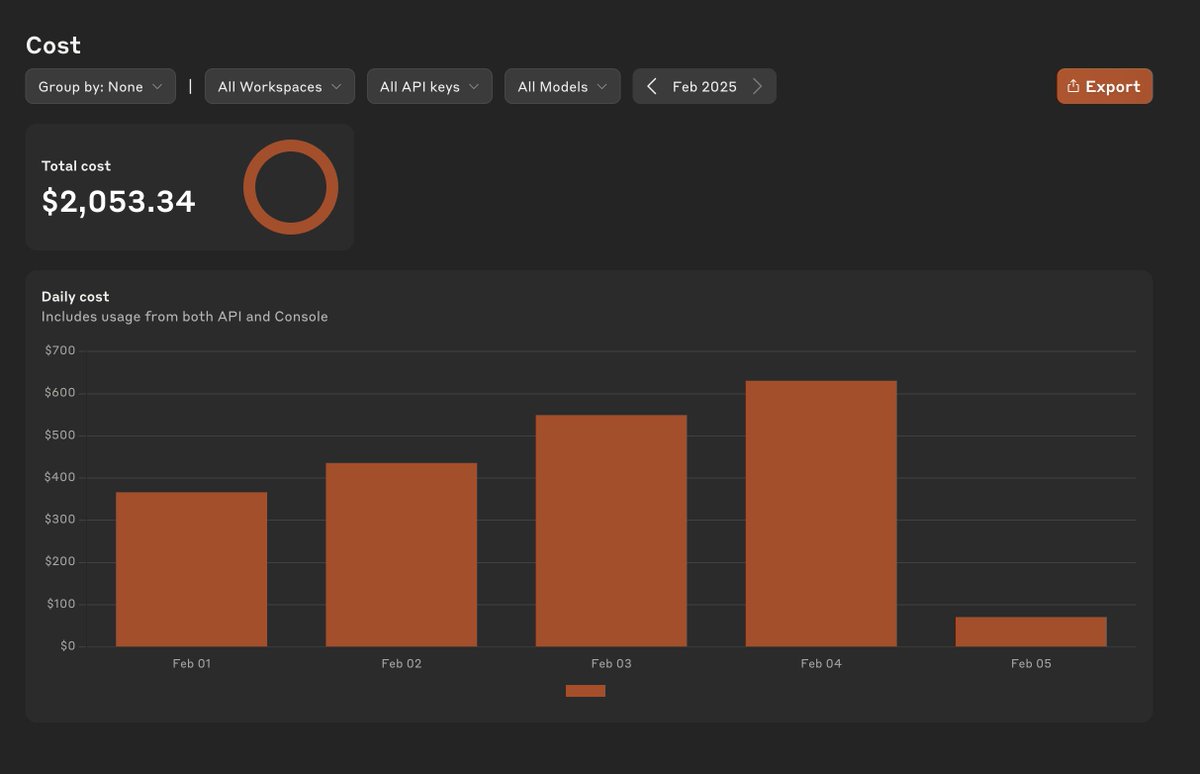
We're currently seeing over $600 of usage per day on Claude, and it's only going up.
These changes make T3 Chat sustainable. We want to be here for a long time. I hope y'all understand 🙏
started this app as part of my PT rehab for my shoulder and it escalated from there
shoulder is doing excellent (pt works if you do the work) https://t.co/dnlFmbvqLG
ml5.js is a JavaScript machine learning library that lets you access ML models right in the browser.
You can also use it to train neural networks in the browser.
In this course, you'll learn how to use ml5.js & practice your skills by building projects.
https://t.co/Qz0L2yVUKD
Building a project is a great way to learn new concepts and practice your skills.
And here's a fun one for you: you'll use Node.js and Redis to build a scalable URL shortener.
You'll learn about hashing, cache invalidation strategies, sharding, & more.
https://t.co/c7qBk2R5Mz
What if AI dev products (Claude, v0, etc) let you install packages, run backends & edit code?
Introducing https://t.co/XXroNZNn7H, by StackBlitz:
- Prompt, edit, run & deploy fullstack apps
- Full dev env (npm, Vite, Next.js, …) w/ frontier AI
- Free!
Scroll-based animations get activated when users scroll up and down a page.
And the Framer Motion library helps you add animations to your React apps.
In this guide, @mannupaaji shows you how to create animations that rotate and scale when users scroll.
https://t.co/cOaHCdsb8j
If you have a website or app, people all over the world may use it.
And if you want to make it accessible to all, you should learn about localization.
In this handbook, @EstefaniaCassN teaches you how to translate your website into different languages.
https://t.co/Faj9MfsUXe
Progressive Web Apps are great because you can install them on your device, use them offline, and so on.
And in this guide, @ophyboamah explains how they work & why they're useful.
You'll learn about service workers, the app manifest, caching, and more.
https://t.co/SLhqMKemHz
LLMs are limited by their training data – so if you want real-time info, you need RAG.
Using Retrieval-Augmented Generation gives your models access to all sorts of helpful data.
In this course, @ania_kubow helps you build your own RAG chatbot with JS.
https://t.co/XcV4eZ7WVP
You can use AI to help speed up your web development process.
One way to do it? Use it to turn your Figma designs into working code.
In this course, @ania_kubow shows you how to use Locofy to convert an Airbnb-style website design into a deployed app.
https://t.co/Y2XPUDbKku