🚨BREAKING: Kevin Sorbo just dropped a TRUTH BOMB — and the left is melting down.
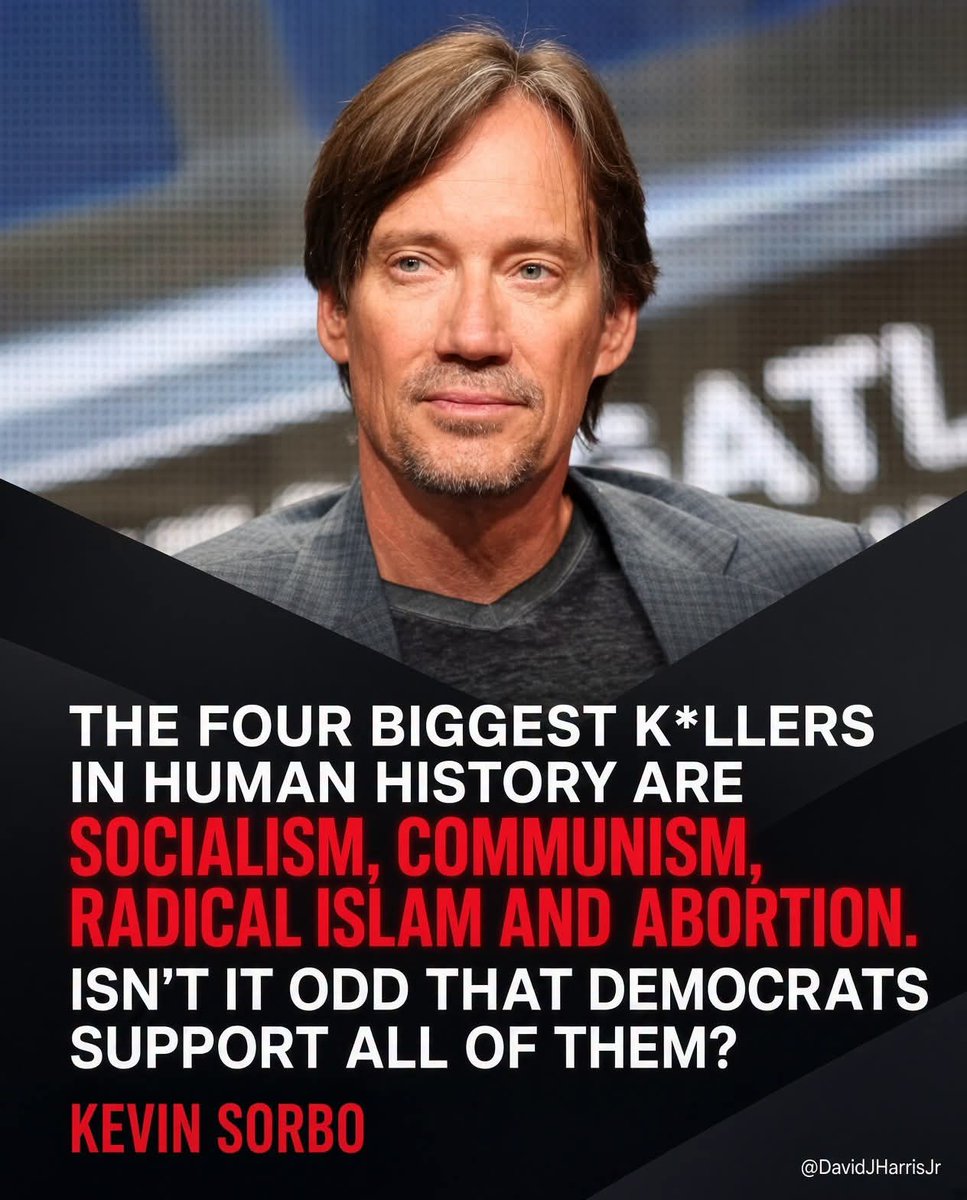
The Hercules star posted what every American should be asking:
"The four biggest k*llers in human history are socialism, communism, Radical Islam and abortion. Isn't it odd that Democrats support all of them?"
He's right. Let's count the bodies:
Socialism and communism: over 100 MILLION dead.
Radical Islam: millions dead in terror, war, and persecution — and still killing Christians today.
Abortion: over 60 MILLION unborn babies killed in America alone.
And Democrats defend ALL FOUR.
The left rushed in to cry about it. Political scientist Matt McManus tried to deflect. Left-wing commentator Caleb Maupin tried to joke about it. Critics whined about what Sorbo left off the list.
But nobody could refute the facts.
Sorbo didn't back down. And his supporters didn't either — one even posted an illustration of Islam, LGBTQ, globalism and socialism as a four-headed snake strangling America.
Kevin Sorbo went from Hercules to Hollywood outcast because he refused to bow to woke Hollywood. Now he's using his voice for faith, family, and freedom.
He said what needed to be said.
Do you agree with Kevin Sorbo?
A retired logger from Oregon bought a house in a dying Japanese village for $9,000.
The village had 31 people. The youngest was 71.
His kids thought he'd lost his mind. The village thought he was a spy.
His name is Gil. He's 73. He cut timber around Coos Bay for 46 years. When his wife, Nancy, passed two years ago, he couldn't stand the quiet in the house. One sleepless night, he watched a video about abandoned houses in Japan that sell for less than a used truck.
He bought one. On his phone. Like a man buying a lawnmower.
His daughter's text the next morning was one word. "DAD."
He didn't tell her the real reason until later. Nancy had kept a list on the fridge for forty years. Places they'd go "when things slow down." Japan was number one. Things never slowed down.
The house is in the mountains of Shikoku. My aunt Michiyo has lived in that village her whole life. She's one of the 31. She sent me updates. At first, they were warnings.
Month one: "An American is living in the Tanaka house. He is very large. He waves at everyone. Nobody knows why."
Month one, later: "He bought a tiny Japanese farm truck. He is six-foot-four. He looks like a bear driving a lunchbox. The children in the next village come to watch."
Month two: "He fixed the roof of the community hall. Nobody asked him. He just climbed up there. Mrs. Ono, 88, watched the entire time and says it is the best television she has seen in years."
Month three: "He fixed my gutter. I offered him money. He said 'No ma'am.' I left a box of mandarins on his porch. The next day he fixed my other gutter. There is no way to stop this."
Month five: "Every grandmother in the village is now leaving food on his porch. He has gained eleven kilos. He claims he's having the time of his life and is mildly worried about his heart."
Month seven: "He has taught three of the old men to make a fire in a barrel and stand around it doing nothing. They call it 'an American meeting.' They hold one every Friday. Their wives are delighted to have them out of the house."
Month eight: "Today I finally asked why he never stops working. He said, 'Grief's like a stump, ma'am. You can't pull it out. So you build something around it.' I did not understand every word. I copied it into my notebook."
Then, last September, a typhoon came through.
It knocked over forty cedar trees across the only road into the village. The whole village cut off. Thirty-one people. Most of them over 80. No way in. No way out. The crews said three days. Maybe four.
Mr. Kubota, 82, needs dialysis every two days.
At dawn, in the rain, the village heard a sound it had never heard before.
A chainsaw. An American one. Gil had shipped it from Oregon. It's older than some of the trees.
He worked for nine hours straight. In the rain. Seventy-three years old. The three old men from the Friday meeting dragged branches behind him, because they could not just stand there and watch an American do it alone. That's not how they were raised either.
By 3 p.m., the road was open. The ambulance got through. Mr. Kubota got his dialysis.
When the government crew finally arrived the next morning, they found the road already clear and an old man from Oregon snoring in a folding chair down by the river, still in his chaps.
That's when the village held a meeting. The real kind.
And they asked him for something.
Every October, for three hundred years, the village carried its little portable shrine, a mikoshi, down the mountain and back. It's as heavy as a piano. It takes eight men to carry it.
The village had not had eight young men since 2006. The festival stopped that year. Twenty years of silence.
Gil said he'd make some calls.
This October, two big men and three bigger teenagers from Coos Bay, Oregon, walked off a bus in the mountains of Shikoku.
Gil's sons. Gil's grandsons. None of them had a passport until August. The youngest had never left Oregon.
They put on festival coats that didn't fit. They put the poles of a three-hundred-year-old shrine on their shoulders, next to three Japanese men in their seventies and one American logger.
And they carried it. Down the mountain. Through the village. Chanting the festival chant, in an Oregon accent, loud enough to wake up the next valley.
Every one of the 31 villagers was out on the road. Some of them in wheelchairs. Mrs. Ono, 88, watched every second. She has upgraded it to the best television of her life.
Afterward, the village elder, who is 94, stood up to speak. My aunt translated for the Americans.
"For twenty years, we prayed for young men to carry our shrine," he said.
"We did not specify Oregon."
Then he asked Gil for one more thing. A photo of Nancy.
It's in the shrine hall now. A small framed photo of a smiling woman from Coos Bay, Oregon, on a shelf next to three hundred years of the village's own ancestors.
The elder said she belongs there.
"She sent him to us."
Gil's daughter came for the festival too. The one who texted "DAD." She told my aunt something on the last night.
After her mom died, her dad stopped talking. For a year. She was scared she'd lose him too.
"He came here to be alone," she said. "Thirty-one people wouldn't let him."
The village has 31 residents now. 32, counting Gil.
They've stopped calling it a dying village.
They call it Gil's village now.
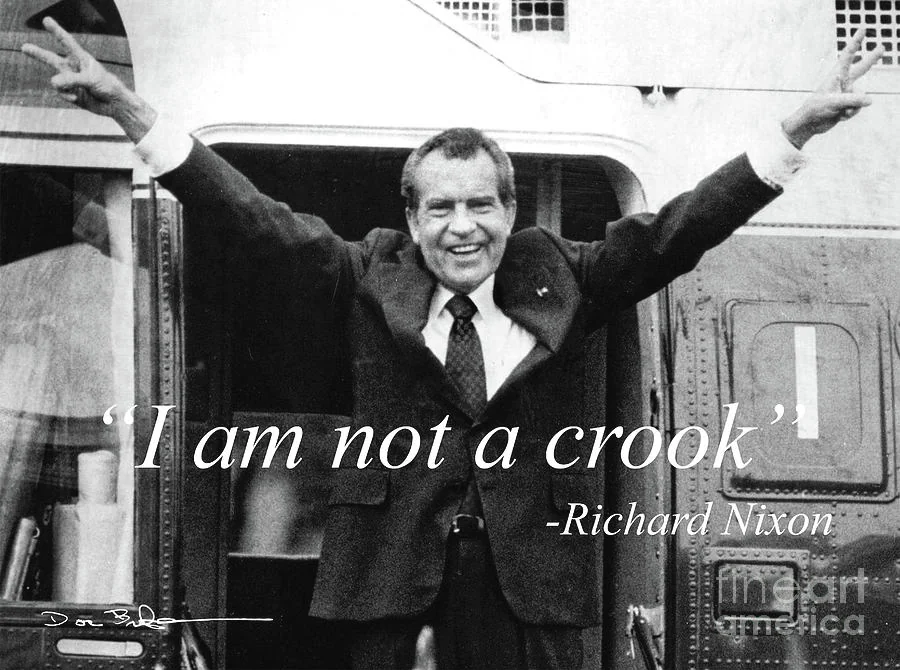
Nov 17, 1973: Richard Nixon stood in front of 400 newspaper editors and told the country he was not a crook. By then, much of the press had spent 25 years trying to destroy him.
It started in 1948. As a young congressman, Nixon went after Alger Hiss, a polished State Department official the Washington establishment adored, for being a Soviet spy. Much of the press sided with Hiss. Nixon was right. Hiss was convicted of perjury, and most historians now believe he was a Soviet agent. The establishment never forgave Nixon for it.
In 1952, newspapers ran stories about a secret fund and called for him to be thrown off Eisenhower's ticket. He went on national TV, laid out his finances, and kept his place.
In 1960 he lost one of the closest elections in history amid real questions about fraud in Illinois and Texas. He refused to challenge it to spare the country. The press thanked him by treating Kennedy like royalty.
The same reporters who hounded Nixon knew about Kennedy's affairs, including with a woman tied to a Mafia boss. They knew he was seriously ill. They printed none of it.
When Nixon lost the California governor's race in 1962, ABC aired a special called The Political Obituary of Richard Nixon. One of the commentators they put on the air to talk about him was Alger Hiss.
As president, every speech was picked apart by network commentators the moment he finished. When he went over their heads and appealed to the silent majority, they mocked the people who supported him.
And while they hunted him, the record shows what his predecessors got away with. Franklin Roosevelt had the FBI investigate his critics and locked up Japanese Americans in camps. Kennedy's IRS targeted conservative groups, his attorney general approved wiretaps on Martin Luther King, and his CIA plotted with the Mafia to kill Castro. Lyndon Johnson used a murky naval incident in the Gulf of Tonkin, one that probably never happened the way he described, to escalate the Vietnam War, and he had the FBI spy on his political opponents. None of them were run out of office.
Even Watergate's most famous secret source, Deep Throat, turned out to be the FBI's number two official, a man furious that Nixon had passed him over for director.
Nixon didn't play their games. He was a grocer's son from Whittier, California, who didn't go to the right schools or belong to the right clubs. He didn't flatter reporters or invite them to his parties. So they never saw him as one of them.
Look at what he actually did. He created the EPA and signed the Clean Air Act. He ended the draft. He signed Title IX. He desegregated Southern schools faster than any president before him. He opened China, signed the first nuclear arms limits with the Soviet Union, ended American combat in Vietnam, and brought the POWs home. He saved Israel with an emergency airlift in 1973.
The American people saw it. In 1972 they reelected him in a 49-state landslide.
When he could have dragged the country through an impeachment trial, he resigned instead. He was never charged with a crime. He spent his last 20 years quietly advising presidents of both parties.
Richard Nixon was a good president who refused to bow to the people who decided who belonged in Washington. That's what they never forgave.
On December 7, 1941, at 7:49 a.m. Hawaii time, a Japanese Navy pilot in a Zero 6,000 feet above Pearl Harbor sent out three words: "Tora! Tora! Tora!"
The man who sent that signal was Commander Mitsuo Fuchida. He led the entire air attack on Pearl Harbor. Over two thousand Americans died that morning because of his order.
On April 18, 1942, the Americans answered. Jimmy Doolittle launched sixteen B-25 bombers off the deck of USS Hornet and hit Tokyo.
One of those American bombardiers was Corporal Jake DeShazer from Oregon. He had told his crewmates, publicly, that he wanted revenge on the Japanese for Pearl Harbor.
His plane ran out of fuel over occupied China. He parachuted into Japanese territory and was captured.
For the next forty months, he sat in a Japanese prison cell. He was starved. He was beaten. Three of his fellow Raiders were executed by firing squad in the same prison. Another died of torture and malnutrition in the next cell.
In that cell, a Japanese guard, for reasons nobody fully understood, handed him a Bible for three weeks.
Jake DeShazer read it. In that cell, on his knees, he forgave every Japanese guard who had broken him.
The war ended. He went home. He thought about Pearl Harbor and Pearl Harbor's commander and he wrote a short tract titled "I Was a Prisoner of Japan." It explained, in simple words, how he had let go of his hate for Japan.
That tract was handed out in Japanese train stations.
In 1948, in Tokyo's Shibuya station, a tired Japanese man picked one up. He had been having nightmares since the war ended. He read the pamphlet standing on the platform. He read it again on the train.
The man was Commander Mitsuo Fuchida. The man who had said "Tora! Tora! Tora!"
Two years later, Fuchida tracked Jake DeShazer down in person and shook his hand.
From that day until Fuchida's death in 1976, the man who led Pearl Harbor and the man who had sworn vengeance for it stood on stages all over America, side by side, telling people that if those two men could stand together, no two people on earth could not.
Twenty-four years of American churches, side by side, arm in arm. Pearl Harbor and his would-be avenger. Best friends.
Japan has never told its children this story clearly enough. America should.
😭 I had to stop and think about — something my wife said during coffee this morning, that honestly left me completely speechless.
She was quietly watching the news… then all of a sudden, she looked at me and asked:
“If Donald Trump already had the money, the success, the properties, and the kind of lifestyle most people can only dream about… why would he choose to take on all these responsibilities?”
Before I could even answer, she said something that truly touched my heart.
“Because nobody would willingly put themselves under this much pressure unless they sincerely believed in something bigger than themselves.”
And honestly… I sat there reflecting on her words for quite a while.
Because she has a point.
Donald Trump was already 70 years old when he first became President. He had already achieved things that countless people spend their entire lives hoping to accomplish. Fame. Wealth. Business success. A lasting name.
He could have spent the rest of his days enjoying his family, playing golf, traveling, and living a peaceful and comfortable life.
But instead… he accepted the pressure.
He accepted the criticism.
He accepted the sleepless nights.
He accepted the endless responsibilities.
He accepted the sacrifices.
The family occasions he missed.
The weddings he couldn't attend. The graduations he had to witness from afar.
The countless nights walking through the White House grounds while the rest of America was sleeping.
Then my wife gently asked me one more thing:
“We pray for our families. We pray for our health. We pray for our future. But when was the last time America stopped for a moment and prayed for him?”
And honestly… I couldn't find an answer.
So today, I have just one humble request for every American reading this.
Take just one moment out of your day.
Close your eyes.
And offer a small prayer for Donald Trump.
Not about politics.
Not about political parties.
Simply for a man who accepted one of the most challenging responsibilities imaginable when he could have easily chosen a peaceful and comfortable life instead.
God — please watch over Donald Trump.
Give him the strength he needs.
Keep his health protected.
And remind him that millions of Americans recognize and appreciate everything he carries on his shoulders. 🙏😭🇺🇸
#Trump #Prayer #Faith
In September of 2005, on the first day of school, Martha Cothren, a History teacher at RobinsonHigh School in Little Rock, did something not to be forgotten. On the first day of school, with the permission of the school superintendent, the principal and the building supervisor, she removed all of the desks in her classroom. When the first period kids entered the room they discovered that there were no desks.
'Ms. Cothren, where are our desks?'
She replied, 'You can't have a desk until you tell me how you earn the right to sit at a desk.'
They thought, 'Well, maybe it's our grades.' 'No,' she said.
'Maybe it's our behavior.' She told them, 'No, it's not even your behavior.'
And so, they came and went, the first period, second period, third period. Still no desks in the classroom. Kids called their parents to tell them what was happening and by early afternoon television news crews had started gathering at the school to report about this crazy teacher who had taken all the desks out of her room.
The final period of the day came and as the puzzled students found seats on the floor of the desk-less classroom. Martha Cothren said, 'Throughout the day no one has been able to tell me just what he or she has done to earn the right to sit at the desks that are ordinarily found in this classroom. Now I am going to tell you.'
At this point, Martha Cothren went over to the door of her classroom and opened it. Twenty-seven (27) U.S. Veterans, all in uniform, walked into that classroom, each one carrying a school desk. The Vets began placing the school desks in rows, and then they would walk over and stand alongside the wall. By the time the last soldier had set the final desk in place those kids started to understand, perhaps for the first time in their lives, just how the right to sit at those desks had been earned.
Martha said, 'You didn't earn the right to sit at these desks. These heroes did it for you. They placed the desks here for you. They went halfway around the world, giving up their education and interrupting their careers and families so you could have the freedom you have. Now, it's up to you to sit in them. It is your responsibility to learn, to be good students, to be good citizens. They paid the price so that you could have the freedom to get an education. Don't ever forget it.'
By the way, this is a true story. And this teacher was awarded the Veterans of Foreign Wars Teacher of the Year for the State of Arkansas in 2006. She is the daughter of a WWII POW.
Do you think this email is worth passing along so others won't forget either, that the freedoms we have in this great country were earned by our U.S. Veterans?... I did.
Let us always remember the men and women of our military and the rights they have won for us.