let's check in on the video game industry...
- EA executes BioWare
- Sucker Punch hit with layoffs
- Ninja Theory killed a week after announcing its next game
- Halo Studios gutted, Halo taken away and given to Activision
- Bungie loses half its staff as Destiny dies
- id Software gutted
- Double Fine bombs twice, Xbox throws it overboard
- Compulsion Games dumped by Xbox
- Undead Labs dumped by Xbox
- Arkane Lyon waiting on the executioner
- Xbox torches 3,200 jobs
- Insomniac's Wolverine turned into a meme
- Ubisoft in freefall
- Red Storm reduced to an IT department
- RedLynx on death row
- Ubisoft Halifax unionizes, gets killed weeks later
- Ubisoft Stockholm, Winnipeg, Belgrade wiped out
- Wildlight dead on arrival, game lasted 45 days
- Sony kills Bluepoint
- Dark Outlaw Games killed before making anything
- Netflix kills Night School
- Build a Rocket Boy implodes after MindsEye disaster
- Spiders shut down
- TiMi Montreal burns five years, ships nothing
- Meta wipes out Sanzaru, Twisted Pixel, Armature in one day
- Epic throws out 1,000+
- Eidos Montreal gutted
- The Initiative killed, Perfect Dark dead
- Monolith killed, Wonder Woman dead
- Player First Games killed by MultiVersus flop
- WB Games San Diego killed
- Cliffhanger killed, Black Panther dead
- NetEase pulls the plug on Fantastic Pixel Castle
- Arkane Austin killed after the Redfall disaster
- Tango Gameworks killed
- Concord flops in two weeks, Firewalk dead
- Neon Koi killed before shipping a game
- London Studio killed
- Meta kills Ready at Dawn
- Take-Two kills Roll7
- KSP2 bombs, Intercept Games dead
- EA kills Ridgeline before launch
- Deviation Games dies without a game
- Riot kills Riot Forge
- Netflix kills its AAA studio before it ships anything
- Saints Row reboot kills Volition
- Free Radical dies a second time
- Mimimi Games burns out and quits
- Embracer bloodbath: 8,000 jobs, 44 studios
- Unity layoffs on repeat
- Activision Blizzard loses 1,900 after the Microsoft buyout
- Sony cuts 900
- EA cuts 670
Hugo Andore from Street Fighter, inspired by the incredible design my friend @ianlaser created about 4 years ago. This is my first sculpture using the new version 5.3 of Blender. And do you know why the message “Pay It Forward” appears in the background?
Sorry to keep tweeting this out.
If you like what I do and wanna support me by throwing me a few bucks, https://t.co/2n0ptQ0V9o is the best way to do it.
All your support has been helping me survive these past few weeks and I'm beyond grateful for y'all.
I am a dinosaur of the game industry still chugging away making games with AI. Making games with AI feels lot like I have always made games, but talking to an agent instead of a real person. I am finding that engaging with small X'ers is super rewarding. We all have the same problems, i.e. it is easy to make, but hard to find audience. Maybe we can figure this out by working together. What are you making? What are your problems?
The full Quixel Megascans library is going free. Fab listings will update between now & Nov 12, so check back if an asset you want isn’t free yet.
We’ve updated terms for all Quixel assets so you can train AI models on Megascans & Megaplants.
Learn more: https://t.co/jX1C4jRauw
🎮 A new free Blender add-on can turn dense 3D scans and high-poly models into lightweight quad meshes, then automatically check how much of the original shape was lost.
Meet CurioMesh, an open-source retopology tool designed for game artists, sculptors and technical artists.
And unlike traditional one-click remeshing, it lets you redo individual parts without processing the entire model again.
What can it do?
▪️ Automatic quad retopology: Convert dense geometry into lower-poly meshes with mostly quad-based topology.
▪️ Part-by-part processing: Separate a model into meaningful regions and optimize each individually.
▪️ Visual verification: Compare the result with the original from six camera directions.
▪️ Selective corrections: Identify problematic regions and regenerate only those parts.
▪️ Detail baking: Transfer surface information into normal maps and color textures.
▪️ Automatic LODs: Generate multiple levels of detail for game-engine workflows.
▪️ Animation preparation: Build a low-poly cage with higher-resolution detail stored in Blender's Multires modifier.
The workflow is surprisingly practical.
1. Choose your target
Select a preset:
▪️ Low Poly
▪️ Game Asset
▪️ Animation
▪️ Subdivision
▪️ Scan Cleanup
▪️ Sculpt Base
Each preset balances polygon density, surface accuracy and topology quality differently.
2. Reconstruct the topology
CurioMesh divides the geometry into segments, chooses suitable remeshing methods and rebuilds each region.
The user can choose between three layout strategies: Keep Detail, Balanced and Clean Rows.
3. Measure the result
Instead of simply assuming the new mesh is good, the add-on renders comparisons from six viewpoints.
It estimates how much of the visible silhouette and surface appearance changed.
4. Fix only what failed
Review Segments highlights individual regions.
You can change the method, density or geometry constraints for one part without rebuilding everything.
The developer's examples show substantial reductions.
▪️ Concrete road barrier: 60,928 → 987 faces.
▪️ Treasure chest: 103,330 → 10,423 quads.
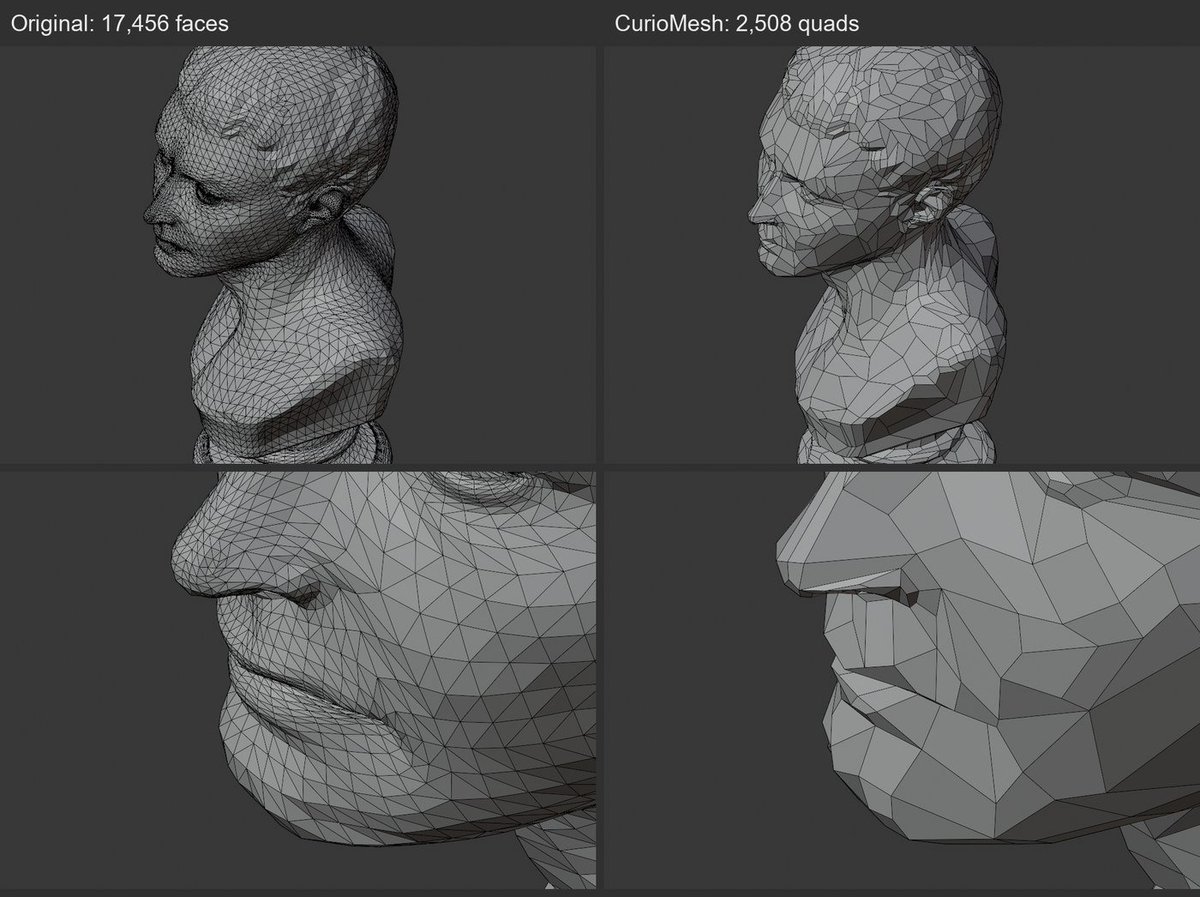
▪️ Marble bust: 17,456 → 2,508 quads.
▪️ Chess set: 76,832 → 10,110 quads.
The measured visual difference in these examples is around 4–6%, depending on the object.
These are self-reported results, not independent quality benchmarks. The visual-difference percentage also doesn't establish whether the topology is suitable for animation.
And there are more advanced controls.
▪️ Draw guide curves that influence edge flow.
▪️ Define loops around eyes, mouths and joints.
▪️ Paint regions that need more geometric detail.
▪️ Mirror symmetrical topology.
▪️ Apply local Boolean-style changes.
▪️ Preserve UV seams or bake new textures.
Availability:
CurioMesh supports Blender 3.6 through 5.2 on supported platforms.
The add-on runs locally, doesn't upload your geometry and is released under GPL-3.0.
There's also an optional Rust-accelerated processing core in the GitHub release builds.
Important limitations:
It doesn't automatically understand ideal facial deformation topology.
Extreme polygon reduction can damage small details, and smooth surfaces can still produce irregular quads.
Large photogrammetry scans may require minutes or tens of minutes.
Why this matters:
Generating 3D objects is getting easier.
Preparing those objects for actual production is still one of the biggest bottlenecks.
CurioMesh tackles that problem by combining automatic remeshing with measurable visual checks and targeted manual correction.
Making a 3D model is one thing. Making its geometry practical to use is another.
💻 https://t.co/fD8w0U3mxl
#Blender #Retopology #GameDev #OpenSource
My Weekend prototype: BrushCraft, a sculpting app designed around high-poly meshes from day one.
1.26 billion polygons. It streams and LODs the mesh, so each frame draws ~16M triangles, and brush strokes land in 1.5 ms.
Built in Rust on Vulkan.
A great album takes you somewhere. I'm wanted to design a music player that does the same: every page transition is unique, so moving through the app feels like a journey that keeps evolving. More to come.