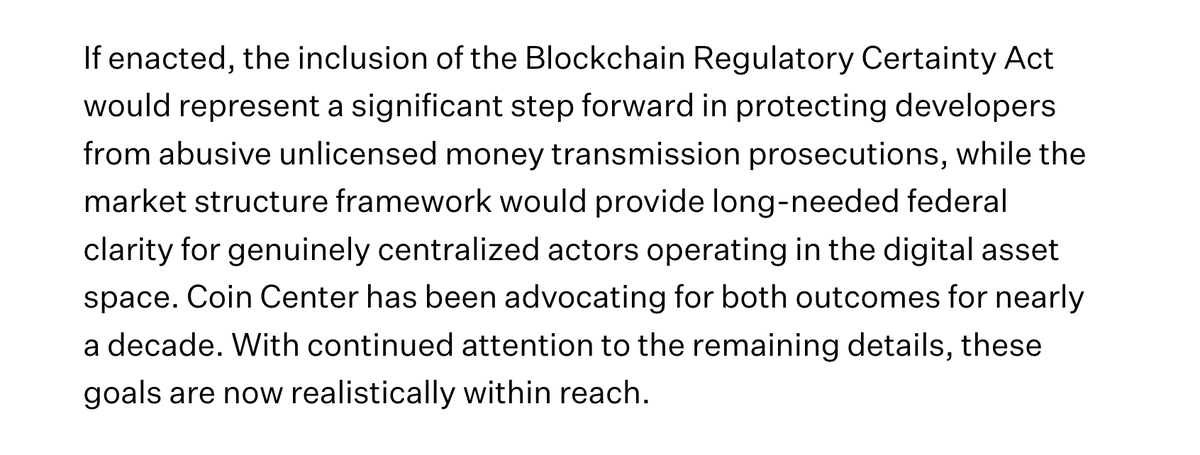
Without the BRCA, Clarity becomes bill that helps the largest and most regulated businesses while leaving the builders of free and open infrastructure out in the cold. https://t.co/CgrbP3eGTM
Stripping the BRCA from Clarity would not make the bill tougher on industry.
It would not address ethics concerns.
All it would achieve is hurting open source developers.
https://t.co/9cPhhM4QU2
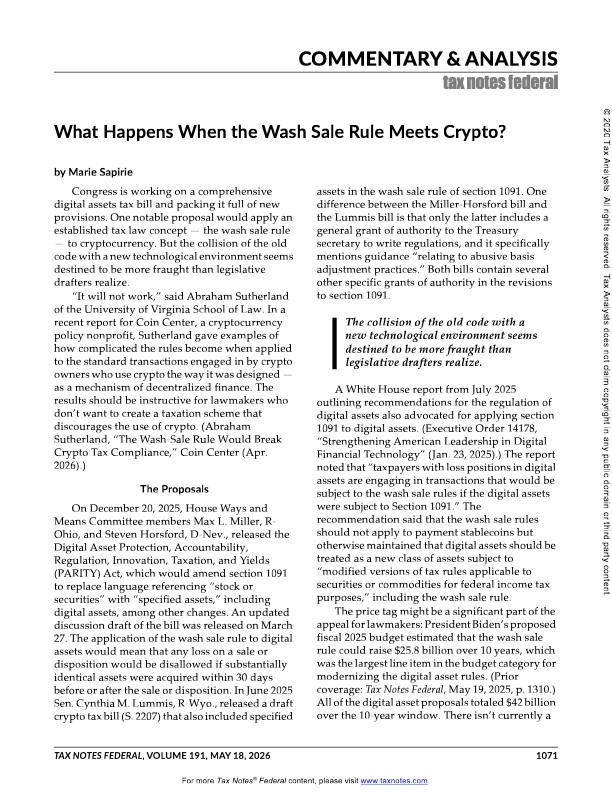
Congress wants to extend wash-sale rules to crypto. Doing so would make everyday crypto use, DeFi, and multi-wallet tracking nearly unworkable.
Summary of the issue in Tax Notes:
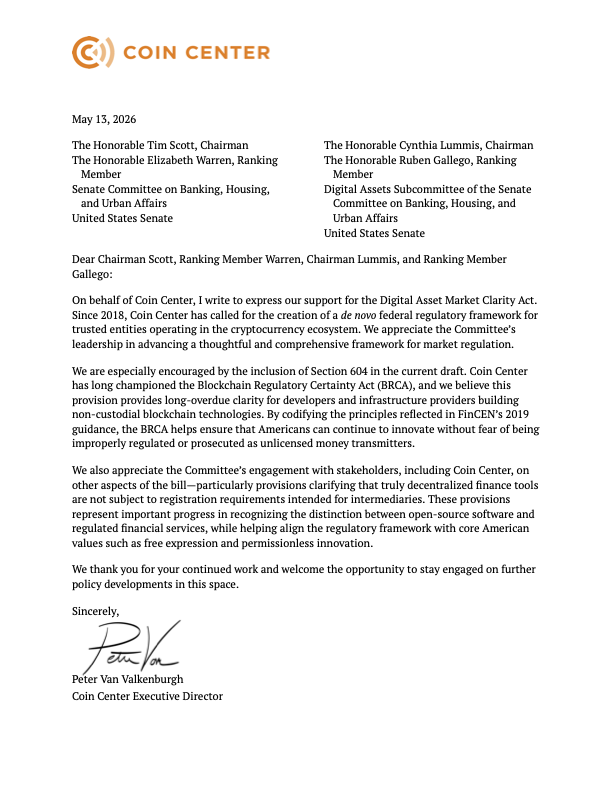
Coin Center is encouraged by the advancement of the Clarity Act through the Senate Banking Committee with the BRCA included. As it heads to the floor, there may be a push to make concessions; the BRCA cannot be one of them. https://t.co/LULpU7SNKh
HUGE.
Looks like we got a non-partisan vote out of Senate Banking with the BRCA still intact. I'm thrilled. The last minute compromise reflects Coin Center's analysis from last January, there were some steps forward since then and then back but we are feeling very comfortable.
Our letter in support of passing the Digital Asset Market Clarity Act and with it the Blockchain Regulatory Certainty Act, which we have championed since 2018.
We just published a new tax report by the inimitable @abesutherland addressing a topic that has not received much attention to-date. Some recent tax bills have included provisions applying the wash-sale rule to crypto. Abe walks through why that would be a mistake.
The Wash-Sale Rule Would Break Crypto Tax Compliance
By walking through detailed real-world scenarios, this report demonstrates that a crypto wash-sale rule would undermine compliance, distort ordinary economic activity, and impose costs far exceeding any potential revenue gains.
New report: https://t.co/htgWhOQA2p
Michael Lewellen is appealing his case to the 5th Circuit.
He faces a credible threat of prosecution for publishing privacy software and he deserves to know whether money transmission licensing laws apply. https://t.co/k75OGuYHvD
Michael Lewellen has appealed Lewellen v. Garland to the Fifth Circuit, with Coin Center’s support.
The DOJ had his case tossed by arguing there’s no “credible threat” to Michael, pointing to a memo promising not to target non-custodial developers.
...Even though they are actively going after non-custodial devs right now.
Michael is an impossible situation. the only way to test those promises is to publish his code and risk prosecution. https://t.co/L8kyqejl9r
Coin Center’s analysis of Treasury’s GENIUS report:
In short, we emphasize privacy and self-sovereignty in digital identity, and explain why Congress should avoid expanding the Bank Secrecy Act and instead focus on CLARITY.
https://t.co/HJsCKyeUTB
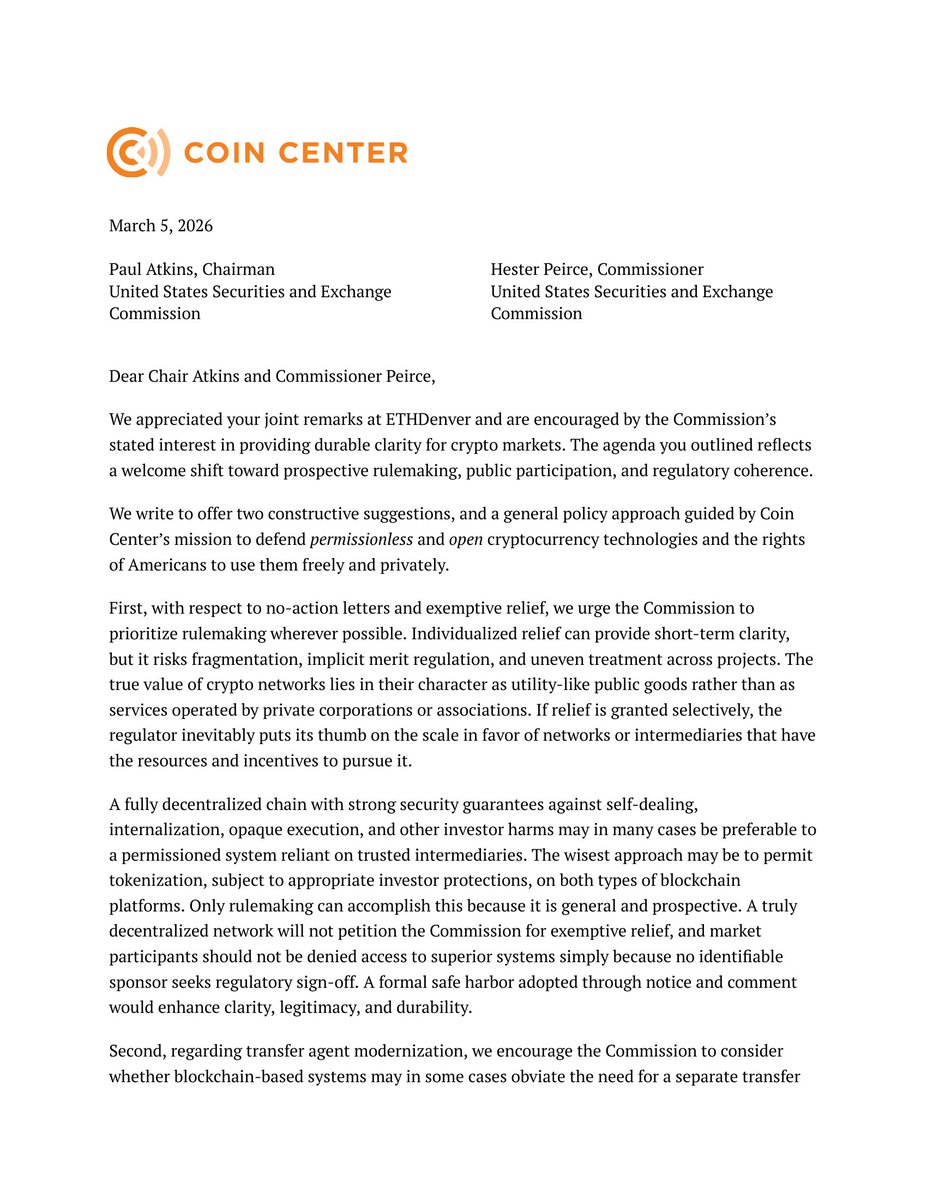
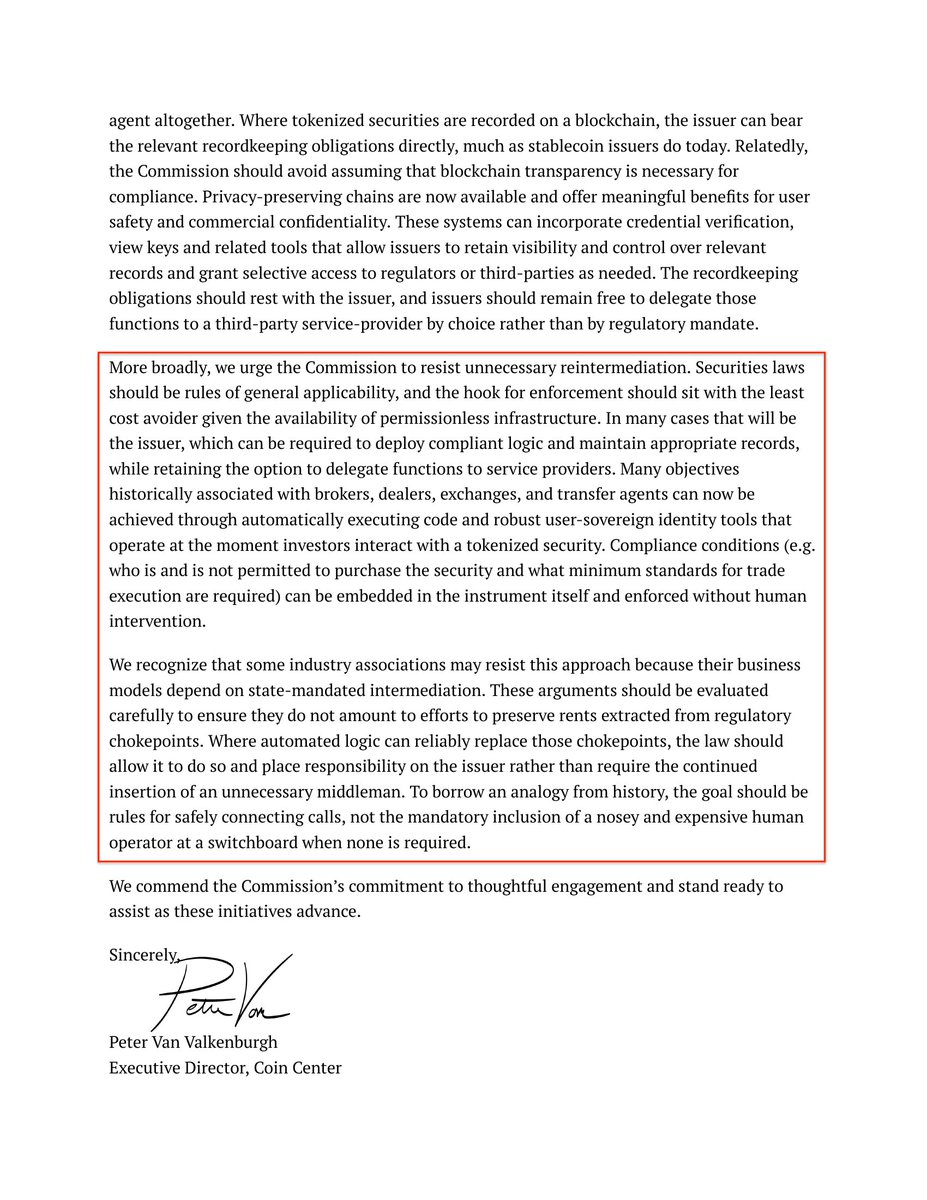
In a letter to the SEC, Coin Center suggests the agency:
1) Prioritize rulemaking over case by case no-action letters
2) Consider whether open blockchains obviate the need for transfer agents altogether (and to resist rent seeking state-mandated intermediation)
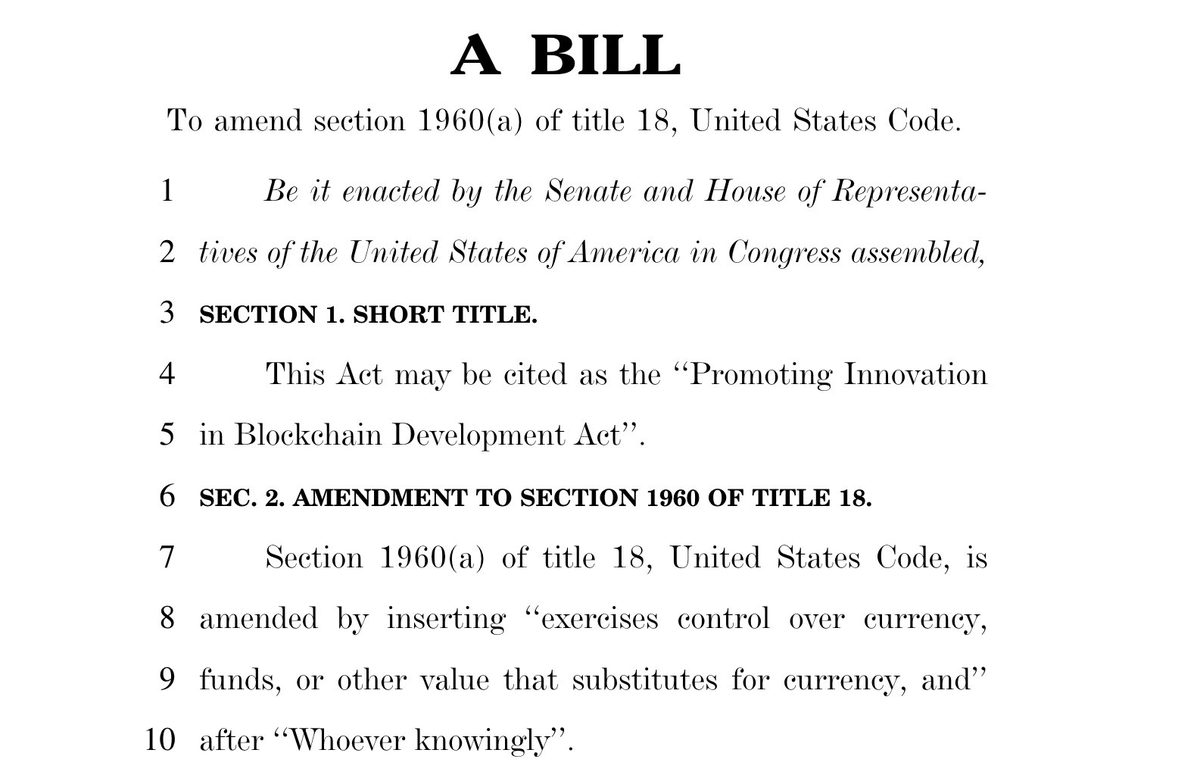
Today, @RepFitzgerald , @RepBenCline, and @RepZoeLofgren have introduced the Promoting Innovation in Blockchain Development Act, which provides the necessary clarity to Title 18 Section 1960 such that software developers will not be misclassified and prosecuted for allegedly running an unlicensed money transmitting business.
This bipartisan bill is a long-needed response to the DOJ's wrongful prosecutions of developers in the Tornado Cash and Samourai Wallet cases.
We applaud this effort, and will continue to support and advocate for these necessary changes to the criminal code and for developer protections more broadly.
New bipartisan bill protects US software developers from unfair criminal prosecution
@RepFitzgerald, @RepBenCline, @RepZoeLofgren introduced 'Promoting Innovation in Blockchain Development Act of 2026' to protect engineers—who write code but do not control other people’s money—from inappropriate misclassification as money transmitting business operators pursuant to criminal code Section 1960.
Coin Center’s mission is to protect software developers and non-custodial, decentralized tools. Judged by that standard, we’re optimistic about where the current market structure draft stands.
Companies and other organizations may have broader or different priorities.
Coin Center’s Top Policy Priorities for 2026
- Stop unjust prosecutions of non-custodial software developers
- Protect Americans holding their own crypto
- Update the tax code to protect against administrative burdens on users
- Clarify securities and commodities law
- Encourage privacy-preserving alternatives to traditional KYC/AML
Six Ways Congress Can Make Crypto Taxes Work for Everyday Users:
1. Adopt a De Minimis Personal Transaction Exemption
2. Forego the Wash Sale Rule
3. Consider Creating a Mark-to-Market Election
4. Clarify Block Reward Taxation
5. Repeal 6050I Reporting
6. Define “Readily Valued” Cryptocurrencies for Charitable Donations
Read more: https://t.co/JN2VY37L1x