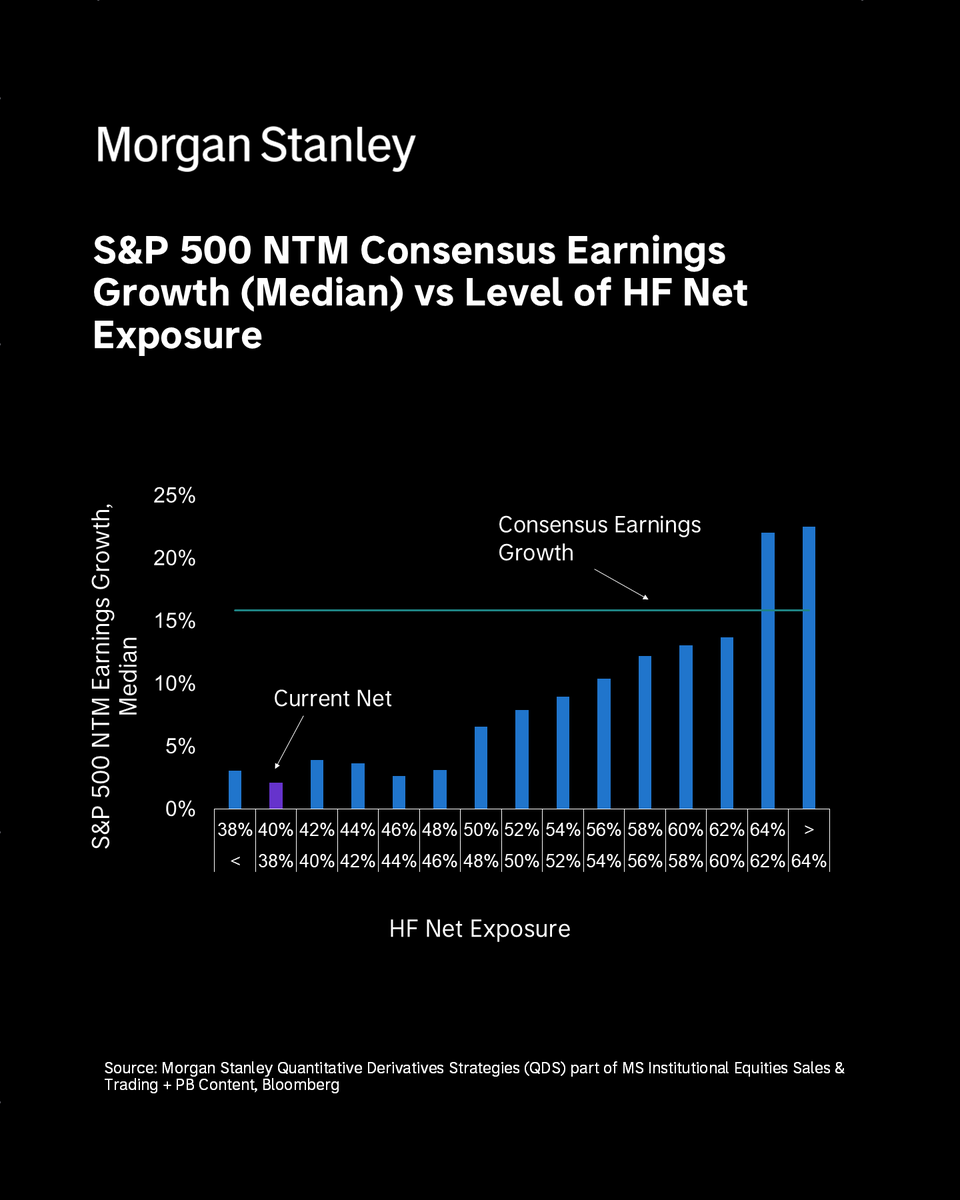
Investors are positioned for an earnings slowdown that is not in Wall Street analyst forecasts.
Typically, Hedge Fund exposures track fundamentals: stronger earnings growth = higher net leverage, slower earnings growth = lower net leverage, with a 58% correlation since 2016.
And US long/short Hedge Fund net exposures are low per MS PB Content: 41%, the lowest in a year and just the 6th percentile since 2010.
At these levels of nets, consensus next twelve-month earnings growth for the S&P 500 has been just 5% (median since 2016). That’s a long way down from current consensus next twelve-month EPS growth of 16%.
MORGAN STANLEY: “.. Investors are positioned for an earnings slowdown that is not in Wall Street .. forecasts.
.. At [current] levels of [hedge fund net exposures], consensus next 12-month earnings growth for $SPX has been just 5% .. down from current consensus .. of 16%.”
When whalers emptied the Southern Ocean, the krill the whales had been eating should have gone through the roof. Instead it fell by more than 80%.
Over the 20th century the factory ships killed something like two million whales in the southern hemisphere. Antarctic blue whales went from roughly a quarter of a million animals to a few hundred. A blue whale can put away around 16 tonnes of krill in a day, and before the harpoons the great whales down there were eating an estimated 430 million tonnes a year. Take the mouths away and you'd expect shrimp from horizon to horizon. In the 1970s the experts expected exactly that, and the trawlers went south to collect it.
The glut never came. The krill went the other way and has stayed down.
The answer turned out to be at the whale's other end.
The Southern Ocean is short of one thing, and it's iron. Without iron the algae can't grow, and without the algae the krill have nothing to eat. A whale feeds deep, comes up to breathe, and empties itself at the surface in a cloud the colour of the krill that went into it. That cloud carries iron at about 10 million times the concentration of the seawater around it, delivered to the exact layer where the sunlight is. The whale eats in the dark and fertilises in the light, season after season, across an ocean the size of a continent.
The whale fed the algae, the algae fed the krill, the krill fed the whale. Nobody had to pay for the fertiliser, because it came attached to the customer.
So when the ships took the krill's predator out of the sea, they took its farmer with it. To feed the whales that used to be there, the ocean would need about five times the krill it carries today.
Every system on earth that has ever fed itself has an animal in the middle, eating the crop and putting it back. The whale did it in the ocean. The bison did it on the prairie. The cow does it on a hill in Wales that grows nothing else.
The Dutch government is currently paying livestock farmers to shut down near its nature reserves, so that nature can recover.
The ocean has already run that experiment. It cost 80% of the krill.
If ever I get down, I think of the universe this way. Far from being insignificant we may the thing that actually matters most. Tip of the hat to @DavidDeutschOxf whose TED Talks inspired this. And thanks to Claude and Suno for helping make the idea feel both real and beautiful.
The plastic chopping board was sold as the hygienic upgrade on wood, and the microbiologist who set out to prove it proved the opposite.
Dean Cliver studied food bacteria at the University of Wisconsin. By the early 1990s it was an article of faith among food-safety experts that plastic boards were cleaner, because wood soaks things up and plastic does not, and Cliver set out to find a way of cleaning wooden boards well enough to catch up.
He smeared both kinds with salmonella, listeria and E. coli and came back to count them.
On the wood, they disappeared. Within minutes the grain had drawn them below the surface, and down there they could not multiply and died. On the plastic they sat on top and lived. On plastic scored by years of knife work they hid in the grooves, came back out on the next knife, and a dishwasher could not be relied on to shift them.
A separate study of people who had caught salmonella at home found they were more likely to be using a plastic board than a wooden one.
The kitchens switched anyway. The beech board went in the skip and the colour-coded plastic came in.
Then in 2023 somebody measured what comes off a plastic board in use. Chopping carrots made it shed more. The researchers worked out that a person's board puts up to 50 grams of plastic a year into their food, which is roughly a Mars bar of polypropylene, finely diced, in the salad.
Your grandmother's bread board was a slab of wood with forty years of knife marks in it, and it quietly killed whatever landed on it.
The new one is safer, according to everybody except the people who checked.
"We know you're terrible right now. As a player, you're absolutely atrocious…I'm not saying you can't kick my ass, I know you can. But I'm not so sure I can't cover you right now" – Rex Ryan on DK Metcalf
There are two types of people. Those who create & do things (Jensen Huang), and those who play an imitative role in a performative game &, on the occasion, execute things.
But Markets figured it out.
"Trade for long enough, and you discover that the market has a godlike ability to peer into your soul, learn your character flaws, your private fears, weaknesses, pain thresholds. And the market uses this knowledge to tease you, sometimes letting you get away with recklessness, rewarding your greed, luring you to commit more brazen sins. At other times it creates false hope that you’ll escape whatever predicament you’ve gotten yourself into, allowing you to believe your own lies, letting you imagine you’ll slip its grasp this one time. Just like it did to leveraged Nvidia longs this Tuesday evening, when a blowout earnings report lifted the stock sharply higher after hours. By Friday's close it had lost 23% on the week. The process wears you down, so that at your weakest moment you puke positions at the absolute low, knowing it’s almost certainly a mistake, but grateful to end the torture. And breathe again.
When enough people hold the same view and pair it with arrogance, the market rounds up the herd and culls it in a violent flush. One man’s stop loss pushes price lower to the next man’s point of maximum pain, a runaway wildfire, a scorched earth cleanse. Sodom. Gomorrah. Like in February 2018, when the sellers of equity volatility watched their hallowed inverse VIX products lose 96% of their value in a ferocious afternoon. There was no specific catalyst. No real reason. Just the market gods at work. And it’s the very personal struggle with this omniscient superintelligence that makes those of us who have survived more introspective and humbler with time. It keeps us on the lookout for those moments when the herd has been rounded up and is being led to slaughter. Doing everything in our power to avoid that fate, and to capitalize on the chaos."
Eric Peters, One River Asset Management
SHOCK VIDEO: for the first time ever demons, crossing the astral plane into our dimension, has been caught on film in New York City.
The creatures were caught on film during a televised meeting of the communist party..
Short sight used to be rare. In 1969 a doctor examining Inuit families in Alaska found it in 2 of 131 older adults, and in more than half of their children and grandchildren.
Same families, same genes, one lifetime. The only thing that had changed was that the young ones had been brought indoors and sat at a desk.
Spectacles go back to the 1280s, but for centuries they were for old eyes that could no longer read. Short sight was a curiosity of scholars and tailors.
Today 96% of 19 year old men in Seoul are short-sighted. In the big Chinese cities it is 8 or 9 school leavers in 10. In America the rate has roughly doubled since the 1970s, and half the world is forecast to need glasses for distance by 2050.
For a hundred years the blame went on books and heredity. Then researchers compared six year olds of Chinese descent in Sydney and in Singapore. Same ancestry, and the Sydney children read more. 3% of them were short-sighted, against 29% in Singapore. The Sydney children were outdoors about 14 hours a week. The Singapore children managed 3.
A growing eye uses daylight to tell it when to stop lengthening. Outdoors, even under cloud, there is 20 or 30 times the light of a classroom. Kept under a ceiling, the eyeball carries on growing, and the far distance goes soft at about eight and stays that way. When Taiwan ordered its schoolchildren outside at break, the rate fell for the first time in decades.
Every human child for 300,000 years grew up under the sky and could see the horizon. We brought them inside for their own good, and now sell them the horizon back at the optician's.
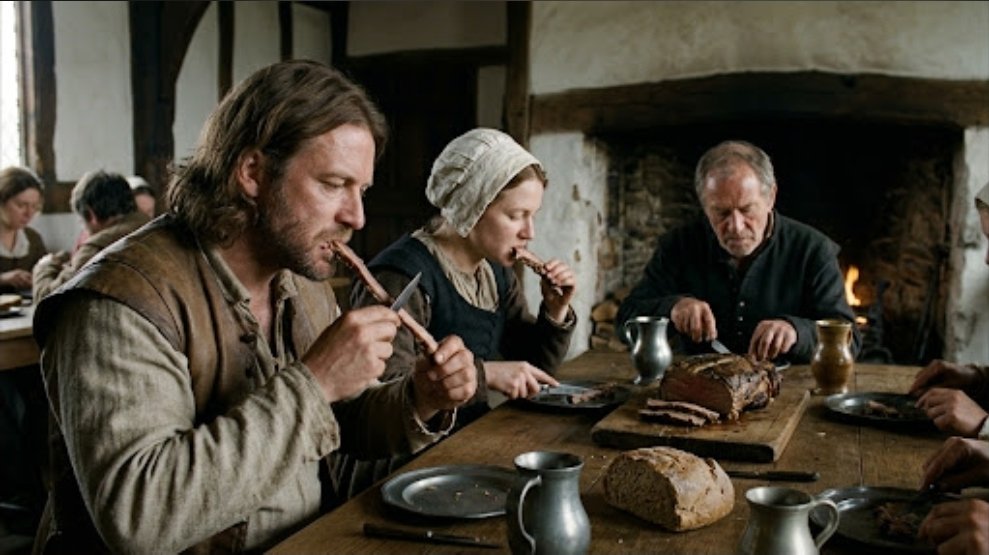
Your top teeth sit in front of your bottom teeth because of the fork.
Nearly every European skull older than about 250 years has the same bite. The front teeth meet edge to edge, like the blades of a pair of pincers. An American anthropologist, Loring Brace, spent decades measuring jaws and found the overbite arriving in Europe in the late 1700s, among the well off first, exactly when the knife and fork reached the table. Before that you clamped the meat in your front teeth and cut it off at the lips, and the tugging held the bite level all through childhood.
He checked it in China. There the overbite turns up about 900 years earlier, with the chopstick, when food started coming to the table already cut small.
Two continents, and on each the bite changed when the cutlery did. It takes one generation.
The rest of the jaw went the same way. Hunter-gatherer skulls have wide arches, straight rows, and room at the back for all four wisdom teeth. Crooked teeth are scarce in any graveyard before the Industrial Revolution. A jaw grows to the work it is given, and ours get porridge, pouches and sliced bread.
Even the language moved. Linguists showed in 2019 that the sounds F and V are only easy with an overbite, and are rare in the languages of people who still chew hard food. Much of the world could not comfortably say "fork" until it owned one.
About a third of British children are now judged to need braces, and Americans have some 10 million wisdom teeth pulled a year.
An entire profession straightens, by wire, a jaw that was only ever short of something to chew.