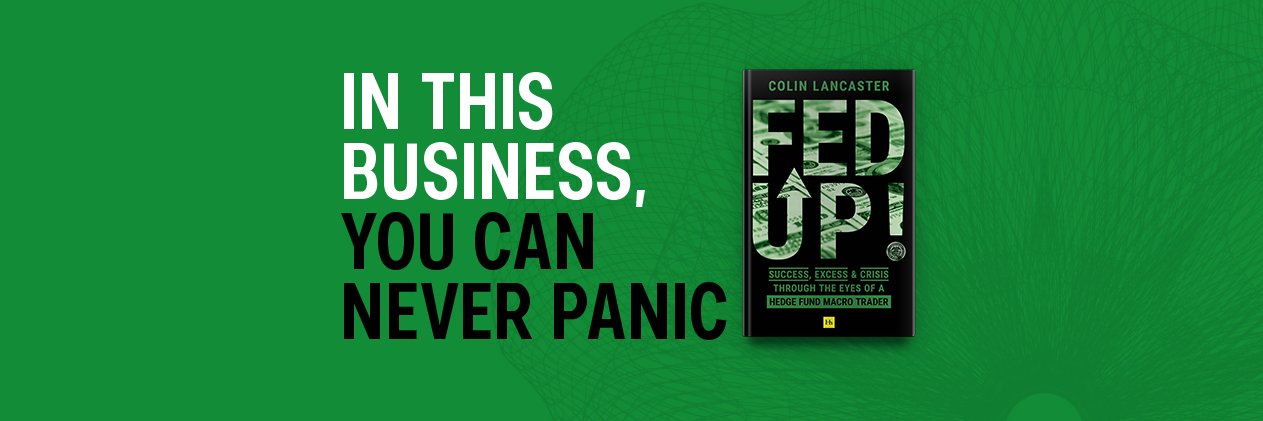
Super excited to announce the upcoming publishing date of my first book, FED UP! It is with pleasure that I bring you a real-time experience of the frenetic pace of the markets over the last year. Pre-order it now -->
https://t.co/DWG65XLBEE
Life is "a trap for logicians" because it is almost, but not quite, reasonable. Such a good quote from When Genius Failed one of my favorite books. Well done, Roger!
My guest today is Paul Tudor Jones (@ptj_official), one of the greatest macro traders of all time.
He correctly predicted the 1987 stock market crash and shorted the Japanese bubble in 1990. For over 40 years, his flagship fund has had a negative correlation to the S&P 500. 100% of his returns are alpha.
He says today's market has so many similarities to 2000, "the easiest bear market I've ever seen in my whole life."
He makes the case for going long dollar-yen, why Bitcoin beats gold as an inflation hedge, and why he was wrong about Warren Buffett.
But what I'll remember most from this conversation is Paul's zest for life. He's 71 and still wakes at 2:30 every morning to trade the London open. He works out for two hours a day. He walks with his wife every evening. He travels the country chasing peak spring and peak fall. He's so excited about the songs picked for his funeral that he wishes he could be there to hear them.
Paul has lived five lifetimes in one. He's one of the most entertaining and interesting people I've met, and the conversation will leave you searching to be as passionate about what you do as he is about what he does.
Enjoy!
Timestamps:
0:00 Intro
1:00 The Kindest Thing
13:19 Trading vs. Investing
17:33 Lessons from Warren Buffet
22:24 The Existential Risks of AI
29:54 The Nature of Trading
31:46 Bitcoin
35:55 Bubbles
42:08 A Day in the Life of PTJ
46:00 Information Overload
47:07 Passion for Markets
50:49 The Robin Hood Foundation
54:18 The Workless World
56:03 Journalism
1:00:00 Principal Components of a Great Life
1:05:06 Kill Them With Kindness
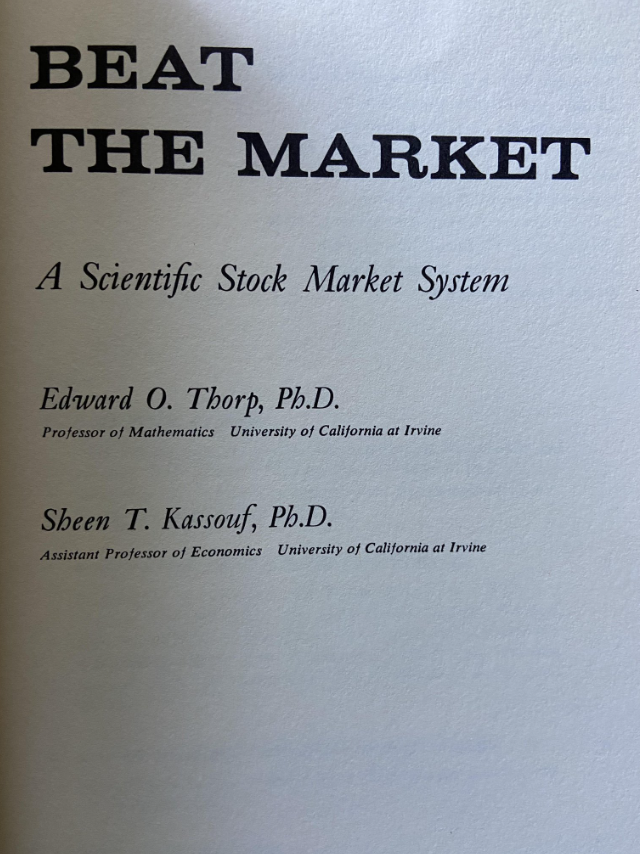
Apart from being a professional investor, I also like to collect (old) investment books.
This one is special.
1st Edition (1967) "Beat the Market" by Edward Thorp
One of the most influential books of all time on Wall Street, whose methods launched “the quant” revolution.
Very saddened to hear of the passing of John C. Hull, whose book Options, Futures and Other Derivative Securities was a foundational text in finance. I purchased the second edition (the first of many editions I would buy) in a mall bookstore decades ago. Liar’s Poker showed me what trading was, and Hull’s book was my first practical resource on how to do it. In today’s world of massively available educational resources it’s difficult to express how critically important the text was at the time. And still is.
This is probably one of my favorite clips from Stanley Druckenmiller. Listen to it at the start of every new year
"We have always believed that January 1 is when the house starts. I think this is the reason we have not had a down year. When I am up, I will play much more aggressively.
I see a lot of managers get up 20% and say I want to book my year, I made my high watermark, lets go to the beach. I am the opposite. Frankly I learned a lot of that from George [Soros]. If you are up 20 or 30%, you are playing the house money, thats when you try to get up 60 or 70%."
Headed into 2026, feels like most US investors don’t own enough commodities or non-US equities…. In any event, I think 2026 could be a great year for Macro!
Big fan of the “The Big Short” book and movie and I’m firmly in that camp versus “Margin Call” (which I also enjoyed).
In the movie, Mark Baum (Steve Carell) asks the exact two-part question which gets to the heart of how to think about systemic risk:
“Is there a housing bubble? And if there is, how exposed are the banks?”
You need two ingredients for a real spillover event: 1) a large mispricing and 2) leverage
When you get these in combination to a substantial degree, disaster awaits. Ultimately, the market is forced to confront the mispricing (in this case of mortgage credit risk and correlation). When that process imposes losses on mark to market sensitive investors, a reflexive risk unwind can materialize.
There are plenty of instances when a repricing does not lead to wide-scale spillover. The Internet bubble comes to mind (though 2002 was quite a credit widening event). The unwind of the Euro-Swiss peg in 2015 is another. There were some hedge funds that went under but it didn’t become systemic.
What you need is a significant combo of Mark Baum’s 2-part question. A big mispricing and widescale exposure to it through leveraged entities that are mark to market sensitive. And then, to hit the home run that John Paulson did, you have to perfect the structuring and timing of a convex trade.
Here’s a rendering of how to think about large risk-off events.
No better way to celebrate Black Monday than with 10 hours of Druck! Black Monday — and 1987 — feels like another planet from our current levels of speculative excess…. Biggest single percentage down day in history.
Here is a YouTube playlist I created of 14 long-form Stanley Druckenmiller interviews I’ve found. I’ve seen most of them and am working through them again.
There is never enough listening to Stan and his wisdom.
https://t.co/YzCzfbhlhB
Hear Stanley Druckenmiller @standuquesne on what makes a great trader.
1. Ultra-competitive and indomitable will to win
2. Discipline no matter what system
3. Emotional regulation/control
“I think the main thing is you have to be disciplined, you have to be unemotional and to me the really great one’s you have to have courage and be able to play big when the opportunity is there”