MICROSOFT BUILT A TOOL THAT CONVERTS LITERALLY ANYTHING INTO CLEAN MARKDOWN FOR YOUR LLM
pdfs. word docs. excel. powerpoint. audio. youtube urls
one pip install and your AI pipeline stops choking on raw files forever
no custom parsers. no broken layouts. no garbled text.
just clean, structured markdown your LLM can actually read
https://t.co/RSt0CczfYa
LLM Knowledge Bases
Something I'm finding very useful recently: using LLMs to build personal knowledge bases for various topics of research interest. In this way, a large fraction of my recent token throughput is going less into manipulating code, and more into manipulating knowledge (stored as markdown and images). The latest LLMs are quite good at it. So:
Data ingest:
I index source documents (articles, papers, repos, datasets, images, etc.) into a raw/ directory, then I use an LLM to incrementally "compile" a wiki, which is just a collection of .md files in a directory structure. The wiki includes summaries of all the data in raw/, backlinks, and then it categorizes data into concepts, writes articles for them, and links them all. To convert web articles into .md files I like to use the Obsidian Web Clipper extension, and then I also use a hotkey to download all the related images to local so that my LLM can easily reference them.
IDE:
I use Obsidian as the IDE "frontend" where I can view the raw data, the the compiled wiki, and the derived visualizations. Important to note that the LLM writes and maintains all of the data of the wiki, I rarely touch it directly. I've played with a few Obsidian plugins to render and view data in other ways (e.g. Marp for slides).
Q&A:
Where things get interesting is that once your wiki is big enough (e.g. mine on some recent research is ~100 articles and ~400K words), you can ask your LLM agent all kinds of complex questions against the wiki, and it will go off, research the answers, etc. I thought I had to reach for fancy RAG, but the LLM has been pretty good about auto-maintaining index files and brief summaries of all the documents and it reads all the important related data fairly easily at this ~small scale.
Output:
Instead of getting answers in text/terminal, I like to have it render markdown files for me, or slide shows (Marp format), or matplotlib images, all of which I then view again in Obsidian. You can imagine many other visual output formats depending on the query. Often, I end up "filing" the outputs back into the wiki to enhance it for further queries. So my own explorations and queries always "add up" in the knowledge base.
Linting:
I've run some LLM "health checks" over the wiki to e.g. find inconsistent data, impute missing data (with web searchers), find interesting connections for new article candidates, etc., to incrementally clean up the wiki and enhance its overall data integrity. The LLMs are quite good at suggesting further questions to ask and look into.
Extra tools:
I find myself developing additional tools to process the data, e.g. I vibe coded a small and naive search engine over the wiki, which I both use directly (in a web ui), but more often I want to hand it off to an LLM via CLI as a tool for larger queries.
Further explorations:
As the repo grows, the natural desire is to also think about synthetic data generation + finetuning to have your LLM "know" the data in its weights instead of just context windows.
TLDR: raw data from a given number of sources is collected, then compiled by an LLM into a .md wiki, then operated on by various CLIs by the LLM to do Q&A and to incrementally enhance the wiki, and all of it viewable in Obsidian. You rarely ever write or edit the wiki manually, it's the domain of the LLM. I think there is room here for an incredible new product instead of a hacky collection of scripts.
🦞🛡️ OpenClaw × VirusTotal: every ClawHub skill now auto-scanned for malware
🔍 AI Code Insight catches reverse shells, crypto miners & exfiltration
⚡ ~30s verdicts
🚦 Benign/Suspicious/Malicious tiers
🔄 Daily re-scans
This is not a silver bullet, but it is another layer to the shell 🦞https://t.co/2HmT6Ubrdm
Wow just wow, I can have #Ollama inside a #Docker offline #OpenClaw managing my internal private home network via an uncensored model. Is this what existential crisis feels like?
https://t.co/j7KjDTDHs4
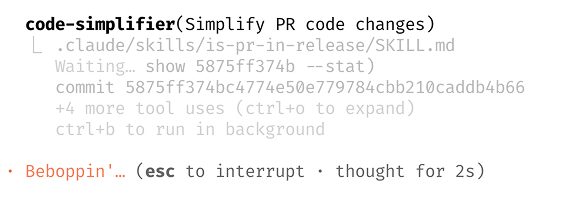
We just open sourced the code-simplifier agent we use on the Claude Code team.
Try it: claude plugin install code-simplifier
Or from within a session:
/plugin marketplace update claude-plugins-official
/plugin install code-simplifier
Ask Claude to use the code simplifier agent at the end of a long coding session, or to clean up complex PRs. Let us know what you think!
This crystal clear video of ICE shooting a US citizen in the head is what Trump’s “Golden Age” looks like:
A regime of Terror Capitalism imposed on subjects across the Americas to protect economic plunder by a decadent class of Zionist tech plutocrats
Love this project: nanoGPT -> recursive self-improvement benchmark. Good old nanoGPT keeps on giving and surprising :)
- First I wrote it as a small little repo to teach people the basics of training GPTs.
- Then it became a target and baseline for my port to direct C/CUDA re-implementation in llm.c.
- Then that was modded (by @kellerjordan0 et al.) into a (small-scale) LLM research harness. People iteratively optimized the training so that e.g. reproducing GPT-2 (124M) performance takes not 45 min (original) but now only 3 min!
- Now the idea is to use this process of optimizing the code as a benchmark for LLM coding agents. If humans can speed up LLM training from 45 to 3 minutes, how well do LLM Agents do, under different kinds of settings (e.g. with or without hints etc.)? (spoiler: in this paper, as a baseline and right now not that well, even with strong hints).
The idea of recursive self-improvement has of course been around for a long time. My usual rant on it is that it's not going to be this thing that didn't exist and then suddenly exists. Recursive self-improvement has already begun a long time ago and is under-way today in a smooth, incremental way. First, even basic software tools (e.g. coding IDEs) fall into the category because they speed up programmers in building the N+1 version. Any of our existing software infrastructure that speeds up development (google search, git, ...) qualifies. And then if you insist on AI as a special and distinct, most programmers now already routinely use LLM code completion or code diffs in their own programming workflows, collaborating in increasingly larger chunks of functionality and experimentation. This amount of collaboration will continue to grow.
It's worth also pointing out that nanoGPT is a super simple, tiny educational codebase (~750 lines of code) and for only the pretraining stage of building LLMs. Production-grade code bases are *significantly* (100-1000X?) bigger and more complex. But for the current level of AI capability, it is imo an excellent, interesting, tractable benchmark that I look forward to following.
I just created a Cursor rule called ask-a-friend.mdc that manually calls up Claude Code when Cursor and all its LLMs are stuck. I think it's going to be a great tool to call when the going gets tough.
this new AI agent is incredible..
it can analyse real time market data 24/7 and suggest you to buy/sell at the right moment, it's crazy
here's how it works (it's still free now):