THE $NVDA VERA RUBIN SUPPLY CHAIN BREAKDOWN
Nvidia’s Vera Rubin is ramping into full-scale production and reshaping the AI rack bill of materials in three major ways: more HBM per rack, a shift from pluggable to co-packaged optics and the move to 800VDC power.
Here are the companies positioned to capture each transition:
Memory Storage (content-per-rack story)
• $MU, $SNDK, $SKHY and Samsung sit at the memory and storage layer as next-gen AI systems require more bandwidth, more capacity and faster data access.
Advanced Packaging (bottleneck that gates everything)
• Foundry / packaging: $TSM, $AMKR, $INTC
• Packaging equipment: $AMAT, $LRCX, $KLAC, $ASML
• Test / validation: $TER, $AEHR
• Substrates / materials: $TTMI
Optical Communication (CPO transition)
• Optical modules: $COHR, $LITE, $AAOI
• CPO / switching chips: $AVGO, $NVDA, $MRVL
• High-speed connectivity: $CRDO, $ALAB
• Fiber / networking: $GLW, $NOK, $CSCO, $ANET
• Silicon photonics / packaging: $TSM, $GFS, $TSEM
800VDC Power Supply (architecture shift)
• Wide-bandgap semis: $STM, $ON, $NVTS, $POWI, $WOLF
• Power management / hardened devices: $MPWR, $ADI, $TXN, $AOSL, $VICR, $MCHP
• Motherboard / connector / power module: $FLEX, $APH, $TEL
• Infrastructure / power delivery: $VRT, $ETN, $GEV
Compute System (integrators)
• $DELL, $HPE, $SMCI provide the system-level integration layer that turns all of these components into deployable AI infrastructure.
While memory stocks continue to sell off, the future of HBM has never been brighter:
• AI inference
• Agentic AI
• Edge AI
• Autonomous driving
• Robotics
• New GPU generations
All need exponentially more memory.
Memory Is the Most Important AI Bottleneck: Who Controls HBM, DRAM, and NAND
AI infrastructure is increasingly constrained by memory bandwidth, memory capacity, and storage density, not only by GPUs. Accelerators need to be fed with data fast enough, or expensive hardware sits underutilized.
HBM is the most AI-critical segment because it sits directly beside the accelerator and solves the bandwidth problem. Q1 2026 HBM market was roughly $11B–$12B, based on Samsung’s reported HBM revenue and market share assumptions.
DRAM is the larger revenue pool. It includes HBM, server DRAM, DDR5, RDIMMs, and LPDDR. Global DRAM revenue reached about $97B in Q1 2026, driven by AI data center demand. Samsung, SK Hynix, and Micron control most of the market.
NAND is less direct than HBM for GPU performance, but it is essential for AI storage. Enterprise SSDs, training data, model checkpoints, retrieval systems, vector databases, and AI data lakes all depend on dense, reliable flash infrastructure.
$MU Micron
Micron is the key U.S. pure-play memory supplier across HBM, DRAM, and high-capacity SSDs. The company is ramping 12-high 36GB HBM4 ahead of schedule, has customer agreements covering HBM capacity through 2026, and is shifting HBM4E base dies to TSMC.
$SKHY SK Hynix
SK Hynix remains one of the most important HBM suppliers for Nvidia-linked AI accelerators. The company is scaling 1b DRAM for HBM4, expanding M15x capacity, and moving base dies toward advanced logic nodes to support wider AI memory interfaces.
$005930(.KS) Samsung
Samsung offers the broadest memory exposure across HBM, DRAM, NAND, and SSDs. The company is accelerating 10nm-class DRAM for HBM4, advancing 400-layer V-NAND, and scaling Key Value SSDs designed for AI inference workloads.
$SNDK SanDisk
SanDisk is focused on the NAND and enterprise SSD layer of AI infrastructure. Its BiCS8 3D NAND and High Bandwidth Flash architecture support dense storage, active data retrieval, training datasets, checkpoints, and AI data lakes.
$285A(.T) Kioxia
Kioxia is positioned as a NAND-focused AI storage supplier. Its 5TB high-bandwidth flash module targets PCIe 6.0 systems with 64 GB/s throughput, helping bridge the gap between expensive compute memory and traditional storage arrays.
HBM is the most strategic AI memory segment, DRAM is the largest profit pool, and NAND is the storage leverage behind AI scale.
Morgan Stanley: Scale-Up Market
Massive Expansion of the Scale-Up Market
> 4x Market Surge: The AI scale-up network market is projected to reach a $70 billion+ opportunity by 2030, which is over four times the size estimated just a year ago ($17 billion by 2029).
> The Scale-Up Moat: Scale-up networks are essential because they allow thousands of GPUs/accelerators to operate seamlessly as a single supercomputer system, eliminating communication bottlenecks during modern frontier AI model training.
> Bigger Clusters: Cluster sizes are expanding rapidly. For example, NVIDIA’s roadmap has progressed from 72 GPUs in a single rack (Blackwell) to 144 GPUs (Vera Rubin), 576 GPUs (Rubin Ultra), and potentially over 1,000 GPUs with Feynman.
The "Copper Wall" vs. Optical Transition
> Copper is Staying Longer: Copper remains the preferred short-reach technology due to lower latency, lower power consumption, and lower cost. Innovations like PAM4/PAM6, advanced SerDes, and retimers are extending copper's life further than the industry previously expected.
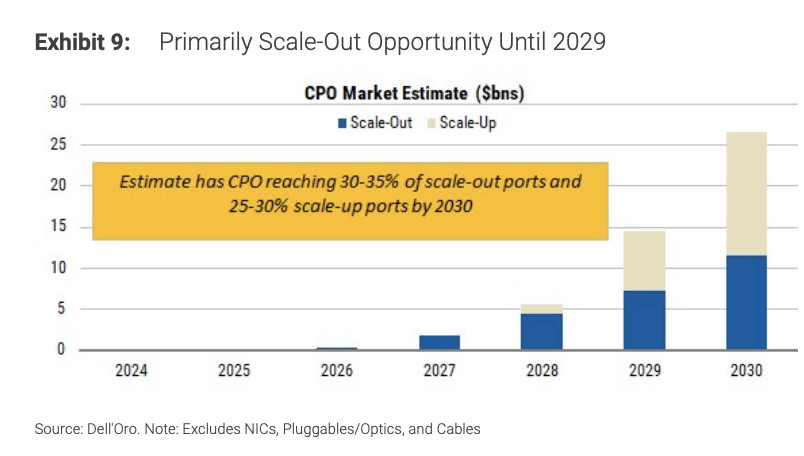
> Optics is Inevitable but Back-Weighted: As cluster domains push past a single rack, managing electrical signal degradation at high speeds becomes too inefficient. Morgan Stanley expects Co-Packaged Optics (CPO) to see meaningful adoption starting with the NVIDIA Feynman generation around 2028–2029. Recent market sell-offs surrounding delayed CPO adoption are viewed as overdone.
Fabric & Ecosystem Protocol Debates
> NVIDIA Dominance: NVLink remains the dominant proprietary fabric. NVIDIA is also deploying NVLink Fusion, which allows third-party CPUs and custom ASICs to tie directly into the NVLink ecosystem.
> Open Alternatives Growing: Broadcom is spearheading Scale-Up Ethernet (SUE), while an AMD-led consortium is backing UALink as an open alternative. Morgan Stanley sees PCIe (e.g., via Astera Labs) acting as an important temporary bridge before hyperscalers migrate to native AI fabrics.
> AWS & Google Outliers: Google relies on an Optical Circuit Switch (OCS) Torus topology. AWS has shifted to a flatter, highly efficient mesh network called Resilient Network Graphs (RNG) using passive optics to reduce router counts and power consumption.
$AMZN $GOOGL $AMD $NVDA $CRDO $SMTC $AVGO $MRVL $LITE $COHR $GLW
Morgan Stanley: Bearings
The Big Picture: Bearings as a Core Robotics Play
> Architecture-Agnostic Growth: Bearings offer a diversified way to invest in the robotics sector because they are required regardless of a robot's ultimate design or form factor.
> Massive Market Expansion: Morgan Stanley forecasts a massive ~300x growth in the robot bearings market through the year 2050.
> Low Risk of Obsolescence: Bearings face very low substitution, in-sourcing, or obsolescence risks—you simply cannot design moving machines around them.
> OpenAI Endorsement: In a recent Request for Proposal (RFP) for U.S.-based hardware manufacturing capacity, OpenAI listed precision bearings as 1 of 6 critical components in its robotics category.
Content Scales with Robot Complexity
> Bearings 101: Every single motor in a robot requires at least one or more bearings to reduce friction and support rotating parts.
> Degrees of Freedom (DoF): As robots get more complex, the number of bearings multiplies.
Small quadcopter drone: Requires 8–12 bearings.
Humanoid robot: Requires 70 or more bearings.
> Pricing Variability: Depending on the specific use-case, individual bearings can range from under $1 to as much as $100
Global Bearings Market Dynamics
> Consolidated Supply: The top 6 global manufacturers control over 50% of the global roller market, with Chinese manufacturers making up about 25%.
> Current Demand Split: Roughly 40% of the overall market goes to industrial equipment OEMs, 30% to automotive, and 30 to distribution channels
BofA: Global Memory
> Super-Cycle Intact: The BofA memory indicator remains near record highs (reaching 183 in May, well above past peaks of 120–130). High-end memory demand (HBM4, SOCAMM, etc.) continues to drive exceptional strength.
> Massive Revenue Growth Forecasted for 2026: Global DRAM revenue is expected to nearly quadruple (+325% YoY) in 2026, primarily driven by a sharp rebound in Average Selling Prices (ASPs). NAND revenue is similarly projected to jump nearly fourfold (+299% YoY) in 2026.
> Servers & AI Dominating DRAM: Servers—especially AI systems utilizing High Bandwidth Memory (HBM)—now account for over half of total global DRAM demand due to high memory density per system.
> SSDs Fueling NAND: Enterprise and data center Solid State Drives (SSDs) utilized in AI applications now make up more than 50% of total NAND demand and sales, commanding a price premium over standard IT applications.
> Sizable Share of AI Hardware Budgets: High-bandwidth memory (HBM) and advanced data center memory now command a massive 35% to 40% of total cloud AI infrastructure spending. Big Tech's cloud and AI capex is projected to push close to $1.5 trillion by 2027.
> HBM Supply Cannibalization: Producing an HBM chip requires 3x to 4x more silicon wafer capacity than traditional DRAM. Because they share the same production lines, manufacturers are prioritizing high-margin HBM, starving the market of standard capacity.
> DDR5 Premium Disappears: The rapid exit of tier-one manufacturers from mature products has triggered a severe, structural shortage in legacy DDR4. BofA notes that spot prices for 16Gb DDR4 and DDR5 have essentially converged into the $35–$40 range. The traditional technology premium of DDR5 over DDR4 has largely vanished because manufacturers are dropping DDR4 production faster than PC and server customers can physically transition their setups.
Massive Revenue Surge Forecasts (2026E)
> Total Market Expansion: Combined DRAM and NAND revenue is projected to nearly quadruple to $891.8 billion in 2026E (up from $214.8 billion in 2025).
> DRAM Performance: DRAM revenue alone is expected to increase by +325% YoY to $568.8 billion in 2026E. This hyper-growth is heavily back-loaded, with quarterly revenue ramping up aggressively from $83.9 billion in 1Q26E to $182.6 billion by 4Q26E.
> NAND Performance: NAND revenue is forecast to surge +299% YoY to $323.1 billion in 2026E, climbing from $45.3 billion in 1Q26E up to $102.4 billion in 4Q26E.
High-Bandwidth Memory (HBM) Deep Dive
> TAM Scaling: The Total Addressable Market (TAM) for HBM is projected to hit $76.8 billion in 2026E (+122% YoY) and skyrocket to $134.6 billion by 2027E.
> Astounding Profitability: The industry average Operating Profit Margin (OPM) for HBM is sitting near a massive 49% for 2026E, climbing even higher to 54% in 2027E.
The Technology Shift (HBM Mix):
2026E: Mainstream volume is dominated by HBM3e (60%) and HBM4 (32%).
2027E: The mix flips heavily into HBM4 (64%), while the next-gen HBM4e begins its entry at 19%.
2028E–2030E: The long-term horizon shows rapid transition into HBM5+, which is expected to command 79% of the market mix by 2030E.
> Server Intensity: AI+HBM server units are scaling to 4.5 million systems in 2026E, with memory intensity per server jumping to 1,413 GB per AI server.
Pricing (ASP) & Shipment Dynamics
> The Rebound Driver: The entire super-cycle is pricing-driven. Blended DRAM Average Selling Prices (ASPs) are modeling a +249% YoY expansion in 2026E ($13.0 per 8Gb equiv. unit vs. $3.7 in 2025). Blended NAND ASPs are modeling a +238% YoY increase.
> Quarterly Pricing Velocity: The fastest pricing momentum occurs in the first half of the year, with DRAM ASP growth showing a massive +73% QoQ spike in 1Q26E and +53% QoQ in 2Q26E, before cooling down to normal levels (+21% in 3Q, +7% in 4Q).
Capex & Capacity Expansions
> Massive Investment Outlays: Total industry Capex spending (DRAM + NAND) is projected to jump +62% YoY to $118.7 billion in 2026E.
> DRAM vs. NAND Split: Manufacturers are funneling the vast majority of cash into DRAM, ramping DRAM capex by +65% YoY to $88.6 billion. NAND capex is expanding much more modestly at +55% to $30.1 billion.
> Wafer Capacity: Total DRAM wafer capacity is expanding to 2,066k wafers per month in 2026E, out of which 23% of all global DRAM wafer capacity is being swallowed up solely by HBM production.
$MU $SNDK
This is the capital of robotics! 🌁
Silicon Valley is home to so many physical AI companies that you could spend a month visiting them and still not see even 10% of them (trust me, I tried).
It took me 3x to create this map as it did to create any other. And the truth is, it's still incomplete.
Let’s see why this is the case.
So, the Bay Area is the world's leading ecosystem for robotics startups, bringing together top AI talent, top universities, experienced founders, and unmatched access to capital.
The region is anchored by Stanford University and University of California, Berkeley, two of the world's top universities for AI and robotics. They produce a constant stream of researchers, founders, and breakthrough technologies.
The Bay Area is also home to many of the companies shaping the future of robotics and AI, including @Figure_robot, @physical_int , and major AI labs such as @OpenAI.
This concentration of talent makes it easy for startups to recruit experienced engineers and collaborate with leaders in embodied AI.
Not mentioning that it is also home to leaders such as @NVIDIARobotics , whose headquarters and leadership in AI chips power much of today's robotics revolution, and @Tesla, whose work on autonomous driving and humanoid robots has created a deep pool of robotics, AI, and manufacturing talent.
Perhaps its biggest advantage is access to capital and ambition.
The Bay Area has the world's deepest network of venture capital firms, serial entrepreneurs, and technical leaders who are willing to fund bold, long-term robotics companies.
In the comments I'll post the companies from the ecosystem.
‼️ Note that Bay Area has >300 robotics companies, research labs, and innovation hubs, so this is a curated selection of the notable product companies, not an exhaustive census!
P.S. I'm constantly working on improving these maps, so if your company is missing, please DM me with basic info about the co, and I will include it in the next release.
~~
♻️ Join the weekly robotics newsletter, and never miss any news → https://t.co/GoA3ZuwoPB
$AMBA Recently took a position in Ambarella. You'll hear a lot more from me on this name, but $AMBA I took a position in Ambarella after spending time on the edge AI stack and the company’s role in physical world intelligence.
Ambarella designs system on chip devices, or SoCs. A SoC integrates CPU cores, AI accelerators, image signal processors, memory controllers, and I O into a single piece of silicon. This allows compute, vision, and AI inference to run efficiently in a compact and power aware form factor, which is essential for edge devices.
Ambarella’s SoCs are built specifically for vision first and multimodal AI at the edge. These chips run perception, object detection, tracking, and reasoning directly inside cameras, drone, vehicles, robots, and industrial systems. The AI workloads involved use small and mid-sized language models, vision language models, and multimodal transformers designed to operate efficiently within constrained environments.
Roughly 70% of Ambarella’s revenue now comes from AI driven IoT applications across edge endpoints and edge infrastructure. Enterprise security, home security, portable video, robotics, AI boxes, and on-premise edge servers represent deployed systems with long product cycles and increasing AI content per device.
This role is becoming more important across the AI infrastructure stack. As AI moves from text generation into perception, autonomy, and real-world decision making, inference increasingly happens where data is created. Sensors generate massive continuous data streams that are inefficient to transmit and impractical to process remotely. Local inference reduces bandwidth usage, improves privacy, increases reliability, and enables real time response.
Compute intensity at the edge continues to rise. Higher resolution sensors, more sensors per system, longer context windows, and more capable models all increase inference demand per device. That drives higher silicon value, more advanced SoCs, and deeper integration of AI accelerators into edge platforms.
Power efficiency is the limiting factor that defines the winners. AI infrastructure in the physical world must balance performance, thermals, and energy consumption. Ambarella’s architecture is designed around these constraints, which become more critical as edge AI deployments scale into the billions of devices.
Last quarter (Q3 FY2026): Revenue grew about 31% year over year, coming in around $108.5M.
Trailing twelve months: Revenue up roughly 48% year over year, reflecting strong acceleration.
Full year outlook: Management guided to 36–38% revenue growth for FY2026, which would be one of the strongest growth years in the company’s history.
It is hard to find what looks like a small cap winner in the AI semiconductors space. Ambarella looks like a good bet to me.
PRESIDENT TRUMP JUST SUBMITTED HIS STOCK PURCHASES/SALES TO THE WHITE HOUSE OFFICE OF ETHICS.
The document is over 100 pages and has thousands of trades.
This is one of the first times we've seen a sitting President actively trade securities and not just sit in corporate debt, index funds, or treasuries.
Here are some of the names that Trump bought:
$PLTR, $HOOD, $NVDA, $SOFI, $MSFT, $AAPL, $DIS, $V, $ULTA, $JPM, $COIN, $LYFT, $AMZN.
DRONES WILL BE ONE OF THE HOTTEST THEMES OF 2026
• $UAVS powers drones for agriculture and commercial applications
• $ONDS provides secure communications infrastructure for autonomous systems
• $DPRO supports drone training, operations and real-world deployment
• $UMAC builds software to coordinate drone swarms and unmanned operations
• $JOBY, $ACHR, $EVTL and $EH are building electric aircraft for urban air mobility
• $AVAV, $KTOS, $RCAT and $AIRO provide the physical drones, defense platforms and mission hardware
SpaceX’s reported IPO spotlight is highlighting space materials. Rockets and satellites rely on titanium, niobium, carbon fiber, advanced polymers, coatings, and chip materials like GaN and SiC. Supply's tight and geopolitics is making the value chain more strategic
#IPO#SpaceX
Every day for the next long while, I'm going to tear down a new public software company and highlight the AI risks/opportunities around it- products launched to date, top startups, key quotes from earnings calls, etc.
Day twenty-five: Cloudflare $NET
Peak share price: $253.3 (Oct 31, 2025)
Share price today: $200.99 (-21%)
EV today: $70.2bn
ARR today: $2.46bn (+34% Y/y
NRR: 120%
EV/ARR: 28.5x
GAAP Operating Margin: 6.2%
EV/Run-rate GAAP EBIT: 453x
Headcount: 5,200 (+21% Y/y)
What Cloudflare does:
Cloudflare operates an edge network that it uses to provide an array of value-added connectivity, CDN, and security services to customers worldwide.
Its core business, application services, is built on upsells on top of its free CDN offering, which undercut the low-end of the paid CDN market and became an onramp to cross-selling higher value security services( WAF, DDoS mitigation, bot management, etc.
It then built and executed on an impressive second act, moving into enterprise access with a SASE business model that replaces corporate VPNs and firewalls with cloud native security.
Finally, Cloudflare uses the same infrastructure to run a developer platform, offering serverless compute (Wokers), object storage (R2), and more at the edge as a sort of distributed, developer-native alternative to traditional hyperscalers.
The company hasn't disclosed much on the relative sizes of these businesses, but its strength in enterprise customers and expanding net retention rate suggest that it is seeing significant success in the latter two businesses.
AI bear case:
This is less of an AI-specific bear case (those are hard to build), but Cloudflare's second-act businesses both face heavy competition from existing cybersecurity (Zscaler/Palo Alto) and hyperscaler (AWS, GCP, Azure) incumbents with substantially larger capex and go-to-market budgets.
On the AI side, perhaps most worrisome is the idea that provisioning of AI infrastructure might become the purview of the model vendors (OpenAI/Anthropic) who leverage their capabilities and the ubiquity of their APIs to ensure that inference compute happens on their backends, not Cloudflare's edge servers.
AI bull case:
The AI bull case for Cloudflare is pretty crisp (and arguably reflected in the multiple and metrics). Cloudflare occupies an increasingly strategic position between users and web content, and as agents proliferate, the types of security that Cloudflare specializes in (especially advanced bot detection) become increasingly critical.
Beyond that, there ARE AI workloads that likely belong at the edge, and in general enterprise security challenges will compound as agents come to the fore.
Finally, Cloudflare has done a surprisingly good job of maintaining its developer-first ethos (I use R2 for some of my projects!), giving it valuable exposure to the broader vibe-coding trend.
In short, Cloudflare has a history of executing well and beachfront real-estate from which to add value in an AI native world.
AI traction:
Cloudflare has seen a material acceleration in growth of late, with revenue growth increasing from 27% in Q1 to 34% Y/y in Q4, driven by increased net expansion, particularly with large customers.
The company doesn't disclose any AI-specific revenue (and indeed, is stingy on revenue breakouts for any segments), but it seems safe to assume that AI is showing up as a tailwind in the business one way or another. One of the most plausible candidates is heavy use of Cloudflare's Workers product by vibecoding customers (both developers and applications).
Strikingly, the company called out that the number of weekly agent-made requests on its platform doubled in the month of January alone (!!), highlighting the intensity of the usage tailwind.
Adjacent AI-native startup summary:
Though not fully AI native, @vercel is the most relevant competitor to the core CDN business (912 employees, +28% Y/y), and clearly executing well.
On the enterprise security side- ZScaler, Netskope and Palo Alto are the companies to watch, although all relatively mature. @Tailscale (315 employees, +68% Y/y) competes with Cloudflare's WARP and Tunnel products at the low end.
On the dev-tooling side, the competition is fierce, with @vercel showing up again along with a host of other inference platforms running from the low end to enterprise. It's hard to specify competitors given the breadth of Cloudflare's offering and the particular wedge it brings (a massive, highly optimized edge network).
Management Quotes:
"We blew away our previous record for new ACV in the quarter, with strong year-over-year and quarter-over-quarter acceleration. In Q4, new ACV book grew nearly 50% year-over-year, making it not only a record quarter in absolute ACV dollars but also the fastest growth rate we've delivered since 2021."
"A leading AI company expanded their relationship with Cloudflare, signing a 2-year $85 million pool of funds contract for our full platform, selecting Cloudflare as their single long-term infrastructure provider with 100% traffic allocation."
"A U.S. media company signed a 3-year $3.1 million contract for AI Crawl Control, along with application services and Workers. This customer was facing a massive increase in AI scraping, which was crushing their network and driving up infrastructure costs. They chose Cloudflare to gain visibility into which AI models are consuming their data, allowing them to protect and eventually monetize their unique content."
"That means we win when AI applications are built on Cloudflare Workers, but we also win just from the increased usage of all of our products and agentic Internet drives."
"It's not a coincidence that most so-called vibe coding platforms are either built on Cloudflare Workers or have us as their preferred deployment target. We exited 2025 with more than 4.5 million human developers active on our platform. It's a lot more if we count their agents."
Commentary:
No comment on Cloudflare would be complete without reference to the company's sky-high valuation multiple. At 28.5x sales only Palantir is higher, and the next highest in SaaS in CrowdStrike at 19.7x with another cliff down to Palo Alto at 12.7x. This is a very, very expensive stock and while the metrics are truly impressive (and more importantly, trending the right direction) it's strike that they aren't yet standout on an absolute basis (other companies have similar/higher growth rates and similar net retention, yet trade at a massive discount). The market clearly believes that Cloudflare is a secular AI winner- and yes, it does have good reason to believe so.
The biggest challenge to writing about Cloudflare's AI tailwinds more specifically is the inscrutability of the business given the range of business lines and market segments served. The company's investor day on June 9th will hopefully provide some helpful context.
What seems true is that AI is a meaningful tailwind for Cloudflare's business, although there is no one hero SKU to point to and analyze. Still, taking the sky high, top-in-all-of-SaaS multiple aside, it is hard to argue against a well-oiled machine with a stellar management team that occupies beachfront AI real estate. It will be interesting to see if/how the story evolves into something more legible (and quantifiable) for investors over time.
Photonics is a stack!
$AXTI $AIXA $TSEM $AEHR $LITE $GLW
Here is a clean map of the sector.
Please bookmark & share!
A laser, a photonic chip, a finished module, and a deployed AI network all sit at different points in one long chain.
Different companies get paid for totally different reasons and on totally different timelines.
I just updated my layer framework so you can instantly see where every major name fits that I track (and why the AI buildout lifts the whole stack).
Quick map:
Layer 1 (Materials & Platforms): $AXTI $ALMU $LWLG $IQE
Layer 2 (Epitaxy Tools): $AIXA $ALRIB $VECO
Layer 3 (Foundries & Scale): $TSEM $FN $SANM
Layer 4 (Test & Yield): $AEHR $FORM $COHU $TER $VIAV
Layer 5 (Devices & Engines): $LITE $COHR $AAOI $POET $SIVE $MTSI
Layer 6 (Connectivity & Networks): $CRDO $MRVL $SMTC $CIEN $NOK $GLW
There are many more names in the industry that didn't make this list.
Which are you tracking the closest?
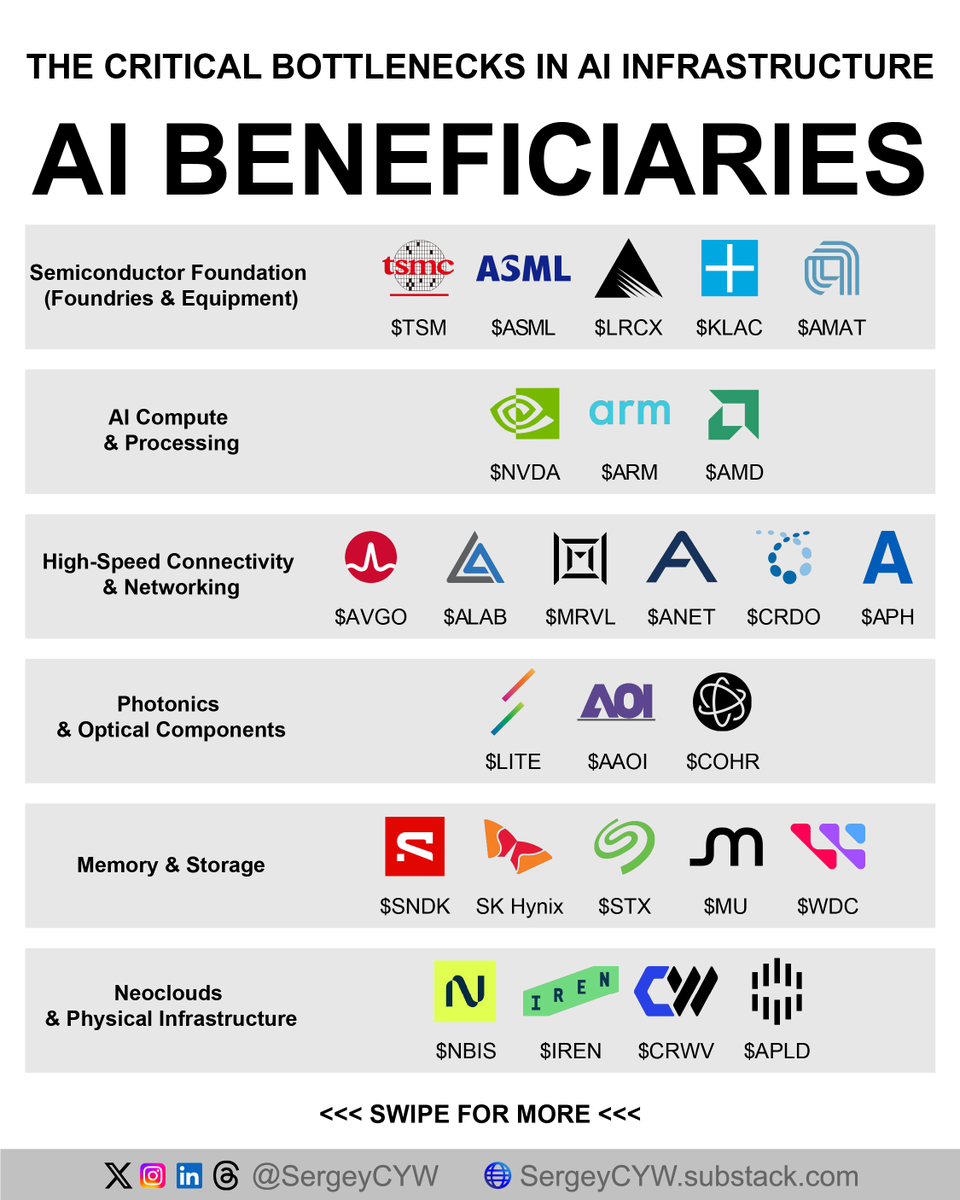
AI Infrastructure Stack (and who’s actually capturing value)
AI is a chain of hard constraints.
Compute. Memory. Power. Bandwidth. Cooling.
Every bottleneck creates pricing power.
Let’s break down the stack 👇
Semiconductor Foundation (Foundries & Equipment)
No advanced chips → no AI scaling. Only a handful of companies can physically produce or enable leading-edge silicon. Supply is structurally tight.
$TSM TSMC Fabricates nearly all advanced AI accelerators globally. 3nm capacity is heavily reserved for AI workloads, while 2nm ramps require new GAA transistor architecture. Arizona fabs expand geographic redundancy while maintaining ~30% capital intensity. Packaging (CoWoS) is now a hidden constraint, limiting how many AI GPUs can actually be deployed at scale.
$ASML ASML Controls EUV lithography. Each High-NA EUV system exceeds $300M and requires years to build. Installed base creates long-term service revenue and lock-in. Tool precision enables sub-2nm scaling, critical for power efficiency in AI chips. No viable alternative exists, making ASML a single-point dependency across the entire semiconductor ecosystem.
$AMAT Applied Materials Owns key steps in deposition and advanced packaging. AI chips require heterogeneous integration—logic + HBM + interconnect. TSV and wafer bonding increase process complexity and tool intensity. Equipment spend shifts toward high-value nodes tied to AI, reducing cyclicality from smartphones or PCs and increasing structural demand visibility.
$LRCX Lam Research Critical for etching in 3D structures. HBM and 3D NAND require extreme precision at atomic layers. Bevel deposition tech reduces edge defects, improving yield on expensive wafers. AI memory scaling increases layers per chip, directly increasing process steps per wafer and driving sustained demand for Lam’s tools.
$KLAC KLA Inspection layer becomes more valuable as complexity rises. Advanced nodes mean one defect can ruin an entire wafer worth millions. KLA’s metrology tools operate inline, catching issues early. 3D stacking and smaller geometries increase inspection intensity per wafer, structurally expanding its role in production.
AI Compute & Processing
Shift from general-purpose CPUs → accelerated compute. AI workloads require parallel processing, custom silicon, and high-efficiency architectures.
$NVDA Nvidia Defines AI compute architecture. Blackwell Ultra targets inference scaling with higher efficiency per token. NVLink Gen5 enables multi-GPU clusters to function as unified systems with >1TB/s bandwidth. CUDA ecosystem locks developers into its stack. Networking + compute integration turns Nvidia into a full AI platform, not just a chip vendor.
$AMD AMD Alternative supplier gaining relevance. Instinct GPUs integrate with ROCm software stack, improving compatibility with enterprise workloads. EPYC CPUs act as orchestration layer, feeding data into accelerators. Hyperscalers deploy AMD to diversify risk and optimize cost per compute unit, creating structural share gains over time.
$ARM Arm Licenses architecture for custom AI chips. Armv9 increases royalty per chip due to higher compute density. Neoverse CPUs power hyperscaler-designed silicon, replacing off-the-shelf processors. Over 70,000 enterprises already run workloads on Arm-based infrastructure, reinforcing its position as the default architecture for power-efficient AI compute.
High-Speed Connectivity & Networking
Compute without bandwidth = idle GPUs. Clusters must operate as a single system. Latency directly impacts ROI.
$AVGO Broadcom Drives traffic inside AI clusters. Tomahawk 5 supports 800G switching, enabling massive GPU fabrics. Jericho chips manage data flow across distributed systems. Custom XPUs deepen integration with hyperscalers. Switching silicon becomes central as clusters scale beyond tens of thousands of GPUs.
$ALAB Astera Labs Solves data bottlenecks within racks. PCIe retimers maintain signal integrity under extreme throughput. Scorpio fabric enables composable infrastructure, allowing flexible resource allocation across GPUs and memory. Rack-level optimization becomes critical as density increases.
$MRVL Marvell Enables long-distance data transfer via optics. Electrical signals convert to light using DSPs, reducing loss across large campuses. Partnership with Nvidia on optical interconnects positions Marvell at the center of next-gen AI networking. Copper limitations accelerate adoption of optical solutions.
$CRDO Credo Dominates short-range connectivity. Active Electrical Cables (AECs) reduce power consumption while maintaining signal quality up to ~7 meters. Hyperscalers standardize AECs for dense racks. Multi-product strategy across copper and optical DSPs captures share across the full connectivity stack.
$ANET Arista Software-defined networking for AI clusters. Ethernet gains share over InfiniBand due to flexibility and cost advantages. Arista’s EOS software enables dynamic routing across large-scale GPU clusters. Backlog reflects long deployment cycles tied to hyperscaler buildouts.
$APH Amphenol Physical interconnect layer. High-speed cables and connectors must handle extreme thermal and power loads. 1.6T active copper extends lifecycle of electrical solutions before full optical transition. Reliability at scale becomes critical as failure rates increase with density.
Photonics & Optical Components
Copper is reaching limits. Light becomes the default medium for high-speed data transfer.
$AAOI Applied Optoelectronics Produces 400G/800G transceivers used in switches and servers. Demand for 1.6T modules is accelerating. Internal capacity expansion required as hyperscaler orders exceed supply. Optical modules become essential to prevent bottlenecks in high-density AI racks.
$LITE Lumentum Supplies EML lasers and optical components. Co-packaged optics integrate directly with silicon, reducing power and latency. Continuous-wave lasers enable high-speed transmission across data centers. Role expands as optical moves closer to compute layer.
$COHR Coherent Controls indium phosphide wafer supply. Critical material for high-speed lasers used in 800G and 1.6T networks. Scaling to six-inch wafers improves output efficiency. 400G-per-lane technology pushes bandwidth limits further, supporting next-gen AI clusters.
Memory & Storage
AI is memory-bound. Compute speed depends on how fast data can be delivered.
$MU Micron Produces HBM used directly alongside GPUs. Entire output allocated years in advance. HBM integrates via advanced packaging, increasing bandwidth and reducing latency. Data center SSDs complement memory, feeding inference workloads efficiently.
SK Hynix Leads in HBM3E. 12-layer stacks dominate premium segment. Early commitment to HBM4 secures future demand. Tight integration with Nvidia supply chain strengthens positioning at the highest end of AI memory.
$WDC Western Digital Focuses on high-capacity HDDs post spin-off. UltraSMR increases storage density, enabling cost-effective AI data lakes. Multi-year contracts with hyperscalers lock in demand through 2026 and beyond.
$SNDK SanDisk Delivers PCIe Gen5 SSDs for low-latency inference. High Bandwidth Flash (HBF) aims to deliver up to 16x capacity vs HBM at similar cost. Addresses memory bottleneck in large-scale inference systems.
$STX Seagate Builds mass-capacity storage. HAMR technology enables 30TB+ drives. Essential for storing training datasets at scale. HDD remains lowest-cost solution for exabyte-level storage.
Neoclouds & Physical Infrastructure
Final constraint: power + cooling. AI scaling is now limited by electricity availability.
$CRWV CoreWeave Pure AI cloud model. Bare-metal Kubernetes stack reduces latency ~30%. Over 200,000 GPUs deployed. Expansion driven by securing power capacity, adding hundreds of megawatts to support dense clusters.
$NBIS Nebius Rapidly scaling neocloud. Secures long-term contracts due to compute shortages. Infrastructure pipeline exceeds 2GW, positioning it to capture demand from enterprises moving into production AI.
$APLD Applied Digital Builds AI-specific data centers. Direct-to-chip liquid cooling reduces thermal constraints. PUE ~1.18 significantly lowers operating costs. Long-term lease agreements secure utilization.
$IREN IREN Owns power-first advantage. Converts energy infrastructure into AI compute capacity. 200MW deployments tied to hyperscaler demand. Expansion path toward 750MW positions it as a key provider in power-constrained markets.
I have put together an optical investment map article for investors interested in optics.
In this article, I break down the overall optical industry into seven structural layers, showing where each company sits within the stack and which companies are building competitiveness through vertical integration.
It goes beyond simply listing companies. I also focus on what investors should be watching right now, which key points remain worth tracking even after many of these stocks have already risen significantly, and which future areas of potential upside the market may still be overlooking.
I hope this article helps readers build a clearer big picture of optical investing.
Note: This map is still a work in progress and will continue to be refined over time. All feedback is welcome.
Full article: https://t.co/5cSQ57T3Jc