Independent Research Group @MPI_NL led by @AndreaRavignani. Why do we speak and have a great sense of rhythm? Comparative work in seals, humans & other species.
Out now in @CellCellPress!
https://t.co/alueorl2UL
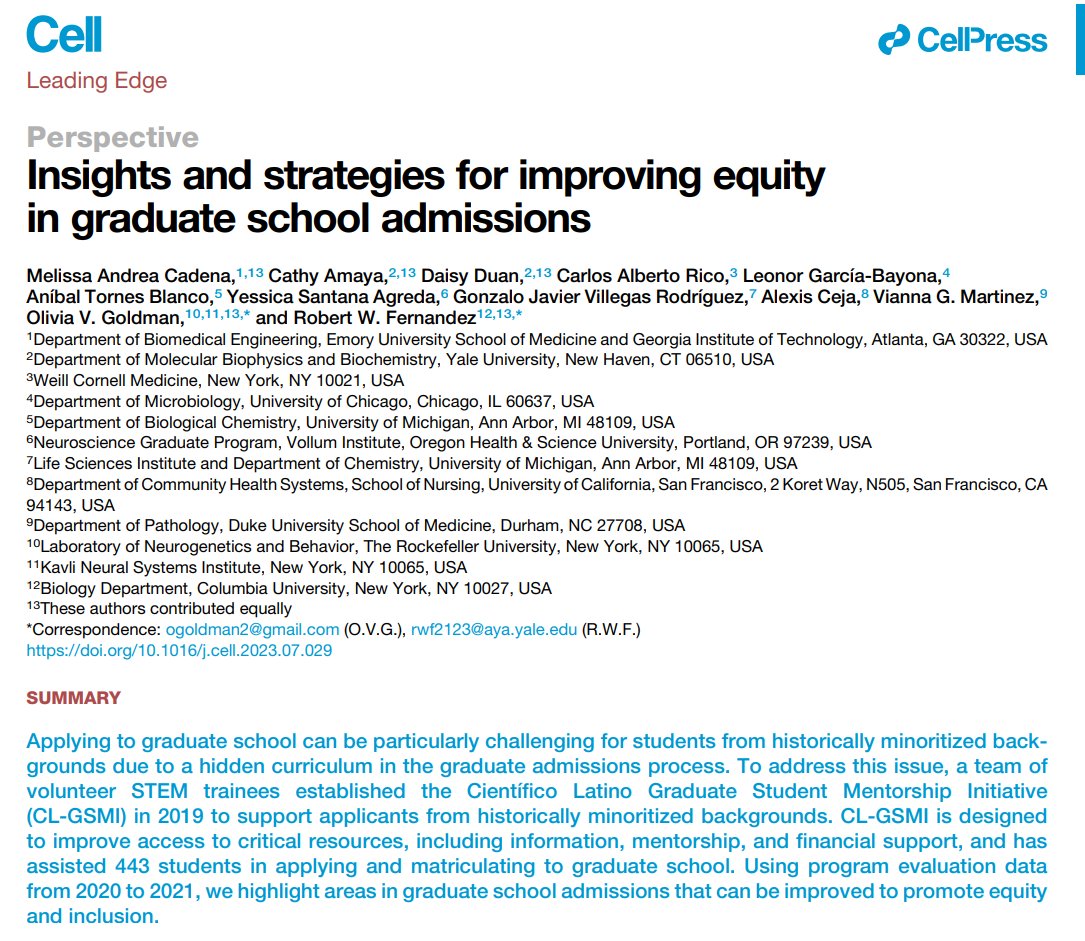
Historically marginalized student representation drastically drops from undergrad to grad school.
Are underrepresented students unqualified? Or are grad school admissions unnecessarily confusing, costly, & gatekeeping?
1/🧵
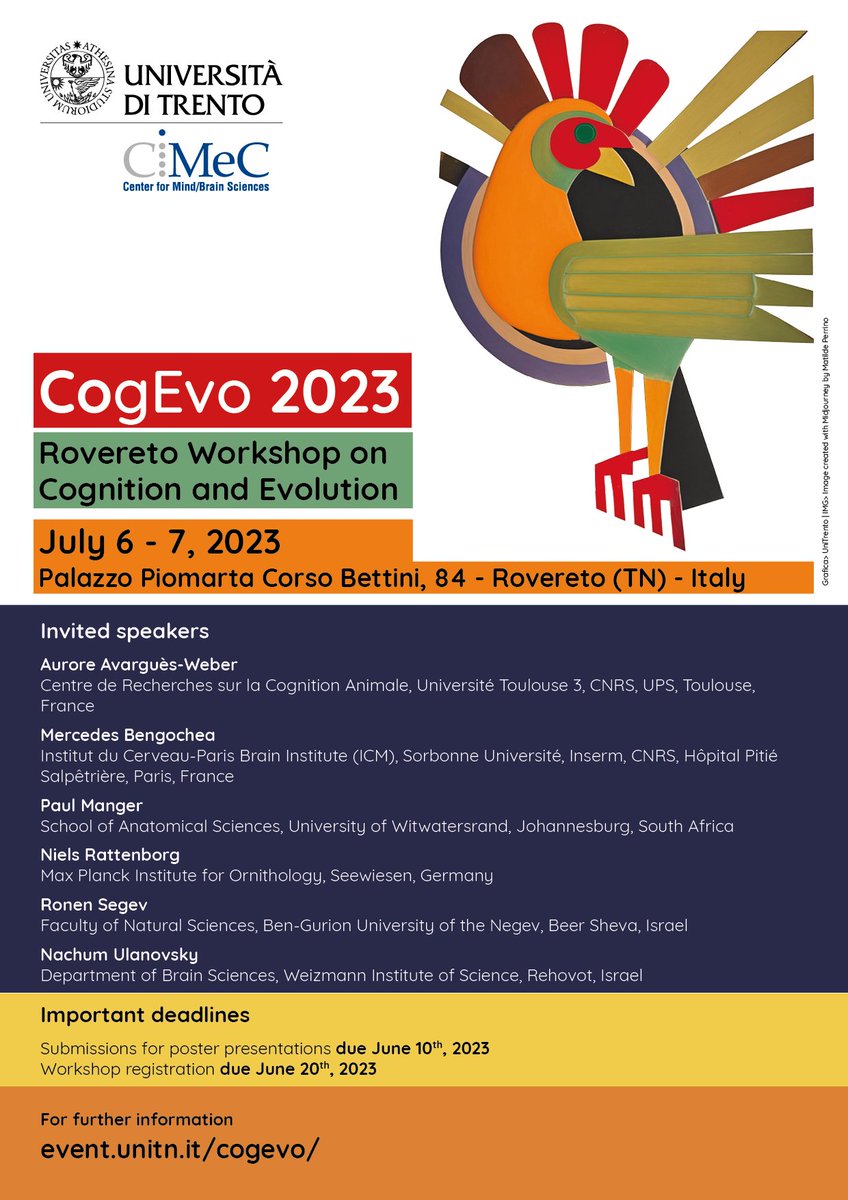
🎉The program of CogEvo 2023 is finally out!
🗣️Check it on our website to have a glimpse of our wonderful plenary talks: https://t.co/acOdTV9A7J
👉Abstract submission by June 10th
👉Registration by June 20th
@gVallortigara@Matildede_@ElenaLorenzi3@ElisaFrasnelli
How do male harbor seals learn their breeding songs? Why do pups show vocal plasticity at a few weeks of age? And why are harbor seals vocal production learners? @AndreaRavignani@MPI_NL
https://t.co/GEmVwgybMZ
A 🦭🧵...
Sensitivity to syllable stress regularities in externally but not self‐triggered speech in Dutch. New paper (open access) by @AlexEmmendorfer et al. https://t.co/PJEijGVTTF.
ECR Visiting Fellowships provide up to £3000 (or currency equivalent) to junior faculty to attract and support an early-career researcher to undertake a defined research project in their lab for one to three months. https://t.co/xs9H2DYyJV
🧵3/4
Applications for the Tropical Bioacoustics School are now open! A once-in-a-lifetime opportunity.
@Univ_St_Etienne@SyddanskUni@Le_Museum
https://t.co/9S0Q9BSlhA
5/5) As always, the underlying data and code are available at @OSFramework: https://t.co/lxkl7aZ99o. This work was done at @ComBioacoustics@MPI_NL and the illustrations are by the very talented @alinevjoustra.
4/5) Not sure where to start? Our decision tree can help users determine which level of reporting is most suitable for their specific situation. With more widespread and consistent reporting, big-picture rhythm questions will be within reach.
2/5) Framework levels fall into 2 categories—metric reporting and data sharing—and are generally quite straightforward. This is intentional! Many acoustics studies, even those not focused on rhythm, are just a few small steps away from contributing to comparative rhythm research.
1/5) I would call this one a labor of love but it was mostly just love… new Perspective out in @MethodsEcolEvol with @AndreaRavignani and @LaraBurchardt! We introduce an eight-level reporting framework for research on acoustic rhythms. Read the paper at: https://t.co/1f6eXI3BSS
Robust rhythm reporting will advance ecological and evolutionary research. New paper by @taylorahersh , @AndreaRavignani and @LaraBurchardt . https://t.co/RbfVtMiMUe.
Announcing this month's Bridging Brains and Bioacoustics!
Join us in a few weeks for two 🔥 talks on rodent vocal communication from Nicole Pranic @m_pranic and Ralph Peterson @ralph_ep
🗓️ May 23rd @ 16:00 CET
✅ Register here: https://t.co/CLUCYClu6O
Integrating the field of cultural evolution of music with the larger literature on language evolution will enrich our understanding of both music and language (evolution)
https://t.co/U0XZAWkU55
Researchers @blasi_lang and @laserhedvig from @MPI_EVA_Leipzig have developed Grambank, a comparative grammatical database with over 400,000 data points and 2400 languages used to systematically describe the diversity of human languages. https://t.co/7Eiw71gyMu
Excited to share this preprint (https://t.co/TvqCJ2JeyT), a practical guide to EEG hyperscanning for joint action, which summarizes the collective wisdom of this wonderful group of co-authors: @janeenloehr@cordulavesper@SINeLabDTU Simon L. Kappel @oleadrian@PVuust@perikeller