A study gave lonely elderly adults an AI voice assistant for six months.
88% of them had been severely lonely before it arrived.
The results made researchers rethink everything they believed about AI and human connection.
105 homebound older adults. At baseline, 88.57% reported moderate to severe loneliness and 93.34% had mild to moderate depression. After six months with an Amazon Alexa Echo Show measurable, statistically significant reduction in loneliness.
A second study confirmed it.
34 older adults living alone. Three months with a voice assistant. Reductions in loneliness. Increases in social support. Significant correlation between the two.
Here is the honest finding most coverage leaves out.
A third study found most participants said the device had not significantly reduced loneliness. 54% were dissatisfied with AI technology before the study began.
It does not work for everyone. Skepticism reduces its effectiveness.
But here is why this matters beyond the lab.
In Japan alone, approximately one million older adults engage in conversation less than once per week. Reduced conversational frequency is linked to cognitive decline, depressive symptoms, and an increased risk of solitary death.
One million people. Alone. For days at a time.
The human care system cannot reach all of them. There are not enough caregivers, volunteers, or family members to provide daily conversation to one million isolated elderly people in one country.
An AI can be there at 3am. It does not get tired. It does not have a caseload. It costs $30 and is available every hour of every day.
The debate about AI companionship has focused almost entirely on teenagers forming unhealthy chatbot dependencies.
But for the homebound 82-year-old who has not had a real conversation in four days the choice is not between AI and human connection.
It is between AI and silence.
88% of them were severely lonely before the device arrived.
After six months, they were less lonely.
That is not a reason to stop asking hard questions about AI companionship.
It is a reason to make sure the hard questions are being asked about the right people.
Sources:
Chen & Spaulding · Advances in Geriatric Medicine · March 2025 ·
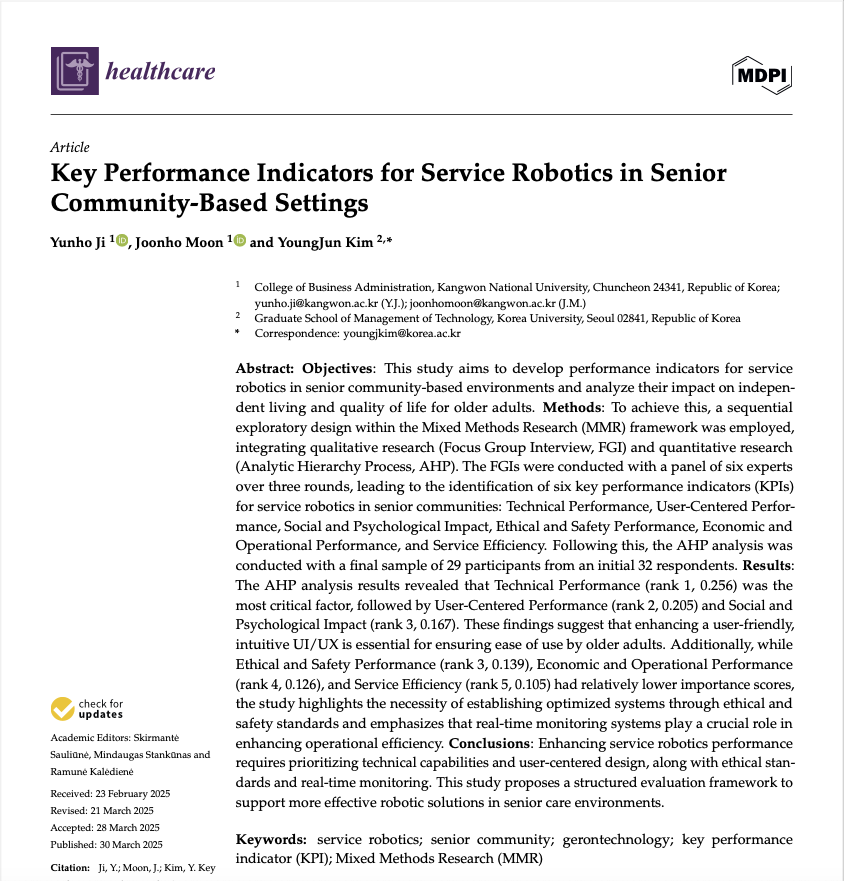
Ji, Moon, Kim · Healthcare · March 2025 ·
Hirakawa et al. · Journal of Rural Medicine · April 2026 ·
The Whole of Government Accounts would, also, benefit from a capital boost to the balance sheet - potentially, lowering borrowing costs to benefit the whole economy.
It’s high time we acknowledged the demographic shift and took decisive action to refashion our social contract to reflect intergenerational requirements.
We must solve today’s policy problems with tomorrow’s solutions.
@AndyBurnhamGM@wesstreeting@Keir_Starmer
Here, the govt would not pay to “nationalise” care but would, instead, establish a new kind of ‘community service’ - one geared to wealth accumulation amongst excluded groups which could, also, turbocharge prevention and community based care per the NHS 10 year plan.
@andrew_lilico So, the “issue” - with a de facto cap on council tax increases - is unmet need amongst those who don’t have a house to sell to fund their own care.
The other “issue” (largely unspoken) is a national eligibility threshold - where house prices are locally determined…
@andrew_lilico 75% of local government spend relates to social care. 25% of social care spend funds children’s services. 50% of social care spend on adults relates to people of working age - so, only 25% reads across to older adults. Those adults have assets <£23,500 and the no. is increasing
D) How to differentiate between short, medium and long-term policies and associated spend - rather than continuing to pretend meaningful change of every kind is deliverable in 5 years
I’m “enjoying” the impetus to debate policy and fwd plans in the U.K. which makes plain:
- which parties don’t have any
- which parties (and supporters) only have policies grounded in yesterday’s problems / solutions
- which politicians imagine “inequality” is evenly spread
C) Whether gender, race and geography can, finally, supplant universal reference to equality, power and wealth narratives to turbo charge contemporary expressions of empowerment?
@rcolvile Please explain: where are unemployed adults of different ages located relative to job vacancies?
Because, I’m tired of reading about universal fixes geared to “people” whilst structural social and economic conditions are ignored.
Yesterday: NEETs = 14%.
It’s 25% in Blackpool.
@Tom__Toad@rcolvile 42% of NHS spend on ppl aged 65+ who make up only 19% of the population. This has been increasing steadily over 20 years due to:
1.Population aging (85+ doubling proportionally)
2.Rising multi-morbidity
3.Higher hospital bed usage and GP consultation rates
4.70% of deaths >75
@Tom__Toad@rcolvile Almost 50% of the “welfare bill” attaches to pensioners - and adult social care spending on people >75 yrs of age is at a roughly similar level. The ratio has shifted from x3 to x8 due to stagnant wages relative to house prices (which have, on average, declined due to inflation).
@hopskipjumpy@GavinBarwell UK is not always the highest in every snapshot, but it is consistently among the most expensive for households and the most expensive for industry among developed economies, because of its gas-driven pricing, tax/levy structure, and high electricity-to-gas price ratio.
@resfoundation Finally, what legitimates one-size-fits-all policy pronouncements when it’s perfectly clear from today’s report: young people living in particular circumstances and geographies are far more likely than others to make up the 1m figure you cite?
@resfoundation Can you, otherwise, do what other commentators seems unwilling / unable to do: make plain *where* the 1m young people you refer to are located and, with that, state how many job vacancies there have been / are relative to such NEETs?