Understand the perspective but I’m skeptical long duration + higher vol gains meaningful share going forward.
It’s arguably not clean enough. Multi strats offer near zero beta with controlled factor tilts.
Giving “long duration higher vol” strategies more leash introduces portfolio level risk management uncertainty.
Not to mention it’s unclear accepting higher vol leads to better compounding long term.
Excellent write up.
The part that seems most difficult to execute is the risk management.
If you’re spending all day cutting losses then you have to adjust both sides of book constantly to keep risk profile at some level of parity, correct?
Doing that constantly actually seems as tough as the other aspects of the process since prices can change every second of the day while your earnings views do not.
And if everyone adopts this mentality trading off technicals then it seems ultimately self defeating.
Could be wrong. Either way good write up, thanks .
@tobi@renald_vie Technology is perhaps the one sector that requires visionary leadership - especially during major technology shifts (which seem to occur every 5-10 years) - and not mere professional management.
Holding on to “judgement” as a moat is also disingenuous because it assumes active manager judgment consistently creates value.
Yet we know empirically active management is mostly zero sum and the industry in total lags relevant benchmarks.
how can investors be thinking so narrowly about AI's impact on investment research
I've been so surprised about the investment community's inability to think more ambitiously about AI
we've been through really interesting phases which were roughly:
1. LLMs are rubbish, won't ever replace judgement
2. LLMs are now quite good, won't ever replace judgement
3. LLMs and coding agents are good, won't ever replace judgement
4. LLMs and coding agents are transformations, but still judgement is incredibly important
5. LLMs and coding agents solve everything, will be able to be fully autonomous research systems, but judgement is still incredibly important
you're all focused on the judgement being replaced here, but this is so short sighted
the biggest assumption of the above 5 points is LLMs.
LLMs and transformer models are not the final form of AI, and it's crazy for me to see so many people discarding next token generation as if that's the only thing that could exist as a model architecture and provides the upper bound of what's possible
how can an industry who's entire job is to try to predict/forecast the future outcomes be so short sighted on what could be possible in the passage of time?
maybe a lesson to learn from recent market volatility is where you can get wrong footed by fat tails
model architecture evolution isn't a far tail, imo it's a <1sigma event which needs to be thought about in detail
how do you do that? you need to get up the Ai skill curve quick
if you're not building and pushing it to its capability limits everyday, you're going to get left in the dust
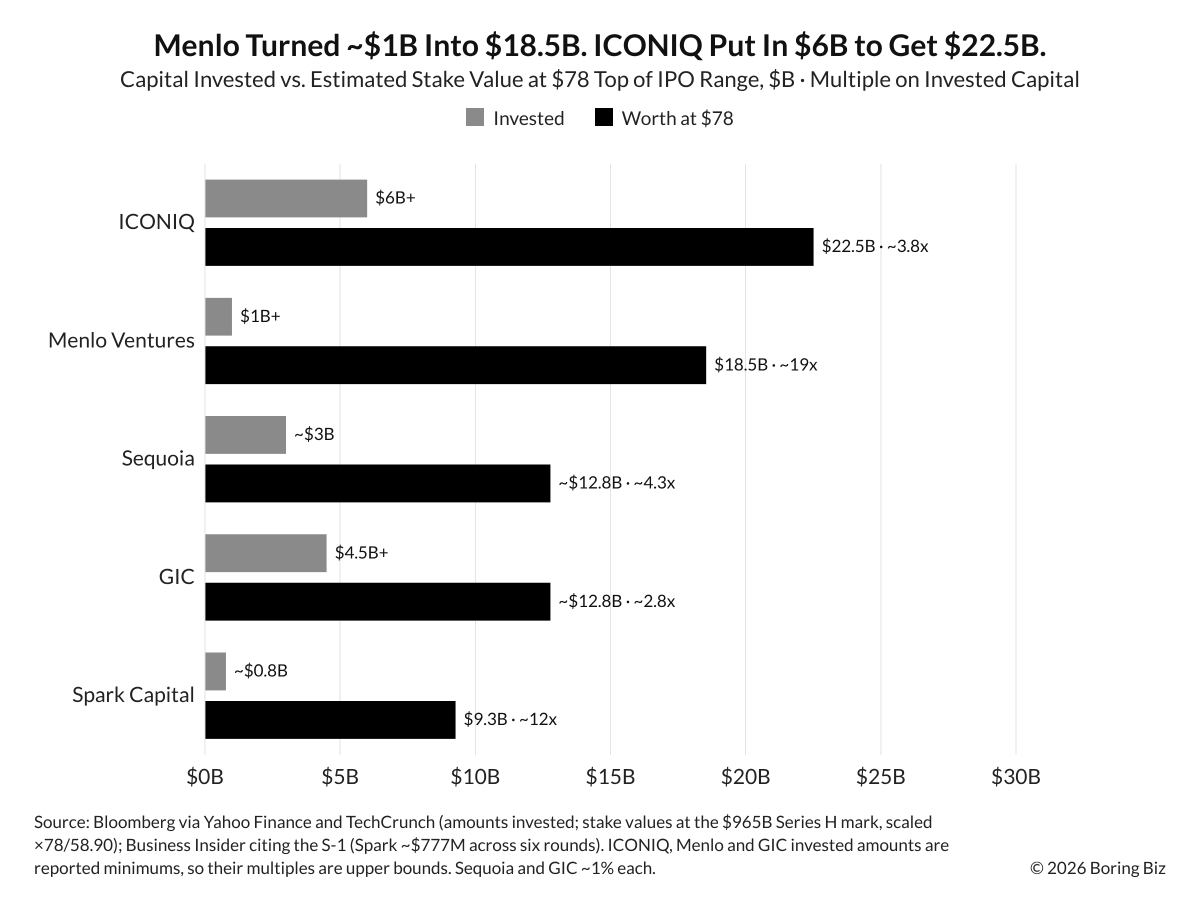
Any 4x or greater return is wonderful.
But for a venture bet, and depending on how they sized, these seem relatively modest.
The funds that made their name on today’s large cap tech giants were making 100x on those bets.
Some incredible fortunes will be made once Anthropic finally goes public in the coming days
Iconiq will make a ~4x return on their $6B of capital invested. Menlo Ventures will return roughly 19x on their position. Spark Capital will generate ~12x.
Massive congratulations to these investment firms
Adding technology to asset management has favored only a few cohorts: quants and multi strats.
All others have lagged as they have in aggregate for 20+ years.
Adding AI for everyone seems unlikely to reverse this.
dumbest shit I’ve read today
the exact opposite will be true
yes, your short term edge may fade
but long term, your ability to think critically and independently will allow you to earn higher excess returns
This assumes the humans get it right more often than not and size the winners enough to offset the losers.
Consistently. Which they do not.
At least not in aggregate.
This is an interesting take. I have observed mean reverting answers as much as consensus answers. By the way, both are the types of mistakes inexperienced analysts and pre GFC value investors make. One just doesn’t have experience to shape the context and the other has a bias. Which one applies to AI? Which one is easier to improve through RL and RSI?
Yes.
These revolutions or innovations stack and compound based on driving key input costs lower.
The dot com boom and bust paved the way for SaaS and mobile; shale helped drive midstream and AI.
Now the question is which new use cases AI driven cost reductions in intelligence/data cost create?
Got it thank you.
That sort of role seems like one of the most attractive spots to be in as far as private investing goes.
Can affect multiple deals at once so you have the leverage that comes with scale + you bring a unique toolkit that your median banker trained associate can’t offer.
Thank you