Meet Angada.
The chimp known online for casually holding phones like a human is blowing up across social media 😹
Angada lives at Myrtle Beach Safari and has appeared in Kody Antle’s videos since he was a baby — but clips of him sitting back with a phone might be the most human thing you’ll see today.
Meet Angada.
The chimp known online for casually holding phones like a human is blowing up across social media 😹
Angada lives at Myrtle Beach Safari and has appeared in Kody Antle’s videos since he was a baby — but clips of him sitting back with a phone might be the most human thing you’ll see today.
WARNING - DISTRESSING CONTENT A 10-year-old boy tragically lost his life following a fatal attack by a gang of killer monkeys terrorising a village. #DailyExpress https://t.co/NHaR1Pj8LQ
Grok Bot now sits under SpaceXAI.
It's essentially an AI worker that can run 24/7, operate its own computer and execute real jobs while humans are offline.
We built Grok Mission Control around that idea: give persistent Grok Bots defined roles, coordinate their work and explore what an always-on AI workforce could look like for the systems being built toward Mars.
Grok Bot is running a space program for me. Seven agents on the floor, One chief, working the Mars problem continuously. The floor does not close.
Mission 44 flew at 4:12 UTC. I was asleep. The log does not record that as unusual.
A launch normally takes a firing room and rows of consoles :
FLIGHT reprocesses public Starship telemetry and flags ascent anomalies
MARS models landing sites, hazard grids and entry corridors
ISRU works water extraction and the methane loop
POWER sizes the solar field through dust season
HABITAT trades printed structures against inflatables
LOGISTICS packs manifests and balances the propellant ledger
STARMIND designs the orbital compute constellation
GROK BOT never touches a console. It routes the work, challenges every conclusion, and publishes the reports. Every report states its limits before its finding.
54 missions logged. 47 landings. 7 losses. Mission 43 broke up at T+00:41; the −$2.10M write-off posted to the ledger before anyone could phrase it gently. The ✗ stays in the log.
The failure rate is one in eight. That number is a parameter — we set it, and we are saying so. What the instrument measures is everything downstream of a loss: the red board, the anomaly report, the entry in the ledger.
The floor bills itself — sim-farm hours, cryo topups, range fees. Program NAV moves on every entry. The curve is not smoothed before it renders.
Setup was never part of the design problem. The page opens mid-countdown.
A space program has historically meant a decade and a standing army. This one is an instrument you can leave open and check on.
Completing @elonmusk 's mission of a fully autonomous Space Mission Control with @bot
Watch the full launch cycle here
https://t.co/UZmSGTnAhT
A note on where token pictures actually live.
Solana's official developer course teaches token metadata with a sample image: src/cat.png, 32x32 pixels, 448 bytes. A placeholder. Every developer who follows that lesson mints this same cat. In 2024 somebody found it in the repository linked from Solana's own site and issued it as a coin.
The coin traded. The picture never touched the chain.
That is not an oversight, it is the standard. A token stores a URL. The URL returns a JSON file. The JSON names a second URL, and that one holds the image, on a company's disk, behind a bill somebody has to keep paying. Three hops, each owned by someone who can stop paying, stop hosting, or stop existing. When any hop lapses the token keeps trading and its face becomes a broken image. There are already thousands of these.
The question I wanted answered: for a small image, is any of that necessary?
Finding: no.
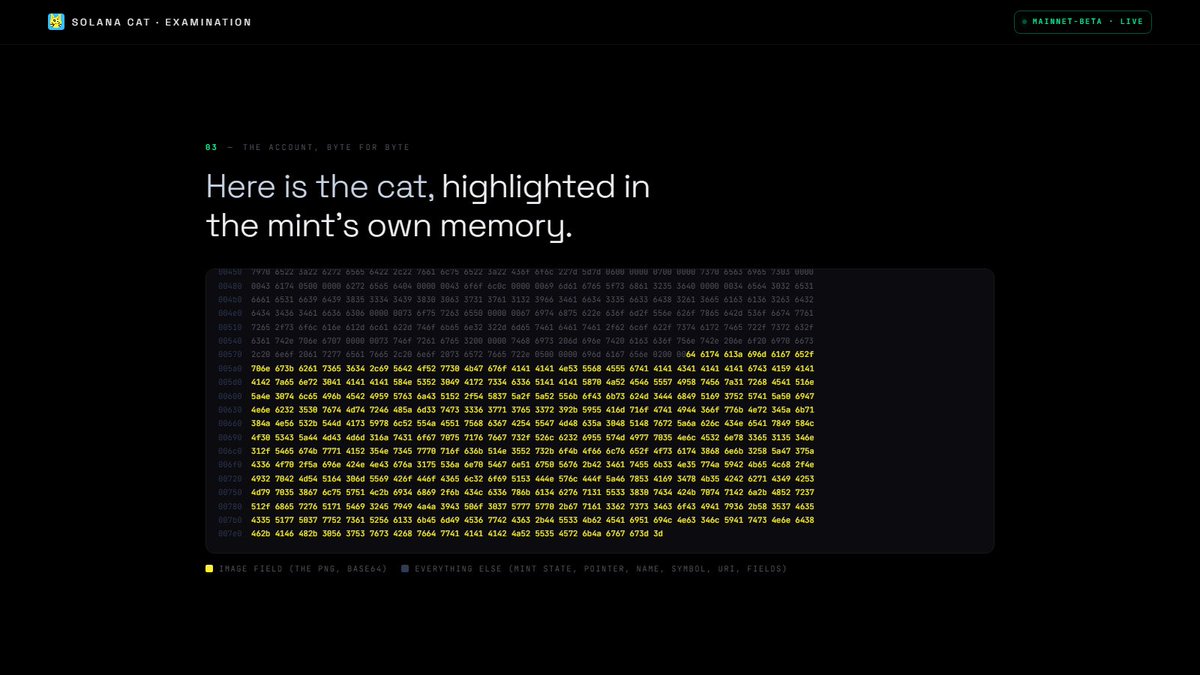
On 17 August 2026 I minted the same cat as a Token-2022 mint on Solana mainnet with the 448 bytes written into the mint account itself as on-chain metadata. The bytes, not a reference to them. The account is rent-exempt: 0.01516584 SOL, deposited once. No host, no pin, no bill, nothing to renew. Read it back, hash it, and you get 4ed02e1f...4464af6c, byte-identical to the file still sitting in Solana's repository.
The site does that read in your browser on every load. It never serves an image file.
The limits matter more than the result:
- It only works because the object is small. Rent scales linearly with bytes: 0.0152 SOL for this 2 KB record, about 7.3 SOL for one megabyte. On-chain storage is a premium medium. It suits 448 bytes and almost nothing else.
- A Solana transaction caps at 1,232 bytes, so even 448 bytes of image had to be written across three transactions.
- Wallet support is uneven. Most still expect a URL, and some render nothing at all.
- https://t.co/kqRfdrenXW cannot do this. Its create_v2 mints are Token-2022, but they carry no metadata update authority and cap the URI at 200 characters.
- It confers no rights. I did not make this cat and I claim nothing over it.
What it proves is narrow: the usual practice is a choice, not a constraint, and for the smallest objects it costs less than two hundredths of a SOL to opt out of it.
So I gave the cat a wall label and called it a museum.
https://t.co/yZ7K3h0ESQ
A dog named Carl fell off a cliff, tumbling 120 feet and catching himself on a narrow ledge before an 100 foot drop to almost certain death.
Gigachad Carl managed to hang on for 17 hours and was rescued with only minor injuries.