In medieval times, within the arms race of ever more demonic torture devices, some sadistic genius came up with the idea of the Little Ease.
This was a prison cell built so small in every dimension that a grown man could not stand upright in it nor lie down at full length nor properly sit.
The pain is relentless and without relief and inflicted by one's own body. Prisoners were known to go insane within a few days. A stay at the Little Ease was considered even more cruel than the rack, the thumbscrew, and the other ghoulish machinery of the Tower of London.
A breeding pig will spend her whole life in a version of that box.
These are social, roaming creatures (more intelligent than dogs) who will never leave this corset of steel.
They have been selectively bred to be bigger than their frames can support. Yet we put them in cells so confined that they cannot comfortably sit, and their attempts to do so (for example, by sneaking their limbs into adjacent stalls) reliably lead to fractures and sprains.
They cannot sweat, yet have nothing to roll around in to cool themselves off. Except their own manure, which (contrary to the common misconception) they are so averse to (thanks to their strong sense of smell) that new sows will often suffer from constipation to avoid soiling the space from which they eat and sleep.
Here is how the writer Matthew Scully described what saw at one of Smithfield’s “gestation barn”:
> “Sores, tumors, ulcers, pus pockets, lesions, cysts, bruises, torn ears, swollen legs everywhere. Roaring, groaning, tail biting, fighting, and other “Vices,” as they’re called in the industry. Frenzied chewing on bars and chains, stereotypical “vacuum” chewing on nothing at all, stereotypical rooting and nest building with imaginary straw. And “social defeat,” lots of it, in every third or fourth stall some completely broken being you know is alive only because she blinks and stares up at you … creatures beyond the power of pity to help or indifference to make more miserable, dead to the world except as heaps of flesh into which the [insemination] rod may be stuck once more and more flesh reproduced.”
—
The Save Our Bacon Act is trying to unroll the few state protections we have against this barbaric cruelty - for example California’s Prop 12 - which banned the sale of pork from pigs kept in gestation crates.
It’s incredibly important we don’t end up with this sort of federal preemption.
SOB will not only kill the most important animal welfare related laws in the US of the past decade, but more importantly, it will also restrict ALL future legislative progress (aka how the animal welfare movement has gotten its biggest wins).
The Senate is currently deciding whether to add the SOB Act to the Farm Bill.
With relatively little money now, we can discourage the most pivotal senators in the Ag committee from backing this amendment.
Defeating this bill is even more important given the amount of philanthropic funding I expect to come online in the next year or two.
It will plausibly be over 10x more expensive to repeal SOB than to prevent it from passing in the first place.
All that money that could be spent transforming our society's relationship to mass animal suffering will instead have to be spent just getting us back to where we are right now.
That's why money spent now fighting this bill (and I mean right NOW) is so effective.
If you’re in a position to donate six figures, please DM me.
Imagine your cat being able to explain to you the real reason why it sometimes gets annoyed when you pet it.
This might be possible if we could actually decode what animals are communicating. @ProjectCETI found what looks like grammar in sperm whale calls in 2024. @earthspecies is running machine learning across dozens of species.
Once we can understand what animals are saying, it’s going to be very hard to keep treating a lot of them the way we do. Will this be enough to extend our moral consideration to all animals?
Great conversation with @michaelandregg last night about @eonsys and the future of brain emulation. What gave me the most hope was that he seemed to have genuine concern for the experiences of the animals that are being uploaded first.
So grateful to @ForesightInst and @HopeExistential for having me on. This was my first time doing a recorded video podcast, and I couldn't have asked for a better team to do it with.
We think a lot about how AI will affect humanity, and for good reason. But AI could have an enormous impact on the trillions of animals that share our world (for better or worse), and almost nobody is talking about it.
In this episode, we talk with Constance Li (@ConLiCats), founder of Sentient Futures (@sentfutures), an organization working to make sure AI and other emerging technologies improve the lives of animals rather than harm them.
Links below!
0:00 Cold open
0:55 Why AI and animals is an overlooked combination
3:44 The staggering scale of factory farming
7:24 How a physician became an animal welfare advocate
8:57 What Sentient Futures does day-to-day
10:36 What "AI for animals" actually means
13:21 Why the organization was renamed Sentient Futures, and the question of AI moral patients
17:06 The biggest misconceptions about AI for animals
19:24 What is precision livestock farming?
23:44 Best and worst-case scenarios for AI in farms
26:44 Communication across species: promise and limitations
34:54 Genetic welfare and using genetics in farms
42:32 What a best-case scenario for AI and animals looks like in the next 5–10 years
46:09 The biggest hurdles: funding and attention
47:37 How to get involved with Sentient Futures
49:42 What gives Constance hope
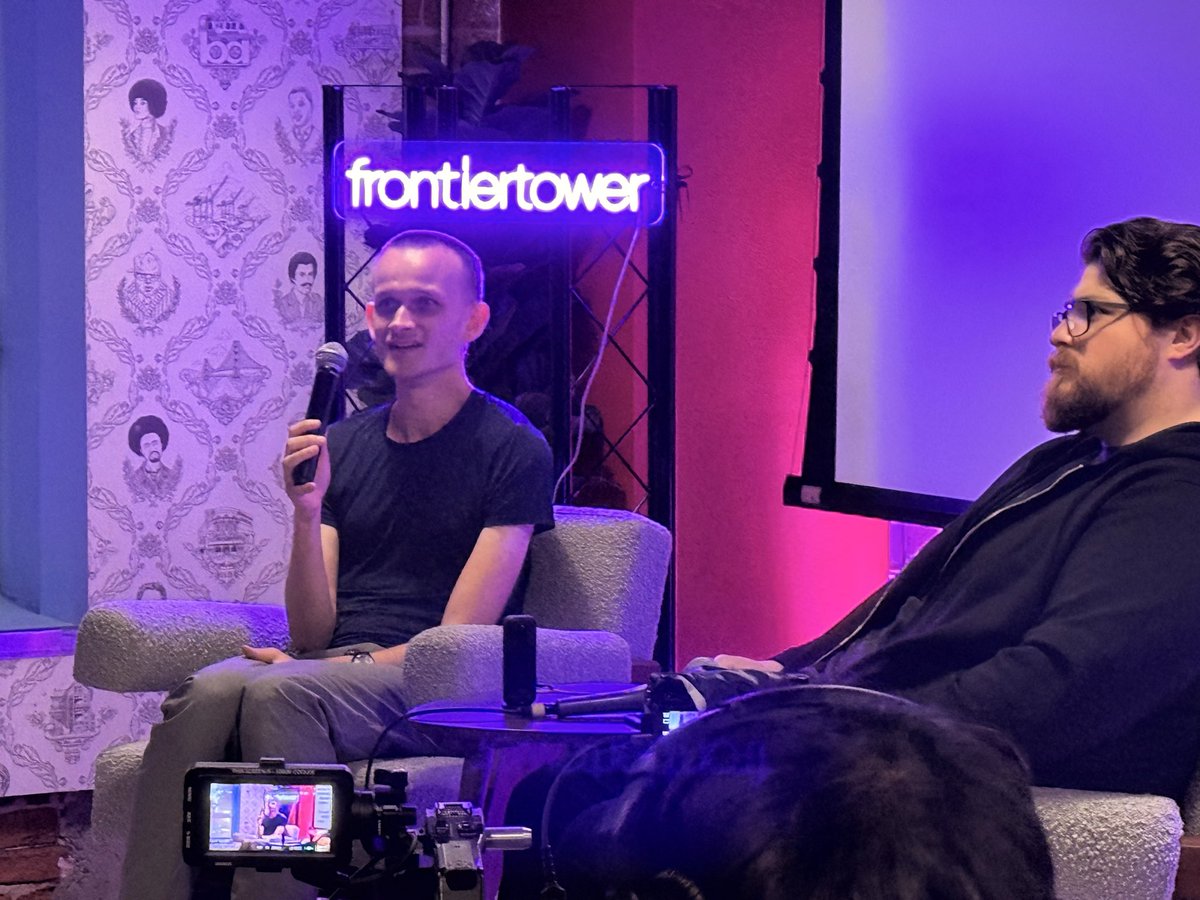
@VitalikButerin's main claim was that more intelligence/entropy = less of the world that humans are capable of understanding.
Therefore, it isn't unreasonable to slow down a bit to increase our proportionate understanding and decide the best next steps.
Surprisingly, it seemed like they agreed on most things, like decentralization of power/technology being better and human-in-the-loop systems being more favorable.