21.7%–21.8% of all employed Canadians work in government.
Statistics Canada data show about 4.58 million public-sector employees out of roughly 21.0 million employed Canadians.
Does NOT include record number of contract workers & consultants paid by government eg
IT contractors
Engineering firms
Management consultants
Construction companies
Outsourced service providers
Legal firms
Communications consultants
The 10-year Treasury yield is perhaps the most important financial benchmark in the global fiat system, as it drives valuations and market trends worldwide. It is widely—and erroneously—regarded as the risk-free rate of return.
The 10-year Treasury yield can be thought of as a key barometer of the US dollar-based fiat system—a critical measure akin to its beating heart.
Bond yields move inversely to bond prices. When bond prices fall, bond yields rise.
A rising 10-year Treasury yield signals trouble for the US dollar because it means investors are selling Treasuries, which pushes up the US government’s borrowing costs. That is why the 10-year Treasury yield is a major pain point for the US government.
The 10-year Treasury yield was 3.97% when the war started. Now it is around 4.60%, an increase of roughly 63 basis points.
I expect the 10-year Treasury yield to keep climbing over the coming weeks and months—until it forces the Fed’s hand. At that point, the intervention will be sold as “stability,” but the mechanism will be familiar: suppress yields by debasing the currency.
At today’s debt levels, every 1 basis point increase in the government’s average borrowing cost adds roughly $3.9 billion in annual interest expense. So a 63 bps rise is not trivial—it translates to nearly $250 billion in additional yearly interest costs, materially widening a 2025 budget deficit that was already around $1.8 trillion.
Higher yields mean the US government must pay tens or even hundreds of billions more in interest on its debt. At the same time, the global economy faces even greater added costs because Treasury rates serve as the benchmark for borrowing worldwide.
That is not an insignificant move. However, given all the headwinds I have discussed, I suspect the 10-year Treasury yield is headed much higher because investors will demand higher yields to compensate for rising inflation. Further, if Hormuz remains closed, drastically higher oil prices are all but certain. Higher energy prices mean higher prices across the economy and higher official inflation rates, which means investors will demand still higher yields to compensate.
The problem is that interest on the federal debt is already over $1.2 trillion and is now the second-largest item in the budget. The US government cannot afford yields going much higher because the interest expense would push it toward bankruptcy.
I am not sure how—or even if—the US government can manage this situation. Something has to give, and we will not have to wait long to find out what.
The Iran war may prove to be more than another foreign policy disaster. It could be the trigger that exposes the fragility of the entire dollar-based financial system.
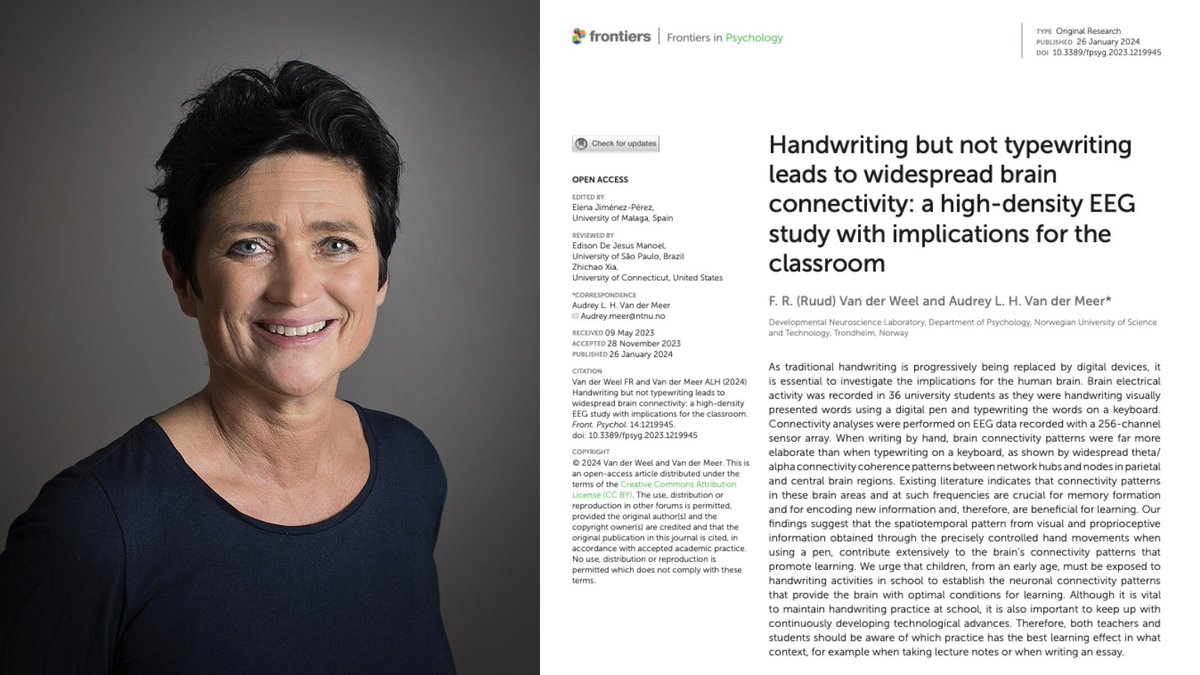
A Norwegian neuroscientist spent 20 years proving that the act of writing by hand changes the human brain in ways typing physically cannot, and almost nobody outside her field has read the paper.
Her name is Audrey van der Meer.
She runs a brain research lab in Trondheim, and the paper that closed the argument was published in 2024 in a journal called Frontiers in Psychology. The finding is brutal enough that it should have changed every classroom on Earth.
The experiment was simple. She recruited 36 university students and put each one in a cap with 256 sensors pressed against their scalp to record brain activity. Words flashed on a screen one at a time.
Sometimes the students wrote the word by hand on a touchscreen using a digital pen, and sometimes they typed the same word on a keyboard. Every neural response was recorded for the full five seconds the word stayed on screen.
Then her team looked at the part of the data most researchers had ignored for years, which is how different parts of the brain were communicating with each other during the task.
When the students wrote by hand, the brain lit up everywhere at once.
The regions responsible for memory, sensory integration, and the encoding of new information were all firing together in a coordinated pattern that spread across the entire cortex. The whole network was awake and connected.
When the same students typed the same word, that pattern collapsed almost completely.
Most of the brain went quiet, and the connections between regions that had been alive seconds earlier were nowhere to be found on the EEG.
Same word, same brain, same person, and two completely different neurological events.
The reason turned out to be something nobody had really paid attention to before her work. Writing by hand is not one motion but a sequence of thousands of tiny micro-movements coordinated with your eyes in real time, where each letter is a different shape that requires the brain to solve a slightly different spatial problem.
Your fingers, wrist, vision, and the parts of your brain that track position in space are all working together to produce one letter, then the next, then the next.
Typing throws all of that away. Every key on a keyboard requires the exact same finger motion regardless of which letter you are pressing, which means the brain has almost nothing to integrate and almost no problem to solve.
Van der Meer said it plainly in her interviews.
Pressing the same key with the same finger over and over does not stimulate the brain in any meaningful way, and she pointed out something that should scare every parent who handed their kid an iPad.
Children who learn to read and write on tablets often cannot tell letters like b and d apart, because they have never physically felt with their bodies what it takes to actually produce those letters on a page.
A decade before her, two researchers at Princeton ran the same fight using a completely different method and ended up at the same answer. Pam Mueller and Daniel Oppenheimer tested 327 students across three experiments, where half took notes on laptops with the internet disabled and half took notes by hand, before testing everyone on what they actually understood from the lectures they had watched.
The handwriting group won by a wide margin on every question that required real understanding rather than surface recall.
The reason was hiding in the transcripts of what the two groups had actually written down.
The laptop students typed almost word for word, capturing more total content but processing almost none of it as they went, while the handwriting students physically could not write fast enough to transcribe a lecture in real time, which forced them to listen carefully, decide what actually mattered, and put it in their own words on the page.
That single act of choosing what to keep was the learning itself, and the keyboard had quietly skipped the choosing and skipped the learning along with it.
Two studies. Two countries. Same answer.
Handwriting makes the brain work. Typing lets it coast.
Every note you have ever typed instead of written went into your brain through a thinner pipe. Every meeting, every book highlight, every idea you captured on your phone instead of on paper was processed at half depth.
You did not forget those things because your memory is bad. You forgot them because typing never woke the part of the brain that would have made them stick.
The fix is the thing your grandmother already knew.
Pick up a pen. Write the thing down. The slower road is the faster one.
When butter was demonised, Unilever sold margarine.
When tallow was demonised, Procter and Gamble sold Crisco.
When eggs were demonised, Kellogg's sold cereal.
When red meat was demonised, Cargill sold soy.
When raw milk was demonised, Nestle sold infant formula.
When leather was demonised, BASF sold PVC.
When wool was demonised, ExxonMobil sold polyester feedstock.
When animal fat was demonised, the seed-oil industry grew from a niche product to the most consumed food ingredient on earth.
Every demonisation of an animal product made a specific group of shareholders very rich.
Every one of those products had been eaten by humans for thousands of years without incident.
The science changed the moment a substitute existed to sell.
Follow the money. The advice will start to make a lot more sense.
Sales pitch seems to be:
“Your livelihood will be stripped from you and we need your electricity and water to accomplish this task.”
Who runs marketing and PR? 🤣😂
When the CEO of Canada’s largest tech company,
is asking Liberals to repeal Bill C-22,
and the very tech companies being asked to spy on Canadians, are saying they will leave Canada instead,
and take their tax dollars with them
YOU KNOW, you’ve made a very big mistake.
Signal, the non-profit, encrypted-messaging app, just warned, it would rather leave Canada than comply with Bill C-22.
Here’s what Bill C-22 actually does:
✅ Forces tech companies to build surveillance backdoors into their systems
✅ Mandates that every cell phone in Canada be trackable
✅ Allows the Minister of Public Safety to issue SECRET orders to turn your Amazon Alexa into a listening device
✅ Requires metadata retention for up to one year: who you called, when, and where you were
No comparable Western nation has adopted surveillance powers this broad.
Meta called it conscripting private companies into “the government’s surveillance apparatus.”
The US wrote directly to the minister warning it compromises American citizens’ privacy.
A lawyer told committee: “As written, the minister could issue a secret order to turn your smart TV into a listening device.”
Imagine: this is the same government that froze bank accounts without a court order.
The same government that turned off committee cameras.
The same government with 638 unresolved wrongdoing complaints.
Now wants inside your phone.
So they're going to hit us with fertilizer-shortage-induced FAMINE, plus oil-scarcity ENERGY LOCKDOWNS, plus the Hantavirus panic "public health" lockdowns, all at the same time, right?
Don't tell me it's not coordinated.
1/ The New Serfdom: Mortgage Debt in Australia’s Hollow Economy
In medieval Europe, serfs were bound to land they did not own, tethered by custom, obligation, and the implicit understanding that freedom meant starvation. In 21st-century Australia, this same dynamic persists, repackaged in glossy brochures, sanctified by central bank policy, and secured by 30-year mortgage contracts. The Australian dream of home ownership has become a modern serfdom: a ritual of financial bondage masked as economic aspiration. Through the lens of historical and political analyses by Postan, Domar, Hayek, Thompson, Graeber, Piketty, and Standing, it becomes clear that Australia’s housing system does not elevate its citizens, it enslaves them in a meticulously constructed edifice of debt. We slave & toil all week in order to pay banks for the privilege of somewhere to sleep. These provide less zero productive benefit to anyone yet we pay 30-50% of our incomes to them for what? What have they done for us? What have they done for the country? We are their slaves.